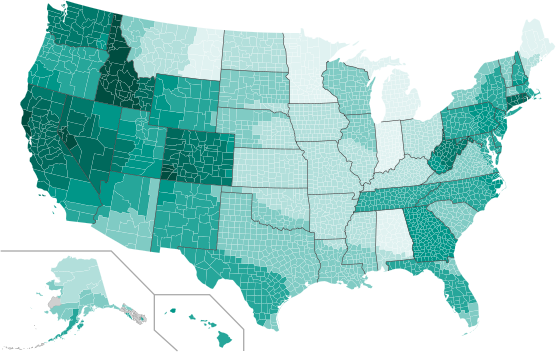
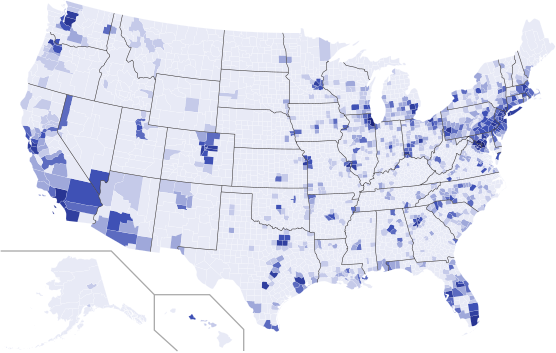
Network engineer/analyst demographics and statistics in the US
Network engineer/analyst demographics research summary. Zippia estimates network engineer/analyst demographics and statistics in the United States by using a database of 30 million profiles. Our network engineer/analyst estimates are verified against BLS, Census, and current job openings data for accuracy. Zippia's data science team found the following key facts about network engineers/analyst after extensive research and analysis:
- There are over 158,768 network engineers/analyst currently employed in the United States.
- 17.1% of all network engineers/analyst are women, while 82.9% are men.
- The average network engineer/analyst age is 43 years old.
- The most common ethnicity of network engineers/analyst is White (61.6%), followed by Asian (12.8%), Hispanic or Latino (12.0%) and Black or African American (8.3%).
- In 2022, women earned 93% of what men earned.
- 9% of all network engineers/analyst are LGBT.
- Network engineers/analyst are 50% more likely to work at private companies in comparison to public companies.
Network engineer/analyst gender statistics
- Male, 82.9%
- Female, 17.1%
Network engineer/analyst gender ratio
| Gender | Percentages |
|---|---|
| Male | 82.9% |
| Female | 17.1% |
Network engineer/analyst gender pay gap
Women earn 93¢ for every $1 earned by men


Network engineer/analyst gender ratio over time
Network engineer/analyst gender ratio by year
| Year | Male | Female |
|---|---|---|
| 2010 | 79.41% | 20.59% |
| 2011 | 79.32% | 20.68% |
| 2012 | 77.35% | 22.65% |
| 2013 | 79.79% | 20.21% |
| 2014 | 79.70% | 20.30% |
| 2015 | 80.04% | 19.96% |
| 2016 | 79.34% | 20.66% |
| 2017 | 77.43% | 22.57% |
| 2018 | 81.78% | 18.22% |
| 2019 | 79.59% | 20.41% |
| 2020 | 82.16% | 17.84% |
| 2021 | 82.87% | 17.13% |
Network engineer/analyst related jobs gender ratio
We compared network engineers/analyst with similar job titles to see how gender ratios vary. As you can see, dell certified systems expert and software applications architect have the biggest gender ratio gaps.
| Job title | Male | Female |
|---|---|---|
| Informatics Nurse Specialist | 13% | 87% |
| Clinical Support Specialist | 22% | 78% |
| Clinic Administrator | 23% | 77% |
| Network Engineer/Analyst | 83% | 17% |
| Senior Data Center Engineer | 98% | 2% |
| Software Applications Architect | 98% | 2% |
| Dell Certified Systems Expert | 99% | 1% |
Network engineer/analyst demographics by race
- White, 61.6%
- Asian, 12.8%
- Hispanic or Latino, 12.0%
- Black or African American, 8.3%
- Unknown, 5.0%
- American Indian and Alaska Native, 0.3%
Network engineer/analyst race
| Network engineer/analyst race | Percentages |
|---|---|
| White | 61.6% |
| Asian | 12.8% |
| Hispanic or Latino | 12.0% |
| Black or African American | 8.3% |
| Unknown | 5.0% |
| American Indian and Alaska Native | 0.3% |
Network engineer/analyst race and ethnicity over time
See how network engineer/analyst racial and ethnic diversity trended since 2010 according to the United States Census Bureau data.
Network engineer/analyst race and ethnicity by year
| Year | White | Black or African American | Asian | Hispanic or Latino |
|---|---|---|---|---|
| 2010 | 66.77% | 9.70% | 11.96% | 9.22% |
| 2011 | 66.86% | 9.38% | 12.06% | 9.45% |
| 2012 | 65.99% | 8.81% | 12.64% | 9.77% |
| 2013 | 66.79% | 9.87% | 12.18% | 8.70% |
| 2014 | 65.20% | 9.82% | 12.87% | 9.60% |
| 2015 | 65.46% | 8.44% | 11.72% | 11.31% |
| 2016 | 65.14% | 9.84% | 12.88% | 9.45% |
| 2017 | 64.49% | 9.24% | 13.37% | 10.38% |
| 2018 | 63.50% | 9.72% | 12.57% | 10.79% |
| 2019 | 63.62% | 9.78% | 12.23% | 10.93% |
| 2020 | 61.17% | 8.01% | 12.66% | 12.92% |
| 2021 | 61.57% | 8.30% | 12.78% | 12.01% |
Network engineer/analyst wage gap by race
| Ethnicity | Salary |
|---|---|
| Unknown | $86,784 |
| White | $84,120 |
| Black or African American | $84,699 |
| Asian | $94,974 |
| Hispanic or Latino | $86,019 |
Average network engineer/analyst age
Network engineer/analyst age by race and gender
| Race | Male age | Female age |
|---|---|---|
| Unknown | 41 | |
| White | 42 | 47 |
| Black or African American | 44 | 43.5 |
| Asian | 45 | 48 |
| Hispanic or Latino | 38 | 40.5 |
Network engineer/analyst age breakdown
Network engineer/analyst age breakdown
| Network Engineer/Analyst Years | Percentages |
|---|---|
| 40+ years | 60% |
| 30-40 years | 31% |
| 20-30 years | 8% |
Network engineer/analyst educational attainment
- Bachelor's, 63%
- Associate, 21%
- Master's, 11%
- Diploma, 2%
- Other Degrees, 3%
Network engineers/analyst by degree level
| Network engineer/analyst degree | Percentages |
|---|---|
| Bachelor's | 63% |
| Associate | 21% |
| Master's | 11% |
| Diploma | 2% |
| Other Degrees | 3% |
Network engineer/analyst jobs you might like
Network engineer/analyst wage gap by degree level
| Education | Salary |
|---|---|
| Master's Degree | $96,415 |
| High School Diploma or Less | $82,358 |
| Bachelor's Degree | $92,822 |
| Some College/ Associate Degree | $83,495 |
Network engineer/analyst employment statistics
Company size where network engineers/analyst work
Network engineer/analyst jobs by employer size
| Company size | Percentages |
|---|---|
| < 50 employees | 7% |
| 50 - 100 employees | 13% |
| 100 - 500 employees | 10% |
| 500 - 1,000 employees | 10% |
| 1,000 - 10,000 employees | 23% |
| > 10,000 employees | 37% |
Network engineer/analyst jobs by company type
Network engineer/analyst jobs by sector
| Company type | Percentages |
|---|---|
| Education | 4% |
| Public | 42% |
| Private | 50% |
| Government | 4% |
Network engineer/analyst jobs by industry
The most common industries for network engineers/analyst are technology, finance and health care.
Network engineer/analyst industry statistics
| Industry | Percentages |
|---|---|
| Fortune 500 | 19% |
| Technology | 18% |
| Health Care | 8% |
| Finance | 8% |
| Telecommunication | 7% |
| Manufacturing | 6% |
| Professional | 6% |
| Media | 3% |
| Transportation | 3% |
| Government | 3% |
| Retail | 3% |
| Education | 3% |
| Construction | 2% |
| Hospitality | 2% |
| Energy | 2% |
| Internet | 1% |
| Automotive | 1% |
| Utilities | 1% |
| Non Profits | 1% |
| Real Estate | 1% |
| Insurance | 1% |
Network engineer/analyst turnover and employment statistics
Network engineer/analyst unemployment rate over time
Network engineer/analyst unemployment rate by year
| Year | Network engineer/analyst unemployment rate |
|---|---|
| 2010 | 5.00% |
| 2011 | 3.88% |
| 2012 | 3.29% |
| 2013 | 3.35% |
| 2014 | 2.81% |
| 2015 | 2.68% |
| 2016 | 2.27% |
| 2017 | 2.77% |
| 2018 | 2.33% |
| 2019 | 2.71% |
| 2020 | 2.42% |
| 2021 | 2.37% |
Average network engineer/analyst tenure
Network engineer/analyst tenure statistics
| Number of years | Percentages |
|---|---|
| Less than 1 year | 15% |
| 1-2 years | 32% |
| 3-4 years | 18% |
| 5-7 years | 15% |
| 8-10 years | 6% |
| 11+ years | 15% |
Network engineer/analyst LGBT ratio compared to similar jobs
| Job title | LGBT | Job openings |
|---|---|---|
| Telecom Analyst | 7.31% | 19,698 |
| Lead System Analyst | 8.42% | 124,634 |
| BOS Developer | 8.46% | 79,713 |
| Securities Analyst | 8.59% | 33,422 |
| Network Engineer/Analyst | 9.03% | - |
| System Test Engineer | 10.54% | 131,653 |
| Configuration Technician | 10.88% | 91,456 |
Similar network engineer/analyst jobs LGBT demographics
| Profession | Percentages of LGBT | Job openings |
|---|---|---|
| Telecom Analyst | 7.31% | 19,698 |
| Lead System Analyst | 8.42% | 124,634 |
| BOS Developer | 8.46% | 79,713 |
| Securities Analyst | 8.59% | 33,422 |
| System Test Engineer | 10.54% | 131,653 |
| Configuration Technician | 10.88% | 91,456 |
Foreign languages spoken by network engineers/analyst
- Carrier, 100.0%
Network engineer/analyst languages spoken
| Foreign language | Percentages |
|---|---|
| Carrier | 100.0% |