What does a network security analyst do?
Network security analysts are information technology (IT) professionals who are responsible for designing and implementing security measures to prevent suspicious or hostile activities on the computer and network systems for an organization. These analysts must install firewalls while working with the IT team to protect their systems against malicious attacks. They are required to perform forensic analysis on those malicious activities so that they can determine the source of the threats. Network security analysts must also communicate the state of information security to the stakeholders as well as suggesting ways to improve system security.
Network security analyst responsibilities
Here are examples of responsibilities from real network security analyst resumes:
- Manage endpoint encryption, antivirus/anti-malware host IPS, process documentation, incident management.
- Design and manage information systems security policy, implementation, and management for a globally distribute MPLS infrastructure.
- Install and provide upkeep for Linux scanning, storage and group-relate web and network management servers.
- Create shell scripts to generate list of all files directories ownership companywide on all UNIX and Linux systems.
- Assist with NIST 800-171 compliance initiative.
- Utilize ArcSight SIEM to create rules, filters and channels.
- Help integrate packet capture and data loss prevention devices into SIEM.
- Implement Splunk for log management, data correlation, and alerting.
- Help establish and maintain tape library procedures for UNIX base program NTCSSII.
- Utilize Splunk to create search queries, dashboards, summary index, and alerts.
- Maintain campus DNS & DHCP infrastructure to ensure performance, scalability, and security.
- Implement security devices on client's network according to their specification and change control windows.
- Work on physical and virtual networks to provide functionality on additional layers on VMware NSX.
- Capture and analyze network alert from various sources within DOD enclave and determine possible causes of alerts.
- Used a variety of in house tools, scripts, and SQL queries are used to assist with investigations.
Network security analyst skills and personality traits
We calculated that 11% of Network Security Analysts are proficient in Network Security, Windows, and Incident Response. They’re also known for soft skills such as Detail oriented, Analytical skills, and Problem-solving skills.
We break down the percentage of Network Security Analysts that have these skills listed on their resume here:
- Network Security, 11%
Responded to network security related intelligence reports from external government and corporate agencies and took required action to mitigate relevant threats.
- Windows, 5%
Provided technical support for the company and set-up security policy within a Windows server/client network.
- Incident Response, 4%
Assisted with communicated with personnel about potential threats to the work environment providing incident response and recommend corrective actions.
- Switches, 3%
Provide assistance to engineering and management with special projects including the configuration of various routers, switches and servers.
- Linux, 3%
Assisted with the installation of a 12-node Linux (Cent-OS) cluster with Torque and Intel C Compiler.
- Tcp Ip, 3%
Analyzed computer/network problems; analytical reports; risk assessment; TCP IP ICMP IDS HTTP HTTPS VPNS.
"network security," "windows," and "incident response" are among the most common skills that network security analysts use at work. You can find even more network security analyst responsibilities below, including:
Detail oriented. To carry out their duties, the most important skill for a network security analyst to have is detail oriented. Their role and responsibilities require that "because cyberattacks can be difficult to detect, information security analysts must pay careful attention to computer systems and watch for minor changes in performance." Network security analysts often use detail oriented in their day-to-day job, as shown by this real resume: "performed detailed packet analysis on triggered security events utilizing tools such as wireshark and netwitness to eliminate false-positives and identify true-positives. "
Analytical skills. Another essential skill to perform network security analyst duties is analytical skills. Network security analysts responsibilities require that "information security analysts must carefully study computer systems and networks and assess risks to determine how security policies and protocols can be improved." Network security analysts also use analytical skills in their role according to a real resume snippet: "collaborated with technical support team to create an interactive sql database where employees shared technical solutions. "
Problem-solving skills. This is an important skill for network security analysts to perform their duties. For an example of how network security analyst responsibilities depend on this skill, consider that "information security analysts must respond to security alerts and uncover and fix flaws in computer systems and networks." This excerpt from a resume also shows how vital it is to everyday roles and responsibilities of a network security analyst: "implement rsa securid 2-factor authentication solution for high-risk servers. ".
The three companies that hire the most network security analysts are:
- Peraton6 network security analysts jobs
- McKesson3 network security analysts jobs
- Motion Recruitment3 network security analysts jobs
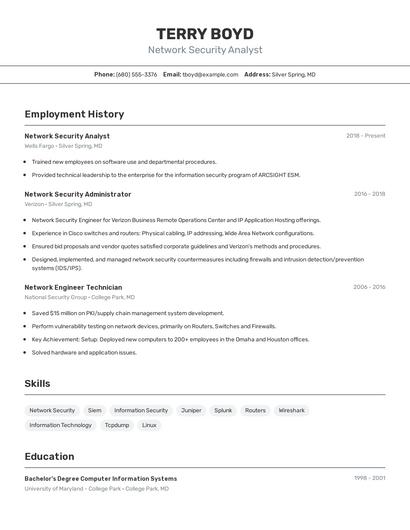
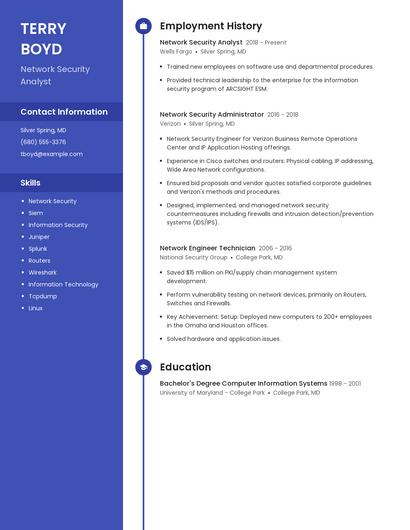
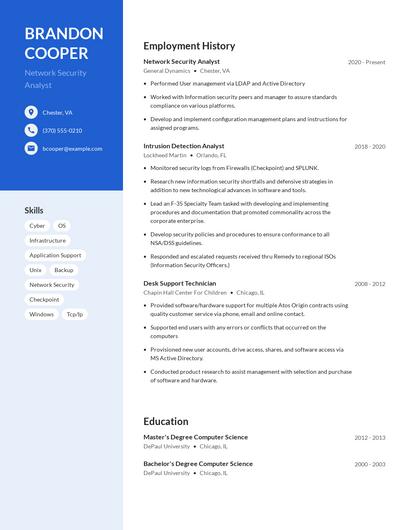
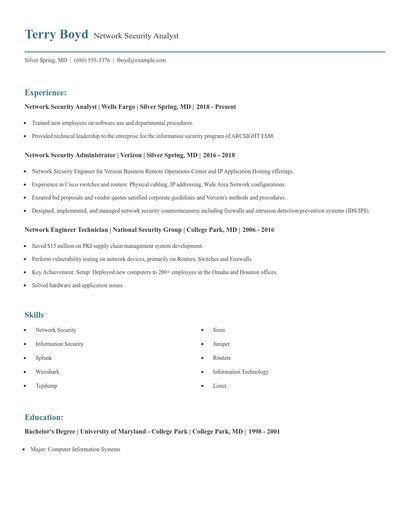
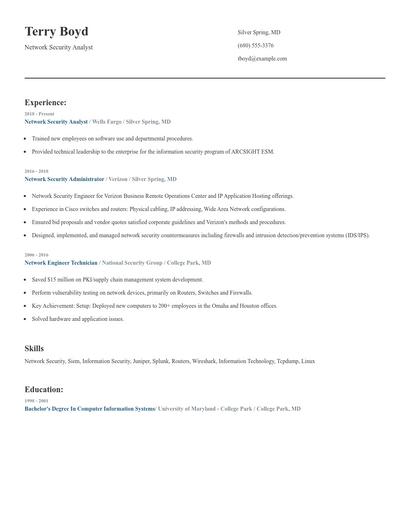
Choose from 10+ customizable network security analyst resume templates
Build a professional network security analyst resume in minutes. Our AI resume writing assistant will guide you through every step of the process, and you can choose from 10+ resume templates to create your network security analyst resume.






Compare different network security analysts
Network security analyst vs. Information assurance engineer
Information assurance engineers are responsible for protecting an organization's data. They act as a team of security specialists that use their skill in securely operating and keeping data to protect the organization's most essential asset. Their main role is to guarantee the quality, security, and retrievability of the organization's information. Also, they outline security systems that make certain the integrity, confidentiality, and accessibility of data. Additionally, they secure IT infrastructure, maintain hardware and software updated, establish security standards, and monitor threats like breaches.
These skill sets are where the common ground ends though. The responsibilities of a network security analyst are more likely to require skills like "wireshark," "intrusion detection systems," "network traffic," and "soc." On the other hand, a job as an information assurance engineer requires skills like "rmf," "iam," "acas," and "poa." As you can see, what employees do in each career varies considerably.
Information assurance engineers tend to make the most money working in the professional industry, where they earn an average salary of $97,153. In contrast, network security analysts make the biggest average salary, $86,309, in the professional industry.information assurance engineers tend to reach higher levels of education than network security analysts. In fact, information assurance engineers are 5.6% more likely to graduate with a Master's Degree and 1.1% more likely to have a Doctoral Degree.Network security analyst vs. Information systems security officer
An information systems security officer's role is to perform preventive measures to protect a company's data and systems from hackers or cyber-attacks. Their responsibilities revolve around assessing the existing security measures to identify any vulnerabilities or inconsistencies, recommending and implementing changes to improve security systems, and developing new strategies and programs for data protection. There are also instances when an information systems security officer must manage and maintain information in databases, train new employees, and create new security policies, all while adhering to the company's vision and mission.
While some skills are similar in these professions, other skills aren't so similar. For example, resumes show us that network security analyst responsibilities requires skills like "network security," "wireshark," "intrusion detection systems," and "network traffic." But an information systems security officer might use other skills in their typical duties, such as, "rmf," "isso," "sci," and "poa."
On average, information systems security officers earn a higher salary than network security analysts. Some industries support higher salaries in each profession. Interestingly enough, information systems security officers earn the most pay in the professional industry with an average salary of $89,615. Whereas network security analysts have higher pay in the professional industry, with an average salary of $86,309.In general, information systems security officers achieve similar levels of education than network security analysts. They're 2.6% more likely to obtain a Master's Degree while being 1.1% more likely to earn a Doctoral Degree.Network security analyst vs. Analyst
Analysts are employees or individual contributors with a vast experience in a particular field that help the organization address challenges. They help the organization improve processes, policies, and other operations protocol by studying the current processes in place and determining the effectiveness of those processes. They also research industry trends and data to make sound inferences and recommendations on what the company should do to improve their numbers. Analysts recommend business solutions and often help the organization roll out these solutions. They ensure that the proposed action plans are effective and produce the desired results.
There are many key differences between these two careers, including some of the skills required to perform responsibilities within each role. For example, a network security analyst is likely to be skilled in "network security," "windows," "incident response," and "switches," while a typical analyst is skilled in "customer service," "troubleshoot," "data analysis," and "management system."
Analysts earn the best pay in the technology industry, where they command an average salary of $79,330. Network security analysts earn the highest pay from the professional industry, with an average salary of $86,309.Most analysts achieve a similar degree level compared to network security analysts. For example, they're 1.9% more likely to graduate with a Master's Degree, and 1.3% more likely to earn a Doctoral Degree.Network security analyst vs. Information security officer
Information security officers are responsible for planning and implementing policies to safeguard an organization's computer network and data from different types of security breaches. Their duties typically include identifying computer network vulnerabilities, developing and executing a plan to secure and protect the network, and tracking computer network usage to ensure adherence to security policies. In addition, information security officers are also expected to conduct penetration tests to look for flaws and work closely with the IT and management departments to improve security.
Types of network security analyst
Updated January 8, 2025
