Explore jobs
Find specific jobs
Explore careers
Explore professions
Best companies
Explore companies
Job outlook for network services technicians in the United States
Network services technician job growth summary. After extensive research, interviews, and analysis, Zippia's data science team found that:
The projected network services technician job growth rate is 5% from 2018-2028.
About 18,200 new jobs for network services technicians are projected over the next decade.
Network services technician salaries have increased 9% for network services technicians in the last 5 years.
There are over 112,060 network services technicians currently employed in the United States.
There are 130,975 active network services technician job openings in the US.
The average network services technician salary is $52,996.
Are network services technician jobs in demand?
Network services technician job and salary trends over time
Network services technician jobs over time
Network services technician job growth rate over time
| Year | # of jobs | % of population |
|---|---|---|
| 2021 | 112,060 | 0.03% |
| 2020 | 158,675 | 0.05% |
| 2019 | 97,622 | 0.03% |
| 2018 | 80,057 | 0.02% |
| 2017 | 79,508 | 0.02% |
Average network services technician salary over time
Network services technician salary by year
| Year | Avg. salary | Hourly rate | % Change |
|---|---|---|---|
| 2026 | $52,996 | $25.48 | +3.4% |
| 2025 | $51,250 | $24.64 | +2.3% |
| 2024 | $50,090 | $24.08 | +1.2% |
| 2023 | $49,510 | $23.80 | +1.8% |
| 2022 | $48,655 | $23.39 | +2.4% |
Network services technician jobs by state
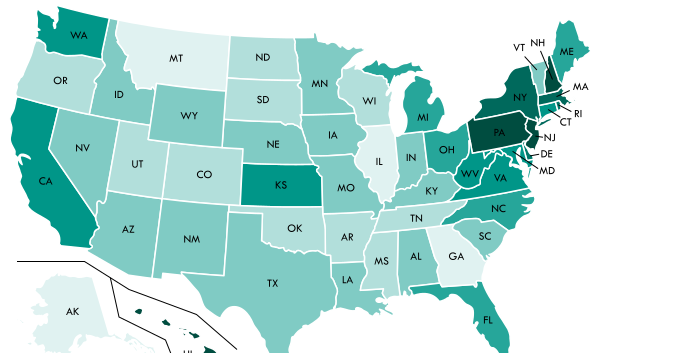
Most common states for network services technicians
| Rank | State | Population | # of jobs | Employment/ 1000ppl |
|---|---|---|---|---|
| 1 | District of Columbia | 693,972 | 454 | 65% |
| 2 | Alaska | 739,795 | 273 | 37% |
| 3 | Minnesota | 5,576,606 | 1,875 | 34% |
| 4 | Virginia | 8,470,020 | 2,704 | 32% |
| 5 | Vermont | 623,657 | 201 | 32% |
| 6 | Maine | 1,335,907 | 381 | 29% |
| 7 | North Dakota | 755,393 | 218 | 29% |
| 8 | Iowa | 3,145,711 | 871 | 28% |
| 9 | Massachusetts | 6,859,819 | 1,751 | 26% |
| 10 | Maryland | 6,052,177 | 1,585 | 26% |
| 11 | Colorado | 5,607,154 | 1,453 | 26% |
| 12 | New Hampshire | 1,342,795 | 355 | 26% |
| 13 | Nebraska | 1,920,076 | 475 | 25% |
| 14 | Delaware | 961,939 | 240 | 25% |
| 15 | Montana | 1,050,493 | 254 | 24% |
| 16 | Oregon | 4,142,776 | 939 | 23% |
| 17 | Utah | 3,101,833 | 722 | 23% |
| 18 | Rhode Island | 1,059,639 | 239 | 23% |
| 19 | North Carolina | 10,273,419 | 2,266 | 22% |
| 20 | Wyoming | 579,315 | 126 | 22% |
Most common cities for network services technicians
| Rank | City | # of jobs | Employment/ 1000ppl | Avg. salary |
|---|---|---|---|---|
| 1 | Newark | 1 | 3% | $58,661 |
| 2 | Downers Grove | 1 | 2% | $43,086 |
Network Services Technician job outlook: Expert opinions
Our panel of network services technician experts
California State University - East Bay

Grantham University
Utah Valley University

Governors State University

New York Institute of Technology

Carleton College
Tufts University
University of North Texas

Slippery Rock University

Stetson University

Saint Peter's University

American University
Dr. Bobby Roohparvar Ph.D.
Professor of Computer Science and Computer EngineeringCalifornia State University - East Bay
Computer Systems Networking And Telecommunications
What general advice would you give to a Network Services Technician?
Dr. Bobby Roohparvar Ph.D.: *The anxiety of AI is likely to change the landscape of computer networking, is a real threat but in my opinion, it won't eliminate the need for human network engineers. The focus will likely shift towards more strategic tasks, complex problem-solving, and leveraging AI tools to improve network efficiency and security.*
*Here again, I will explain in more detail about the expectation and future of Comp. Network Eng.*
* 1. AI Augments, Not Replaces: While AI can automate some network tasks, like data analysis and basic troubleshooting, it won't replace the need for human network engineers. It will increase the productivity for sure; Complex problem-solving, strategic decision-making, and human judgment are still crucial in network management. AI will likely become a valuable tool that assists network engineers in their tasks, making them more efficient.*
*2. Growing Demand: Our reliance on technology and data is constantly increasing. Businesses and organizations need secure, reliable networks to function. This necessitates a skilled workforce to design, implement, maintain, and secure these networks. The demand for qualified network engineers is expected to grow in the coming years.*
*In our technology horizon, I can see the quantum internet coming and I can see the demand for network engineering accelerate.*
*3. Diverse Skillset: A strong foundation in computer networking equips you with a versatile skillset. You'll understand network protocols, security concepts, and troubleshooting methodologies. These skills are valuable across the IT field and can be applied to areas like cloud computing, data center operations, or even cybersecurity. Data Centers for AI are becoming a huge opportunity for Comp Network Eng.*
Laura Kier
Network Design and Administration InstructorWhat general advice would you give to a Network Services Technician?
Laura Kier: Students graduating from the Computer Network Design and Administration program will enter the job market with a solid foundation in networking technologies. Above that they should also be able to develop and demonstrate excellent communication and interpersonal skills. Networking has a strong emphasis on teamwork and being able to communicate well with customers, co-workers and teammates is vital. Attaining certifications in Cisco, Linux, Windows, and security will also help the student stand out within the industry (classes in the program help to learn the knowledge needed to attain certifications). Students should participate in any local or online communities and groups to enhance skills and knowledge and find networking opportunities.
What Network Services Technician skills would you recommend for someone trying to advance their career?
Laura Kier: Computer Networking is a dynamic field with a wide variety of opportunities in many different industries. Some skills that will be more important in general are skills in software defined networking and automation. Skills in the DevOps field will be necessary, as well as skills leveraging AI tools. Cybersecurity is always important and using AI tools to enhance security and monitoring is necessary.
What will help Network Services Technicians increase their earning potential?
Laura Kier: Learn to present your skills well from the interview and into your career. Those communication skills count! Industry certifications like CCNA matter. They help you demonstrate a willingness to grow and learn beyond what was required for your degree. Be willing to take on new challenges with your new job and keep learning new skills. It is really important for graduates to understand that talented IT professionals can move up quickly in a company, but they often must start at the bottom to showcase their technical and soft skills. Because of that, they should not shy away from entry level jobs if there is potential for growth.
What experience really stands out on Network Services Technician resumes?
Lisa Sietstra: The job seeker's experiences will stand out when they've described previous accomplishments and shown a potential employer the value they have added in the past. Students/recent graduates (or really any job seeker at all) need to include quantifiable data in their statements; clearly painting a picture of achieved results. Connect the dots for the recruiter or hiring manager and really show that you have the potential to join the team and immediately contribute in positive ways.
Add details about academic projects if you do not yet have work experience in your field. Include a section of highlights from your coursework that applies to what the company is asking for in the job description.
Curtis Welborn
ProfessorUtah Valley University
Computer Science Department
Will there be an enduring impact of the coronavirus pandemic on Network Services Technicians?
Curtis Welborn: Not that I can see. The high tech sector and jobs for CS students remains very strong, and as the economy recovers, these areas will continue to grow as they have over the past 40 years.
What type of skills will young Network Services Technicians need?
Curtis Welborn: First, they need a strong fundamental understanding of Computer Science. People think they have to learn language X or environment Y or this thing or that thing because it is hot. Well, the thing to know about Computer Science jobs is there is always some new thing, always some new language better than the last, always something that is hot. Learning the hottest new thing might get you a job today, but it will not keep you a job tomorrow.
Having strong fundamental skills in Computer Science will equip you to learn ANY new thing. A good fundamental education in CS includes knowledge of programming languages, data structures, database, computer architecture, internet programming and networking, incremental design and development, and some advanced topic, which can vary based on a person's interest. Beyond this, everyone should have a basic understanding of math and the ability to write clearly because you always have to write something.
What experience really stands out on Network Services Technician resumes?
Curtis Welborn: That can really depend upon the company. Some companies want people with a strong background in machine learning right now. But I've met people who shy away from hiring people with too much machine learning on their resume even when the company wants someone to do machine learning because too many of these people only want to, or only can, do machine learning. They don't have a strong fundamental understanding of Computer Science (see No. 2). Our students who complete the Compiler course get jobs, not because companies are building a compiler but because companies know that someone who can build a compiler can most likely do anything they would want done. So people should not focus on finding that thing that makes their resume look good today. Just be great at everything you do. Take hard classes, and excel at them. Learn EVERYTHING you can, and companies will want you.
What are the biggest trends we'll see in the Network Services Technician job market given the pandemic?
Stephen Hyzny: Security, as more people need online services, the protection behind that technology will be needed.
What technology do you think will become more important and prevalent for Network Services Technicians in the next 3-5 years?
Stephen Hyzny: IoT having small devices connected to networks that control everything in our lives will become more integrated into our lives.
Will there be an increase or decrease in demand for Network Services Technicians in the next 5 years?
Stephen Hyzny: As everything involves technology, more educated people will need it in the future. As our cars, houses, and lives connect, people will be required to make it all work.
What technology do you think will become more important and prevalent for Network Services Technicians in the next 3-5 years?
Babak Beheshti Ph.D.: -The enormous growth of IoT and wearables. The number of connected devices is expected to be more than 26 billion in 2020. That includes things like household appliances, controllable lighting, and much more. This trend is likely to continue as it is expected to see the industry grow to 661 billion dollars by 2021.
-We will be witnessing a more widespread commercial deployment of 5G in 2020. With the implementation of the Standalone 5G devices based on the 3gpp release 16, we should be seeing the more robust mobile broadband deployment of 5G, wider availability of 5G smartphones, and a push towards an all 5G Network in select urban areas around the world.
-Significant growth in AI-based technologies, from face recognition and voice recognition to business intelligence and market predictions. As machines and deep learning algorithms get integrated into many applications, many industries will undergo substantial changes. AI systems will continue to interact with our phones; cars will interpret and analyze their surroundings and intelligently drive themselves. Online vendors will monitor our browsing habits, and Google decides what kind of search results to give us, based on who it thinks we are.
What type of skills will young Network Services Technicians need?
Joshua Davis Ph.D.: Studying mathematics is good practice for rigorous thinking and problem solving, which are valued across the workforce. For science and engineering applications, it is often also helpful to have R, Python, Matlab, or another popular programming language. But technical abilities get the graduate-only so far. They need interpersonal communication skills so that they can understand the needs of stakeholders and cooperate with colleagues. For this reason, many faculty at my school emphasize writing, speaking, listening, and teamwork skills.
How do you envision technology impacting Network Services Technicians in the next 5 years?
Joshua Davis Ph.D.: Electronic communication has enabled new collaborative projects in academic math, sometimes involving tens of mathematicians, spontaneously organizing around new problems. In industrial math, computers' ever-increasing power is getting more and more math turned into practical technology. Many of today's biggest buzzwords --- machine learning, self-driving cars, etc. --- are based on sophisticated math and statistics. I expect that math will only grow in importance as these technologies become more prevalent in society.
Are there any particularly good places in the United States for Network Services Technicians to find work opportunities?
Joshua Davis Ph.D.: Math is arguably the highest of high-tech, in the sense that it leads to other high-tech fields. For example, differential geometry and complex analysis were developed in the early 1800s; they became central to the language of physics in the early 1900s; those physics led to consumer products such as GPS and electronics in the present day. So it's unsurprising that companies in technology centers with research and development divisions often employ mathematicians. But I also have friends in the financial industry, the video game industry, the federal government, etc.
Will there be an increase or decrease in demand for Network Services Technicians in the next 5 years?
Ming Chow: On the one hand, there are many opportunities in tech currently. On the other hand, new college hires will be competing with crowds of people with real experience who were laid off during COVID. Five years is too far ahead to predict.
What are the biggest trends we'll see in the Network Services Technician job market given the pandemic?
Ming Chow: -Need to hit the ground running as many employees and companies don't have the time, energy, and training infrastructure.
-The soft skills, including communications, how to deal with change and the basics are becoming more critical-things like using a calendar, following-up, etc.
What technology do you think will become more important and prevalent for Network Services Technicians in the next 3-5 years?
Ming Chow: Infrastructure, including cloud and networking, Security, Machine Learning, and Data Science.
References:
1. cybersecurity
2. cybersecurity
What experience really stands out on Network Services Technician resumes?
Mark Albert Ph.D.: Projects. For resumes, it needs to be beyond a standard course final project. This can include a capstone team effort, a consistent theme among course projects, or engaging with faculty as a part of multi-year research pursuits. Also, we encourage our students to engage in the local community and seek internships to validate further their ability to work as part of a team.
How do you envision technology impacting Network Services Technicians in the next 5 years?
Mark Albert Ph.D.: AI is impacting everything we do, and the Biomedical Engineering program is integrating both human-based decision making and moral, well-validated, artificial intelligence into research and development. We also engage students in the MS in AI program and Data Engineering, both of which have Biomedical Engineering concentrations as part of the course sequence.
Will there be an enduring impact of the coronavirus pandemic on Network Services Technicians?
Mark Albert Ph.D.: They are now better at working remotely than ever before! It sure did accelerate the transition. Interestingly, our students are now more engaged beyond our academic borders than before, given remote collaboration capabilities.
Abdou Karim Jallow Ph.D.
Associate ProfessorSlippery Rock University
Department of Information Systems
Will there be an enduring impact of the coronavirus pandemic on Network Services Technicians?
Abdou Karim Jallow Ph.D.: It is obvious that the COVID-19 pandemic has impacted and transformed the lives of many people, including students all over the world. A major effect is requiring students to stay and learn from home because of the closure of educational institutions as a precautionary measure. Missing saying the traditional goodbye to friends, fraternities, and sororities, and having to watch commencement ceremonies in bedrooms online will leave an indelible mark in graduates.
This means a great U-shift in memories of college life, including physical interaction and learning environment, and systems adopting a new way of doing things. Graduates will enter the job market with uncertainties of availability of traditional jobs and how to work in a new normal. Many graduates will find themselves having to search for jobs virtually and having to start working remotely from the beginning in most cases and in most industries. What would have been a new beginning, along with the excitement of stepping through the doors of the new office and career, will not be there physically. This will have an impact on these graduates because of the transformation of society as a result of the pandemic.
Are there any particularly good places in the United States for Network Services Technicians to find work opportunities?
Abdou Karim Jallow Ph.D.: Sometimes new graduates from college can find it hard to get the perfect or preferred job location. This may be different for those with information sciences or information systems and related degrees. Luckily there are big companies, multinational companies as well as some-sized enterprises who need skills in that discipline. Most of these can be found in some of the big cities beyond Silicon Valley such as NY, San Francisco, Seattle, Los Angeles, Pittsburgh, Atlanta, Denver, Colorado, Philadelphia, Chicago, DC, Charlotte, Houston, Boston, Dallas, and Minneapolis, just to name a few.
Some of these locations are where some of the big tech companies reside, such as Google, Microsoft, Apple, Amazon, Facebook, Twitter, IBM, HP, SAP, etc. The advantage of this degree is that graduates not only can work for tech companies but any company because of the need to manage data, information, process, and technology. Companies all over have or are putting together strategies to harness the potential of big data, and graduates with information sciences, information systems, and related degrees are sought after continuously.
How do you envision technology impacting Network Services Technicians in the next 5 years?
Abdou Karim Jallow Ph.D.: The trend we have witnessed in the past two decades in terms of development in technology is unprecedented. This has a ripple effect on the field of information sciences and systems. Most traditional jobs have changed or rebranded. For example, consider how information and data processing and management (IDPM) has revolutionized into what is today information management or management information systems; business intelligence is almost transformed into business analytics, data science; high-performance computing, and grid computing is today predominantly engulfed by cloud computing services.
These are changing how data and information are managed. The decision-making process is changing in various information and knowledge-intensive and process-oriented industries such as healthcare, banking, transportation, engineering, education, security, just to name a few, despite the fact that roles and services still remain. New and emerging disciplines and services are added, driven by the advancement and greater capabilities of technology. Without a doubt, in the next few years, data and information services will be revolutionized by technology hugely. Consider the development in artificial intelligence, data science, blockchain, 5G, and broadband networks, all of which have huge potential to impact the discipline. This means that information sciences and information systems courses must adapt to take into consideration the emerging skills required by the professionals and businesses of the future. The education and training of professionals in this domain have to be continuously changing to prepare graduates adequately.
Will there be an enduring impact of the coronavirus pandemic on Network Services Technicians?
Dr. Hala ElAarag: I didn't see any negative impact of coronavirus on our graduates. Our graduates did not have any problem finding internships and jobs during the pandemic. After the pandemic, there will be even more demand and opportunities for our graduates.
Are there any particularly good places in the United States for Network Services Technicians to find work opportunities?
Dr. Hala ElAarag: Not really. With the increasing shift of working remotely, the jobs now are not tied to a specific location in the US or anywhere in the world.
How do you envision technology impacting Network Services Technicians in the next 5 years?
Dr. Hala ElAarag: In our field, it might be more appropriate the other way around. I would like to rephrase the question as to how does the computer science field impact technology in the next five years? The answer is tremendous. With fields like quantum computing, artificial intelligence, visual, and augmented reality making great strides, there is no doubt that we will witness a revolution in technology in the next five years.
Will there be an enduring impact of the coronavirus pandemic on Network Services Technicians?
Edward Moskal: While it's unclear how the pandemic will play-out, it will, without a doubt, change the landscape on how companies conduct business and the type of college graduates they will be looking to hire. Graduating into a bad economy can affect everything from obtaining that first full-time position to short- and long-term earnings. Recent college graduates and entry-level workers are being hit especially hard, as I see companies rescinding offers for jobs and internships as they navigate their recovery during the recession. As companies have shifted to remote work and phased returns, with furloughs and job eliminations, look for those graduates that can differentiate themselves from others to make the cut.
So internships, apprenticeships, certifications from professional organizations, acquiring skills, and on-the-job-training (above and beyond the related technical instruction acquired while in college), will be of paramount importance to have in your portfolio. However, it's not all doom and gloom for graduates who are having some challenges landing that first job. Graduate schools could be a prime pivot. While graduate school could result in additional student loans, it could also provide a career pathway by acquiring additional skills and a lever to start building a network of professionals that could provide the conduit to the job market.
Are there any particularly good places in the United States for Network Services Technicians to find work opportunities?
Edward Moskal: Top places for graduates to find work opportunities would be in areas surrounding these cities: New York, Los Angeles, San Francisco, Chicago, Seattle, Dallas, and Boston. So look at a 50-mile radius surrounding these cities, and those areas would be prime. These cities and their surrounding geographic areas will provide job connections to major financial services, manufacturing, tech, and logistics companies. According to cyberseek.org, just for cybersecurity job openings, New York has 15,000 openings, California has 68,000, Illinois has 18,000, Washington has 10,000, Texas has 47,000, and Massachusetts has 15,000.
How do you envision technology impacting Network Services Technicians in the next 5 years?
Edward Moskal: Technology will have a significant impact over the next five years. While technology associated with the software, databases, blockchain, cloud computing, and cybersecurity will still have an impact, we are likely to see significant changes and advancements in fields such as artificial intelligence, combinations of augmented and mixed reality, and quantum computing. Industry and business will be driving these advancements, in particular, the healthcare industry and large tech companies like Google and Facebook that have already started establishing a strong presence in these fields.
How do you envision technology impacting Network Services Technicians in the next 5 years?
Kathleen Riley: I expect some of the changes we've seen in the work world as a result of the pandemic to remain part of our lives long after the virus is no longer a threat. In particular, the pandemic has caused a lot of people to think more favorably about remote work, online meetings and conferences, and other video interactions. Not only do I expect to see increased availability of jobs supporting such technology, but I also anticipate that there will be more opportunities for computer scientists to join companies in other parts of the country without having to move to high cost-of-living areas like the Silicon Valley.
Will there be an enduring impact of the coronavirus pandemic on Network Services Technicians?
Kathleen Riley: The job market has been good for Computer Science graduates in the last several years, and I expect it to stay good, despite the pandemic. The coronavirus pandemic is changing the job market overall, with some industries cutting back and others increasing hiring, so there has been some redistribution of job opportunities as a result, but I fully expect the demand for our graduates to stay high. One of the changes we see in the industry right now is a growing demand for technology that enables and facilitates remote and touchless interactions; there will be significant demand for people with computer science skills to make that technology successful.
Are there any particularly good places in the United States for Network Services Technicians to find work opportunities?
Kathleen Riley: My computer science students from the class of 2020 had a variety of experiences when they entered the job market after graduation. Those who had already signed on at companies like Amazon or Google, whose business stayed strong during the pandemic and whose workplace models adjusted easily to remote work, had a relatively easy time starting their industry jobs. Others, especially those who had planned to work for companies whose business depended on clients or industries which suffered under the pandemic, saw delays, changes in their work plans, and even cancellations of contracts; several found themselves job hunting again over the summer, interviewing remotely and having to assess companies without setting foot outside their own home. Fortunately, there are still a lot of jobs out there for Computer Science graduates, and most of the students I know have found other placements or are well into that process.
We all know about the abundance of computer science opportunities in the Silicon Valley, the Dulles Technology corridor, and other tech hubs, but there is also an abundance of computer science opportunities in large and small cities throughout the country. In addition to businesses whose focus or products are technology-related, many other businesses have significant technology and computer science needs that are provided in-house, and those who thrive and survive will continue to hire.