Explore jobs
Find specific jobs
Explore careers
Explore professions
Best companies
Explore companies
Job outlook for nurse case managers in the United States
Nurse case manager job growth summary. After extensive research, interviews, and analysis, Zippia's data science team found that:
The projected nurse case manager job growth rate is 6% from 2018-2028.
About 195,400 new jobs for nurse case managers are projected over the next decade.
Nurse case manager salaries have increased 10% for nurse case managers in the last 5 years.
There are over 112,318 nurse case managers currently employed in the United States.
There are 83,480 active nurse case manager job openings in the US.
The average nurse case manager salary is $68,461.
Are nurse case manager jobs in demand?
Nurse case manager job and salary trends over time
Nurse case manager jobs over time
Nurse case manager job growth rate over time
| Year | # of jobs | % of population |
|---|---|---|
| 2021 | 112,318 | 0.03% |
| 2020 | 110,069 | 0.03% |
| 2019 | 109,913 | 0.03% |
| 2018 | 108,796 | 0.03% |
| 2017 | 107,133 | 0.03% |
Average nurse case manager salary over time
Nurse case manager salary by year
| Year | Avg. salary | Hourly rate | % Change |
|---|---|---|---|
| 2026 | $68,461 | $32.91 | +2.8% |
| 2025 | $66,616 | $32.03 | +2.2% |
| 2024 | $65,189 | $31.34 | +2.5% |
| 2023 | $63,617 | $30.58 | +2.3% |
| 2022 | $62,208 | $29.91 | +1.4% |
Nurse case manager jobs by state
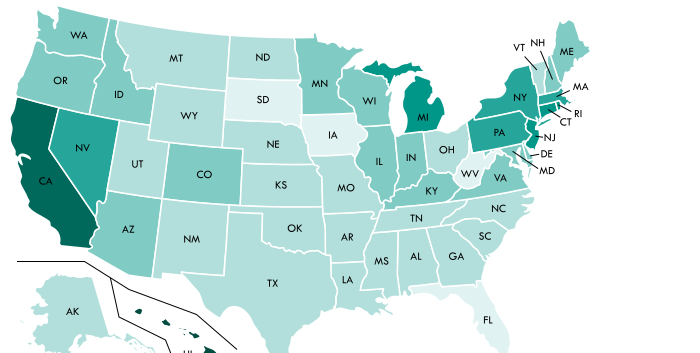
Most common states for nurse case managers
| Rank | State | Population | # of jobs | Employment/ 1000ppl |
|---|---|---|---|---|
| 1 | New Hampshire | 1,342,795 | 1,276 | 95% |
| 2 | Vermont | 623,657 | 590 | 95% |
| 3 | Massachusetts | 6,859,819 | 6,257 | 91% |
| 4 | South Dakota | 869,666 | 795 | 91% |
| 5 | North Dakota | 755,393 | 682 | 90% |
| 6 | Maine | 1,335,907 | 1,177 | 88% |
| 7 | District of Columbia | 693,972 | 571 | 82% |
| 8 | Montana | 1,050,493 | 846 | 81% |
| 9 | Delaware | 961,939 | 757 | 79% |
| 10 | Alaska | 739,795 | 562 | 76% |
| 11 | Indiana | 6,666,818 | 4,650 | 70% |
| 12 | Washington | 7,405,743 | 5,014 | 68% |
| 13 | Pennsylvania | 12,805,537 | 8,389 | 66% |
| 14 | Iowa | 3,145,711 | 2,065 | 66% |
| 15 | New Mexico | 2,088,070 | 1,372 | 66% |
| 16 | Nebraska | 1,920,076 | 1,265 | 66% |
| 17 | Kansas | 2,913,123 | 1,888 | 65% |
| 18 | Florida | 20,984,400 | 13,485 | 64% |
| 19 | Virginia | 8,470,020 | 5,385 | 64% |
| 20 | Maryland | 6,052,177 | 3,890 | 64% |
Most common cities for nurse case managers
| Rank | City | # of jobs | Employment/ 1000ppl | Avg. salary |
|---|---|---|---|---|
| 1 | Severn | 7 | 16% | $74,919 |
| 2 | Miami Lakes | 4 | 13% | $57,470 |
| 3 | Palo Alto | 4 | 6% | $109,466 |
| 4 | Rancho Cordova | 4 | 6% | $105,549 |
| 5 | Costa Mesa | 4 | 4% | $105,933 |
| 6 | Columbus | 5 | 3% | $63,747 |
| 7 | Savannah | 5 | 3% | $63,681 |
| 8 | Saint Louis | 6 | 2% | $60,362 |
| 9 | Boston | 10 | 1% | $82,267 |
| 10 | Baltimore | 7 | 1% | $74,971 |
| 11 | Atlanta | 4 | 1% | $64,372 |
| 12 | Miami | 4 | 1% | $57,555 |
| 13 | Tampa | 4 | 1% | $56,975 |
| 14 | Cincinnati | 3 | 1% | $66,920 |
| 15 | Los Angeles | 10 | 0% | $106,994 |
| 16 | New York | 4 | 0% | $83,856 |
Nurse Case Manager job outlook: Expert opinions
Our panel of nurse case manager experts
Northwestern State University of Louisiana
Pennsylvania State University - Harrisburg
California State University - Chico
Molloy College
University of St. Francis
The University of Tampa
Harding University
Hartwick College
Troy University
University of Wyoming
Francis Marion University
University of Southern Maine
Metropolitan State University of Denver
California State University - Dominguez Hills
University of Detroit Mercy
Stephen F Austin State University
Huertas College
Prairie View A & M University
Krystyna Tabor
Assistant ProfessorNorthwestern State University of Louisiana
Allied Health And Medical Assisting Services
What Nurse Case Manager skills would you recommend for someone trying to advance their career?
Krystyna Tabor: The biggest thing that I think everyone entering the field of nursing should do on a daily basis is LEARN. Just because you graduated nursing school and passed the NCLEX does not mean that you know everything that you need to know in order to care for people.
What will help Nurse Case Managers increase their earning potential?
Krystyna Tabor: Nursing has always been and will continue to be a good profession to enter. Nursing offers a flexibility that other professions do not offer. You can work at the bedside, in a clinic, or at home, etc. A nurse is not limited to a specific area. IE: nurses can change environments and specialties.
Dr. Robert Doerfler PhD, CRNP
Associate Teaching Professor of Nursing & NLN Certified Nurse EducatorPennsylvania State University - Harrisburg
Registered Nursing, Nursing Administration, Nursing Research And Clinical Nursing
What general advice would you give to a Nurse Case Manager?
Dr. Robert Doerfler PhD, CRNP: The earliest approach for the individual new grad is to consider several offers; don't agree to the first job offer—no matter how flattering and rosy it seems. You may end up agreeing to it in a short time, but give yourself a chance to consider other offers as well. Think about secondary gains. One offer may be a little less than another, but money isn't everything. Secondary benefits may include employer reimbursement or payment for continuing education (required by many states for re-licensure), cross-training in or certification for a clinical specialty that pays better (and thus a job you can bid on later), a promotion scheme that supplies specific benchmarks to the new grad to aim for to hit higher salary targets, and benefits plans that cover more out of pocket costs for health care, dental and vision insurance, 401k, and similar non-salary compensation. You may make more money at one job, but end up paying out of pocket for high deductibles or non-covered care, than you might at a job that has a much better benefits package, even if the pay is a little less.
What Nurse Case Manager skills would you recommend for someone trying to advance their career?
Dr. Robert Doerfler PhD, CRNP: I would strongly recommend that new graduates consider carefully the structure and duration of orientation or onboarding. Many hospitals are understaffed and new nurses are often being rushed through shortened orientations/residencies in an effort to relieve those staffing shortfalls. Duration and expected benchmarks for achievement should be available in writing as you consider your first job offer. If possible, ask to spend a few hours or shifts with the unit you are thinking about joining: Observe how the nurses treat each other and the ancillary staff. Do they seem mutually supportive? Is there a lot of gossipy talk? How does the morale seem? These social issues can become quite distressing to the new grad, and can result in dissatisfaction and premature departure due to emotional stress.
What will help Nurse Case Managers increase their earning potential?
Dr. Robert Doerfler PhD, CRNP: Facility with telehealth will become more important, as health systems develop better follow up of discharged patients in order to reduce readmissions. Recognizing clinical deterioration and knowing when to speak up about it, and to whom, will become more important as health care systems become more consolidated, and as they continue to experience shortages of RNs (especially as more states pass minimum staffing laws). Developing skills in research ("evidence-based practice"), collaboration with colleagues in councils and committees, and unit-based advocacy will become more important as a counterweight to the prerogatives of non-clinical administrators seeking to boost efficiencies, cut costs, and control risk: Advocating for patients is important, but advocating for your unit's needs also advocates for your patients as a class of people with particular needs.
What general advice would you give to a Nurse Case Manager?
Rich Burton DNP, RN, CMSRN: Often new graduates become hyper focused on working in a specialty unit for example ER, ICU, or NICU etc. I recommend instead focus on finding great hospitals that have extensive training programs and you want to work for. You will always have an opportunity to change positions within the hospital once you have a few year’s experience. A great hospital with adequate staffing and training will provide a much more supportive learning environment as you transition from student nurse to professional nurse.
What Nurse Case Manager skills would you recommend for someone trying to advance their career?
Rich Burton DNP, RN, CMSRN: Most hospitals have set rates for nurses but if you are looking to maximize your salary, I would say location location location. Certain areas of the country pay more than others, be willing to move to maximize your earning potential. Hospitals might also pay more for certifications or a bachelor’s degree as well.
What will help Nurse Case Managers increase their earning potential?
Rich Burton DNP, RN, CMSRN: Its only a matter of time before artificial intelligence (AI) makes its way into healthcare and nursing. Keeping up to date on new technology and being flexible to adapt to the ever changing field of nursing is very important. Flexibility and embracing change is essential.
Normadeane Armstrong PhD, RN, ANP-BC
ProfessorMolloy College
Registered Nursing, Nursing Administration, Nursing Research And Clinical Nursing
What general advice would you give to a Nurse Case Manager?
Normadeane Armstrong PhD, RN, ANP-BC: Starting a career in nursing can be both exciting and intimidating. Some general advice for new nursing graduates embarking on their professional journey may include: Never Stop Learning, Develop Strong Communication Skills, Cultivate Critical Thinking, Prioritize Self-Care, Build a Strong Support System.
What Nurse Case Manager skills would you recommend for someone trying to advance their career?
Normadeane Armstrong PhD, RN, ANP-BC: Technological Proficiency, Cultural Competence, Focus on Preventive Care and Health Promotion, Interprofessional Collaboration.
What will help Nurse Case Managers increase their earning potential?
Normadeane Armstrong PhD, RN, ANP-BC: Specialize, Further Education, Negotiate, Explore Alternative Settings, Stay Updated.
Dr. Maria Martinez DNP RN
Interim Associate Dean for Undergraduate NursingUniversity of St. Francis
Registered Nursing, Nursing Administration, Nursing Research And Clinical Nursing
What general advice would you give to a Nurse Case Manager?
Dr. Maria Martinez DNP RN: Bedside clinical experience is important, getting certifications, soft skills to enhance your EI quotient, develop your leadership skills, going back for your MSN.
What Nurse Case Manager skills would you recommend for someone trying to advance their career?
Dr. Maria Martinez DNP RN: Stay resilient and gain your experience for 2-3 years as an RN. When interviewing and applying for your first RN career opportunity, look at the mission and vision of the hospital, to see if it matches your work ethic values. Inquire and seek a good preceptor/mentor who will empower you to grow in your career. Stay humble and learn from the experts.
What general advice would you give to a Nurse Case Manager?
Dr. MaryAnn D'Alesandro DNP, MSN, RN, CNOR, NI-BC, CNE: The most important to skills to have and/or learn are critical thinking, trusting, and strengthening their gut intuition, and being adaptable to unpredictable situations and changing environments. The pandemic taught us that in many ways. Common sense and critical thinking are more important than you can imagine. But the most important skill is being okay being a life-long learner and understanding that no 2 days will be the same.
What Nurse Case Manager skills would you recommend for someone trying to advance their career?
Dr. MaryAnn D'Alesandro DNP, MSN, RN, CNOR, NI-BC, CNE: The most important advice is to keep in mind is that the first 1 to 2 years is still the learning phase of being an RN. Be kind and patient with yourself and be comfortable with asking questions and for help when you need it. Emulate the nurses that you admire and respect. Be a sponge when you can learn new skills and new concepts from your more experienced teammates. Be humble and be gracious. Enjoy it. Embrace the experiences and learn from them.
What will help Nurse Case Managers increase their earning potential?
Dr. MaryAnn D'Alesandro DNP, MSN, RN, CNOR, NI-BC, CNE: As a graduate and new RN, the salaries are competitive in the general areas. If you choose to specialize such as the OR, ER, ICU etc., or if you choose night shifts and weekends opposed to day shift, you could see the rates increase by several dollars an hour. Keep in mind that if you do not get a position in the area that you most want, for example labor and delivery, getting in the door of the hospital that you want to work at is most important. Getting your foot in the door is the opportunity. Most hospitals hire and promote from within, so that when a position opens in the area you truly want to work, you are in a better position to obtain it than someone who is not already a committed employee.
Marcus Binns MSN-NE, RN
Assistant ProfessorHarding University
Registered Nursing, Nursing Administration, Nursing Research And Clinical Nursing
What general advice would you give to a Nurse Case Manager?
Marcus Binns MSN-NE, RN: With technologies like AI becoming more prominent, nursing is a field that will stand out because it requires human intervention to provide hands-on care, perform skills, and critically think. That being said, I think nurses will become increasingly exposed to AI decision-making tools being utilized in medicine. What I think will be most important is utilizing those tools to streamline your tasks and decision-making, while at the same time being aware that your human interventions are still vital to notice things the algorithm misses while also providing compassionate care.
What Nurse Case Manager skills would you recommend for someone trying to advance their career?
Marcus Binns MSN-NE, RN: I would recommend they try to find their passion in nursing and get into it as quickly as they are able. You may not be able to start off on a specialty unit, but work on the steps needed to get there within a few years after starting off. If you try to practice nursing without passion, you can quickly experience feelings of burnout. If you work on a unit or with a population that you care deeply about, some days will *still* be hard but you will be encouraged to show up the next day and continue working with people you care about.
What Nurse Case Manager skills would you recommend for someone trying to advance their career?
Lorena Marra MS, FNP-C: For any graduate novice nurse, I would say to start your career in a facility that is comfortable for you. Perhaps it is somewhere that you were able to have good clinical experiences in, or perhaps a facility that you have been working in while you were in school. That familiarity is always helpful when you are getting started and taking on the new role of graduate nurse. It is also good to start in a facility with a nurse residency program. These programs will help the new nurse with skills that they have not been able to do in school. For example-starting intravenous lines or doing blood draws. Another tip would be to hold off on doing travel nurse experiences until you have more clinical work under your belt. When traveling, you need to be at the top of your skills, so take time to reach that pinnacle before heading off. The same can be said of starting graduate school. Some real-world clinical experience before starting NP school is incredibly helpful. Be patient with yourself as you get started in your new and exciting career.
Kayla Jackson RN BSN
BSN Success CoachTroy University
Registered Nursing, Nursing Administration, Nursing Research And Clinical Nursing
What general advice would you give to a Nurse Case Manager?
Kayla Jackson RN BSN: Salary potential varies depending on location, specialty and experience but a few ways to maximize your salary potential are: Consider pursuing further education which can include certifications in your field or area of expertise, an advanced degree, or specialized training. Gain experience. Seek out unique opportunities for professional growth so you can build an exceptional resume. This can position you for higher paying roles. Negotiate strategically-just as we advocate for our patients, we must be an advocate for ourselves. Do your research and know the standards where you are located, but also highlight the skill set you are bringing to the table and articulate how valuable you will be to their organization. Explore different employment settings. Nurses have so many opportunities in different fields, so explore what is out there and base your decision on who offers the best salary and benefits.
Karen Gorton PhD, RN, FNP, MS
Associate Dean, Associate ProfessorUniversity of Wyoming
Registered Nursing, Nursing Administration, Nursing Research And Clinical Nursing
What general advice would you give to a Nurse Case Manager?
Karen Gorton PhD, RN, FNP, MS: Continue to learn and grow. When opportunities for professional development arise, ask your managers to support you in gaining further knowledge and certifications. When you start in your first job, salary is important, but not as important as having an environment that will support you in your growth and development as a RN. If you have completed any micro-credentials, be sure to highlight those in the application process. For example, if you have completed the IHI Open School Basic Certificate in Quality and Safety, note that in your certifications on your resume. The increased knowledge and certifications may lead to some pay increases.
What Nurse Case Manager skills would you recommend for someone trying to advance their career?
Karen Gorton PhD, RN, FNP, MS: In nursing, the ability to think critically within the clinical context, communication, and assessment skills will continue to be very important. You, as the nurse, are with the patient for more hours than any other provider. Your ability to look at the patient combined with your assessment, their current issues, their lab values, and clinical presentation will be the difference in their outcome. Once you put your pieces together, your ability to clearly communicate your findings with the providers will advocate for the patient and their care.
What will help Nurse Case Managers increase their earning potential?
Karen Gorton PhD, RN, FNP, MS: As a recently graduated nurse who has passed NCLEX-RN, I would encourage you to be sure to learn all that you can from your mentors and preceptors who are helping you orient to your new role/position. They have so much knowledge that can be very helpful to your continued growth as a RN. Be sure to demonstrate informed inquiry – ask them questions that demonstrate your understanding of the context, but also your desire to learn more. Find a new graduate residency program to start your employment as a RN in. This program will provide you support for your first 9-12 months of working as a nurse.
Deborah Hopla DNP, APRN-BC, FAANP, FAAN
ProfessorFrancis Marion University
Communication Disorders Sciences And Services
What will help Nurse Case Managers increase their earning potential?
Deborah Hopla DNP, APRN-BC, FAANP, FAAN: The general advice I would give to a nursing graduate student as they begin their career in nursing is to understand every patient you treat is someone’s Mom, Dad, Aunt, Uncle, Brother, Sister, Child. Treat patients like they are your family member. Always keep up with the latest evidence and treatment options.
Dr. Debra Gillespie PhD, RN, CNE
Associate Professor of NursingUniversity of Southern Maine
Registered Nursing, Nursing Administration, Nursing Research And Clinical Nursing
What general advice would you give to a Nurse Case Manager?
Dr. Debra Gillespie PhD, RN, CNE: Skills needed in the future will more than likely involve the use of technology. AI and other technologies are rapidly being developed and implemented into the healthcare system.
What will help Nurse Case Managers increase their earning potential?
Dr. Debra Gillespie PhD, RN, CNE: ask questions and don't put too much pressure upon yourself. Be eager to learn new things, and stay on top of new initiatives in nursing and healthcare. Become a lifelong learner.
What Nurse Case Manager skills would you recommend for someone trying to advance their career?
Dr. Cindy Krentz DNP, RN, ACUE: Entering the nursing profession at present offers numerous advantages. Firstly, there's a widespread shortage of nurses nationwide, making nursing a highly sought-after career. With the aging population and retiring nurses, there's a pressing need for new nurses to fill these vacancies. Additionally, nursing offers diverse career paths, allowing individuals to transition between different specialties if desired. Moreover, the field boasts high earning potential, job stability, and flexibility in scheduling.
Cathy Andrade DNP, MSN, RN
Assistant ProfessorCalifornia State University - Dominguez Hills
Registered Nursing, Nursing Administration, Nursing Research And Clinical Nursing
What general advice would you give to a Nurse Case Manager?
Cathy Andrade DNP, MSN, RN: It seems we are in a phase in healthcare where the use of technology is growing at a rapid pace. Having an open mind to accept and continue to build skills using new technologies will continue to be important factors for the future of nursing practice.
What will help Nurse Case Managers increase their earning potential?
Cathy Andrade DNP, MSN, RN: Nurses who have a Bachelor’s of Science in Nursing degree often find there are more opportunities for employment for positions with higher salaries. An example of this is the Magnet designation for hospitals, which requires that at least 80% of their nursing positions be filled by BSN prepared RNs. These positions generally offer higher salaries than positions in sub-acute care settings and in home health.
Wendy Bowles PhD, APRN-CNP, CNE
Associate Clinical Professor, Associate Dean for Baccalaureate ProgramsWhat general advice would you give to a Nurse Case Manager?
Wendy Bowles PhD, APRN-CNP, CNE: To maximize your salary potential you should consider going back to school and pursuing your doctorate degree from a high quality, reputable institution. There are many programs that offer BSN to doctorate pathways and that will enhance earnings potential.
What will help Nurse Case Managers increase their earning potential?
Wendy Bowles PhD, APRN-CNP, CNE: Nursing offers many opportunities for a career and you never know what door will open for you in your calling to care. You should explore many possibilities and not limit yourself to any one particular area. It is also important to explore your future career and educational doors in the future.
Dr. Ashlee Barnes DNP, APRN, FNP-C
Assistant ProfessorUniversity of Detroit Mercy
Registered Nursing, Nursing Administration, Nursing Research And Clinical Nursing
What Nurse Case Manager skills would you recommend for someone trying to advance their career?
Dr. Ashlee Barnes DNP, APRN, FNP-C: People like the career paths that are offered in nursing. People also like the flexibility, ever-evolving shifts, job security and the opportunity to make a difference on a daily basis. People dislike the long hours at times, constant pressure, emotional involvement, and physical demands.
What will help Nurse Case Managers increase their earning potential?
Dr. Ashlee Barnes DNP, APRN, FNP-C: In the daily routine of a registered nurse, tasks vary widely from managing patient care, making important decisions, individualizing care plans, educating patients and resolving issues. Registered nurses administer medications, communicate empathetically, and advocate for patients ensuring their needs are addressed. Case management is crucial and overseeing seamless care transitions. Advanced practice registered nurses are licensed to diagnose and prescribe treatments, advancing patient care with precision and specialized knowledge.
Dr. Erin Bailey DNP, APRN, FNP-C
MSN CoordinatorStephen F Austin State University
Registered Nursing, Nursing Administration, Nursing Research And Clinical Nursing
What Nurse Case Manager skills would you recommend for someone trying to advance their career?
Dr. Erin Bailey DNP, APRN, FNP-C: Be patient. You may not get the exact job you want right out of nursing school but I bet it is available within 2 years of graduation. You do not have to take one you hate but experience is key to advancing.
Folake Adelakun DNP, MBA, HCA, MSN, BSN, RN, PHN,CNE
Clinical Assistant ProfessorHuertas College
Registered Nursing, Nursing Administration, Nursing Research And Clinical Nursing
What Nurse Case Manager skills would you recommend for someone trying to advance their career?
Folake Adelakun DNP, MBA, HCA, MSN, BSN, RN, PHN,CNE: People love nursing because it has been rated the most trusted profession in the United States continually. The reward of appreciation for caring for others. Good pay comparable to some professions. Numerous specialties to choose from. You will always have a job. Lifelong learning. Some dislike nursing because it demands a lot physically, emotionally, and mentally. Stress and job burnout. Work overload. Not enough renumeration. Constant change. Not being appreciated sometimes.
What Nurse Case Manager skills would you recommend for someone trying to advance their career?
Allyssa Harris RN, PhD, WHNP-BC: The health care system is experiencing a shortage of health care providers including nurses. Between 2020 and 2030 the need for RNs is expected to grow by 9% yearly, making the profession on of the fastest growing in the health care sector. Nurses and the care they provide will always be in demand, whether you are employed in a hospital environment or other health care setting. Furthermore, the skills that you learn as a nurse are transferrable. Nurses not only work in hospitals, but they also work in variety of settings such as health educators in business, health insurance case managers, they work in STEM industries as computer software developers, in law offices, in the travel industries on cruise lines, school settings and are business owners.
What will help Nurse Case Managers increase their earning potential?
Allyssa Harris RN, PhD, WHNP-BC: I can't speak for everyone but what I like about being a nurse is the ability to connect one on one with the patient and their family. Patients allow us the privilege of providing care and comfort during one of the most vulnerable times in their lives. It is the connection that we share that is the most rewarding. I believe that is this care and education that provides patients with the opportunity to make knowledgeable decisions about their health and well-being. What is most challenging about nursing is the increasing complexity of the patient care provide. Often patients enter the health care system later, having delayed care variety or reasons including lack of access, socio-economic challenges, unawareness, etc. This often increases the complexity of the care needed and nurses are required to have a broad knowledge of many things. I wouldn't say that they dislike the nursing profession, but the work is challenging.
What general advice would you give to a Nurse Case Manager?
Alison Alaimo MSN, RN: Nursing is a good profession to enter for several reasons. It is a very demanding, yet very fulfilling career. Nurses get to have a direct impact on patient health outcomes. The demand for nurses is exceedingly high now. Our students are securing employment one or even two semesters before they graduate from the nursing program. Nursing is also a career path which is available everywhere so no matter where you go, you can have a job in nursing. There are diverse career opportunities in nursing, so jobs are available no matter a person's interests. Working as a nurse offers a lot of flexibility so nurses can work nights, full-time, part-time, or per diem. The high demand for nurses is driving competitive compensation and benefits packages. Many hospitals will assist students in paying off student loans in return for a work agreement. Finally, there is always room for professional growth. Continuing education opportunities abound and there is always the option to pursue an advanced degree or other specialized training.
What Nurse Case Manager skills would you recommend for someone trying to advance their career?
Alison Alaimo MSN, RN: Nurses spend their days or nights assisting clients and their loved ones on their healthcare journeys. They possess a variety of tools and knowledge in which to do this. They assess and monitor patients, which is often a very dynamic process. They are trained to provide emergency response treatment. They administer medications and perform various aspects of patient care. They provide education to patients and loved ones and advocate for patients' rights and needs. Nurses maintained detailed documentation on all information pertaining to patients. They also work closely as a member of an interdisciplinary healthcare team. Finally, they also maintain their own professional development as changes in healthcare are frequent and/or they are interested in pursuing advanced degrees or certifications. Nurses work tirelessly to promote positive patient outcomes
What will help Nurse Case Managers increase their earning potential?
Alison Alaimo MSN, RN: I think the biggest thing people like about nursing is the opportunity to make a difference in the lives of others which is highly rewarding. Job stability in the field as well as variety and flexibility are also viewed as favorable. Nurses can also have a high degree of autonomy in their practice allowing them to make clinical decisions. Finally, there are always opportunities for leadership advancement and a large variety of advanced education that can be obtained in the field. Some of the things people dislike about being a nurse are the high workloads and emotional stress that often come with the job. There is also often a lack of recognition and support for nurses. The tasks of nursing can also be physically demanding, and nurses must be careful not to accidentally injury themselves on the job. Administrative burdens such as documenting can reduce the amount of time a nurse can spend on direct patient care and may cause frustration for some nurses. Overall though, I think the positive aspects of being a nurse far outweigh the negative ones.