Explore jobs
Find specific jobs
Explore careers
Explore professions
Best companies
Explore companies
Job outlook for operation system engineers in the United States
Operation system engineer job growth summary. After extensive research, interviews, and analysis, Zippia's data science team found that:
The projected operation system engineer job growth rate is 5% from 2018-2028.
About 18,200 new jobs for operation system engineers are projected over the next decade.
Operation system engineer salaries have increased 9% for operation system engineers in the last 5 years.
There are over 162,495 operation system engineers currently employed in the United States.
There are 101,173 active operation system engineer job openings in the US.
The average operation system engineer salary is $98,135.
Are operation system engineer jobs in demand?
Operation system engineer job and salary trends over time
Operation system engineer jobs over time
Operation system engineer job growth rate over time
| Year | # of jobs | % of population |
|---|---|---|
| 2021 | 162,495 | 0.05% |
| 2020 | 147,069 | 0.04% |
| 2019 | 144,434 | 0.04% |
| 2018 | 365,646 | 0.11% |
| 2017 | 356,791 | 0.11% |
Average operation system engineer salary over time
Operation system engineer salary by year
| Year | Avg. salary | Hourly rate | % Change |
|---|---|---|---|
| 2025 | $98,135 | $47.18 | +3.4% |
| 2024 | $94,901 | $45.63 | +2.3% |
| 2023 | $92,753 | $44.59 | +1.2% |
| 2022 | $91,679 | $44.08 | +1.8% |
| 2021 | $90,096 | $43.32 | +2.4% |
Operation system engineer jobs by state
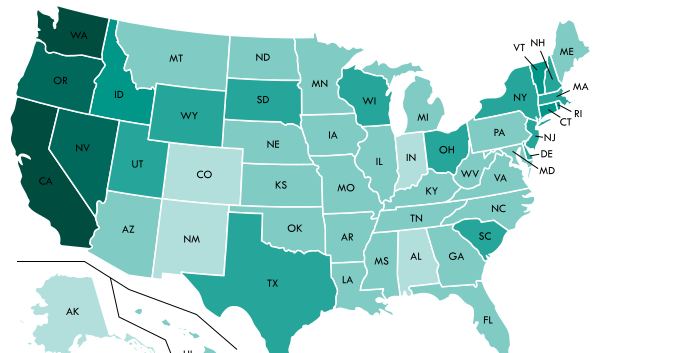
Most common states for operation system engineers
| Rank | State | Population | # of jobs | Employment/ 1000ppl |
|---|---|---|---|---|
| 1 | District of Columbia | 693,972 | 810 | 117% |
| 2 | Virginia | 8,470,020 | 3,631 | 43% |
| 3 | Maryland | 6,052,177 | 2,553 | 42% |
| 4 | Colorado | 5,607,154 | 1,730 | 31% |
| 5 | Massachusetts | 6,859,819 | 1,875 | 27% |
| 6 | Utah | 3,101,833 | 637 | 21% |
| 7 | New Hampshire | 1,342,795 | 268 | 20% |
| 8 | California | 39,536,653 | 7,327 | 19% |
| 9 | Washington | 7,405,743 | 1,421 | 19% |
| 10 | Delaware | 961,939 | 180 | 19% |
| 11 | Vermont | 623,657 | 114 | 18% |
| 12 | Oregon | 4,142,776 | 694 | 17% |
| 13 | Alaska | 739,795 | 126 | 17% |
| 14 | Arizona | 7,016,270 | 1,121 | 16% |
| 15 | Alabama | 4,874,747 | 788 | 16% |
| 16 | Rhode Island | 1,059,639 | 164 | 15% |
| 17 | North Dakota | 755,393 | 110 | 15% |
| 18 | Minnesota | 5,576,606 | 785 | 14% |
| 19 | Connecticut | 3,588,184 | 490 | 14% |
| 20 | Wyoming | 579,315 | 83 | 14% |
Most common cities for operation system engineers
| Rank | City | # of jobs | Employment/ 1000ppl | Avg. salary |
|---|---|---|---|---|
| 1 | Frankfort | 3 | 11% | $79,766 |
| 2 | Annapolis | 4 | 10% | $83,595 |
| 3 | Juneau | 3 | 9% | $78,026 |
| 4 | Dover | 3 | 8% | $90,097 |
| 5 | Lansing | 3 | 3% | $82,606 |
| 6 | Cedar Rapids | 3 | 2% | $79,206 |
| 7 | Hartford | 3 | 2% | $98,773 |
| 8 | Little Rock | 3 | 2% | $83,711 |
| 9 | Atlanta | 3 | 1% | $80,745 |
| 10 | Baton Rouge | 3 | 1% | $79,547 |
| 11 | Des Moines | 3 | 1% | $78,140 |
| 12 | Montgomery | 3 | 1% | $73,621 |
| 13 | Boston | 3 | 0% | $90,536 |
| 14 | Denver | 3 | 0% | $74,955 |
| 15 | Indianapolis | 3 | 0% | $76,139 |
| 16 | Phoenix | 3 | 0% | $85,327 |
Operation System Engineer job outlook: Expert opinions
Our panel of operation system engineer experts
University of South Alabama
California State University - East Bay
Stevens Institute of Technology
Massachusetts Maritime Academy
Worcester Polytechnic Institute
Northwood University

Albertus Magnus College
Wayne State University

University of Washington

Bakersfield College
Portland State University
University of Colorado at Colorado Springs

University of New Hampshire

Texas A&M University - Kingsville

Northeastern University

Indiana University Bloomington

Kennesaw State University

Idaho State University

Pennsylvania State University - Great Valley
What general advice would you give to an Operation System Engineer?
Sean Walker: Model Based Systems Engineering (MBSE) and Artificial Intelligence (AI) are going to be incredibly important in Systems Engineering over the next 3-5 years. MBSE has already become quintessential to the practice of Systems Engineering, which is why it has become a staple of our Master's and Doctoral programs. AI, of course, is changing almost every technical field and will be important to Systems Engineers as well. For Systems Engineers, the challenge will be understanding how and when to apply AI to solve systemic problems. Of course, both of these elements must be applied with an understanding of sociotechnical systems concerns. An engineer with the skills to apply MBSE and AI without losing sight of the humans in the system will be highly sought after.
What Operation System Engineer skills would you recommend for someone trying to advance their career?
Sean Walker: To maximize your salary, it is really essential to learn the tools and methods associated with Systems Engineering while also maintaining a sense of creativity. Employers are not only looking for engineers with the ability to apply specific tools but also the ability to think creatively to solve complex systems problems. I often encourage my students to maintain their creative hobbies so that they don't lose those skills. But, more immediately, gaining a graduate education in Systems Engineering can help any engineer increase their earning potential.
What will help Operation System Engineers increase their earning potential?
Sean Walker: I think the best advice for a new Systems Engineer, or really any engineer, is to be observant. One of the best things you can do when starting to apply the theoretical aspects that you've learned in school to your new career is to watch and listen to how experienced Systems Engineers practice in the field. This doesn't mean that you can't offer ideas or perspectives that are new, but that there will be challenges in your field that - due to the breadth of Systems Engineering - may not have been covered in your education.
Dr. Bobby Roohparvar Ph.D.
Professor of Computer Science and Computer EngineeringCalifornia State University - East Bay
Computer Systems Networking And Telecommunications
What Operation System Engineer skills would you recommend for someone trying to advance their career?
Dr. Bobby Roohparvar Ph.D.: *Favor:*
*Variety: Each day presents new challenges and opportunities for problem-solving.*
*Demand: The field offers strong job growth and stability.*
*Impact: Your work ensures businesses and organizations remain connected and operational.*
*Learning: There's always something new to learn with emerging technologies.*
*Dislike:*
*Troubleshooting: Issues can be complex and take a lot of time to resolve.*
*On-call: Network problems can occur at any time, requiring on-call availability.*
*Pressure: Maintaining network uptime can be stressful, especially during critical periods.*
*Keeping Up-to-Date: Rapid technological changes necessitate continuous learning.*
What general advice would you give to an Operation System Engineer?
Anthony Barrese: Pursue opportunities to broaden your experience across systems engineering, development, integration and test, field sales support and professional services positions. Generalist experience becomes invaluable with career advancement. Running a team is much more feasible for leaders who understand the process behind the work their reports deliver.
What Operation System Engineer skills would you recommend for someone trying to advance their career?
Anthony Barrese: There are many paths leading to increased salary potential. Rapidly developing a deep understanding of customer environments and needs can be one of those, but is often not sufficient on its own. Cultivating strong communication skills, building relationships across the business and distinguishing yourself as a leader will all position you for career advancement and the compensation increases that go along with that.
What will help Operation System Engineers increase their earning potential?
Anthony Barrese: The ability to listen to the customer is the most critical skill. Deeply understanding the needs of the end user ensures business success. In addition, digital engineering environments and digital twin technology in particular, will become increasingly important. These tools enable gains in efficiency and promote enhanced quality.
What general advice would you give to an Operation System Engineer?
Mark Whalen P.E.: A system engineer designs, develops, and manages complex technical systems across a large variety of industries. This can include defining solutions to system-level problems, plus allocating requirements, technologies and team member tasking at a project level, as well as communicating complex ideas and systems to key stakeholders.
An entry-level system engineer will typically apply advanced mathematical techniques to solve system-level technical problems, as well as installing, testing, and troubleshooting complex operating systems
What Operation System Engineer skills would you recommend for someone trying to advance their career?
Mark Whalen P.E.: Many system engineers enjoy working across all technologies at a higher organizational level, and interacting with all types of technologists to manage and implement complex technical systems.
Many system engineers can feel challenged by their lack of depth of understanding of particular technologies compared to technical specialists.
What will help Operation System Engineers increase their earning potential?
Mark Whalen P.E.: There are many complex systems in existence or being developed that require knowledge and experience across many different technologies. Also, system engineering careers can often lead to managerial positions like becoming a project manager, operations manager or chief engineer.
What general advice would you give to an Operation System Engineer?
Don Gelosh Ph.D.: Systems Engineering is a contact sport. As a systems engineer you are expected to be a leader.
Successful systems engineers are those who get out of their office and engage with other
engineers and technicians who work on complex systems. On any given day, systems engineers
could be working on a team, possibly leading that team, in one of the several phases of the
design and development effort. They may be working with stakeholders to determine their
requirements for the complex system or they may be working with validation test engineers to
determine if the complex system will satisfy the stakeholders needs.
While it would be expected that you are very knowledgeable in a few discipline areas, such as
electrical, mechanical or chemical engineering, you are not expected to be an expert in all
areas. However, you would be expected to know the experts in those fields and others and
how they should be involved in the overall development process. You would be expected to
understand the many processes of systems engineering and how each process contributes to
the success of the complex system.
You would also be expected to thoroughly understand any other systems and the operational
environment that will interface and interact with your system. As a systems engineer, you
would be expected to understand the big picture of the complex system.
What Operation System Engineer skills would you recommend for someone trying to advance their career?
Don Gelosh Ph.D.: Being a systems engineer provides you with many opportunities to learn and grow. Systems engineers
have the opportunity to learn all they can about a specific engineering discipline field of choice (i.e.,
electrical, mechanical, chemical, power, etc.). Systems engineers are also expected to learn in general
what engineers and technicians in other disciplines do on a daily basis. Systems engineers should talk to
other systems engineers about their daily activities as much as possible. Systems engineers should learn
how to lead people and manage resources; they should learn how to both lead and serve on teams.
Systems engineers should prepare themselves through education, training, and experience for
opportunities to grow and take on new responsibilities.
One dislike may be the long hours in dealing with the challenges of developing complex systems.
However, if you enjoy this type of work, the rewards of leading and managing the creation of successful
systems will be worth the effort it takes.
What will help Operation System Engineers increase their earning potential?
Don Gelosh Ph.D.: There is a great demand for those who can understand the big picture as well as knowing the
smallest detail in the development and delivery of complex systems. It is very important that
everyone involved in the engineering of complex systems works from the same requirements
and understands the intended operational environment. Systems engineers facilitate this
common understanding of the target system, interconnected systems and the operational
environment.
Today's advanced technology and systems that utilize that technology are increasingly
becoming more complex and more challenging to develop and deliver. This requires a different
type of engineer, one who has both in-depth technical knowledge and leadership skills.
Systems engineers who understand these requirements and can deliver successful complex
systems will always be in demand.
Professor David Sanford
Associate Professor an Department Chair (MIS, CS, CYB MGT, IS CYB)Northwood University
Computer And Information Sciences
What general advice would you give to an Operation System Engineer?
Professor David Sanford: Workers like that they are challenged to solve problems and lead technological innovations.
They appreciate the diversity of projects
They enjoy the need for continuous improvement and education
Many see the global impact of their work.
They also desire and appreciate the need for versatile skills
A competitive salary is also an item that employees like
Workers dislike that the work can be stressful
Dealing with tight deadlines and/ or cybersecurity concerns.
This is a positive and a negative: The need to constantly stay up to date with technology can be a bit overwhelming for some.
There may be times of isolation, and
The unexpected system failures can be frustrating as they often require extra hours or the need to be on-call.
The multiple responsibilities and managing repetitive tasks are also issues workers point out in this field.
In short, the workplace offers exciting opportunities but comes with its fair share of pressures and challenges. Different people have different experiences based on their roles and personal preferences.
David Garaventa
Director, Computer Information Systems and Cybersecurity Programs, Assistant Professor, CISAlbertus Magnus College
Business Administration and Management Department
What skills stand out on Operation System Engineer resumes?
David Garaventa: The skills/attributes required across a variety of jobs in the IT fields.
Dr. Nabil Sarhan Ph.D.
Associate ProfessorWayne State University
Department of Electrical & Computer Engineering
What will help Operation System Engineers increase their earning potential?
Dr. Nabil Sarhan Ph.D.: The graduates can increase their earning potential by obtaining master's degrees or certificates based on the current market needs. These qualifications are expected to become increasingly more important because of the rising competition in the marketplace.
Will there be an enduring impact of the coronavirus pandemic on Operation System Engineers?
Les Atlas: Most certainly an impact, a very strong impact. The best lesson for us is from the 1919 Spanish Flu pandemic. That strain of flu still circulates as a seasonal virus. Over 100 years laters, it is now considered a Phase 6 pandemic by the World Health Organization. While it is reduced due to current social distancing and mask wearing, the 1919 Spanish Flu virus still causes community-level outbreaks in multiple parts of the globe. Societal changes from this event of over 100 years ago are still with us.
In fact, they changed society. As is well-documented, after a high level of immunity was reached in the 1920's, the resulting labor shortage enabled workers to demand better living and working conditions, as well as better wages and public health care. As just one example of the societal changes due to the 1919 pandemic, the drop in the male labor force empowered male workers, and also changed the gender composition.
The aftermath of the 1919 pandemic was the start of women joining the labour force. In the United States, the proportion of women in the labour force rose from 18 per cent in 1900 to almost 21 per cent in 1920. In that same year, with the ratification of the 19th Amendment of the Constitution, the Congress of the United States guaranteed all American women the right to vote.
The current COVID-19 pandemic will certainly change the way we live, be it our mobility or the kinds of career options people have. After our current year-long experience in remote learning and work, will we go back to the inefficiencies of going to our office every work day? Or will remote work be acceptable, where one's residence will not be dependent upon the locations of employment. Will we avoid future hotspots of infection, choosing to instead reside and travel in areas where infection is decreasing? Will we prefer to travel on aircraft which are certified to be virus-free and frequent restaurants which are documented to be safer? Future marketing will likely make a sharp turn in this direction.
What type of skills will young Operation System Engineers need?
Les Atlas: With an expected increase in mobility, companies will have a larger pool of employees to search over and interview. Potentially orders of magnitude more. Searches for employees need not be regional. Thus, if a specific specialization is needed, the pool of applicants, which will likely come from a search over a large region, state-wide or larger, or even international.
Thus specializations will become more important, both in terms of depth and fit to the needs of an employer. Advanced graduate degrees will become more necessary. It seems very likely that filed which help understand data for epidemiology and disease forecasting and geographical hotspots will continue to be especially pertinent.
What experience really stands out on Operation System Engineer resumes?
Les Atlas: The most obvious experience, in terms of being timely, is work with the science and data interpretation from the current pandemic. Epidemiology and statistics, computer science, and data science for data from the COVID-19 epidemic and similar public health data will remain on the forefront. In the many other areas of technology, having up to date skills, with advanced degrees, combined with the ability to work anywhere in the world, not by traveling, but instead remotely, will likely fit most future positions.
What are the biggest trends we'll see in the Operation System Engineer job market given the pandemic?
Maryam Farahani: In my opinion, technology will play a much bigger role in our day-to-day life compared to the pre-pandemic world. Artificial intelligence and robotics will have a boost in employment numbers. Companies like Amazon, Walmart, Targets and etc, will need more IT and technology specialists to meet their customer's need for online shopping and supplying/delivering products to their customers. Jobs like programmers, data analysts, and technology support positions will have a rise in response to the change in the market due to pandemic.
For so many of the jobs, the need for a physical office is under question now, many employees are working from home and managing/coordinating their projects virtually. This will change the job market forever and job seekers need to learn new skills to adjust to this change.
Right now, healthcare-related job opportunities are growing in response to the rising need. In addition to doctors and nurses, there will be needs for management roles, accountants, technology supports, and lab technicians in health care industry.
What Operation System Engineer skills would you recommend for someone trying to advance their career?
Maryam Farahani: The best approach is researching skills and technologies required in their field of education or their field of work. Specially if there are simulation software/skills presented in their schools (related to their field of work/study), they should not miss the opportunity to learn them. These type of trainings are much less expensive in school and help them to standout in the pool of candidates in current competitive job market. Plus the hiring companies will save time/money for training the trained candidates, and it gives the trained candidates higher chance of employment.
What general advice would you give to an Operation System Engineer?
Maryam Farahani: Thinking about the fields they want to experience or try. And to be intentional about their job search. The best advice is learning as much as they can about what company offers. Visualizing themselves in the next 5 years as a starting point. Do they want to travel a lot, or be in management positions? Do they want to be subject matter expert, or a hands-on engineer or technologist? Their goal may change as they progress in their career but having one makes a big difference in their career choices and keeping them on track.
Dr. Wayne Wakeland Ph.D.
Professor and Systems Science Program ChairPortland State University
Systems science program
What are the biggest trends we'll see in the Operation System Engineer job market given the pandemic?
Dr. Wayne Wakeland Ph.D.: Obviously, there is and will continue to be increased receptivity to (and necessity of) working remotely. This is likely to benefit some job seekers. On the other hand, the weakened economy, which may take years to recover, means that less jobs are/will be available, and, therefore, the competition for attractive jobs will be intense.
What Operation System Engineer skills would you recommend for someone trying to advance their career?
Dr. Wayne Wakeland Ph.D.: For analyst positions, I think that employers want to hire people with strong data analysis skills, which, of course, includes statistics, but also big data, machine learning (algorithms), computer-based modeling, and programming. And, in addition to these apparently rather specialized skills, there is growing recognition that a talent for thinking, communicating, and problem-solving in a very general sense, and being able to cope with/address complexity, is also quite important.
What general advice would you give to an Operation System Engineer?
Dr. Wayne Wakeland Ph.D.: Develop a thoughtful combination of technical skills/expertise and qualitative resources/assets/prowess. Purely technical savvy can go a long way, but it is not enough. Employers are eager to hire well-rounded, easy to work with employees and leaders who can go deeper technically as required.
Dr. T.S. Kalkur
Department ChairUniversity of Colorado at Colorado Springs
Electrical and Computer Engineering Department
Will there be an enduring impact of the coronavirus pandemic on Operation System Engineers?
Dr. T.S. Kalkur: Yes, students complained that, while they are earning an online degree, they aren't learning as much.
What type of skills will young Operation System Engineers need?
Dr. T.S. Kalkur: They should be have the fundamentals down: good computer skills, knowledge of software tools used in design, good communication skills. They should also have a team spirit and internship experience before graduation.
What experience really stands out on Operation System Engineer resumes?
Dr. T.S. Kalkur: Internship experience and tools used in design.
Marc Lessard
ProfessorUniversity of New Hampshire
Physics and Astronomy Department and Space Science Center
What type of skills will young Operation System Engineers need?
Marc Lessard: This is a very good and important question. Graduates who can address complex problems in creative ways will be the most successful. This might sound obvious, but there seems to be a trend developing where younger engineers tend to want to follow written procedures or instructions for solving problems.
What is more valuable, of course, is being able to use a broad-based background to provide new and creative solutions, or at least to suggest new ideas and engage in discussions to further develop those ideas. The cliche of "thinking outside the box" will always be important.
What experience really stands out on Operation System Engineer resumes?
Marc Lessard: Students who have been significantly involved in research projects have a distinct advantage over those who haven't. Those who began such work (which is typically paid) as sophomores or juniors often will have played a significant role in these real-world research efforts, which can be very different than what might be tackled as part of a capstone project.
Written and oral presentation skills are also essential!
Will there be an enduring impact of the coronavirus pandemic on Operation System Engineers?
Marc Lessard: I think there might be a lag in some fields, but the need for good engineers in today's world will remain strong. Certainly, I would expect no long-term concerns. The world will always need new technology!
This is especially true for engineering-physics graduates, who are often trained to provide more of a "systems" perspective in their problem-solving strategies. Being able to see the "big picture", to understand what challenges need to be addressed and how to solve them, is a fundamentally important skill.
Austin McCoy
Director of Javelina Engineering Student Success CenterTexas A&M University - Kingsville
Engineering Department
What are the biggest trends we'll see in the Operation System Engineer job market given the pandemic?
Austin McCoy: -Adapting to the virtual setting
Remote work is becoming more of an option for employees.
What skills stand out on Operation System Engineer resumes?
Austin McCoy:
-Internship/co-op experience -Research experience
-Good leadership skills and involvement on campus and in the community and activities where the individual works as part of a team.
-Well written resume can tell a lot about the technical writing skill; a resume needs to be clean and comfortable to read; recruiters can find what they are looking for easily.
-Less is sometimes more because students sometimes will put more information on a resume than is pertinent to the position applying for.
Are there any particularly good places in the United States for Operation System Engineers to find work opportunities?
Austin McCoy: -I think that if enough effort is put into looking for a job, there is an ability to find a job in just about any location
-The ABC's of job searching: Any job, Better job, Career job
What general advice would you give to an Operation System Engineer?
Laura A. Meyer M. Ed.: I tell my students often do not give up! Resilience is so important right now and with that comes being mindful about how they are applying to positions and to what positions they are applying. Really crafting their resumes and cover letters for each position they are applying is very important. Also, stay sharp - keep honing your skills and be consistent about doing so.
What are the biggest trends we'll see in the Operation System Engineer job market given the pandemic?
Laura A. Meyer M. Ed.: This is a tough one, as nothing has been consistent since the pandemic. At the start, for students I advise in the Information Systems program, those in data roles lost their opportunities, where those with offers in software were able to maintain their opportunities. As we moved into summer and began looking to the fall co-op cycle, hiring was very slow all the way around as companies were navigating remote work and how to fit a co-op into a fully remote work role. Now, as we are moving into the Spring cycle, I see much more hiring in all roles with all of my students on co-op working remotely or starting to work remotely, then hopefully moving back into a physical work location. The one consistent piece since the pandemic has been remote work.
What Operation System Engineer skills would you recommend for someone trying to advance their career?
Laura A. Meyer M. Ed.: Students should really be working on honing the skills in their areas of focus and interest. With that said, they should also work toward becoming more well-rounded in all areas. A few of my students have realized through job postings, they have found that although they may want to work in data, knowing the basics of programming will be useful as well.
Dr. Ariful Azad Ph.D.
Director of Graduate Studies for the Dept. of Intelligent Systems Engineering, Assistant Professor of Intelligent Systems EngineeringIndiana University Bloomington
Department of Intelligent Systems Engineering
What are the biggest trends we'll see in the Operation System Engineer job market given the pandemic?
Dr. Ariful Azad Ph.D.: The pandemic taught us that many jobs do not require physical office spaces. Hence, we may see more jobs permanently relying on virtual communications. We have already seen this trend in the retail industry, where Amazon forced many retail stores to shut down. This trend is expected to be accelerated in the aftermath of the pandemic.
What Operation System Engineer skills would you recommend for someone trying to advance their career?
Dr. Ariful Azad Ph.D.: I recommend enhancing skills in data analytics, if a graduate lacks such skills. Revitalizing business practices by analyzing user or inventory data is an integral part of almost all business applications. Hence, skills in data analytics will give a graduate an edge in the changing job market. Data analytics comes in various flavors: from gathering simple statistics to advanced machine learning. Hence, a graduate can always improve their skill from freely available online lectures, online classes such as Coursera, or on-ramp classes offered by many universities.
What general advice would you give to an Operation System Engineer?
Dr. Ariful Azad Ph.D.: Look for a job that you would enjoy doing, even if it takes some time to find such a position. Internships are great to explore various options.
What experience really stands out on Operation System Engineer resumes?
Adeel Khalid Ph.D.: It is the age of diversity. A graduate can stand out when their resume shows a broad portfolio of experiences. In addition to a solid academic record, students who demonstrate that they can take on challenging tasks and work beyond a degree's basic requirements are more likely to be successful. I advise students to get involved in various activities, including undergraduate research projects, student design competitions, student organizations, internships, co-ops, etc. All of these should be highlighted on the resume. When a recruiter sees an overview of a student that shows relevant work experience in the form of work-study, internships, or co-op or research, their resume automatically comes to the top of the pile.
How do you envision technology impacting Operation System Engineers in the next 5 years?
Adeel Khalid Ph.D.: Technology will continue to become more prevalent in the workspace. For students to be successful, they will need to keep up with the rapidly changing technology, and I do not see the rate of this change slowing down anytime soon. More and more systems are becoming interdisciplinary. This is where systems engineering plays a key role. Systems engineers can bridge the gap between other engineers by establishing and communicating the requirements at the system level. They also play a crucial role in the verification and validation of complex systems. With the advent of technology in the coming years, this role will become even more paramount.
Will there be an enduring impact of the coronavirus pandemic on Operation System Engineers?
Adeel Khalid Ph.D.: It would be unreasonable to believe that there will be no enduring impact of coronavirus. It has changed the way engineers work. Dependence on technology has increased multifold during the pandemic. When a cure is finally in place, this dependence on technology is unlikely to slow down. This translates to the ability to perform engineering tasks virtually. So graduates need to be well versed in technology to be able to stay engaged and productive. Graduates will also need to adapt to the changing environment where they can meet the needs of the customers that will be more and more dependent on technology and their ability to conduct business virtually.
Vince Bowen
Executive Director, Department Chair Energy Systems Technology & Education Center (ESTEC)Idaho State University
College of Technology
What type of skills will young Operation System Engineers need?
Vince Bowen: How to learn. How to problem-solve. Emotional Intelligence to work in teams and get along with coworkers/customers. Then they need the tech skills.
Are there any particularly good places in the United States for Operation System Engineers to find work opportunities?
Vince Bowen: Any large city will have several openings. Beyond that, these people can work anywhere in the world.
How do you envision technology impacting Operation System Engineers in the next 5 years?
Vince Bowen: AI and IoT are the newest technologies in the area and will have an enormous impact on training programs.
What experience really stands out on Operation System Engineer resumes?
Nil Ergin Ph.D.: Knowledge of analytical skills, methods, and tools for analysis, design, and management of complex systems and experience working with interdisciplinary teams are essential for systems engineering professionals. Experience in applying systems thinking and design thinking approaches to understanding organization, technical, and non-technical factors that influence the design and performance of complex systems stands out on resumes.
How do you envision technology impacting Operation System Engineers in the next 5 years?
Nil Ergin Ph.D.: Advances in sensors, networking, communication, and computing are shaping the systems and services that are designed and deployed. Systems are becoming increasingly complex and interconnected; thus, more challenging to manage. Systems engineering discipline is becoming an essential element of managing and designing these systems. The field is evolving to address the challenges emerging from these advances in technology, including but not limited to, methods and tools to improve system resiliency, flexibility, agility, security, privacy, along with new ways to manage, design, and evaluate complexity.
Will there be an enduring impact of the coronavirus pandemic on Operation System Engineers?
Nil Ergin Ph.D.: The pandemic disrupts all systems. With disruptions, new forms of services, delivery formats, and jobs will emerge. One overall result of the epidemic is that tech companies consider allowing employees to work remotely, beyond the end of the pandemic. Emerging work from the home norm will enable companies to hire a diverse and distributed workforce and compete for technical talent nationwide. This will also create a demand for IT capabilities and create a network of shared workspaces. Graduates need to diversify their skill sets to adapt and be agile to new forms of change.