What does an optometric assistant do?

An optometric assistant performs a variety of support tasks to assist optometrists and maintain a smooth flow of operations at clinics. They typically greet clients and identify their eye and vision care needs, answer inquiries, gather patient histories and other information, prepare and assist the clients for vision tests, and administer eye drops. They may also perform clerical tasks such as processing documents, organizing files, handling calls and correspondence, liaising with external partners such as suppliers and vendors, and updating databases. Moreover, an optometric assistant may also adjust and repair glasses, all according to the clients' needs.
Optometric assistant responsibilities
Here are examples of responsibilities from real optometric assistant resumes:
- Manage telecommunications, provide patient telephone triage and documentation thereof.
- Utilize organization skills in managing business operation keeping Dr. Rivera on schedule.
- Maintain medical records in accordance with HIPAA.
- Administer vaccines, EKG and Spirometry testing.
- Test patients for glaucoma and cataracts on NCT machine.
- Assist physicians with injections, EKG testing, treadmill tests.
- Assist with scribing, medical coding, phone triage and coordinate pharmacy requests.
- Update patient charts with proper histories, medication lists and allergies, and new complaints.
- Order online prescription drops for glaucoma, dry eye, patients with infections and other conditions.
- Input charge entry with CPT code / ICD-9-CM code / collect co-pay and outstanding patient balances.
- Review CPT & ICD codes to create & and submit medical claim charges to appropriate insurance payer.
- Maintain accurate electronic health records (EHR) for each patient using fully integrate practice management software, Compulink.
- Can operate machine such as iCare, tonopen, applinate, Pachemetry, PentaCam, topography, sterilizing surgical tools.
- Perform pre-examinations following HIPAA guidelines.
- Thank you for your consideration.Jennifer KingSkills UsedRevolution ehr / computer system.
Optometric assistant skills and personality traits
We calculated that 36% of Optometric Assistants are proficient in Patients, Appointment Scheduling, and Customer Service. They’re also known for soft skills such as Analytical skills, Detail oriented, and Interpersonal skills.
We break down the percentage of Optometric Assistants that have these skills listed on their resume here:
- Patients, 36%
Prepared patients for eye examinations by administering tests to ensure accurate diagnosis and treatment.
- Appointment Scheduling, 5%
Performed office duties including filing, appointment scheduling, scanning, insurance authorization.
- Customer Service, 4%
Communicated with patients, sales representatives, customer service representatives.
- Patient Care, 4%
Assisted optometrist with patient care including documentation of encounters in electronic health records.
- Visual Acuity, 3%
Performed visual acuity, glaucoma screenings, assisted optometrist.
- Blood Pressure, 3%
Scheduled appointments, pretesting, including VA's, blood pressure, visual field testing, contact lens ordering and dispensing.
Most optometric assistants use their skills in "patients," "appointment scheduling," and "customer service" to do their jobs. You can find more detail on essential optometric assistant responsibilities here:
Analytical skills. To carry out their duties, the most important skill for an optometric assistant to have is analytical skills. Their role and responsibilities require that "medical assistants must be able to understand and follow medical charts and diagnoses." Optometric assistants often use analytical skills in their day-to-day job, as shown by this real resume: "supervised peers and trained hires on database management, appointment scheduling, customer service, and product purchases. "
Detail oriented. Another soft skill that's essential for fulfilling optometric assistant duties is detail oriented. The role rewards competence in this skill because "medical assistants need to be precise when taking vital signs or recording patient information." According to an optometric assistant resume, here's how optometric assistants can utilize detail oriented in their job responsibilities: "provided customer service by informing patients of their exam fees and details regarding their insurance coverage. "
Interpersonal skills. This is an important skill for optometric assistants to perform their duties. For an example of how optometric assistant responsibilities depend on this skill, consider that "medical assistants need to be able to discuss patient information with other medical personnel, such as physicians." This excerpt from a resume also shows how vital it is to everyday roles and responsibilities of an optometric assistant: "lead by example with strong interpersonal skills, which provides comfortable relationships with physicians, patients, and coworkers. ".
Technical skills. optometric assistant responsibilities often require "technical skills." The duties that rely on this skill are shown by the fact that "medical assistants should be able to use basic clinical instruments so they can take a patient’s vital signs, such as heart rate and blood pressure." This resume example shows what optometric assistants do with technical skills on a typical day: "prepared patient for vision examination.^ trained and managed technical staff and achieved significant improvements in their productivity. "
The three companies that hire the most optometric assistants are:
- The Henry Ford11 optometric assistants jobs
- Henry Ford Health System11 optometric assistants jobs
- Kaiser Permanente9 optometric assistants jobs
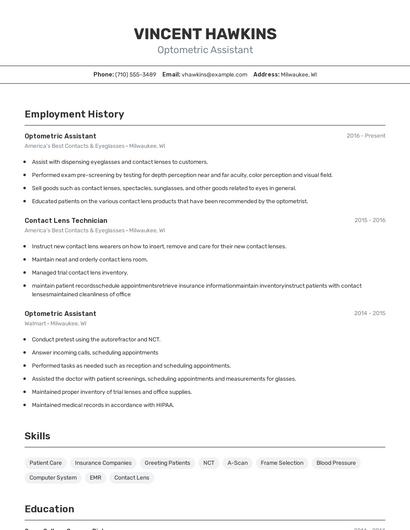
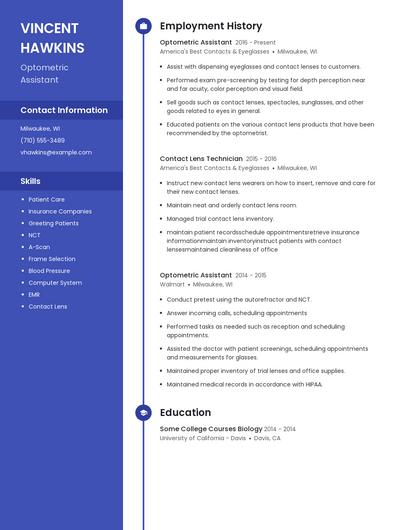
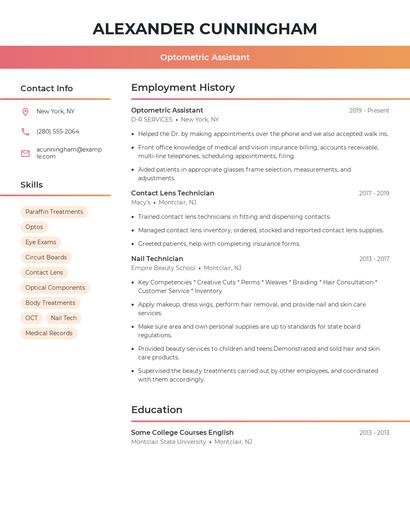
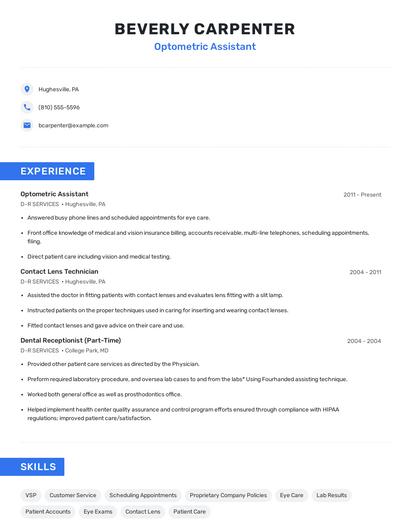
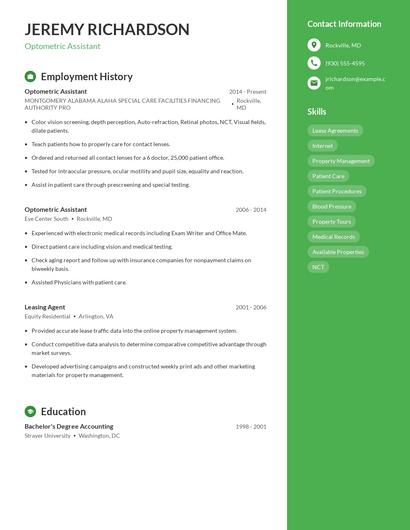
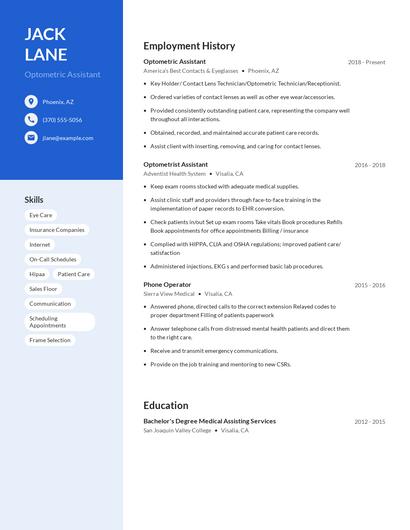
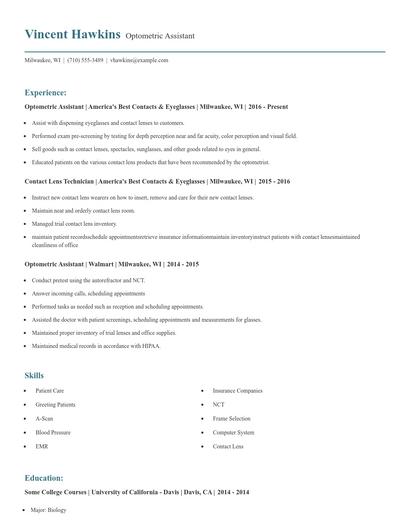
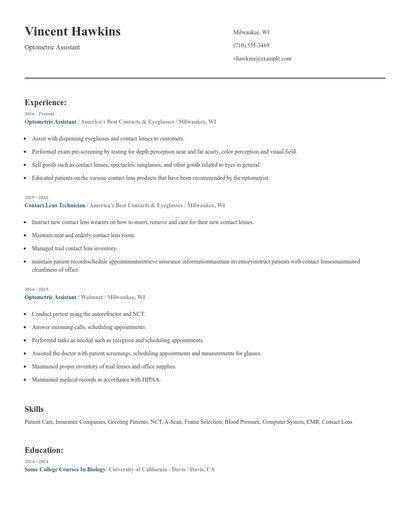
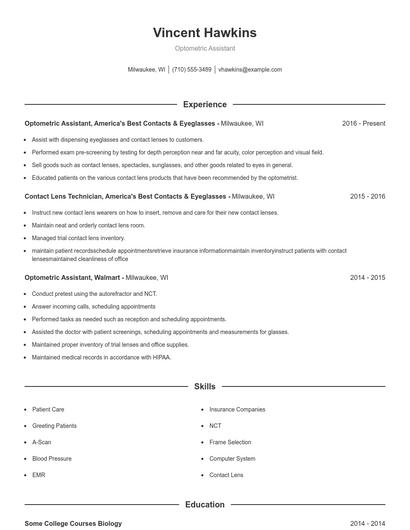
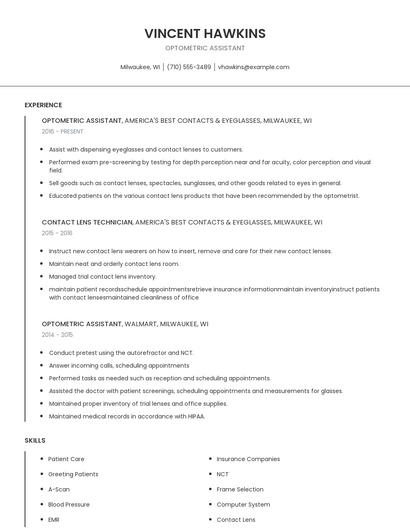
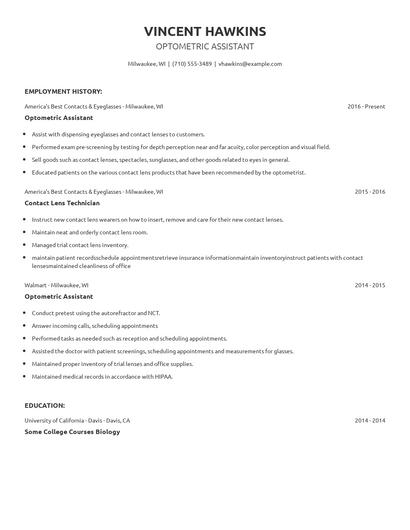
Choose from 10+ customizable optometric assistant resume templates
Build a professional optometric assistant resume in minutes. Our AI resume writing assistant will guide you through every step of the process, and you can choose from 10+ resume templates to create your optometric assistant resume.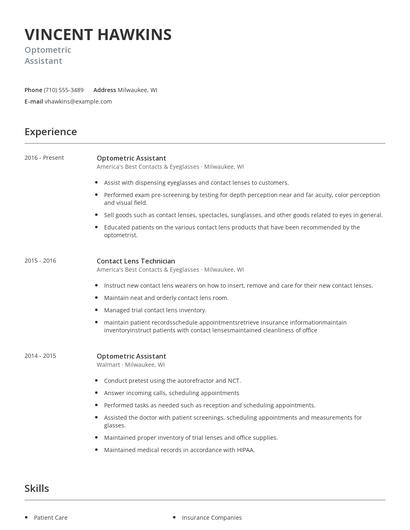
Compare different optometric assistants
Optometric assistant vs. Optical technician
Optical lab technicians, also known as ophthalmic laboratory technicians, create prescription eyeglasses and contact lenses. They work together with optometrists, opticians, and ophthalmologists. They received orders from optometrists and opticians to create prescription eyeglasses or contact lenses as per requirement. They also do the cutting, polishing, and grinding lenses as per prescription for products like microscopes, binoculars, or telescopes. They do their work by a computer program and automated tools to make the prescribed lenses before it is sent off to the customer.
While similarities exist, there are also some differences between optometric assistants and optical technician. For instance, optometric assistant responsibilities require skills such as "appointment scheduling," "vision examination," "exam rooms," and "auto refraction." Whereas a optical technician is skilled in "chrome," "dexterity," "manual dexterity," and "cnc." This is part of what separates the two careers.
Optical technicians tend to make the most money working in the technology industry, where they earn an average salary of $47,206. In contrast, optometric assistants make the biggest average salary, $82,759, in the manufacturing industry.On average, optical technicians reach similar levels of education than optometric assistants. Optical technicians are 0.3% more likely to earn a Master's Degree and 1.1% less likely to graduate with a Doctoral Degree.Optometric assistant vs. Medical assistant/phlebotomist
Medical assistants/phlebotomists are medical personnel who execute administrative and clinical tasks in healthcare facilities or units. They are responsible for providing healthcare to patients such as immunization administration, orthopedic supplies, and wound care. It is part of their job to take the blood of patients for blood testing. They also take charge of handling other medical tests for the upkeep of patients' health. These professionals should exhibit compatibility, initiative, and cohesiveness within the team.
Each career also uses different skills, according to real optometric assistant resumes. While optometric assistant responsibilities can utilize skills like "visual acuity," "visual fields," "vision examination," and "r," medical assistant/phlebotomists use skills like "office procedures," "venipuncture," "strong customer service," and "phlebotomy procedures."
Medical assistant/phlebotomists may earn a lower salary than optometric assistants, but medical assistant/phlebotomists earn the most pay in the finance industry with an average salary of $35,745. On the other hand, optometric assistants receive higher pay in the manufacturing industry, where they earn an average salary of $82,759.Average education levels between the two professions vary. Medical assistant/phlebotomists tend to reach similar levels of education than optometric assistants. In fact, they're 0.2% more likely to graduate with a Master's Degree and 1.1% less likely to earn a Doctoral Degree.Optometric assistant vs. Clinical medical assistant
A clinical medical assistant specializes in performing administrative and clinical tasks in a hospital or similar setting. Their responsibilities revolve around gathering a patient's information, medical history, test results, and other essential documentation, and updating patient medical records. Other tasks include reaching out to patients' families and guardians, assisting health workers with room preparation and patient care, and preparing medications and other treatments, all in adherence to a physician's directives. Furthermore, a clinical medical assistant may conduct inspections to ensure that the hospital complies with government regulations.
Some important key differences between the two careers include a few of the skills necessary to fulfill the responsibilities of each. Some examples from optometric assistant resumes include skills like "visual acuity," "visual fields," "vision examination," and "r," whereas a clinical medical assistant is more likely to list skills in "cpr," "medical assistants," "phlebotomy," and "ekg. "
Clinical medical assistants earn the best pay in the health care industry, where they command an average salary of $35,264. Optometric assistants earn the highest pay from the manufacturing industry, with an average salary of $82,759.When it comes to education, clinical medical assistants tend to earn similar degree levels compared to optometric assistants. In fact, they're 0.6% more likely to earn a Master's Degree, and 0.2% more likely to graduate with a Doctoral Degree.Optometric assistant vs. Student medical assistant-externship
Student Medical Assistant Externship is a broad term for catering students for short, reliable, and practical work experience. Once you graduate, you can get a chance to meet contacts that may be useful for your career. You can have a better chance to work in a clinic, hospital, and any medical platform after going through this kind of externship.
Even though a few skill sets overlap between optometric assistants and student medical assistant-externships, there are some differences that are important to note. For one, an optometric assistant might have more use for skills like "customer service," "patient care," "visual acuity," and "visual fields." Meanwhile, some responsibilities of student medical assistant-externships require skills like "ekg," "cpr," "data entry," and "surgery. "
In general, student medical assistant-externships hold similar degree levels compared to optometric assistants. Student medical assistant-externships are 3.2% more likely to earn their Master's Degree and 0.1% more likely to graduate with a Doctoral Degree.Types of optometric assistant
Updated January 8, 2025
