
Automatically apply for jobs with Zippia
Upload your resume to get started.
Parent educator skills for your resume and career

15 parent educator skills for your resume and career
1. Child Development
- Facilitated parenting education classes for a nonprofit organization in child development and effective parenting strategies to over 500 parents and caregivers.
- Developed family partnership agreements by conducting developmental assessments and provided information on child development and related areas for each family.
3. Community Resources
Community resources are a set of resources that are used in the day to day life of people which improves their lifestyle in some way. People, sites or houses, and population assistance can come under the services offered by community resources.
- Develop with parent input, an individualized family service plan and offers referral to community resources as appropriate.
- Prepared and distributed monthly parent newsletter with information of early childhood education and community resources.
4. Mental Health
Mental health is the state of wellbeing in which an individual can cope with the regular stresses and tensions of life, and can work productively without having any emotional or psychological breakdown. Mental health is essential for a person of any age and helps them make the right decisions in their life.
- Provide family support follow-up, Developmental follow-up, referral to community services, Mental Health referrals.
- Consult with mental health provider when needed to support mental health needs of parent(s) or children.
5. Family Support
Family support refers to assistance provided or offered to a family with a child, adult, or elderly person living in their home with a disability. However, family support may also be offered to families experiencing domestic issues, such as abusive parents or poor living conditions. Individual family support plans may be developed in order to help a family better understand how to reach a healthy family status.
- Supervised Family Support staff for a Metro Atlanta early education agency.
- Collaborate with Family Support Specialist in case management screenings and staffing.
6. Child Abuse
When a child who is under 18 is mistreated by an adult, it is considered child abuse. There are many forms of intentional harm and mistreatment for example physical abuse, sexual abuse, emotional abuse, medical abuse, and neglect in providing adequate basic life necessities.
- Mandated child abuse reporting as necessary.
- Provided classes in the identification of child abuse identification and reporting to DODDS to support child and spouse abuse prevention.
Choose from 10+ customizable parent educator resume templates
Build a professional parent educator resume in minutes. Our AI resume writing assistant will guide you through every step of the process, and you can choose from 10+ resume templates to create your parent educator resume.7. Kindergarten
Kindergarten is an early form of education that begins when a child is about five years old. During kindergarten, children learn the basic elements of reading, writing, and mathematics in addition to colors, telling time, sharing, and similar principles. Kindergarten classes are typically overseen by a single teacher who lectures on all of the subjects listed.
- Provided parents and caregiver with research-based information and support from pregnancy through Kindergarten and implemented effective parenting support programs.
- Provided parent education through regular home/personal visits implementing the Parents as Teachers prenatal to kindergarten curriculum.
8. Children Birth
- Facilitated a weekly playgroup for community members with children birth-five.
- Conducted developmental assessments on children birth-age five.
9. Community Agencies
Community agencies stand for the organizations operated to provide human service in the community.
- Demonstrated the ability to collaborate with multiple community agencies, participated in the case staffing assignments with Department of Family Services.
- Participated in recruitment and community awareness events to facilitate referral of families from appropriate community agencies for participation in the program.
10. CPR
Cardiopulmonary resuscitation or CPR is a medical procedure that involves chest compression to help a patient breathe. This artificial ventilation helps in keeping the brain function in place and regulates blood throughout the body. CPR is a lifesaving procedure that is used in emergencies.
- Certified to teach Lamaze, Infant Massage, Infant and Adult CPR, Baby Care Basics.
- Developed courses, and provided training for infant CPR and newborn care for expectant parents.
12. Support Services
Support services are services that support the organization internally and are usually non-revenue generating. Examples include, IT, admin, HR, etc.
- Provided education and support services to teen mothers and fathers with children between the ages of conception to three years old.
- Performed needs assessments on birth parents in order to determine clinical and support services needed to help with reunification process.
13. Parent-Child Interaction
- Plan and facilitate monthly parent group connection meetings with a focus on parent-child interaction, development-centered parenting, or family well-being.
- Provide monthly personal visits to families and group connections focused on parent-child interaction, development-centered parenting, and family well-being.
14. Community Outreach
- Participated in both clinical and community outreach activities to identify families at risk on monthly basis.
- Led community outreach initiatives, identified/supported special projects, and optimized learning resources and student opportunities.
15. Early Intervention
- Promote early identification of hearing loss and awareness of early intervention programs.
- Flagged any developmental delays for early intervention.
5 Parent Educator resume examples
Build a professional parent educator resume in minutes. Browse through our resume examples to identify the best way to word your resume. Then choose from 5+ resume templates to create your parent educator resume.

What skills help Parent Educators find jobs?
Tell us what job you are looking for, we’ll show you what skills employers want.
What skills stand out on parent educator resumes?
Thomas Matula Ph.D.
Professor of Business Administration, Business Specialist
What soft skills should all parent educators possess?
Jo Ann Donnenwirth
Dean of Nursing, Aultman College
What parent educator skills would you recommend for someone trying to advance their career?
Dr. Stephen Graves Ph.D
Director of Undergraduate Studies, Assistant Professor, University of Missouri
What type of skills will young parent educators need?
Rachel Goldberg Ph.D.
Associate Professor, Director of the Peace and Conflict Studies program, DePauw University
What hard/technical skills are most important for parent educators?
Andrew Sobel Ph.D.
Director and Professor of Global Studies, Washington University in St. Louis
Our grads land in a wide variety of settings such as grad school, many head to policy-oriented jobs in DC or in NGOs here and abroad, consultancies, corporate positions, etc.
List of parent educator skills to add to your resume
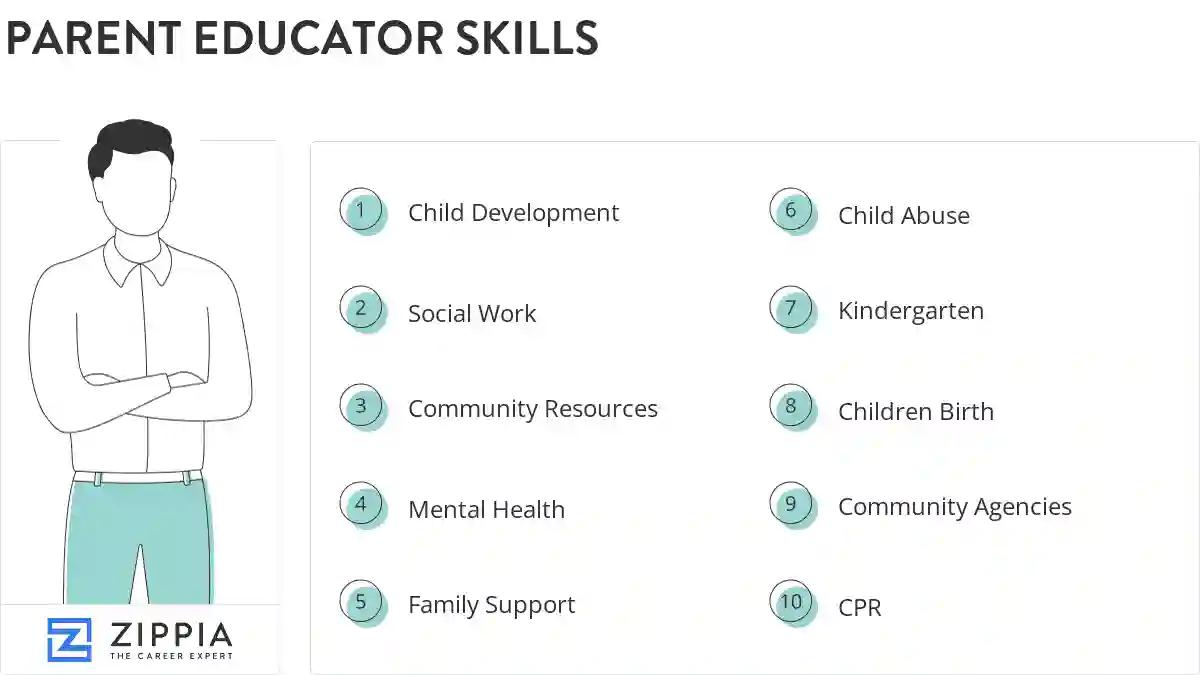
The most important skills for a parent educator resume and required skills for a parent educator to have include:
- Child Development
- Social Work
- Community Resources
- Mental Health
- Family Support
- Child Abuse
- Kindergarten
- Children Birth
- Community Agencies
- CPR
- Social Services
- Support Services
- Parent-Child Interaction
- Community Outreach
- Early Intervention
- Crisis Intervention
- Developmental Screenings
- Early Childhood Development
- Group Connections
- Emotional Support
- Community Events
- Child Care
- Developmental Delays
- Community Services
- Parent Support
- Substance Abuse
- Income Families
- First Aid Training
- at-Risk
- Domestic Violence
- Health Issues
- Parent Involvement
- CPS
- Child Protective
- Early Development
- Health Screenings
- Asq-Se
- Anger Management
- IEP
- Community Organizations
- Family Assessments
- Discipline Techniques
- IFSP
- DCF
- Developmental Milestones
- DHS
- Educational Services
- Local Agencies
Updated January 8, 2025

2. Social Work