What does a payroll analyst do?

A payroll analyst is primarily in charge of overseeing a company's payroll processes and transactions, ensuring efficiency and timeliness. Their responsibilities typically revolve around coordinating with human resources for accurate and complete timesheets and employee data, managing calendars and schedules, calculating wages and deductions, and performing consistent audits. There are also instances when a payroll analyst must perform clerical tasks such as processing documents, prepare progress reports, and respond to employee inquiries. Furthermore, it is essential to report to managers should there be any issues and concerns.
Payroll analyst responsibilities
Here are examples of responsibilities from real payroll analyst resumes:
- Manage all activities relate to base pay, overtime, PTO, garnishments and payroll tax.
- Perform monthly accounting functions including journal entries, general ledger account reconciliations, benefit and salary accruals, and headcount reconciliations.
- Create PowerPoint slides to train new timekeepers and managers in KRONOS.
- Lead functional tester in support of timekeeping, payroll and labor upgrades and conversion projects.
- Support the third-party web applications like KRONOS and custom-built time entry systems to input the time data
- Enter new hires, terminations, and employee maintenance changes into HRIS & ADP including process employee benefit elections.
- Develop a streamline process for entering and approving personnel time off (PTO) for salary and hourly employees.
- Coordinate internal SOX auditing and verification of all paperwork process.
- Provide clarification of policies and ensure adherence of policies regarding timekeeping and payroll.
- Redesign business processes and respond to internal audit to assist with SOX implementation.
- Consolidate Richmond and San Francisco operations in PeopleSoft, including testing of interfaces.
- Improve department productivity by successfully transitioning the retroactive calculation process from a manual to automate process
- Develop moderately complex PeopleSoft enhancements/issues resolution and reporting (to include SQL data sources).
- Work closely with management on projects including professional employer licensing, notices, accrual account reconciliations and amending previous returns.
- Collaborate with various vendors to work on projects regarding executive deferral and retirement elections and calculations.
Payroll analyst skills and personality traits
We calculated that 11% of Payroll Analysts are proficient in Customer Service, Payroll System, and Payroll Data. They’re also known for soft skills such as Communication skills, Math skills, and Organizational skills.
We break down the percentage of Payroll Analysts that have these skills listed on their resume here:
- Customer Service, 11%
Provide customer service to associates by offering individuals information on payments, researching payroll discrepancies and providing manual payments as needed.
- Payroll System, 6%
Prepared Workers' Compensation payments for entry into Integral payroll system and prepared and entered statistical reports for bi-weekly payroll.
- Payroll Data, 4%
Maintain payroll information by collecting, calculating and entering payroll data for assigned corporate payroll.
- Human Resources, 4%
Maintained internal relationship with Human Resources department, including mutual process dependencies, information sharing and internal controls.
- Reconciliations, 4%
Performed monthly accounting functions including journal entries, general ledger account reconciliations, benefit and salary accruals, and headcount reconciliations.
- Data Entry, 3%
Performed data entry for voluntary and mandatory payroll deductions.
Common skills that a payroll analyst uses to do their job include "customer service," "payroll system," and "payroll data." You can find details on the most important payroll analyst responsibilities below.
Communication skills. One of the key soft skills for a payroll analyst to have is communication skills. You can see how this relates to what payroll analysts do because "financial clerks should be able to explain policies and procedures to colleagues and customers." Additionally, a payroll analyst resume shows how payroll analysts use communication skills: "created documentation of communications to employees for annual benefits enrollment packages through excel file exports from hr and payroll systems. "
Math skills. Another essential skill to perform payroll analyst duties is math skills. Payroll analysts responsibilities require that "the job duties of financial clerks includes calculating charges and updating financial records." Payroll analysts also use math skills in their role according to a real resume snippet: "utilize mathematical and analytical skills daily * computer system data entry and case management, ten key data entry. "
Organizational skills. Another skill that relates to the job responsibilities of payroll analysts is organizational skills. This skill is critical to many everyday payroll analyst duties, as "financial clerks must be able to arrange files so they can find them quickly and efficiently." This example from a resume shows how this skill is used: "maintained corporate department table and organizational structure including the creation, updates and restructuring within peoplesoft. "
The three companies that hire the most payroll analysts are:
- Randstad North America, Inc.56 payroll analysts jobs
- Robert Half15 payroll analysts jobs
- Nike14 payroll analysts jobs
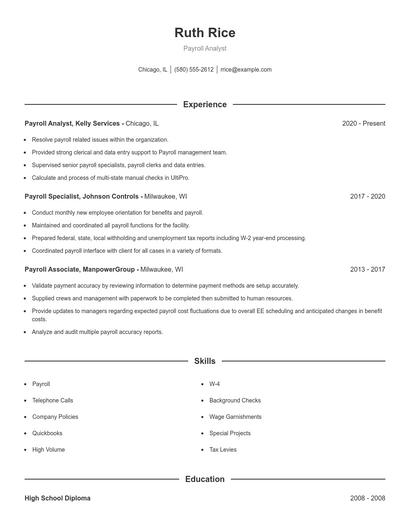
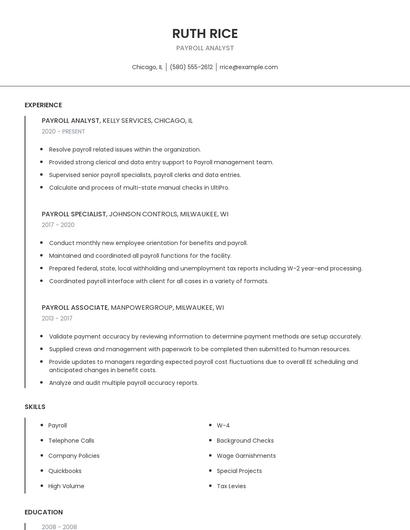
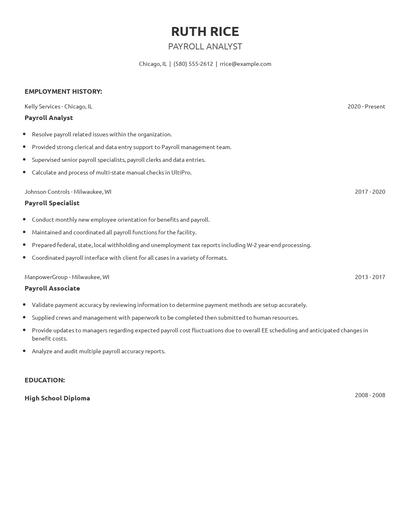
Choose from 10+ customizable payroll analyst resume templates
Build a professional payroll analyst resume in minutes. Our AI resume writing assistant will guide you through every step of the process, and you can choose from 10+ resume templates to create your payroll analyst resume.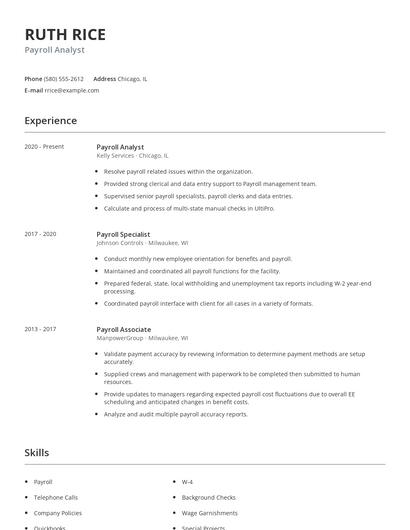


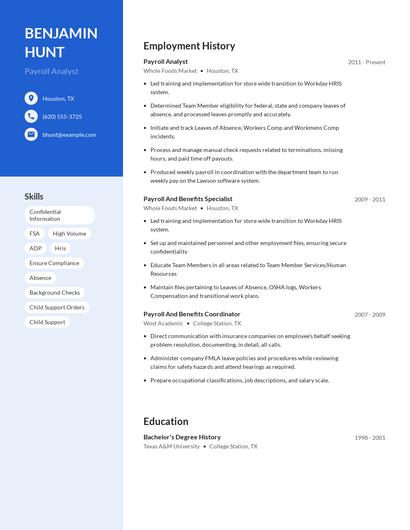
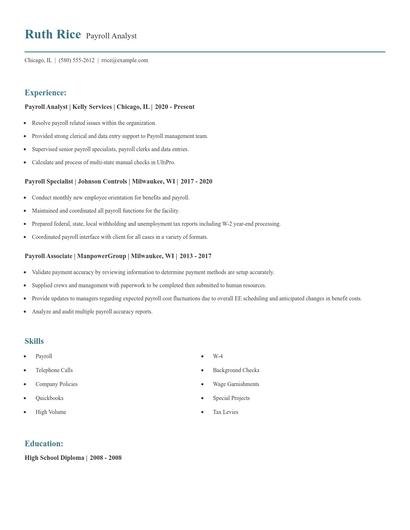
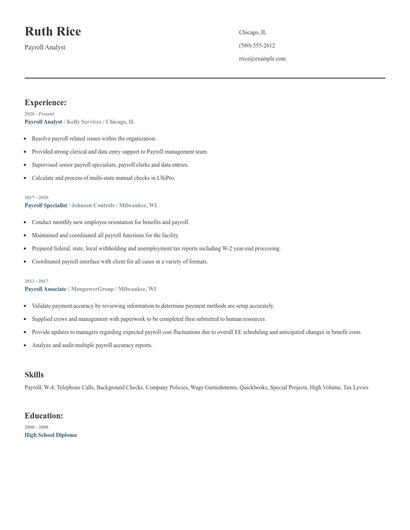
Compare different payroll analysts
Payroll analyst vs. Benefits clerk
A Timekeeper works in various industries and organizations and is typically hired as the acting liaison between payroll coordinators and employees. This is to make sure the pay distribution process runs smoothly. As a timekeeper, you will be required to maintain an accurate track of the total number of hours worked for payroll purposes. This involves compiling payroll data from timesheets, computing wages, including the removal of taxes and social security withholding, and putting it into the computer system.
There are some key differences in the responsibilities of each position. For example, payroll analyst responsibilities require skills like "customer service," "payroll data," "reconciliations," and "calculation." Meanwhile a typical benefits clerk has skills in areas such as "open enrollment," "life insurance," "health insurance," and "workers compensation." This difference in skills reveals the differences in what each career does.
Benefits clerks tend to make the most money working in the government industry, where they earn an average salary of $40,253. In contrast, payroll analysts make the biggest average salary, $57,169, in the technology industry.benefits clerks tend to reach similar levels of education than payroll analysts. In fact, benefits clerks are 2.3% less likely to graduate with a Master's Degree and 0.3% more likely to have a Doctoral Degree.Payroll analyst vs. Timekeeper
The main duty of a Payroll & Human Resources Assistant is to provide payroll information through collecting time and attendance records. They also answer questions regarding examinations, eligibility, salaries, benefits, and other important information.
While some skills are similar in these professions, other skills aren't so similar. For example, resumes show us that payroll analyst responsibilities requires skills like "customer service," "reconciliations," "calculation," and "hris." But a timekeeper might use other skills in their typical duties, such as, "per diem," "turnaround," "purchase orders," and "office equipment."
Timekeepers earn lower levels of education than payroll analysts in general. They're 5.5% less likely to graduate with a Master's Degree and 0.3% less likely to earn a Doctoral Degree.Payroll analyst vs. Payroll & human resources assistant
Some important key differences between the two careers include a few of the skills necessary to fulfill the responsibilities of each. Some examples from payroll analyst resumes include skills like "customer service," "human resources," "reconciliations," and "calculation," whereas a payroll & human resources assistant is more likely to list skills in "assist human resources," "background checks," "adp payroll," and "payroll processing. "
Payroll & human resources assistants earn the highest salary when working in the manufacturing industry, where they receive an average salary of $45,905. Comparatively, payroll analysts have the highest earning potential in the technology industry, with an average salary of $57,169.When it comes to education, payroll & human resources assistants tend to earn similar degree levels compared to payroll analysts. In fact, they're 3.7% less likely to earn a Master's Degree, and 0.3% less likely to graduate with a Doctoral Degree.Payroll analyst vs. Payroll bookkeeper
Types of payroll analyst
Updated January 8, 2025
