What does a payroll supervisor do?

A payroll supervisor ensures employee salaries are released in a timely manner and accounts for all payrolls and cash released by the company. The payroll supervisor organizes all financial transactions and generates reports for accounting. This position ensures employees are paid accurately and calculates all deductibles such as insurance, child support, taxes, and payroll adjustments. The payroll supervisor must have accounting and bookkeeping skills and has pertinent experience in relevant fields of study.
Payroll supervisor responsibilities
Here are examples of responsibilities from real payroll supervisor resumes:
- Manage the administration and processing of KRONOS time reporting system.
- Manage installation of automate timekeeping systems in facilities, ensuring accurate, timely processing of time and attendance information.
- Act as the HRIS backup running queries and reports as scheduled and upon request via PeopleSoft for management and key stakeholders.
- Create journal entries and account reconciliations for key benefit programs and maintain account reconciliations of liability accounts.
- Assist in implementing new PTO plan, work with ADP to interface system.
- Check all new hire information, ensuring accuracy of information complete in KRONOS system.
- Maintain PTO balances, accrual, absence transactions and prepare PTO liability report at month-end.
- Provide guidance that demonstrates an understanding of payroll compliance and taxation as it relates to the company.
- Perform daily file maintenance ensuring all employee files and records including pay rates are accurate with in-house HRIS.
- Ensure compliance with all federal, state and local laws governing the taxation of wage and hours laws.
- Lead payroll role on implementation of PeopleSoft e-Pay/e-Profile.
- Prepare various month-end payroll accruals and reconcile payroll relate accounts.
- Direct department conversion to the PeopleSoft Payroll/HRIS software package and implement numerous system upgrades.
- Facilitate conversion of payroll and timekeeping systems to support management initiatives with no adverse impact on service to employees.
- Manage installation of automate timekeeping systems in facilities, ensuring accurate, timely processing of time and attendance information.
Payroll supervisor skills and personality traits
We calculated that 9% of Payroll Supervisors are proficient in Customer Service, Payroll System, and Payroll Tax. They’re also known for soft skills such as Communication skills, Math skills, and Organizational skills.
We break down the percentage of Payroll Supervisors that have these skills listed on their resume here:
- Customer Service, 9%
Provide excellent customer service to all departments, establishing increased trust and communication between payroll and other departments.
- Payroll System, 6%
Evaluated internal workings of the department; digest and diversify the payroll system making recommendations for improvements in efficiency.
- Payroll Tax, 5%
Supervised seven payroll coordinators responsible for payroll tax deposits and reporting, wage attachments and G/L payroll account reconciliation.
- Reconciliations, 5%
Created journal entries and account reconciliations for key benefit programs and maintained account reconciliations of liability accounts.
- Human Resources, 4%
Scheduled, prioritized and directed activities for posting of payroll information into Human Resources System.
- Process Payroll, 4%
Process payroll for U.S. and Canada for approximately 400 employees ensuring a high level of accuracy and timely payment of wages.
Common skills that a payroll supervisor uses to do their job include "customer service," "payroll system," and "payroll tax." You can find details on the most important payroll supervisor responsibilities below.
Communication skills. To carry out their duties, the most important skill for a payroll supervisor to have is communication skills. Their role and responsibilities require that "financial clerks should be able to explain policies and procedures to colleagues and customers." Payroll supervisors often use communication skills in their day-to-day job, as shown by this real resume: "established effective communication on payroll issues, within the corestates network. "
Math skills. Another essential skill to perform payroll supervisor duties is math skills. Payroll supervisors responsibilities require that "the job duties of financial clerks includes calculating charges and updating financial records." Payroll supervisors also use math skills in their role according to a real resume snippet: "maintained pto accruals and usage statistics. "
Organizational skills. payroll supervisors are also known for organizational skills, which are critical to their duties. You can see how this skill relates to payroll supervisor responsibilities, because "financial clerks must be able to arrange files so they can find them quickly and efficiently." A payroll supervisor resume example shows how organizational skills is used in the workplace: "developed process improvements, policy changes, strategic plans, budgets, resource plans, forecasts and organizational goals. "
The three companies that hire the most payroll supervisors are:
- Robert Half22 payroll supervisors jobs
- Paychex13 payroll supervisors jobs
- ABM Industries3 payroll supervisors jobs
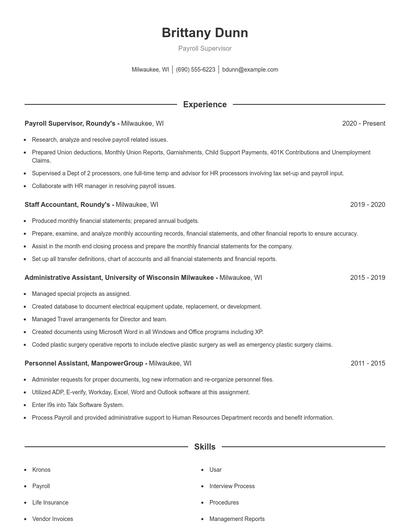
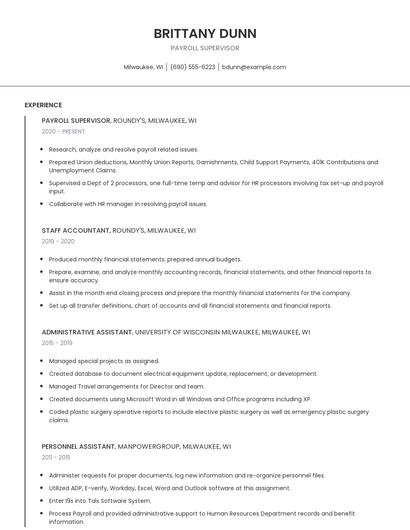
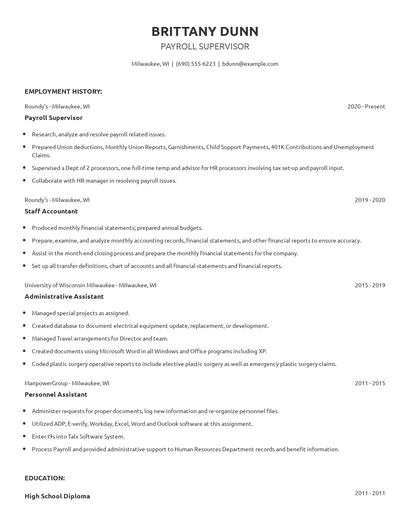
Choose from 10+ customizable payroll supervisor resume templates
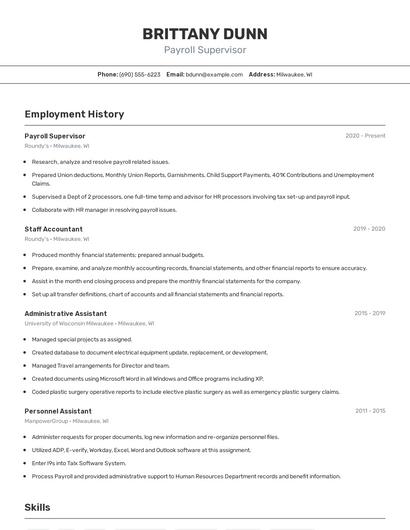
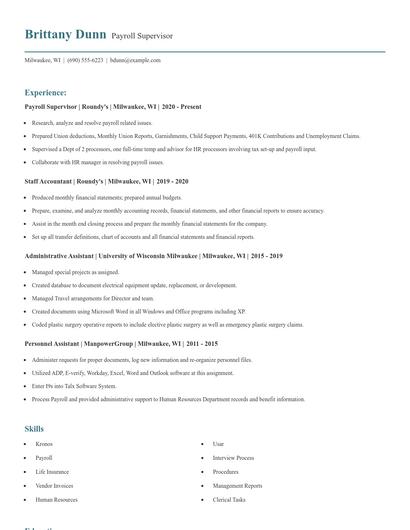
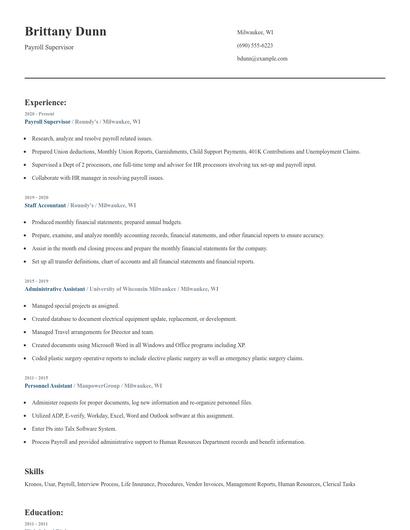
Build a professional payroll supervisor resume in minutes. Our AI resume writing assistant will guide you through every step of the process, and you can choose from 10+ resume templates to create your payroll supervisor resume.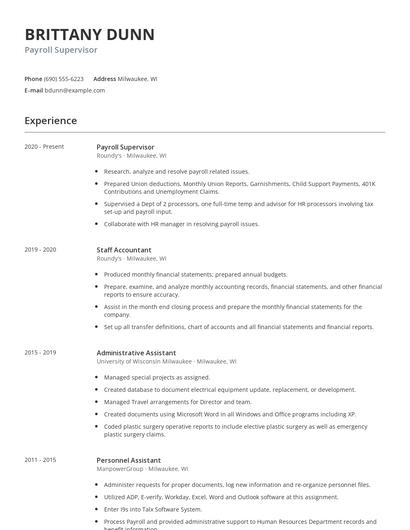


Compare different payroll supervisors
Payroll supervisor vs. Benefits clerk
A Timekeeper works in various industries and organizations and is typically hired as the acting liaison between payroll coordinators and employees. This is to make sure the pay distribution process runs smoothly. As a timekeeper, you will be required to maintain an accurate track of the total number of hours worked for payroll purposes. This involves compiling payroll data from timesheets, computing wages, including the removal of taxes and social security withholding, and putting it into the computer system.
There are some key differences in the responsibilities of each position. For example, payroll supervisor responsibilities require skills like "customer service," "payroll tax," "reconciliations," and "multi-state payroll." Meanwhile a typical benefits clerk has skills in areas such as "open enrollment," "life insurance," "health insurance," and "workers compensation." This difference in skills reveals the differences in what each career does.
Benefits clerks earn the highest salaries when working in the government industry, with an average yearly salary of $40,253. On the other hand, payroll supervisors are paid more in the technology industry with an average salary of $67,684.The education levels that benefits clerks earn slightly differ from payroll supervisors. In particular, benefits clerks are 0.0% less likely to graduate with a Master's Degree than a payroll supervisor. Additionally, they're 0.6% more likely to earn a Doctoral Degree.Payroll supervisor vs. Timekeeper
Each career also uses different skills, according to real payroll supervisor resumes. While payroll supervisor responsibilities can utilize skills like "customer service," "payroll tax," "reconciliations," and "process payroll," timekeepers use skills like "per diem," "turnaround," "purchase orders," and "office equipment."
In general, timekeepers achieve similar levels of education than payroll supervisors. They're 3.3% less likely to obtain a Master's Degree while being 0.6% less likely to earn a Doctoral Degree.Payroll supervisor vs. Commission clerk
The required skills of the two careers differ considerably. For example, payroll supervisors are more likely to have skills like "customer service," "payroll system," "payroll tax," and "reconciliations." But a commission clerk is more likely to have skills like "planning commission," "legal notices," "commission payments," and "word processing."
Commission clerks typically earn similar educational levels compared to payroll supervisors. Specifically, they're 2.4% less likely to graduate with a Master's Degree, and 2.3% less likely to earn a Doctoral Degree.Payroll supervisor vs. Paymaster
Types of payroll supervisor
Updated January 8, 2025
