
Automatically apply for jobs with Zippia
Upload your resume to get started.
Performance test engineer skills for your resume and career
15 performance test engineer skills for your resume and career
1. Java
Java is a widely-known programming language that was invented in 1995 and is owned by Oracle. It is a server-side language that was created to let app developers "write once, run anywhere". It is easy and simple to learn and use and is powerful, fast, and secure. This object-oriented programming language lets the code be reused that automatically lowers the development cost. Java is specially used for android apps, web and application servers, games, database connections, etc. This programming language is closely related to C++ making it easier for the users to switch between the two.
- Analyzed Application CPU Usage, Heap Memory, GC activity, threads, using Visual VM Java profiling tool.
- Create Load Test for the Profile Web Service and Database application across multiple high-profile projects in Java Implementation.
2. Test Results
- Worked with technical stakeholders to interpret basic test results while identifying bottlenecks and advise on potential system backlogs.
- Analyzed test results, reported findings to clients, and provided recommendation for performance improvements and capacity requirements.
3. JMeter
- Developed Continues Data driven testing using CSV file/Counter service using JMeter.
- Performed Test Data Management/Automation and Data Driven Testing with JMeter.
4. C++
C++ is a general-purpose programming language that is used to create high-performing applications. It was invented as an extension to the C language. C++ lets the programmer have a high level of domination over memory and system resources. C++ is an object-oriented language that helps you implement real-time issues based on different data functions
- Recorded and coded scripts using C++ to prepare for automated testing of Nextel's web based applications for various releases.
- Develop mathematical simulations of casino games using C++ in order to perform mathematical analysis to determine jurisdictional compliance of software.
5. C #
- Developed test code for RF Ciber-Tech driver using the C #.NET and executing the test performance.
- Developed several utility functions in C # language for optimizing and enhancing VSTS scripts.
6. Test Cases
- Generated Test Cases for each specification in Requirement Specification Document corresponding to each module.
- Developed and executed Test Cases covering several scenarios, including Positive/Negative scenarios.
Choose from 10+ customizable performance test engineer resume templates
Build a professional performance test engineer resume in minutes. Our AI resume writing assistant will guide you through every step of the process, and you can choose from 10+ resume templates to create your performance test engineer resume.7. Test Data
- Verified capacity model with test data and develop and document performance related metrics.
- Maintained an exclusive Load Test Database instance dedicated to Load Testing activity.
8. QA
QA, or Quality Assurance is a procedure that entails all of the steps taken to avoid any errors in the manufacturing process or in the production of the goods that a company produces. It can also include ensuring the consistency of the services rendered. Quality assurance ensures that the quality of the service delivered to consumers meets or exceeds the promised expectations. This greatly aids in the prevention of any complications that might arise after the goods or services have been distributed. It makes sure that customers are satisfied.
- Developed QA criteria and performed testing to verify the website security features like Identity management and internet transaction security.
- Participated in application technical design process, involved in QA environment setup and application build process.
9. Linux
Linux is a Unix-like operating system. Just like Windows, Mac OS, and IOS, Linux is an operating system used by millions across the globe. Android itself is powered by the Linux operating system. Linux manages all the hardware resources that are associated with your computer. The software is famous because of the protection it grants from viruses, malware, and crashes. The Linux operating system is entirely free and is an open-source software meaning it can be altered by those equipped with the knowledge to code.
- Collected, analyzed and presented data using Linux Shell, AWK, Perl and MS Excel tools.
- Installed and configured foreman with puppet for auto-provisioning the Linux machines in AWS and VMware environments.
10. Web Services
A web service is software that is available on the internet and uses a specific messaging system. A web service is a kind of service that is not bound to any specific programming language or operating system. Web services help every device to communicate over the world wide web.
- Web services analysis for dependency details.
- Created scripts using web services protocol to test the web services deployed, in Service oriented architecture (SOA) testing.
11. Dynatrace
- Configured DynaTrace for performance monitoring and performed trouble shooting on Bottlenecks with performance testing along with response times and its analysis.
- Installed and configured application through DynaTrace Profiling tool.
12. Jenkins
Jenkins is an open source automation server that is free to use. It aids continuous deployment and execution by automating the aspects of product creation related to building, analyzing, and deploying. It is a system based on the server that runs in servlet containers like Apache Tomcat. Jenkins is a Java-based fully accessible automation platform with plugins designed for Continuous Integration.
- Worked on distributed test automation execution on different environment as part of Continuous Integration Process using Selenium Grid and Jenkins.
- Worked on distributed test automation execution on different environment as part of Continuous Integration Process using Selenium Grid and Jenkins.
13. Load Test
- Identified and recorded the necessary server monitors during performance/load testing, analyzed baseline reports and made recommendations for environment performance tuning.
- Created controller scenario and executed load test to verify application expected load handling capacity.
14. Performance Issues
The failure to meet the basic requirements of a job is called a performance issue. These issues are measured based on policies company culture and job objectives. Performance issues can broadly fall into either one or more categories quantity of work, quality of work, inappropriate behavior, and resistance to change.
- Monitor application health, diagnose performance issues and identify application performance bottlenecks.
- Analyze and correlate system statistics to identify bottlenecks and performance issues.
15. Test Execution
- Designed scenarios for test execution to ensure performance meets or exceeds previous performance benchmarks using LoadRunner.
- Automated LTE UDP/TCP throughput testing under various fading and AWGN conditions, increasing the test execution rate by 200%.
5 Performance Test Engineer resume examples
Build a professional performance test engineer resume in minutes. Browse through our resume examples to identify the best way to word your resume. Then choose from 5+ resume templates to create your performance test engineer resume.

What skills help Performance Test Engineers find jobs?
Tell us what job you are looking for, we’ll show you what skills employers want.
List of performance test engineer skills to add to your resume
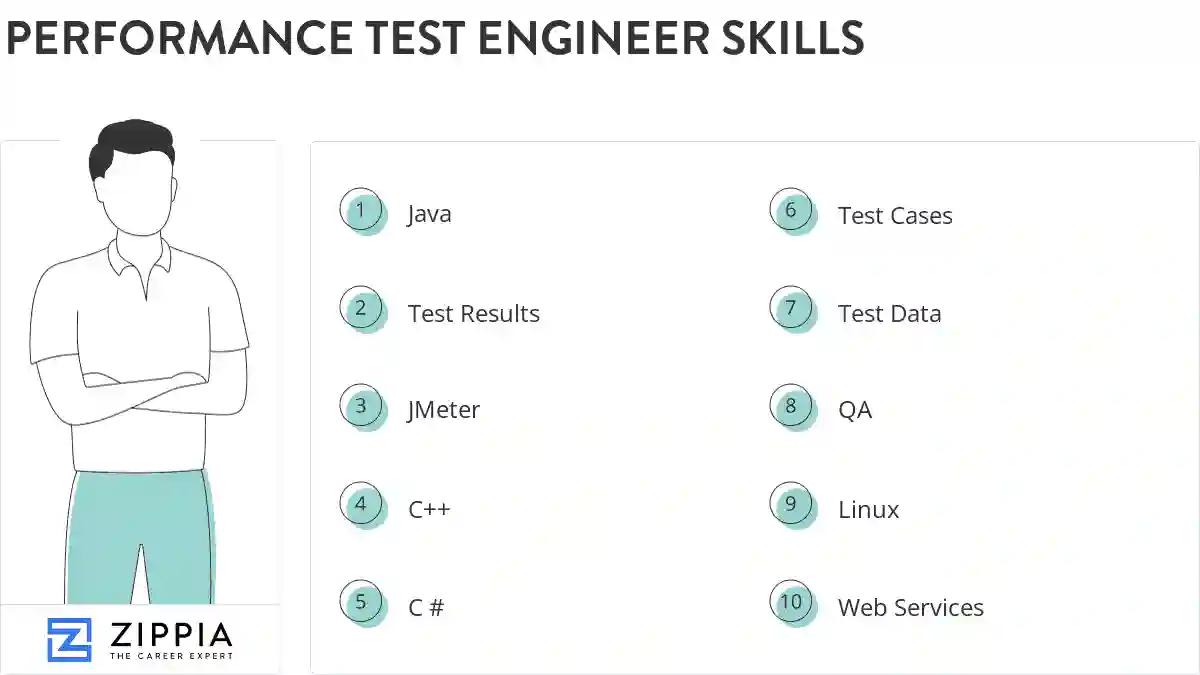
The most important skills for a performance test engineer resume and required skills for a performance test engineer to have include:
- Java
- Test Results
- JMeter
- C++
- C #
- Test Cases
- Test Data
- QA
- Linux
- Web Services
- Dynatrace
- Jenkins
- Load Test
- Performance Issues
- Test Execution
- Test Strategy
- Application Performance
- Jira
- Profiling
- Performance Metrics
- Unix
- Performance Test Scenarios
- XML
- CPU
- Performance Test Scripts
- Test Environment
- Performance Test Plan
- Ruby
- ALM
- Debugging
- Ajax
- Test Reports
- Regression
- Performance Bottlenecks
- UI
- Endurance
- Http
- HTML
- SQL Server
- Fiddler
- SoapUI
- Azure
- Virtualization
- J2EE
- Macro
- JVM
- Citrix
- DB
- PL/SQL
Updated January 8, 2025
