What does a performance test engineer do?
A performance test engineer is responsible for conducting performance testing to ensure system capacity, reliability, and scalability. Typical duties that you will perform include working closely with the testing team in developing performance test cases and plans, analyzing test results, and handling bug fixes in collaboration with development teams. Additionally, you will be responsible for evaluating the root causes of performance problems and resolve them. You will also be responsible for developing automated test scenarios for performance testing.
Performance test engineer responsibilities
Here are examples of responsibilities from real performance test engineer resumes:
- Used rundeck and Jenkins to automate the task, creating load for the test.
- Analyze and profile performance issues with Dynatrace.
- Used Dynatrace, JProbe tools for profiling the application to find out where the performance issue.
- Monitor memory stacks, CPU utilization on AIX UNIX operating systems on application and database servers.
- Document and track defects, using JIRA.
- Work on JIRA performance testing which has multiple environments.
- Validate XML file against relate XSD schema files using XMLSPY.
- Validate existing scripts and execute scripts for DSF error debugging.
- Capture Java threads and exceptions in the application logs for the analysis.
- Develop numerous Linux and Perl scripts in support all of the above.
- Validate services using SAOPUI and CA/ITKO LISA by testing XML request and response data.
- Work on UNIX extensively and expose to executing and troubleshooting batch jobs and their dependencies.
- Involve in defining the performance scenarios base on the client provide QA use cases and inputs.
- Install and configure foreman with puppet for auto-provisioning the Linux machines in AWS and VMware environments.
- Create response curves involving client transactions-per-second and average response times used to determine optimal server CPU levels.
Performance test engineer skills and personality traits
We calculated that 9% of Performance Test Engineers are proficient in Java, Test Results, and JMeter.
We break down the percentage of Performance Test Engineers that have these skills listed on their resume here:
- Java, 9%
Analyzed Application CPU Usage, Heap Memory, GC activity, threads, using Visual VM Java profiling tool.
- Test Results, 8%
Worked with technical stakeholders to interpret basic test results while identifying bottlenecks and advise on potential system backlogs.
- JMeter, 7%
Developed Continues Data driven testing using CSV file/Counter service using JMeter.
- C++, 5%
Recorded and coded scripts using C++ to prepare for automated testing of Nextel's web based applications for various releases.
- C #, 5%
Developed test code for RF Ciber-Tech driver using the C #.NET and executing the test performance.
- Test Cases, 4%
Generated Test Cases for each specification in Requirement Specification Document corresponding to each module.
"java," "test results," and "jmeter" are among the most common skills that performance test engineers use at work. You can find even more performance test engineer responsibilities below, including:
The three companies that hire the most performance test engineers are:
- Apple9 performance test engineers jobs
- Applied Systems7 performance test engineers jobs
- Honda5 performance test engineers jobs
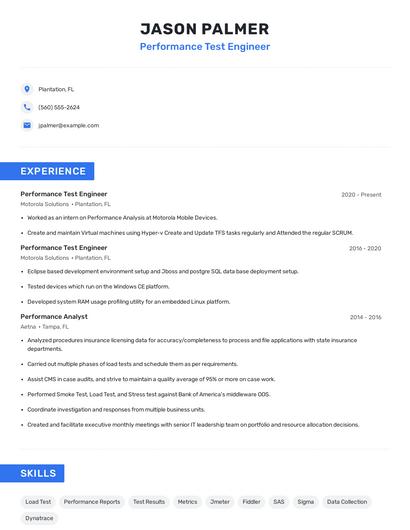
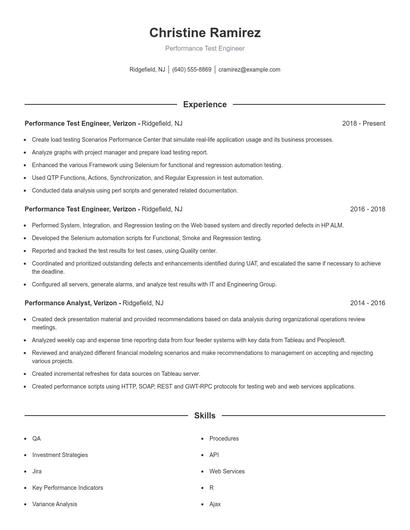
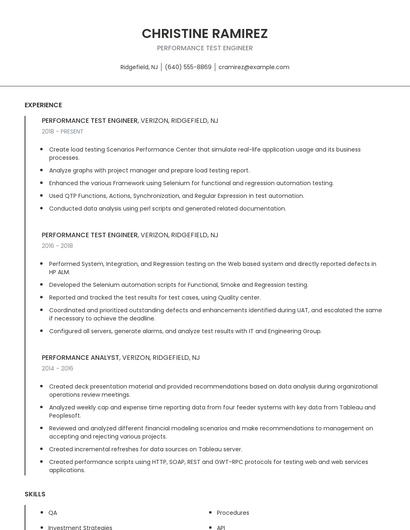
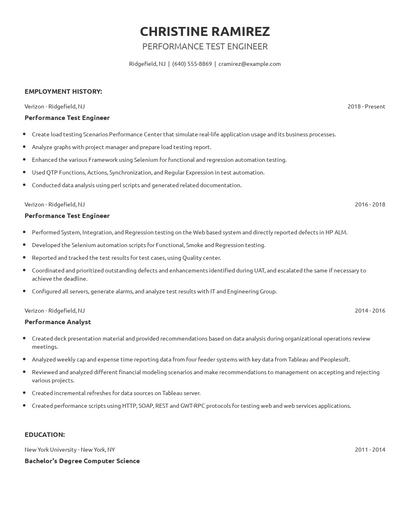
Choose from 10+ customizable performance test engineer resume templates
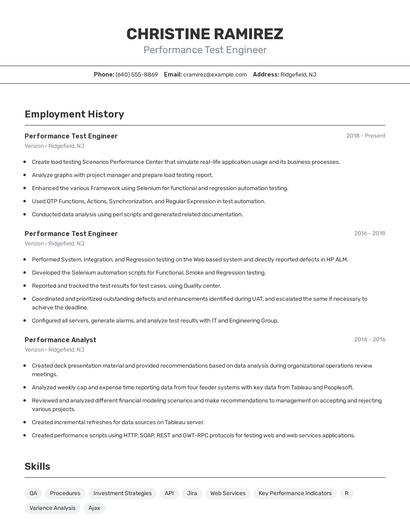
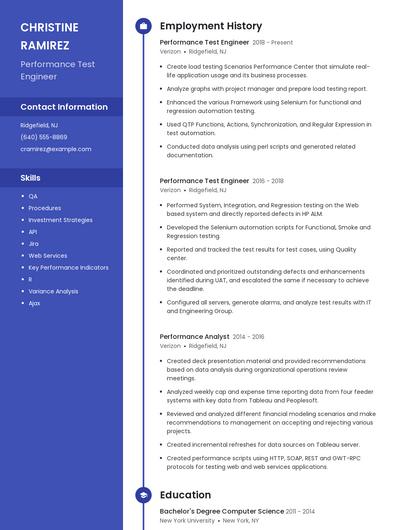
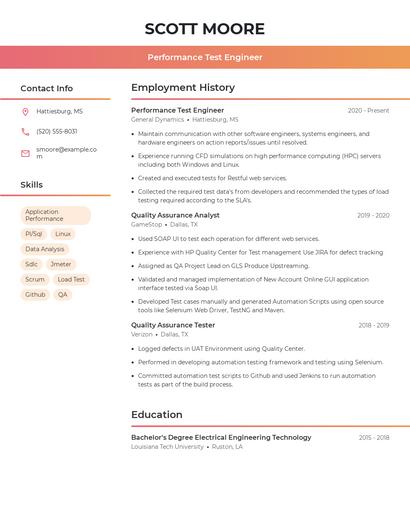
Build a professional performance test engineer resume in minutes. Our AI resume writing assistant will guide you through every step of the process, and you can choose from 10+ resume templates to create your performance test engineer resume.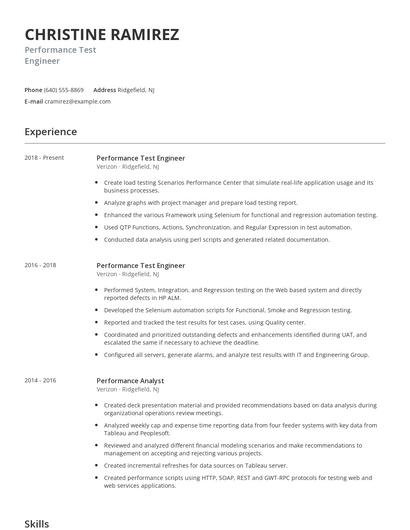




Compare different performance test engineers
Performance test engineer vs. Engineer lead quality assurance lead
Engineer Lead Quality Assurance Leads are responsible for managing the designing and operations of hardware or software testing. Their duties include developing testing plans, implement risk mitigation strategies, communicate process improvements to cross-teams such as marketing and engineering, resolve the conflict between teams, and ensures product or software adheres to the organization and industry standards. They are also involved in reviewing technical design and specification, setting performance targets, and writing progress reports for management updates.
There are some key differences in the responsibilities of each position. For example, performance test engineer responsibilities require skills like "test cases," "qa," "dynatrace," and "load test." Meanwhile a typical engineer lead quality assurance lead has skills in areas such as "api," "scrum," "test scripts," and "selenium webdriver." This difference in skills reveals the differences in what each career does.
Engineers lead quality assurance lead earn the highest salaries when working in the hospitality industry, with an average yearly salary of $114,398. On the other hand, performance test engineers are paid more in the hospitality industry with an average salary of $105,148.engineers lead quality assurance lead tend to reach lower levels of education than performance test engineers. In fact, engineers lead quality assurance lead are 6.7% less likely to graduate with a Master's Degree and 0.3% more likely to have a Doctoral Degree.Performance test engineer vs. Test analyst
The duties of a test analyst depend on one's line of work or industry of employment. In the information technology setting, a test analyst is responsible for testing computer software or hardware to ensure its quality before being released in the market. They participate in the development process to monitor the product specifications, review and analyze documentation, and create test systems, implementing them promptly and efficiently. As a test analyst, it is essential to produce progress reports, prepare presentations, and even give recommendations.
In addition to the difference in salary, there are some other key differences worth noting. For example, performance test engineer responsibilities are more likely to require skills like "jmeter," "c++," "c #," and "test cases." Meanwhile, a test analyst has duties that require skills in areas such as "test scripts," "test plan," "manual test cases," and "status reports." These differences highlight just how different the day-to-day in each role looks.
On average, test analysts earn a lower salary than performance test engineers. Some industries support higher salaries in each profession. Interestingly enough, test analysts earn the most pay in the finance industry with an average salary of $74,197. Whereas performance test engineers have higher pay in the hospitality industry, with an average salary of $105,148.test analysts earn lower levels of education than performance test engineers in general. They're 6.7% less likely to graduate with a Master's Degree and 0.3% less likely to earn a Doctoral Degree.Performance test engineer vs. Tester
The role of technical testers is to test computer software for defects, bug errors, or any issues that may come across by an end-user. They mainly conduct product testing and prepare reports about any problems or recommendations for improvements. Other responsibilities include reviewing test plans, assessing and analyzing product specifications and requirements, and mapping out testing strategy. Technical testers also frame the test environments or support network management staff and system administrators. Qualifications for this position include knowledge of the database or structured query language, proficiency in Linux commands, and proficiency in defect tracking tools.
There are many key differences between these two careers, including some of the skills required to perform responsibilities within each role. For example, a performance test engineer is likely to be skilled in "jmeter," "c++," "c #," and "test cases," while a typical tester is skilled in "digital transformation," "web application," "test scripts," and "metasploit."
Testers earn the best pay in the telecommunication industry, where they command an average salary of $74,239. Performance test engineers earn the highest pay from the hospitality industry, with an average salary of $105,148.When it comes to education, testers tend to earn lower degree levels compared to performance test engineers. In fact, they're 12.8% less likely to earn a Master's Degree, and 0.3% less likely to graduate with a Doctoral Degree.Performance test engineer vs. Etl tester
An ETL tester is responsible for validating data sources, extracting data applications of transformation logic, and uploading data in target tables. They are responsible for designing, testing, and troubleshooting the company's data storage system before it goes live. They must have strong technical capabilities and good knowledge of the coding languages commonly used in ETL development, such as Java, SQL, XML. Familiarity with data warehouse architecture techniques like ODS, DM, EDW, M, and ROLAP is also needed. Employers or clients often prefer ETL developers with extensive experience in solving complex technical problems and troubleshooting.
Types of performance test engineer
Updated January 8, 2025
