Explore jobs
Find specific jobs
Explore careers
Explore professions
Best companies
Explore companies
Job outlook for policy advisors in the United States
Are policy advisor jobs in demand?
Policy advisor job and salary trends over time
Policy advisor jobs over time
Policy advisor job growth rate over time
| Year | # of jobs | % of population |
|---|---|---|
| 2021 | 2,932 | 0.00% |
| 2020 | 958 | 0.00% |
| 2019 | 926 | 0.00% |
| 2018 | 3,018 | 0.00% |
| 2017 | 2,850 | 0.00% |
Average policy advisor salary over time
Policy advisor salary by year
| Year | Avg. salary | Hourly rate | % Change |
|---|---|---|---|
| 2026 | $98,220 | $47.22 | +4.0% |
| 2025 | $94,481 | $45.42 | +2.4% |
| 2024 | $92,268 | $44.36 | +0.7% |
| 2023 | $91,588 | $44.03 | +1.4% |
| 2022 | $90,319 | $43.42 | +1.3% |
Policy advisor jobs by state
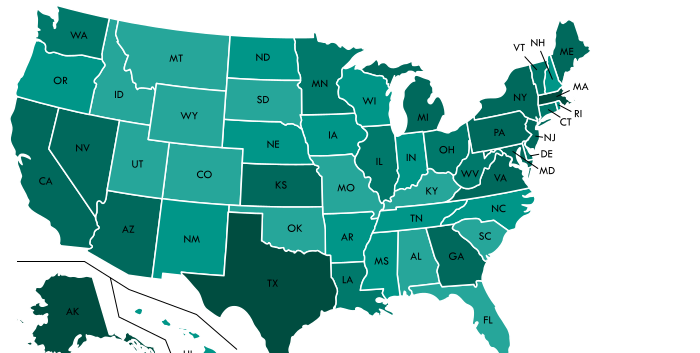
Most common states for policy advisors
| Rank | State | Population | # of jobs | Employment/ 1000ppl |
|---|---|---|---|---|
| 1 | District of Columbia | 693,972 | 201 | 29% |
| 2 | North Dakota | 755,393 | 104 | 14% |
| 3 | Wyoming | 579,315 | 73 | 13% |
| 4 | Utah | 3,101,833 | 331 | 11% |
| 5 | Wisconsin | 5,795,483 | 572 | 10% |
| 6 | Minnesota | 5,576,606 | 542 | 10% |
| 7 | Connecticut | 3,588,184 | 372 | 10% |
| 8 | Rhode Island | 1,059,639 | 101 | 10% |
| 9 | Delaware | 961,939 | 73 | 8% |
| 10 | Virginia | 8,470,020 | 629 | 7% |
| 11 | Colorado | 5,607,154 | 369 | 7% |
| 12 | New Hampshire | 1,342,795 | 91 | 7% |
| 13 | Alaska | 739,795 | 50 | 7% |
| 14 | Illinois | 12,802,023 | 793 | 6% |
| 15 | Missouri | 6,113,532 | 394 | 6% |
| 16 | Arizona | 7,016,270 | 391 | 6% |
| 17 | Maryland | 6,052,177 | 380 | 6% |
| 18 | New Mexico | 2,088,070 | 115 | 6% |
| 19 | Nebraska | 1,920,076 | 110 | 6% |
| 20 | Vermont | 623,657 | 40 | 6% |
Most common cities for policy advisors
| Rank | City | # of jobs | Employment/ 1000ppl | Avg. salary |
|---|---|---|---|---|
| 1 | Bethesda | 1 | 2% | $99,755 |
| 2 | Rosemead | 1 | 2% | $102,227 |
| 3 | Washington | 6 | 1% | $103,451 |
| 4 | Cambridge | 1 | 1% | $115,839 |
| 5 | Denver | 2 | 0% | $76,469 |
| 6 | Boston | 1 | 0% | $115,877 |
| 7 | Oakland | 1 | 0% | $108,161 |
Policy Advisor job outlook: Expert opinions
Our panel of policy advisor experts
Pennsylvania State University
University of North Carolina at Charlotte
University of Maryland - College Park
SUNY at Albany
Kent State University
University of Rhode Island
Oregon State University
California State University - Sacramento
University of North Carolina at Chapel Hill
The University of Texas at San Antonio
What general advice would you give to a Policy Advisor?
Nicole Kreisberg: At Penn State, we pride ourselves on training graduate students to enter a range of industries where they can impact policy. I would advise students to be open-minded about where they can best make that impact, whether that be in research, organizing, management, or policy advocacy.
What Policy Advisor skills would you recommend for someone trying to advance their career?
Nicole Kreisberg: As new technologies and artificial intelligence become increasingly prevalent across industries, it would behoove all new graduate students to learn technical skills in data science, big data computing, and coding to keep pace.
What will help Policy Advisors increase their earning potential?
Nicole Kreisberg: All graduate students can benefit from knowing their worth, as well as advocating for themselves at the hiring stage. I always advise students to do their homework in researching average salaries in a given field, and tell them there is never any harm in asking!
What general advice would you give to a Policy Advisor?
Dr. Naomi Bick: I would tell a graduate beginning their career to take every opportunity presented to them. By trying everything and working with as many people and across as many different settings as possible, they will find the perfect opportunities to thrive and make key connections. I would also tell them to utilize their networks of fellow students, professors, alumni, and community members to find great opportunities. Finally, I would tell them to not be afraid to reach out to professionals in their field for advice and insights. Everyone started from somewhere, and many professionals are excited to mentor and encourage recent graduates.
What Policy Advisor skills would you recommend for someone trying to advance their career?
Dr. Naomi Bick: I think in the next several years research and policy analysis will be very important, particularly in the state of California. Being able to understand new policies and apply those to day-to-day administration in various organizations will be key. Increasingly, being able to work with diverse groups of people and respect diversity is also becoming increasingly important, as the field becomes more diverse and public administrators continue to serve diverse communities. Skills such as communication and problem-solving will continue to be important for public-serving employees.
What will help Policy Advisors increase their earning potential?
Dr. Naomi Bick: While the public sector is not known for overall high salaries, new grads can maximize their potential salaries and benefits by thoroughly researching positions before applying and looking for publicly available data. Additionally, gaining additional training, certifications, and ultimately a Master's Degree can help grads advance to higher paid positions in the field.
What general advice would you give to a Policy Advisor?
Maria Ivanova: My general advice for graduates beginning their careers in Public Policy is to connect research to practice continuously. Engage deeply with your passion and remain adaptable. Building strong relationships with mentors and colleagues is critical. Collaboration across disciplines and contexts can lead to innovative ideas and responses to real-world problems. Remember to follow your intuition—you often know the right thing to do. Once you leave a policy program, you will not only produce policy but also use and follow it. Lastly, you likely entered this field because you are committed to making a positive impact on society, keep this drive alive.
What Policy Advisor skills would you recommend for someone trying to advance their career?
Maria Ivanova: In the next 3-5 years, skills related to data analytics and technology will become increasingly important. The ability to analyze large datasets, use machine learning algorithms, and develop data-driven policy recommendations will be highly valued. Sustainability and environmental policy expertise will grow in importance as global challenges related to climate change and resource management intensify. Other critical skills, including effective communication, negotiation, and stakeholder engagement, will also continue to be essential. Responding to real problems through engagement in the classroom will prepare graduates to tackle emerging challenges.
What will help Policy Advisors increase their earning potential?
Maria Ivanova: To maximize salary potential when starting a career in Public Policy, graduates should seek out internships and co-op opportunities that provide practical experience. Connecting with colleagues is crucial—attending industry conferences, joining professional associations, and connecting with alumni can open doors to various new positions. Pursuing advanced certifications or degrees in specialized areas of public policy can also increase earning potential. Demonstrating a strong track record of successful projects and quantifiable impacts in previous roles can make a candidate more attractive to employers.
What general advice would you give to a Policy Advisor?
Jaclyn Piatak PhD: Soft skills like professionalism, teamwork, and communication will continue to be vital on the job. However, recent graduates will have an edge with the latest data and technology skills from utilizing AI to streamline tasks to performing data analytics.
What Policy Advisor skills would you recommend for someone trying to advance their career?
Jaclyn Piatak PhD: Be open to opportunities, work hard, and network. Public administration is an applied field where students are well-prepared for the job and tend to move up quickly with their skills, professionalism, and management training.
What will help Policy Advisors increase their earning potential?
Jaclyn Piatak PhD: Our Masters in Public Administration students frequently start full-time careers before graduation. Nonprofit organizations and government agencies across levels of government – federal, state, and local need trained professionals and have entry-level vacancies. Show initiative. Definitely accept guidance, ask questions, and seek mentorship, but also be sure to do your own research on projects, organization, and your department, policy, or issue area.
What general advice would you give to a Policy Advisor?
John Ronquillo Ph.D., MPA: Build a strong, foundational knowledge base. Working in public policy requires continuous learning and adaptability, so committing to thoroughly understanding the history, theories, processes, stakeholders, and current debates generally, and in your substantive areas of policy interest can be a tremendous benefit. Develop excellent research, analysis, and writing abilities. The ability to objectively gather data from reliable sources, derive insights, and communicate them clearly and persuasively are critical skills to build. Cultivate strong communication and people skills. One does not act alone in this line of work, and thus collaborating with diverse groups, public speaking, negotiation, and consensus-building are essential components of the policy process. Find a mentor or two who can be good sounding boards and advisors as you confront challenges in your work, and be open to receiving feedback from them and those with whom you interact with. Utilize their advice in the best ways while developing your own expertise and decision-making skills. Be perpetually curious. Stay up-to-date on current policy issues and debates. Read authoritative sources and cultivate a network that helps you continuously remain informed and engaged. By focusing on building expertise, honing relevant skills, getting tactile experience, maintaining engagement and awareness, and leveraging communication abilities, new public policy graduates can position themselves for long-term success and impact.
What Policy Advisor skills would you recommend for someone trying to advance their career?
John Ronquillo Ph.D., MPA: Data analytics and visualization. As data continues to play a bigger role in policymaking, the ability to collect, analyze, and visualize complex datasets will be vital. Skills in statistical analysis, programming, and tools like R, Stata, Python, Tableau among many others are and will continue to be highly valued. Digital literacy and technology. Many policy issues will intersect with emerging technologies like AI, blockchain, cybersecurity, and others that are likely outpacing our ability to keep up. Having a grasp of these technologies and their implications will allow for more informed policymaking. Cross-disciplinary thinking. Policy issues are rarely, if ever, confined to one domain. An interdisciplinary mindset that can synthesize knowledge from fields like economics, public health, sociology, law, ethics, and more will be a major asset. Stakeholder engagement and collaboration. Policymaking is becoming more open, participatory, and inclusive of diverse stakeholders. Skills in facilitation, negotiation, public consultation, and building coalitions continue to grow in importance. Adaptability and learning agility. The policy landscape is rapidly changing. Those who work in this field will need the ability to constantly upskill, take on new roles, and pivot strategies in response to emerging challenges and priorities. While strong fundamentals in areas like research, communication, and subject matter expertise will still matter greatly, these new skills will likely differentiate top policy professionals over the next few years as the field evolves in response to data, technology, and engagement trends.
What will help Policy Advisors increase their earning potential?
John Ronquillo Ph.D., MPA: Consider getting an advanced degree. Having a master's degree in public policy, public administration, or a related field can significantly increase your earning potential upon completion. These degrees are typically designed to enhance skills and demonstrate specialized expertise. Try to gain relevant preparatory experience through internships. Internship experience, especially at government agencies or think tanks, can make you a more competitive candidate and may allow you to negotiate a higher starting salary. Develop specialized skills. Skills in areas like data analysis, GIS mapping, program evaluation, or language proficiency can differentiate you in an applicant pool and potentially lead to higher compensation. Negotiate strategically. Research salary data, highlight your qualifications, discuss the long-term value you bring, and don't be afraid to counter low initial offers. Keep learning whenever possible. Earning professional credentials, in either formal credit-bearing programs or more informal trainings offered through job settings or professional networks can validate your expertise and possibly boost your earning power. The key is leveraging education, skills development, strategic job targeting, and confident negotiation to maximize your policy career earning potential from day one. Building a strong portfolio early can potentially pay dividends.
What general advice would you give to a Policy Advisor?
Jennifer Dodge: Two skills stand out as critical for public managers and nonprofit professionals, first, being able to manage information well. We are in an information society where we are overwhelmed at times, and public/nonprofit professional need to know how to filter and judge what is relevant and important information, as well produce information that is credible and useable, and that can serve as the basis for making good decisions, including information from the public. Second, many issues are becoming highly politicized, and public professional will need to be able to understand and operate in politically charged contexts. These two skills are interrelated! It is even more important to be a wise consumer of information when issues become politicized.
What Policy Advisor skills would you recommend for someone trying to advance their career?
Jennifer Dodge: When you’re entering the field of public administration and policy, it’s really important to build your professional networks, continue to build your skills by taking on assignments whenever possible that challenge you to grow and develop, and remember your values. In our program, we teach students so called “hard” skills such as public financial management, statistics and information literacy, as well as “soft” skills like working in teams and upholding key public values such as democracy, accountability, transparency and integrity. When entering the workforce, it’s important to remember these key values and practice them from the start. Strong professional networks can help navigate challenging situations while upholding strong public values.
What will help Policy Advisors increase their earning potential?
Jennifer Dodge: It is important to negotiate a good salary at every opportunity (at the time or hire, during promotions, when taking on additional work), while keeping in mind that working in the public sector is not only about money but also about creating public value and serving the public. With this in mind, it can be helpful to talk through a negotiation strategy with a trusted mentor to help with this process. Research shows that men tend to negotiate more than women when it comes to salary, so it’s good to know that this is a normal part of the process. You can also negotiate working conditions that are important to you, especially if there are limited resources in your organization for salary increases, such as work from home opportunities to help with childcare.
What general advice would you give to a Policy Advisor?
Emily White: A combination of both specialized skills and soft skills will be most sought by employers. Examples of specialized or technical skills include analytical skills, policy development, economics, research analysis, data analysis and project management. Soft skills that would be imperative for any policy job are excellent verbal and written communication skills, leadership skills, and interpersonal skills. After you have completed your degree, find ways to continue building your technical and soft skills to stay current with what is needed in your work.
What Policy Advisor skills would you recommend for someone trying to advance their career?
Emily White: When searching for a career in public policy, public affairs or public policy analysis, networking is so important, particularly with alumni from your university. They are the ones who want to mentor you and have been in your shoes. Making those alumni connections via LinkedIn, conferences or informational interviews can often lead to an internship or even a full-time job. It’s all about networking! It can be helpful to narrow your interest based on your skills and strengths, whether it’s government relations, nonprofit management, federal government, or policy analysis. Employers are looking for job seekers who can tell a good story about what they are interested in and why.
What will help Policy Advisors increase their earning potential?
Emily White: Don’t be afraid to ask for time to think about your first job offer. Use that time to do your own research on industry salary trends and practice communicating your value. Make sure you take into account other benefits and perks of the position, which sometimes can also be negotiable. Be confident, firm and kind.
What general advice would you give to a Policy Advisor?
Daniel Hawes Ph.D.: There are several good reasons to consider pursuing a career in public administration at this time: - Demand for public service: The demand for public administrators is growing, particularly following the COVID-19 pandemic and significant growth has been seen at all levels of government (federal, state, and local). Furthermore, the nonprofit sector – for which a public administration degree is well-suited – is one of the fastest-growing sectors in the United States. - Growing complexity of societal issues: One reason for the growth in the demand for public administrators is that as society becomes increasingly complex, government and nonprofit organizations need greater capacity to deal with growing societal challenges such as climate change, public health, and urban development. Thus, there is a strong demand for skilled professionals who can develop and manage programs addressing these issues. - Career stability and growth: Public administration jobs tend to offer more stability and better benefits compared to the private sector. There is also potential for career growth into leadership positions, especially for those with an MPA.
What Policy Advisor skills would you recommend for someone trying to advance their career?
Daniel Hawes Ph.D.: Public administrators manage and implement public programs and policies within government and nonprofits organizations (and even in some private-sector organizations that work on public projects). Public administrators’ daily tasks can vary widely depending on their role and the size of their organization but generally, their tasks include planning, organizing, directing, controlling, and coordinating resources to provide public goods. For someone with an undergraduate degree entering the field, daily tasks might include supporting policy analysis, assisting in the management of community projects, and conducting research related to program delivery. Alternatively, a Master's in Public Administration (MPA) is specifically designed for upper management roles in public and nonprofit organizations. Those in these positions focus more on strategic planning, decision-making processes, and leading teams to implement policies or projects effectively. An MPA equips them with advanced leadership, decision-making, planning, and policy analysis skills to make organizations more effective in serving the public interest.
What will help Policy Advisors increase their earning potential?
Daniel Hawes Ph.D.: Likes: - Impact on society: Many are drawn to public administration because of the opportunity to make a tangible difference in people's lives. As we say, public service is for people who care to matter. Public service careers are particularly compelling to those who feel called to help others and aim to make an impact on our world – either locally, nationally, or internationally. - Diversity of roles: The field offers a variety of roles across many sectors and provides numerous career paths and opportunities to work on a range of policy areas from environmental, education, criminal justice, public health to social service provision. Dislikes: - Bureaucracy, red tape, and administrative burden: Working within government agencies can sometimes involve navigating complex bureaucracies and red tape, which can be frustrating (even though many of these rules are in place to increase transparency and accountability). - Political environment: Since many public administration roles are tied to governmental or political settings, recent shifts in political climates have made some policies highly political. Administrators generally aim to address public problems through professional competence in implementing policy. The politicization and polarization of public policy can hinder this. - Resource constraints: Especially in public sectors, there might be significant constraints on resources, which can be challenging when trying to implement programs or initiatives effectively. Overall, a career in public administration is rewarding and dynamic, with significant opportunities for those who are committed to public service and community development.
What general advice would you give to a Policy Advisor?
Daniel Carrigg Ph.D.: Public sector jobs tend to have public salaries. They may or may not be negotiable, and this may depend on union contract or law. Being a member of an honors society such as Pi Sigma Alpha or Pi Alpha Alpha can help for undergraduates. As can having a high GPA – higher than 3.0. These might get you a start at the GS-7 level instead of the GS-5 pay level in the Federal government. A masters' degree like an MPA can help go higher than that starting out, perhaps at the GS-9 level. Very often they will simply start you at the lowest step in that grade, adjusted for your locality. The salaries are all listed publicly online. Private sector jobs often have more room to negotiate salary. But as I said, most of these positions want 2-3 years experience minimum working with various government entities, and that kind of experience may be easier to obtain working directly for government in an entry-level job.
What Policy Advisor skills would you recommend for someone trying to advance their career?
Daniel Carrigg Ph.D.: Increasingly some basic statistical analysis, modeling projections, and basic programming skills can be useful. Some advanced experience with MS Excel, some experience with a statistical package such as R Studio or STATA and some basic experience with Python can go a long way, and I suspect this will only become more important as more and more data becomes available.
What will help Policy Advisors increase their earning potential?
Daniel Carrigg Ph.D.: Getting your foot in the door can be the hardest part. Some good advice is to think very specifically about what you want to do. Do you want to work for Federal, state, or local government? Which department? Which agency in that department? Which office in that agency? Who runs that office now? Who works there? Where is it physically located? What are they currently working on? See if they hold public meetings or conferences you can attend to meet people. Often they will. An internship can help you meet people too. For private sector policy analyst jobs, often they want experience, so doing at least some time in government can help get there. Finally, if it's a Federal job, know that a Federal resume is completely different than a standard resume. It has a lot more info on it and it may be several pages long. You must list salaries. You must not stretch the truth even a little. USAjobs.gov has a wizard to help you build a Federal resume. It does not come out formatted pretty, however. You may format it better yourself, just make sure it includes all of the information from the wizard. They want to know more than most employers, including state and local governments.
What general advice would you give to a Policy Advisor?
Brent Steel: In the coming years, data analysis and quantitative skills will become increasingly important in public policy analysis. Proficiency in data analytics, statistical software like R and Python, and big data analysis will be highly valued. Digital literacy, including an understanding of digital tools, social media, and online platforms for policy advocacy and communication, will also be essential. Interdisciplinary knowledge, integrating insights from economics, sociology, environmental science, and other fields, will enhance the ability to address complex policy issues. Adaptive and strategic thinking will be crucial for navigating and responding to rapid changes in the political, economic, and social landscape, as well as for anticipating future policy challenges and opportunities.
What Policy Advisor skills would you recommend for someone trying to advance their career?
Brent Steel: Beginning a career in public policy analysis requires strategic networking and seeking mentorship from experienced professionals. Attending industry conferences, workshops, and events can help build a robust professional network. Continuous learning is essential; staying updated on current events, policy changes, and emerging trends, as well as pursuing additional certifications or advanced degrees (e.g., Master of Public Policy), will enhance your knowledge and skills. Gaining practical experience through internships, volunteer opportunities, or entry-level positions is crucial for applying theoretical knowledge in real-world scenarios. Additionally, developing soft skills such as communication, negotiation, and presentation, as well as the ability to collaborate with diverse teams and stakeholders, will be invaluable.
What will help Policy Advisors increase their earning potential?
Brent Steel: To maximize salary potential when starting a career in public policy analysis, obtaining advanced degrees and relevant certifications is beneficial. Specializing in high-demand areas such as health policy, environmental policy, or data analytics can also enhance earning potential. Researching and targeting regions or sectors known for higher salary ranges, such as private consulting firms, international organizations, or government agencies, and being open to relocation can provide better compensation and growth opportunities. Effective negotiation is key; preparing thoroughly by researching industry standards and average salaries, and demonstrating the value you bring to the organization, can lead to better salary outcomes. Engaging in continuous professional development, seeking leadership, and project management opportunities will further build a strong track record and resume, positioning you for a financially rewarding career.
Richardson Dilworth
What general advice would you give to a Policy Advisor?
Richardson Dilworth: You should have already started your career, through internships, relevant coursework, informational interviews, conferences, everything … You need to distinguish yourself as having unique knowledge and experience in whatever field you’re pursuing. I personally think any form of thesis is an excellent opportunity to demonstrate unique area knowledge relevant to whatever career you want to pursue.
What Policy Advisor skills would you recommend for someone trying to advance their career?
Richardson Dilworth: There are so many sources these days for learning about the salaries in various professions. So, you need to research the existing data you can find on salaries. Since we’re talking about public policy jobs, governments are typically quite transparent about salaries and salary ranges. Many states have laws on the books that require companies to disclose various aspects about salaries, though if a company declines to follow those laws they obviously won’t help you (but that does tell you something about your potential employer). And don’t be afraid to negotiate and ask for a higher salary if you’re offered a job. Any company that would balk at negotiating may well not be a company you want to work for. They may so no to a salary increase but it shouldn’t hurt to ask.
What will help Policy Advisors increase their earning potential?
Richardson Dilworth: Data analysis, but even more importantly research design – intelligently constructing the systems for data analysis – and the intelligent interpretation of data analyses. Also, in a world of big data, smart data collection is also crucial. And writing – good writing, which is also a reflection of clear thinking, is a critical element in the age of AI-generated writing (which reflects no thinking at all).
What Policy Advisor skills would you recommend for someone trying to advance their career?
Dr. James Rae: Certain skills will be valuable in any career, and for international relations, one should be a good communicator and be able to express their views and ideas both verbally and in written and visual form. Writing concise memos is important, but also using new tools to communicate, whether PowerPoint or even short videos, podcasts, and social media. Certainly, problem-solving skills are important, and being solution-oriented. Relatedly, in the future, having some specific credential or training is helpful, in mediation perhaps, or more technical expertise in trending areas like climate change, artificial intelligence, cyber security, etc.
What Policy Advisor skills would you recommend for someone trying to advance their career?
Paul Manna: Quantitative and computing skills certainly will increase in demand, but that has been true for a while. With more and more people learning these sorts of tools these days, including some that are highly technical, a couple of things help set some folks apart from the crowd. First, being technically sophisticated is great, but adding to that the ability to interpret the results of complex analyses and communicate them to policymakers and the broader public is even better. People who can write and speak clearly about these matters, especially doing so for audiences who lack technical skills, are hugely valuable. Second, stepping back a bit, people who are able to think broadly about the ethical dimensions of policy work will continue to be highly valued. Rather than data-driven thinking, I push students to embrace a different approach: values-driven thinking with data. The ability to use critical thinking skills to recognize key values and value tensions in policy, and then knowing where to look for data to grapple with those tensions, is a hugely important skill that has always been important and is becoming more important each day as the policy world becomes flooded with data. How to make sense of it all, and how to leverage it to address key values that communities care about, is hugely important.
What will help Policy Advisors increase their earning potential?
Paul Manna: People positioned for the most success in public policy work tend to be able to think in theoretical and applied ways. In other words, it isn't enough to simply know a concept or a theory. Having the ability to apply it to familiar and unfamiliar situations to help address real life problems is key. One way for people to get that kind of training is to take courses or have other experiences where they actually work on actual problems that governments or community organizations are grappling with each day on the ground level. In addition, jobs that command the best salaries tend to be looking for people who have sophisticated skills that allow them to gather and use evidence from a variety of sources. Taking courses that develop skills in data management, statistics (introductory and advanced), network analysis, geographic information systems (GIS), survey design and analysis, elite or mass interviewing, and running focus groups are examples. People with those skills tend to be highly competitive in applicant pools for many jobs in public policy.
Elizabeth Sasser
Teaching Assistant Professor, Interim Director of Experiential EducationUniversity of North Carolina at Chapel Hill
Public Policy Department
What soft skills should all Policy Advisors possess?
Elizabeth Sasser: Employers tell us that they value teamwork, strong written and verbal communication skills, and sound time management skills. Our Public Policy Department at the University of North Carolina at Chapel Hill helps students hone these soft skills through an experiential education course where students work with a non-profit or government client on a real-world policy problem. In this class, students also sharpen their professional etiquette, leadership, and problem-solving skills, which are crucial for pursuing a career in public policy.
What hard/technical skills are most important for Policy Advisors?
Elizabeth Sasser: Strong quantitative analysis and writing skills are two of the most important skills a public policy analyst needs. Quantitative analysis might include the ability to use statistical techniques to draw accurate inferences from a sample of data. Strong writing skills are necessary because policymakers don't have a lot of time to read through lengthy, dense reports, so public policy analysts must write clearly and concisely. They need to be able to distill today's complex problems in a way that clarifies how to think through and address a challenge.
Derek Plantenga
Graduate Advisor of Record and Senior LecturerThe University of Texas at San Antonio
The Department of Social Work
What certifications/licenses/courses can have the biggest impact for Policy Advisors?
Derek Plantenga: There is no standard national licensure for social workers, so it is important for social workers to learn and understand the license structure of the state in which they are living and working. In general, though, earning a Master of Social Work (MSW) degree and then obtaining licensure will open up the vast majority of social work positions. For those wanting to work in the most clinical settings, obtaining clinical licensure will be required. In Texas, for example, the LCSW is needed in order to begin private clinical practice, and it is preferred for many positions with an intense clinical focus. MSW graduates interesting in pursuing this path begin by obtaining licensure as an LMSW and then work toward their clinical licensure. Beyond the primary degree and licensure; however, social work students can position themselves for success in the job market by expanding their knowledge and experience in the specific area of social work that interests them. For example, if a student is passionate about working with homeless veterans, then they can greatly increase the probability of securing a job in this arena by completing a practicum and/or volunteer experience working with veterans, seek out additional certifications or trainings related to trauma-informed practice, and network through community task forces or associations related to homelessness or veterans. Whatever the field of interest, the best way to get there is to seek out training, connections and experience in that particular field.
What's a good job out of college for Policy Advisors?
Derek Plantenga: It is important for graduates to balance realism and intentionality when seeking a first job post-MSW. On the one hand, it is not likely that the first job out of school will be someone's dream job-those opportunities tend to come with experience. On the other hand, graduates are wise to consider their first job as a purposeful extension of their professional growth. Seek out a position that provides a genuine opportunity to serve others, aligns with your passion and allows you the opportunity to gain a new skill or additional experience that will move you a step closer toward your dream job. It doesn't have to be the perfect job. Use any position you obtain as a learning experience, and keep an open mind along the way. Sometimes goals can evolve. Pay attention to what excites you or fulfills you, and be open to exploring new directions for your career in social work. The prospects for social workers are strong!