Explore jobs
Find specific jobs
Explore careers
Explore professions
Best companies
Explore companies
Job outlook for postdoc fellows in the United States
Are postdoc fellow jobs in demand?
Postdoc fellow job and salary trends over time
Postdoc fellow jobs over time
Postdoc fellow job growth rate over time
| Year | # of jobs | % of population |
|---|---|---|
| 2021 | 368 | 0.00% |
| 2020 | 428 | 0.00% |
| 2019 | 431 | 0.00% |
| 2018 | 408 | 0.00% |
| 2017 | 379 | 0.00% |
Average postdoc fellow salary over time
Postdoc fellow salary by year
| Year | Avg. salary | Hourly rate | % Change |
|---|---|---|---|
| 2026 | $58,376 | $28.07 | +3.1% |
| 2025 | $56,641 | $27.23 | +4.7% |
| 2024 | $54,102 | $26.01 | +3.3% |
| 2023 | $52,367 | $25.18 | +1.9% |
| 2022 | $51,372 | $24.70 | --2.1% |
Postdoc fellow jobs by state
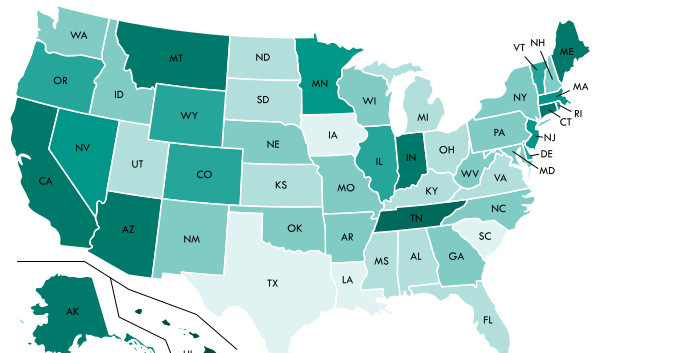
Most common states for postdoc fellows
| Rank | State | Population | # of jobs | Employment/ 1000ppl |
|---|---|---|---|---|
| 1 | District of Columbia | 693,972 | 92 | 13% |
| 2 | Massachusetts | 6,859,819 | 843 | 12% |
| 3 | Colorado | 5,607,154 | 255 | 5% |
| 4 | New York | 19,849,399 | 870 | 4% |
| 5 | New Mexico | 2,088,070 | 75 | 4% |
| 6 | New Jersey | 9,005,644 | 302 | 3% |
| 7 | Minnesota | 5,576,606 | 183 | 3% |
| 8 | Maryland | 6,052,177 | 176 | 3% |
| 9 | Nebraska | 1,920,076 | 61 | 3% |
| 10 | Vermont | 623,657 | 21 | 3% |
| 11 | North Carolina | 10,273,419 | 169 | 2% |
| 12 | Tennessee | 6,715,984 | 153 | 2% |
| 13 | Oregon | 4,142,776 | 97 | 2% |
| 14 | West Virginia | 1,815,857 | 39 | 2% |
| 15 | Maine | 1,335,907 | 24 | 2% |
| 16 | Montana | 1,050,493 | 22 | 2% |
| 17 | Delaware | 961,939 | 22 | 2% |
| 18 | Rhode Island | 1,059,639 | 21 | 2% |
| 19 | Alaska | 739,795 | 13 | 2% |
| 20 | Wyoming | 579,315 | 10 | 2% |
Most common cities for postdoc fellows
| Rank | City | # of jobs | Employment/ 1000ppl | Avg. salary |
|---|---|---|---|---|
| 1 | San Mateo | 1 | 1% | $70,667 |
| 2 | Santa Clara | 1 | 1% | $70,415 |
| 3 | Baltimore | 1 | 0% | $51,800 |
Postdoc Fellow job outlook: Expert opinions
Our panel of postdoc fellow experts
Georgetown University
Santa Fe College
Southern Illinois University Carbondale
Washington State University
University of Pittsburgh
University of Nebraska - Omaha
Loyola University New Orleans
Western Washington University
University of Houston

Wright State University
What Postdoc Fellow skills would you recommend for someone trying to advance their career?
Christopher Vitek Ph.D.: Population biology, especially biology that focuses on disease vectors, is a great field to pursue. People will always want to get rid of mosquitoes, so there is always a demand for learning when, where, and how to control them, as well as helping to identify risks for disease transmission. Newly available molecular tools help us understand more about the biological underpinnings that control characteristics like population growth and distribution.
What general advice would you give to a Postdoc Fellow?
Ivica Labuda PhD: The 21st century is the century of biotechnology, which means that opportunities for a successful, impactful career in the field are there for those who go after them. Your blossoming career path may take you from the private sector, to government agencies, to academia and beyond, so taking advantage of every opportunity to gain exposure to the different sides of biotech will set you up to grasp varied and exciting opportunities.
What will help Postdoc Fellows increase their earning potential?
Ivica Labuda PhD: Everyone's career is a unique path, but a strong education gets your foot in the door and graduate programs such as Georgetown's MS in Biotechnology are accelerators for your potential. An advanced degree and the exposure to real-world internships they often provide bring you to a much higher starting point in negotiations and can help you gain confidence to start at higher positions. Salary, however, is just one measure of success -- also important to consider are satisfaction from the working environment, a great team, and potential for professional and personal growth.
What will help Postdoc Fellows increase their earning potential?
Kristopher Koudelka Ph.D.: Always keep learning. These fields change fast! The leading edge is always unveiling new information that can be applied to the area you are working on, and there will be new techniques developed that allow you to answer questions in more efficient ways. You must learn to regularly update yourself through conversations, reading, conferences, and trainings. This change is fun and exciting, embrace it. It will keep your job feeling new.
What general advice would you give to a Postdoc Fellow?
Jeff Heslep: Find a starting job that gives you a wide range of work to perform. The more experience you can gain during the first few years will help you to hone your skills, decide what areas interest you the most, and give you the opportunity to choose. Learn as much as you can about the various equipment, analytical techniques, processes, and how to troubleshoot minor problems. Take the initiative and ask to learn how to use instruments you aren't familiar with. It is unlikely someone will deny you the opportunity to broaden your knowledge. Take every chance you have to network and get to know the people within your local biotechnology industry. Networking plays a major role in employment opportunities. Work on your written and verbal communication skills. Communicating well will help you stand out. Being able to effectively convey complex scientific concepts in such a way that anyone can understand it can be a powerful skill.
What general advice would you give to a Postdoc Fellow?
Jacob Nordman: Salary potential in my field of neuroscience almost always involves publications, awards, and technical acumen. Therefore, as I mentioned, it is important to start early looking for opportunities that can strengthen these areas. Another important aspect of getting high-profile, and thus high-paying, positions, is being able to tell a story with your research and career. Employers want to see that you have thought deeply and strategically about your career and where it’s going. This will allow them to believe you are a safe bet and worthy of their investment.
What general advice would you give to a Postdoc Fellow?
Lindsey du Toit: The ability to put advanced, including molecular plant pathology, skills and methods pathology in the context of fundamental principles of plant pathology is so important. There is a real danger of being trained/educated so narrowly that you lose the bigger picture and context of the work. Make an effort to learn from people with expertise in related disciplines to avoid working in an isolated ivory tower, and to benefit from the amazing cross-pollination that can happen with shared expertise.
What will help Postdoc Fellows increase their earning potential?
Lindsey du Toit: Take every opportunity you can to learn, network, and build an effective team of people that bring a greater breadth and depth of skills and expertise to the work on which you will be focusing. Cultivate a life-long sense of intellectual curiosity and learning. Don’t be afraid to ask questions. Treat ignorance as an opportunity to learn. Questions demonstrate you want to understand the situation/problem effectively and that you are paying attention. Always demonstrate integrity in your work. It is one of the most valuable traits you can bring to your career. Be kind and supportive of your colleagues.
What general advice would you give to a Postdoc Fellow?
Arjumand Ghazi Ph. D: Don’t hesitate to experiment with different career options before settling for one where you enjoy the work and make a good living.
What will help Postdoc Fellows increase their earning potential?
Arjumand Ghazi Ph. D: Having an advanced degree such as a PhD and even a few years postdoc is a good way to start at a higher level. It often allows one to make up for the reduced earnings during the training periods while increasing long-term earnings.
Andrew Riquier Ph.D.
InstructorUniversity of Nebraska - Omaha
Neurobiology And Neurosciences
What general advice would you give to a Postdoc Fellow?
Andrew Riquier Ph.D.: Apply for the positions you want, even if you feel underqualified. I know plenty of people who have applied for jobs they didn't quite meet the requirements for, and got hired for other reasons. In my experience, many recent graduates choose to take time to strengthen their resumes by retaking classes, working jobs they don't particularly want to get experience, etc. There is some value in that, particularly if you have been unsuccessful attaining the position you want, or if you want to see if you even enjoy that type of work. But if you are confident in what you want to do, go for it; in the worst-case scenario, you are in the same position you would be if you hadn't applied, but now you have experience applying and have potentially gained a contact in the field.
Kimberlee Mix PhD
Provost Distinguished Professor of Biological SciencesLoyola University New Orleans
Biochemistry, Biophysics And Molecular Biology
What general advice would you give to a Postdoc Fellow?
Kimberlee Mix PhD: Keep looking for opportunities to grow and learn. Pursuing an advanced degree may help with earning potential, but also consider online courses in bioinformatics and other certificate programs that will give you a competitive edge.
What will help Postdoc Fellows increase their earning potential?
Kimberlee Mix PhD: Keep an open mind in your first position - it may involve repetitive lab work focused on a single technique or protocol. Learn as much as you can about the big picture of your project and know that you have an important part in it. Take advantage of down-time during incubations to socialize with your new colleagues and learn about their career journeys. Ask lots of questions and take good notes.
What Postdoc Fellow skills would you recommend for someone trying to advance their career?
Kimberlee Mix PhD: Bioinformatics knowledge and skills will be in high demand across the board. Understanding the principles of DNA and RNA sequencing and multi-omics analysis methods will be very helpful. Reading the scientific literature and going to research conferences are great ways to stay current on new techniques and advances in the field.
What Postdoc Fellow skills would you recommend for someone trying to advance their career?
Josh Kaplan Ph.D.: Demonstrating a skill set that is unique, such as experience with a rare technical research approach, or demonstrating that you can save your employer money by utilizing free resources, can be used to negotiate a higher salary.
What will help Postdoc Fellows increase their earning potential?
Josh Kaplan Ph.D.: Be reliable, consistent, and focus on the details. Your neuroscience training required you to develop an attention to detail that permeated many aspects of your work. Further, you had to apply that detailed approach in a consistent manner across a potentially long experimental duration. Your future coworkers and employers will appreciate knowing that you'll be able to apply the instructions for a novel scenario reliably and consistently.
Badri Roysam D.Sc.
Hugh Roy and Lillie Cranz Cullen University Professor Chair, Electrical & Computer Engineering Department University of HoustonUniversity of Houston
Petroleum Engineering
What general advice would you give to a Postdoc Fellow?
Badri Roysam D.Sc.: The fundamentals of the discipline, and critical thinking skills will continue to be important.
What type of skills will young Postdoc Fellows need?
David Cool Ph.D.: The skill sets that young graduates will need when they graduate and enter the workforce are similar to and vastly different from just 15-30 years ago. If they are working in a laboratory setting, then the standards are the same; accurate pipetting, the ability to make complex buffers, and understanding how all the necessary equipment in a lab works. However, that is not nearly enough nowadays. The equipment and instrumentation have been expanding exponentially to the point that you will be working with both expensive and complicated instruments to generate a more considerable amount of data than anyone ever thought possible. Standards for labs today will be using digital imaging devices to capture everything from microscopic images, to western blots, to automated living cell analysis using multi-well plates. Multiplexed assays for 27 to 50 to 1050 cytokines and proteins have replaced single marker ELISA. But knowing ELISA will allow you to be trained to do the multiplexed assays. Most pharmaceutical companies have a great need still for 'old-fashioned' HPLC techniques. Every student I have had in my research techniques class, that graduates and goes for a Pharma position, comes back and tells me they asked them if they could run an HPLC.
Some were even given a test to see if they understood the concept. This then leads to mass spectrometry, LCMS, MALDI-TOF, and even GCMS, and everything that has been developed around those basic techniques is now commonplace in most core facilities and Pharma. New methods for flow cytometry, FACS, are necessary for the higher throughput drug discovery types of labs. Molecular biology has evolved from simple PCR machines that could run 24 samples, just 25 years ago, to digital PCR machines that can run 384 pieces today and email the final data to you at home, while you sleep. Knowing how to calculate the PCR data is extremely critical, as it isn't intuitive, and people tend to take short cuts. Knowing how to do that will be vital. Cell culture and working with animals are still common ways to generate data in any lab, and people who have those skills will always have a job. What do all these techniques have in common? They all have evolved to the point that no one is an expert in every one of them. Labs focus and concentrate on the ones they need the most and make use of them over a long period. What a student should develop is what I call a big toolbox. Learn as many of these techniques as you can, and then use them. Understanding that these are all cyclic and that you may get rusty, or the technology will change. It doesn't matter. By being trained in any of these, it will mean that you can be prepared for other things, that you can catch up and learn and update your techniques in your toolbox. This is what any PI running a lab will be looking for, someone who can be trained, and can evolve and adapt to different technologies, know how they work and how they can be used, what the data looks like when it is working well, and what it looks like when it isn't. The people who have these skills will always be employable.
There is a greater need than ever for workers to analyze data and synthesize a reasonable idea about what it means. This means that they must understand their experiments at a deeper level than just pipetting buffers and timing reactions. They must know what is happening, and if there is a problem, first, they have a problem and then how to solve it. Bioinformatics has become one of the fastest-growing fields. The increased amount of data, whether from standard assays run in an ordinary lab or high throughput data, needs more crunching. The future researcher will not be able to get by just knowing how to use a computer stats program but will be required to understand how to run data in R or Python or whatever new data analysis package is coming next. This becomes even more critical as the data becomes more complex, i.e., 27 cytokines analyzed in 3 different tissues over three other times, from 14 different groups, 6 of which are controls, with the rest being toxin and then treatment groups and authorities. A simple two way ANOVA just doesn't cut it. For this, machine learning tools, pattern recognition, neural networks, topological data analysis (TDA), Deep Learning, etc., are becoming the norm and are being advanced and changed to give more and more substance to what the data means. Students who can operate instruments to generate data and run more complex types of analysis on this 'big data' are in great demand. Likewise, learning the computer-generated design of drugs 'in silico' is a growing field that is now required to screen tens of thousands of compounds before generating them in the lab. This will need someone who can think three-dimensionally; even though the software and advanced computers can do that, it helps if your brain is wired that way, at least a little.
Aside from instruments and complex data analysis, consider where the clinical research is headed. With COVID19, the need to quickly advance drugs from potential use to clinical application has undergone an exponential increase. Lives are being lost daily to the lack of a vaccine or medication that can attenuate to any level the impact the virus has on the human body. The future clinical researcher will need to understand how the instruments work and how tests are run, how a vaccine works, how the virus or disease manifests itself, and how to get it under control. This will only be possible if the researcher is familiar with much of what I wrote above. You won't need to be an expert on virtually everything, but you'll need to understand it so you can use it to synthesize new ideas that may be applicable in the clinical environment. COVID19 is a perfect example. One of the early struggles with this virus was how to test for it. Antibodies weren't developed for it in the very beginning, so an ELISA was out.
In contrast, PCR is one of the most sensitive methods to identify genetic material, such as viruses. So, early on, PCR primers were created that could be used to run a PCR to determine if a person had a live virus. However, the first such PCRs had high false negatives and positives. Further refinement led to the creation of PCR primer sets and protocols that allowed for a more accurate and faster test. An advantage that anyone who has been trained in biotechnology will know the basics of developing a test. If it is a PCR, then what goes into that. Suppose it is an ELISA, how it works, and what you need to set it up. Imagine a test strip similar to the one used for at-home pregnancy tests. This came about in much the same way, through experimentation and developing a way to lower the false negatives and positives, to allow a quick, 5-minute test that could determine if a particular hormone was in your urine at a stage of pregnancy when many women may not have realized there was a possibility they could be pregnant. The person entering the workforce that can think in these ways will be employable and will be able to move between jobs and continue with a very successful and enriching career.