Explore jobs
Find specific jobs
Explore careers
Explore professions
Best companies
Explore companies
What is a precision assembler and how to become one

A precision assembler fabricates and assembles small parts and components with a high degree of accuracy and precision. They use specialized tools, instruments, and equipment to ensure pieces fit together perfectly. Precision assemblers work in industries including electronics, medical devices, and aerospace. The job requires a keen eye for detail, steady hands, and the ability to interpret technical diagrams and instructions. A precision assembler troubleshoots problems and makes adjustments as needed to meet quality standards.
Avg. Salary $31,774
Avg. Salary $59,228
American Indian and Alaska Native 0.43%
Asian 10.27%
Black or African American 8.78%
Hispanic or Latino 16.29%
Unknown 2.68%
White 61.55%
Genderfemale 25.37%
male 74.63%
Age - 51American Indian and Alaska Native 3.00%
Asian 7.00%
Black or African American 14.00%
Hispanic or Latino 19.00%
White 57.00%
Genderfemale 47.00%
male 53.00%
Age - 51Stress level is manageable
7.1 - high
Complexity level is challenging
7 - challenging
Work life balance is poor
6.4 - fair
What are the pros and cons of being a precision assembler?
Pros
Job security due to high demand for precision assemblers
Opportunity for advancement to supervisory roles
Possibility of flexible work schedules
Opportunities for overtime and bonuses
Competitive salaries and benefits packages
Cons
Repetitive nature of the work can lead to boredom or burnout
Work may require long hours or shifts, including nights and weekends
Possibility of exposure to chemicals or hazardous materials during assembly processes
Potential for production quotas or deadlines that may be difficult to meet
May require wearing personal protective equipment, which can be uncomfortable
Precision assembler career paths
Key steps to become a precision assembler
Explore precision assembler education requirements
Start to develop specific precision assembler skills
Skills Percentages Hand Tools 25.46% Calipers 12.39% Lean Manufacturing 7.96% Continuous Improvement 6.99% Aerospace 4.91% Complete relevant precision assembler training and internships
Accountants spend an average of Less than 1 month on post-employment, on-the-job training. New precision assemblers learn the skills and techniques required for their job and employer during this time. The chart below shows how long it takes to gain competency as a precision assembler based on U.S. Bureau of Labor Statistics data and data from real precision assembler resumes.Research precision assembler duties and responsibilities
- Work in an ESD environment.
- Operate a computer laser marking machine.
- Build components and running electronic tests with laser diodes.
- Assemble ESD components/parts while maintaining a positive efficiency rate.
Prepare your precision assembler resume
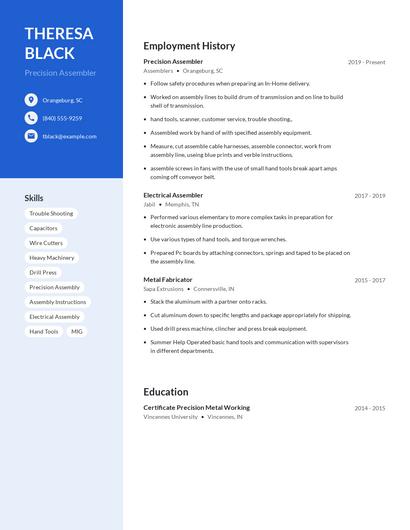
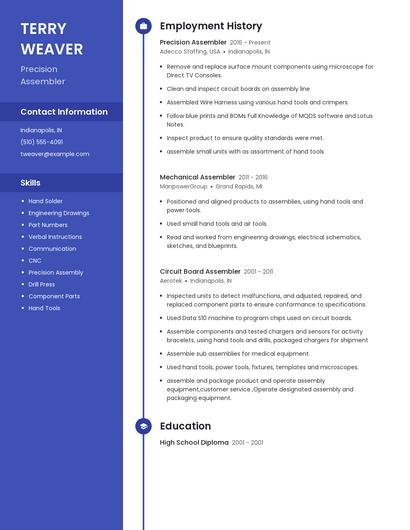
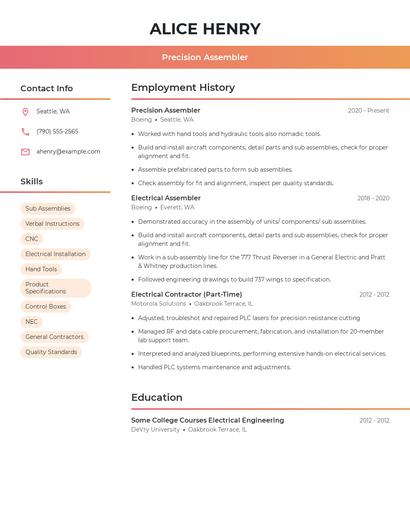
When your background is strong enough, you can start writing your precision assembler resume.
You can use Zippia's AI resume builder to make the resume writing process easier while also making sure that you include key information that hiring managers expect to see on a precision assembler resume. You'll find resume tips and examples of skills, responsibilities, and summaries, all provided by Zippi, your career sidekick.
Choose from 10+ customizable precision assembler resume templates
Build a professional precision assembler resume in minutes. Browse through our resume examples to identify the best way to word your resume. Then choose from 10+ resume templates to create your precision assembler resume.

Apply for precision assembler jobs
Now it's time to start searching for a precision assembler job. Consider the tips below for a successful job search:
- Browse job boards for relevant postings
- Consult your professional network
- Reach out to companies you're interested in working for directly
- Watch out for job scams
How did you land your first precision assembler job

Are you a precision assembler?
Share your story for a free salary report.
Average precision assembler salary
The average precision assembler salary in the United States is $31,774 per year or $15 per hour. Precision assembler salaries range between $24,000 and $41,000 per year.
What am I worth?

How do precision assemblers rate their job?
Precision assembler reviews

Using my hands and keeping them busy
If you like what you do in your job then there's nothing you'll not like I love my job
Updated January 8, 2025
