What does a processing supervisor do?

A processing supervisor is responsible for overseeing the overall operational processes of a department and ensuring that the team members adhere to the highest quality standards and efficiency. Processing supervisors strategize efficient techniques to maximize the productivity and performance of the staff to deliver customer satisfaction and increase the company's brand reputation to the public. They also coordinate with clients, respond to inquiries and concerns, and resolve any complications related to the process and project management procedures.
Processing supervisor responsibilities
Here are examples of responsibilities from real processing supervisor resumes:
- Utilize and manage KRONOS timekeeping software in updating and maintaining payroll records; prepare and upload end-of-shift reports into SharePoint.
- Provide customer service, which include answering inquiries, store-to-store calls, and operate POS system.
- Qualify in advance first aid and CPR.
- Ensure execution of company initiatives to abide by OSHA standards with the disposal of raw material.
- Require to maintain quality assurance, within strict compliance with all USDA standards through in depth observation process.
- Involve in opening of new store location, receive freight, learned new POS system and merchandising standards.
- Perform monthly safety inspections in the processing area to ensure that safety and work conditions fall within the OSHA parameters.
- Analyze and recommend solutions to ensure compliance with USDA and industry regulations in a fast-pace environment daily.
- Develop job descriptions and maintenance procedures and create team orient environment which successfully improve cleanliness and comfort for students and staff.
- Optimize process and fine tune process PLC
- Work on PLC to open/close valve, to chemical tanks, and bulk storage tanks.
- Verify required inbound/outbound receipts with floor lead, ensuring that all products are properly count and receive into WMS system.
- Deliver and setup oxygen, concentraitors, wheel chairs power chairs, scooters hospital beds.
- Utilize systems training/dept to troubleshoot problems in customer-orient WMS system.
Processing supervisor skills and personality traits
We calculated that 16% of Processing Supervisors are proficient in Sterile Processing, Customer Service, and Patients. They’re also known for soft skills such as Communication skills, Leadership skills, and Management skills.
We break down the percentage of Processing Supervisors that have these skills listed on their resume here:
- Sterile Processing, 16%
Instituted daily review of sterilization records and enhanced the sterile processing infection control report to incorporate greater metrics and controls.
- Customer Service, 11%
Developed and conducted stringent training programs focusing on technical aspects of passport administration, quality control, and customer service.
- Patients, 9%
Enter insurance payments and PPO's according to EOB on patients accounts.
- Quality Standards, 4%
Maintain performance standards at maximum productivity levels and quality standards to ensure timely and efficient operations.
- SPD, 4%
Record Documentation for sterilization, decontamination, case carts and biological results from all sterilizer in SPD and OR.
- Safety Procedures, 4%
Developed and implemented Lockout / Tag-Out safety procedures plant-wide.
"sterile processing," "customer service," and "patients" are among the most common skills that processing supervisors use at work. You can find even more processing supervisor responsibilities below, including:
Communication skills. The most essential soft skill for a processing supervisor to carry out their responsibilities is communication skills. This skill is important for the role because "top executives must be able to convey information clearly and persuasively." Additionally, a processing supervisor resume shows how their duties depend on communication skills: "created a cohesive, targeted team dedicated to customer service, professionalism, communication, and transparency. "
Leadership skills. Many processing supervisor duties rely on leadership skills. "top executives must be able to shape and direct an organization by coordinating policies, people, and resources.," so a processing supervisor will need this skill often in their role. This resume example is just one of many ways processing supervisor responsibilities rely on leadership skills: "supported senior leadership initiatives in seeking remittance processing solutions identified process improvement opportunities and provided streamlining suggestions. "
Problem-solving skills. A big part of what processing supervisors do relies on "problem-solving skills." You can see how essential it is to processing supervisor responsibilities because "top executives need to identify and resolve issues within an organization." Here's an example of how this skill is used from a resume that represents typical processing supervisor tasks: "completed production reports and solved customer problems in a timely and efficient manner. "
Time-management skills. Another crucial skill for a processing supervisor to carry out their responsibilities is "time-management skills." A big part of what processing supervisors relies on this skill, since "top executives do many tasks concurrently to ensure that their work gets done and that the organization meets its goals." How this skill relates to processing supervisor duties can be seen in an example from a processing supervisor resume snippet: "completed a $250,000 process improvement project on time and within budget. "
The three companies that hire the most processing supervisors are:
- WakeMed11 processing supervisors jobs
- Steris9 processing supervisors jobs
- Post Holdings8 processing supervisors jobs
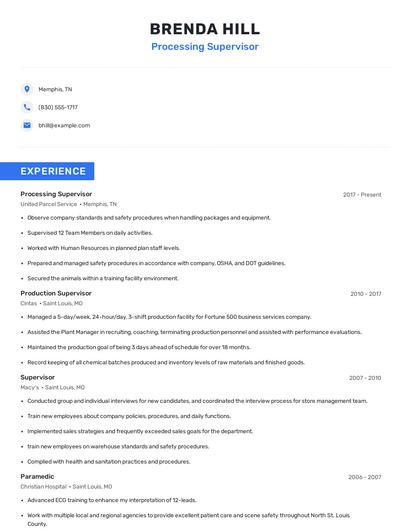
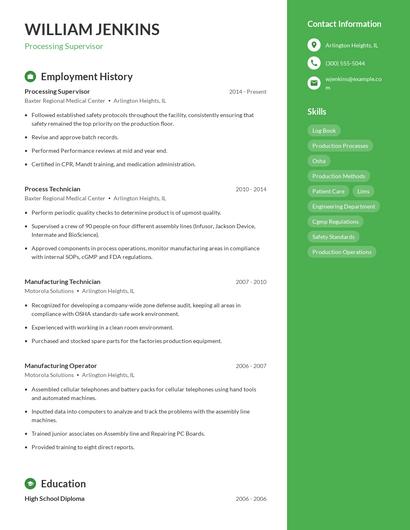
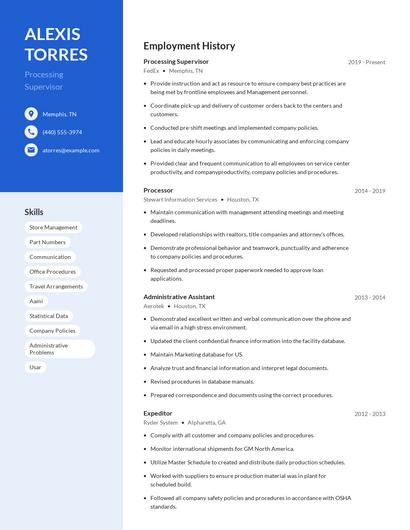
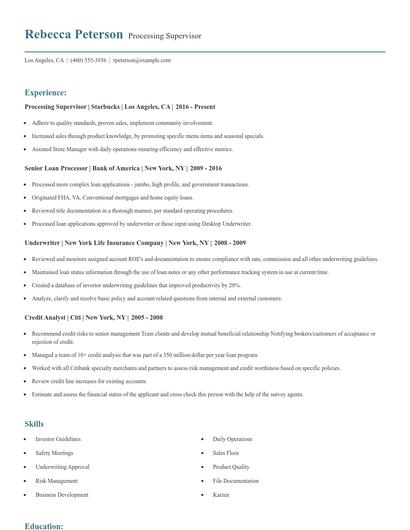
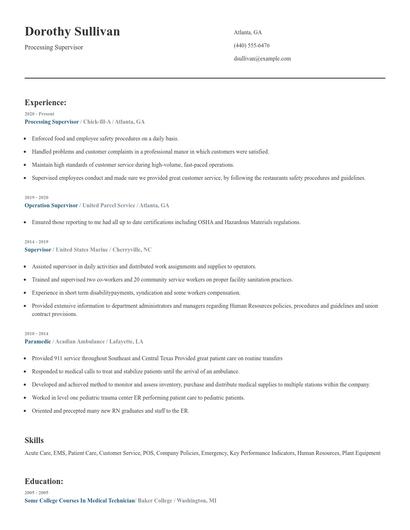
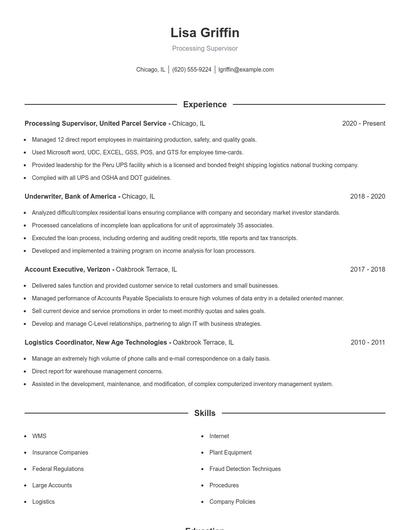
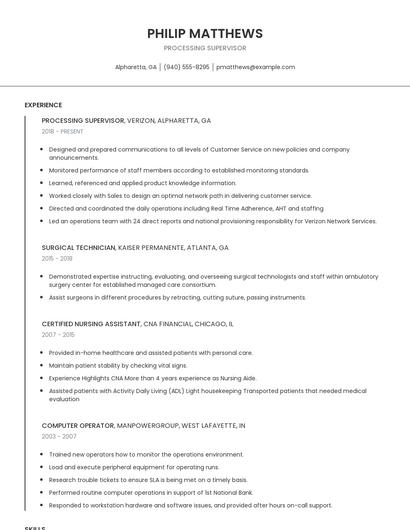
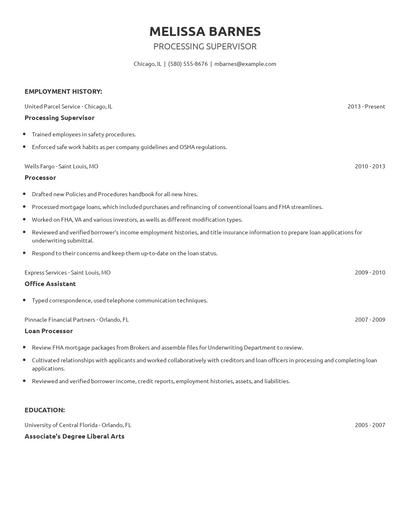
Choose from 10+ customizable processing supervisor resume templates
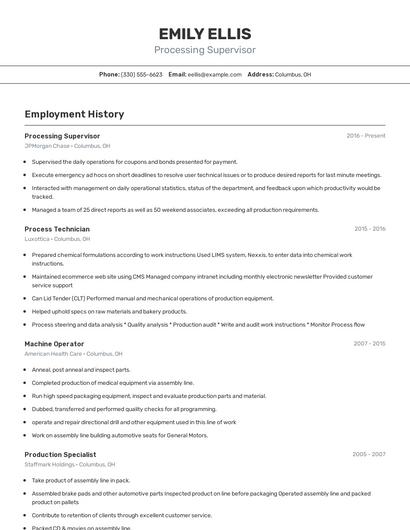
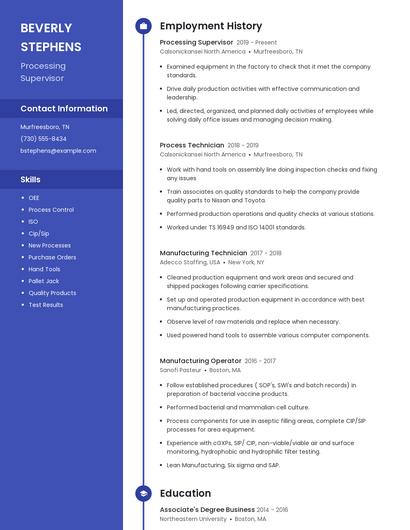
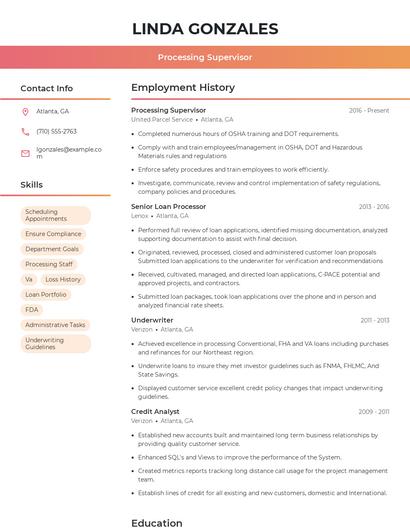
Build a professional processing supervisor resume in minutes. Our AI resume writing assistant will guide you through every step of the process, and you can choose from 10+ resume templates to create your processing supervisor resume.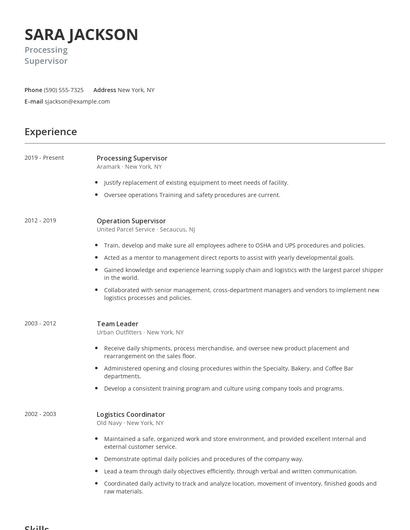
Compare different processing supervisors
Processing supervisor vs. Team leader/supervisor
A team leader or supervisor is an individual who leads and supervises a workgroup's functionality through instructions and guidance in an organization. Team leaders provide support to staff members by way of coaching and skills development. They are responsible for preventing and resolving conflicts among staff members by setting ground rules and assigning tasks properly. They also organize team meetings and report the progress of a project to the management. Since they lead a workforce, team leaders must possess excellent verbal communication skills and have a great work ethic.
There are some key differences in the responsibilities of each position. For example, processing supervisor responsibilities require skills like "sterile processing," "patients," "spd," and "osha." Meanwhile a typical team leader/supervisor has skills in areas such as "payroll," "continuous improvement," "customer care," and "windows." This difference in skills reveals the differences in what each career does.
The education levels that team leader/supervisors earn slightly differ from processing supervisors. In particular, team leader/supervisors are 0.0% more likely to graduate with a Master's Degree than a processing supervisor. Additionally, they're 0.1% more likely to earn a Doctoral Degree.Processing supervisor vs. Field operations supervisor
Field operations supervisors are professionals who supervise staff members to ensure that an organization is running smoothly and effectively to produce increased sales and profits. These supervisors are required to develop operational policies and procedures to increase business growth while implementing best practices to improve operational efficiency. They must participate in creating an annual budget so that they can manage expenses within the assigned budget. Field operations supervisors must also prepare effective training programs and conduct performance evaluations of the office staff.
In addition to the difference in salary, there are some other key differences worth noting. For example, processing supervisor responsibilities are more likely to require skills like "sterile processing," "patients," "spd," and "aami." Meanwhile, a field operations supervisor has duties that require skills in areas such as "safety standards," "eeo," "direct supervision," and "tcp ip." These differences highlight just how different the day-to-day in each role looks.
Field operations supervisors earn a higher average salary than processing supervisors. But field operations supervisors earn the highest pay in the utilities industry, with an average salary of $69,024. Additionally, processing supervisors earn the highest salaries in the finance with average pay of $55,456 annually.Average education levels between the two professions vary. Field operations supervisors tend to reach similar levels of education than processing supervisors. In fact, they're 1.1% more likely to graduate with a Master's Degree and 0.1% more likely to earn a Doctoral Degree.Processing supervisor vs. 2nd shift supervisor
A 2nd shift supervisor is responsible for supporting the operations of a department, managing the staff's performance, and assisting the team in achieving maximum productivity. They provide high-quality services for the customers by responding to their inquiries and concerns and resolving complaints. They also implement strategic procedures to achieve production goals, as well as identifying business opportunities that would drive more revenue resources and profits for the company. A 2nd shift supervisor also assists in handling the department's budget, ensuring adequate allocation to support operations.
There are many key differences between these two careers, including some of the skills required to perform responsibilities within each role. For example, a processing supervisor is likely to be skilled in "sterile processing," "patients," "spd," and "aami," while a typical 2nd shift supervisor is skilled in "basic math," "continuous improvement," "pallets," and "work ethic."
2nd shift supervisors earn the highest salary when working in the automotive industry, where they receive an average salary of $36,245. Comparatively, processing supervisors have the highest earning potential in the finance industry, with an average salary of $55,456.2nd shift supervisors typically earn similar educational levels compared to processing supervisors. Specifically, they're 4.4% less likely to graduate with a Master's Degree, and 0.3% less likely to earn a Doctoral Degree.Processing supervisor vs. 3rd shift supervisor
A 3rd shift supervisor is responsible for monitoring the operations and staff performance of a specific shift. 3rd shift supervisors strategize on effective business techniques to maximize staff's productivity and improve customers' experience. They also analyze sales reports, resolve discrepancies, and identify business opportunities that would generate more resources for revenues and increase the company's profitability. A 3rd shift supervisor addresses customers' inquiries and concerns, as well as resolving their complaints about services timely and accurately.
Types of processing supervisor
Updated January 8, 2025
