Explore jobs
Find specific jobs
Explore careers
Explore professions
Best companies
Explore companies
Job outlook for project inspectors in the United States
Project inspector job growth summary. After extensive research, interviews, and analysis, Zippia's data science team found that:
The projected project inspector job growth rate is -4% from 2018-2028.
About -5,700 new jobs for project inspectors are projected over the next decade.
Project inspector salaries have increased 7% for project inspectors in the last 5 years.
There are over 4,212 project inspectors currently employed in the United States.
There are 58,403 active project inspector job openings in the US.
The average project inspector salary is $68,048.
Are project inspector jobs in demand?
Project inspector job and salary trends over time
Project inspector jobs over time
Project inspector job growth rate over time
| Year | # of jobs | % of population |
|---|---|---|
| 2021 | 4,212 | 0.00% |
| 2020 | 4,067 | 0.00% |
| 2019 | 3,947 | 0.00% |
| 2018 | 3,720 | 0.00% |
| 2017 | 3,532 | 0.00% |
Average project inspector salary over time
Project inspector salary by year
| Year | Avg. salary | Hourly rate | % Change |
|---|---|---|---|
| 2026 | $68,048 | $32.72 | +3.5% |
| 2025 | $65,721 | $31.60 | +1.7% |
| 2024 | $64,628 | $31.07 | +1.0% |
| 2023 | $63,967 | $30.75 | +1.0% |
| 2022 | $63,307 | $30.44 | +2.0% |
Project inspector jobs by state
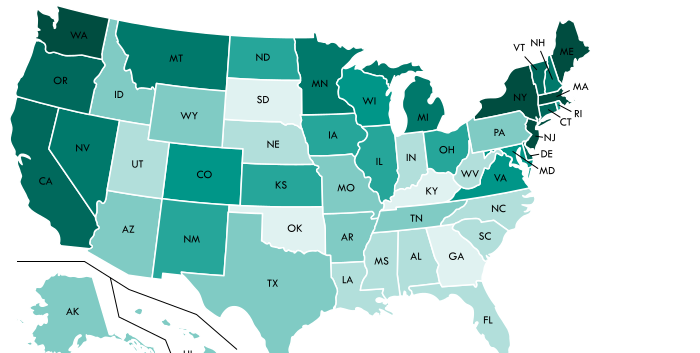
Most common states for project inspectors
| Rank | State | Population | # of jobs | Employment/ 1000ppl |
|---|---|---|---|---|
| 1 | District of Columbia | 693,972 | 190 | 27% |
| 2 | New Hampshire | 1,342,795 | 284 | 21% |
| 3 | Minnesota | 5,576,606 | 1,131 | 20% |
| 4 | North Dakota | 755,393 | 147 | 19% |
| 5 | Georgia | 10,429,379 | 1,723 | 17% |
| 6 | Nebraska | 1,920,076 | 319 | 17% |
| 7 | Wisconsin | 5,795,483 | 857 | 15% |
| 8 | New Mexico | 2,088,070 | 310 | 15% |
| 9 | Maine | 1,335,907 | 206 | 15% |
| 10 | Ohio | 11,658,609 | 1,656 | 14% |
| 11 | Indiana | 6,666,818 | 909 | 14% |
| 12 | Missouri | 6,113,532 | 857 | 14% |
| 13 | Iowa | 3,145,711 | 449 | 14% |
| 14 | Kansas | 2,913,123 | 409 | 14% |
| 15 | Idaho | 1,716,943 | 246 | 14% |
| 16 | South Dakota | 869,666 | 121 | 14% |
| 17 | Tennessee | 6,715,984 | 892 | 13% |
| 18 | Michigan | 9,962,311 | 1,155 | 12% |
| 19 | South Carolina | 5,024,369 | 589 | 12% |
| 20 | Nevada | 2,998,039 | 339 | 11% |
Most common cities for project inspectors
| Rank | City | # of jobs | Employment/ 1000ppl | Avg. salary |
|---|---|---|---|---|
| 1 | Akron | 2 | 1% | $71,580 |
| 2 | Metairie | 1 | 1% | $55,058 |
| 3 | Columbus | 2 | 0% | $68,299 |
| 4 | Albuquerque | 1 | 0% | $70,886 |
| 5 | Baltimore | 1 | 0% | $74,286 |
| 6 | Indianapolis | 1 | 0% | $58,258 |
| 7 | Philadelphia | 1 | 0% | $66,985 |
Project Inspector job outlook: Expert opinions
Our panel of project inspector experts
Southern Illinois University Edwardsville

Kennesaw State University

Penn State Behrend

Franklin and Marshall College
Old Dominion University
Dr. John Cabage
Chair, Associate ProfessorSouthern Illinois University Edwardsville
Construction Engineering Technology/Technician
What Project Inspector skills would you recommend for someone trying to advance their career?
Dr. John Cabage: The Construction Industry is robust and vital for the health of our nation. The industry is growing and will continue to grow in the future. Projects are becoming larger and more complex requiring teamwork and collaboration from partners of all walks both internal and external to the construction community.
Neil Opfer
Assoc. Professor - UNLV Civil & Environmental Engineering & Construction DepartmentWhat Project Inspector skills would you recommend for someone trying to advance their career?
Neil Opfer: First off, know what competitive salaries are in your area of the country for the type of job you want as you never have to recover from a good start. Some companies, for instance, will offer salaries that are simply not competitive. As an example, a few years ago, we had one CM graduate starting at $70K per year at one firm (heavy-highway contractor) whereas another grad had been offered $42K per year for a commercial flooring contractor. That $42K was simply not competitive with the market whether that employer offering that salary knew it or not. Also, compare offers versus area living costs. Use cost-of-living calculators such as at bankrate.com If you, using this bankrate.com tool, were offered one job in Las Vegas NV at $80,000 per year versus another job opportunity in Los Angeles CA, you would need $122,000 per year as a comparable salary. Remember to measure yourself as to earning that salary on a regular basis. Don't take jobs where a bonus is promised to make up for a bad salary. Example here is taking a Superintendent Job where your Job ended up profitable but other jobs run by others overall didn't so taking that lower salary and not getting that bonus didn't work out so well. Again, benchmark yourself against what others in the industry in that same area are actually getting paid. If you truly feel you deserve a raise where you're at but can't get it you may need to change jobs to get to a higher salary scale. But that firm offering above-market salaries may be doing so because of internal problems (bad bosses, poor working conditions, insane hours, insane understaffing, etc.) so look before you leap. It's a given that to be successful as a working professional in construction, one cannot just work a 40-hour week. But you shouldn't be working 7-10s or more on a regular basis either. Again, through networking you perhaps can find out who are the 'bad employers.'
Irish Horsey Ph.D.
Interim Chair of the Department of Construction Management and Assistant ProfessorKennesaw State University
Department of Construction Management
What soft skills should all Project Inspectors possess?
Irish Horsey Ph.D.: Leadership and communication are among the most essential skills of a construction manager. Construction managers are responsible for ensuring that projects are built safely on schedule, within budget, and to the quality outlined in the drawings and specifications. To fulfill these responsibilities, construction managers must lead multiple teams, including primary, secondary, and third party players, on a construction project through effective oral and written communications.
What experience really stands out on Project Inspector resumes?
Phil Stuczynski: Currently? I think a big one is going to be being flexible, showing you are able to adapt, and having any example of continuing to push through during these recent times.
We have had students who have literally been stuck. They have been in an apartment or a dormitory hours (or countries) away from home. And yet they still managed. They still did their coursework, they learned new software on the fly, they felt comfortable asking more questions than ever and even teaching themselves more as needed.
When we go back to something such as the great financial crisis, you had individuals who would sort of get burnt out when searching for a job. And to be fair, who could blame them. This was a strained economy and even the most qualified of candidates were hard pressed to find employment coming out of college when you had people with decades of experience competing just to continue bringing a paycheck in. However, you also had some individuals who would do what was necessary. For example I am keenly aware of an individual student I had years ago who was qualified for almost any job in a normal economy. That being said, he took a job with a bank where his degree wasn't even required. He was overqualified and knew it, but he would rather get experience than just sit around and do nothing. Fast forward a few years and he was not only at that bank only a short time before being promoted, but he used that promotion to move into yet a higher role later and has continued to enjoy success he may not have had if he was just waiting on a good job to come along.
What I'm saying is, the parallels here are through no fault of their own, students are going to enter an economy where things aren't as normal as they were just weeks before. This is going to sort itself out, but the students who push forward and adapt and just do something will stand out compared to those who sit on the sidelines and wait. Anything that highlights they are flexible and able to work in the face of disjointed operations or new limitations will not just find themselves being sought after, but because businesses need employees who can make quick changes on the fly more than ever, those students who can prove they can do it? They're going to be the ones who get ahead.
What are the biggest trends we'll see in the Project Inspector job market given the pandemic?
Nicole Jones Young Ph.D.: One big trend we will see is the continuation of working from home. It may not be for all employees every day, but I think that is definitely here to stay. Many employees have been asking for this benefit for years. After almost a year of working from home, many employers that were reluctant in the past have likely realized that employees can still be very productive and they can decrease expenses related to office space.
Another is related to the focus on diversity, equity, and inclusion related efforts. While the majority of the country was quarantined, we all witnessed the same horrific murder of George Floyd, and there was nothing else to distract us from finally directly addressing issues related to race in this country. Many employees of color, and particularly Black employees, are no longer interested in making everyone else around them feel comfortable. Organizations that issued statements and initiatives in the spring will likely be held more accountable than ever before.
Another trend may be the elimination of jobs in their previous iteration. Many companies that have survived, or even thrived, during COVID likely did so by adapting. As such, these organizations may not return to their prior ways of doing business, which may require employees and applicants to increase or highlight a different skill set.
Will there be an enduring impact of the coronavirus pandemic on Project Inspectors?
Robert Mcnab Ph.D.: Graduates will enter a workplace that is dramatically different than a couple of years ago. Remote work, which once was frowned upon by many managers, has become commonplace for many organizations. It is likely that many graduates will do most of their interviewing on Zoom or similar software and some may start their jobs remotely. We should not expect remote interviewing to go away as it increases efficiency and effectiveness. Economics graduates are likely to be in demand given the numerous economic shocks from the pandemic. Understanding how to communicate economic concepts and apply tools and techniques is of increasing importance.