Explore jobs
Find specific jobs
Explore careers
Explore professions
Best companies
Explore companies
Job outlook for regional property managers in the United States
Regional property manager job growth summary. After extensive research, interviews, and analysis, Zippia's data science team found that:
The projected regional property manager job growth rate is 3% from 2018-2028.
About 11,100 new jobs for regional property managers are projected over the next decade.
Regional property manager salaries have increased 5% for regional property managers in the last 5 years.
There are over 106,595 regional property managers currently employed in the United States.
There are 35,266 active regional property manager job openings in the US.
The average regional property manager salary is $79,788.
Are regional property manager jobs in demand?
Regional property manager job and salary trends over time
Regional property manager jobs over time
Regional property manager job growth rate over time
| Year | # of jobs | % of population |
|---|---|---|
| 2021 | 106,595 | 0.03% |
| 2020 | 99,837 | 0.03% |
| 2019 | 100,268 | 0.03% |
| 2018 | 92,001 | 0.03% |
| 2017 | 84,811 | 0.03% |
Average regional property manager salary over time
Regional property manager salary by year
| Year | Avg. salary | Hourly rate | % Change |
|---|---|---|---|
| 2025 | $79,788 | $38.36 | +1.5% |
| 2024 | $78,584 | $37.78 | +0.7% |
| 2023 | $78,022 | $37.51 | --0.6% |
| 2022 | $78,464 | $37.72 | +2.9% |
| 2021 | $76,284 | $36.67 | +3.0% |
Regional property manager jobs by state
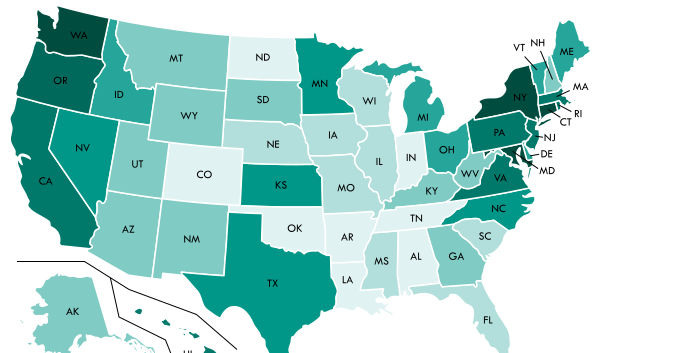
Most common states for regional property managers
| Rank | State | Population | # of jobs | Employment/ 1000ppl |
|---|---|---|---|---|
| 1 | District of Columbia | 693,972 | 315 | 45% |
| 2 | Massachusetts | 6,859,819 | 772 | 11% |
| 3 | Virginia | 8,470,020 | 811 | 10% |
| 4 | Maryland | 6,052,177 | 611 | 10% |
| 5 | Oregon | 4,142,776 | 408 | 10% |
| 6 | Illinois | 12,802,023 | 1,151 | 9% |
| 7 | Washington | 7,405,743 | 695 | 9% |
| 8 | Colorado | 5,607,154 | 531 | 9% |
| 9 | California | 39,536,653 | 3,031 | 8% |
| 10 | Pennsylvania | 12,805,537 | 971 | 8% |
| 11 | Georgia | 10,429,379 | 877 | 8% |
| 12 | North Carolina | 10,273,419 | 842 | 8% |
| 13 | New Jersey | 9,005,644 | 687 | 8% |
| 14 | Arizona | 7,016,270 | 536 | 8% |
| 15 | Indiana | 6,666,818 | 514 | 8% |
| 16 | Minnesota | 5,576,606 | 451 | 8% |
| 17 | Utah | 3,101,833 | 246 | 8% |
| 18 | Rhode Island | 1,059,639 | 87 | 8% |
| 19 | Delaware | 961,939 | 80 | 8% |
| 20 | New York | 19,849,399 | 1,353 | 7% |
Most common cities for regional property managers
| Rank | City | # of jobs | Employment/ 1000ppl | Avg. salary |
|---|---|---|---|---|
| 1 | Gaithersburg | 2 | 3% | $101,625 |
| 2 | Greenville | 2 | 3% | $70,709 |
| 3 | Farmington Hills | 2 | 2% | $82,665 |
| 4 | Atlanta | 6 | 1% | $74,342 |
| 5 | Cleveland | 3 | 1% | $84,655 |
| 6 | Saint Louis | 3 | 1% | $72,970 |
| 7 | Saint Paul | 3 | 1% | $86,330 |
| 8 | Irving | 2 | 1% | $87,076 |
| 9 | Plano | 2 | 1% | $86,836 |
| 10 | Chicago | 5 | 0% | $72,454 |
| 11 | Houston | 4 | 0% | $88,129 |
| 12 | San Francisco | 4 | 0% | $100,476 |
| 13 | Austin | 3 | 0% | $88,449 |
| 14 | Boston | 3 | 0% | $93,102 |
| 15 | Dallas | 3 | 0% | $87,101 |
| 16 | San Jose | 3 | 0% | $99,400 |
| 17 | Los Angeles | 2 | 0% | $88,278 |
| 18 | Raleigh | 2 | 0% | $87,108 |
Regional Property Manager job outlook: Expert opinions
Our panel of regional property manager experts
University of Alaska Fairbanks
Weber State University

Manhattan College

Sacred Heart University

Dedman College of Hospitality

Goldey-Beacom College

Centenary College of Louisiana

University of Arkansas at Little Rock
What Regional Property Manager skills would you recommend for someone trying to advance their career?
Jaunelle Celaire: Never stop learning! This may consist of going back to school, earning new certifications in your field of study, attending conferences and seminars, and making sure that your time management is always at its finest level of excellence.
Pieter Van Der Have
Chair, Construction and Building Sciences (CBS), Program Coordinator & Instructor, Facilities Management ProgramsWeber State University
Department of Construction and Building Sciences
What soft skills should all Regional Property Managers possess?
Pieter Van Der Have: People skills are always important but have to be tempered by legal and fiscal accountabilities. In many cases, the p.m. may end up being a project manager responsible for managing contracts and contractors.
What skills stand out on Regional Property Manager resumes?
Pieter Van Der Have: Communication and financial/accounting skills, closely followed by an understanding of how "smart" buildings function.
What skills will help Regional Property Managers earn the most?
Pieter Van Der Have: I believe understanding the true vision/purpose and the culture of the enterprise (company) is extremely essential to a successful career. Coupled, of course, with the ability to implement long-term planning activities and processes in support (exceeding?) the vision of the enterprise.
What hard/technical skills are most important for Regional Property Managers?
Pieter Van Der Have: Up-to-date computer skills are certainly desirable. I don't necessarily recommend that a p.m. have plumbing or electrical skills, though a general understanding of building systems could frequently be very useful.
What technical skills for a Regional Property Manager stand out to employers?
Dr. John Leylegian Ph.D.: I think almost any graduate will finish school with the same skill set in terms of technical knowledge. What can stand out is an ability to code and use various professional-grade software packages - the actual programming languages and software packages are secondary. If you can code in VBA, moving to Matlab or Python is not a big deal - it's just a matter of syntax. If you can use one CFD code or one FEA code, others will be much easier to learn. The foundation will be attractive to employers. Of course, the non-technical skills are SO important as well, most notably communication (speaking and writing).
What technical skills for a Regional Property Manager stand out to employers?
Keith Hassell: Employers are increasingly looking for applied skillsets and additional certifications to set a candidate apart. Sacred Heart University has recently launched a remote work certification, which houses three modules - focusing on the remote worker, the remote team and the remote leader, providing the tools and resources to comfortably leverage and utilize virtual platforms at various organizations. Additional specialized training, certifications and more are great selling tools pending on the specific area of interest. Certifications are common in areas such as project management, sales, IT/network/software, Google application and more. The candidate needs to think, "What can I do that is beyond my coursework to show I am passionate about my field? How do I make myself stand out?" Certifications is an attainable way to do this.
In addition, soft skills continue to be equally important in today's job market. NACE (the National Association of Colleges and Employers) identified seven core competencies that employers seek from entry level candidates which include critical thinking/problem solving, oral/written communication, teamwork/collaboration, digital technology, leadership, professionalism/work ethic, career management and global/intercultural fluency.
What are the biggest trends we'll see in the Regional Property Manager job market given the pandemic?
Alishia Piotrowski Ed.D.: The biggest trend that we are currently seeing is the move away from formal management training programs in favor of direct-placement positions. Companies are beginning to hire again, but the competition for these positions is strong. Within our student population, we are seeing a renewed interest in vacation destinations, such as beach resorts with strong drive markets. That is where we are seeing the most success with recruitment.
What's a good job out of college for Regional Property Managers?
Alishia Piotrowski Ed.D.: I think in today's market, students have to think less about the actual job, and think more about the company that they want to work for. I encourage students to look into different companies in their area of hospitality and assess how they feel they would "fit" into that company. What are the company's values? What type of culture has that company created? What are your opportunities for advancement, or for movement? These are the types of questions that a student should be asking. Unfortunately, in today's market, a great student may not get their "dream job" right out of college. But, if they target a company that they see themselves growing with, they should focus on finding any job within that company that would allow them to gain experience and to grow. If they do this, and they work hard, they will be much more likely to get that dream job once the industry has recovered and positions are available.
Will there be an enduring impact of the coronavirus pandemic on Regional Property Managers?
Dr. Nicole Evans: The full impact of the coronavirus pandemic is not yet known. Some industries have been hit harder than others. For example, demand for courier and logistic services has increased during the pandemic. On the other hand, sales in the hospitality industry have declined. On a positive note, young graduates are very adaptable and are just beginning their careers. They are very flexible and have numerous career options, so the impact will probably not be enduring and long term for them.
Dr. Barbara Davis
William J. Atkins DeanCentenary College of Louisiana
Frost School of Business
What experience really stands out on Regional Property Manager resumes?
Dr. Barbara Davis: Graduates participating in internships related to their areas of interest. Internships spanning more than one semester at the same firm stand out as well.
What skills stand out on Regional Property Manager resumes?
Dr. Timothy Edwards: Writing and research skills. Analytical and critical thinking skills. Technical skills such as web design, graphic design, audio and video production skills. Employers are interested in potential employees knowledge, intelligence and skills.
Are there any particularly good places in the United States for Regional Property Managers to find work opportunities?
Dr. Timothy Edwards: Like most jobs, opportunities exist in major media hubs like New York, Chicago, Los Angeles, Miami, Atlanta. But one can find digital media jobs in medium and small markets as well. Looking media and media-related jobs in non-traditional places such as hospitals, schools, colleges and universities, non-profit organizations, religious institutions could bear fruit for the enterprizing college graduate.