What does a reporting analyst do?

As a reporting analyst, you are responsible for collecting relevant reports, analyzing raw data, writing, and delivering executive-ready qualitative and/or quantitative reports as per clients' requirements. The results collected will be communicated to managers or clients, who will then provide suggestions based on their findings. This person must have excellent quantitative & qualitative analytical skills, a strong eye for detail, strong organizational and multitasking abilities, and be able to work on tight deadlines. Intermediate to advanced knowledge of Excel is a must for this position.
Reporting analyst responsibilities
Here are examples of responsibilities from real reporting analyst resumes:
- Accomplish in SOX compliance & internal audit & testing, business process documentation and supervising employee.
- Help manage SOX program for organization including control development.
- Manage data extractions to review attrition rates, management communication and annual review process through demographics study.
- Lead development of MicroStrategy base reporting system that clearly highlight previously unclear revenue from different customer segments.
- Charge with and achieve the production of accurate and timely monthly investor reports and reconciliations in accordance with applicable service agreements.
- Gather business requirements and deliver business analytics base solutions using structured/unstructure business data to help achieve measurable business outcomes for clients.
- Develop SAS programs using SAS/BASE, SAS/SQL, SAS/STAT, and SAS/MACROS for descriptive and inferential statistical analysis and data displays.
- Create analysis using ICD-9, DRG, CPT and UB -Revenue codes.
- Supply of bi weekly and ad-hoc productivity reporting.
- Create various types of charts to provide better visualization.
- Research trends and techniques to ensure compliance with GAAP reporting.
- Create tables, views in Teradata, according to the requirements.
- Plan and advise setting up XBRL tagging by new reporting requirements.
- Assist in Medicare cost report preparation and filing for several hospitals.
- Update pending cases with site changes and CPT code change request.
Reporting analyst skills and personality traits
We calculated that 9% of Reporting Analysts are proficient in Power Bi, Data Analysis, and Dashboards. They’re also known for soft skills such as Interpersonal skills, Time-management skills, and Problem-solving skills.
We break down the percentage of Reporting Analysts that have these skills listed on their resume here:
- Power Bi, 9%
Design and develop Power BI Dashboards from data warehouse for better prediction on the performance of cloud services.
- Data Analysis, 8%
Provided data analysis and documentation for senior management and Legal and Management Controls Division using Microsoft Excel and Business Objects.
- Dashboards, 8%
Developed weekly dashboards consisting of OBIEE Reports and published using BI publisher for executive reporting of corporate financial data.
- BI, 6%
Provided consultation on all BI related requests in other departments to help them obtain the reports easily from the Data Warehouse.
- Analyze Data, 6%
Analyze data model and create clinical and non-clinical reports/dashboards for distribution to end users using
- PowerPoint, 5%
Prepared and delivered PowerPoint presentations of utilization reports to customers; incorporated new HealthOne coverage reporting with traditional and CustomBlue.
"power bi," "data analysis," and "dashboards" are among the most common skills that reporting analysts use at work. You can find even more reporting analyst responsibilities below, including:
Interpersonal skills. To carry out their duties, the most important skill for a reporting analyst to have is interpersonal skills. Their role and responsibilities require that "management analysts work with managers and other employees of the organizations for which they provide consulting services." Reporting analysts often use interpersonal skills in their day-to-day job, as shown by this real resume: "display excellent interpersonal skills with a team-oriented focus. "
Time-management skills. Another essential skill to perform reporting analyst duties is time-management skills. Reporting analysts responsibilities require that "management analysts often work under tight deadlines and must use their time efficiently to complete projects on schedule." Reporting analysts also use time-management skills in their role according to a real resume snippet: "ensured hr related paperwork, reviews, terminations, and changes were completed and submitted on time. "
Problem-solving skills. This is an important skill for reporting analysts to perform their duties. For an example of how reporting analyst responsibilities depend on this skill, consider that "management analysts must be able to think creatively to solve clients’ problems." This excerpt from a resume also shows how vital it is to everyday roles and responsibilities of a reporting analyst: "created custom vba macros and recommended solutions to management. ".
Analytical skills. A big part of what reporting analysts do relies on "analytical skills." You can see how essential it is to reporting analyst responsibilities because "management analysts must be able to interpret information and use their findings to make proposals." Here's an example of how this skill is used from a resume that represents typical reporting analyst tasks: "introduce tableau for data visualization. "
Communication skills. A commonly-found skill in reporting analyst job descriptions, "communication skills" is essential to what reporting analysts do. Reporting analyst responsibilities rely on this skill because "management analysts must be able to convey information clearly in both writing and speaking." You can also see how reporting analyst duties rely on communication skills in this resume example: "provide communication within the organization to senior executive using various dashboards. "
The three companies that hire the most reporting analysts are:
- U.S. Bank120 reporting analysts jobs
- Ernst & Young88 reporting analysts jobs
- Bank of America77 reporting analysts jobs
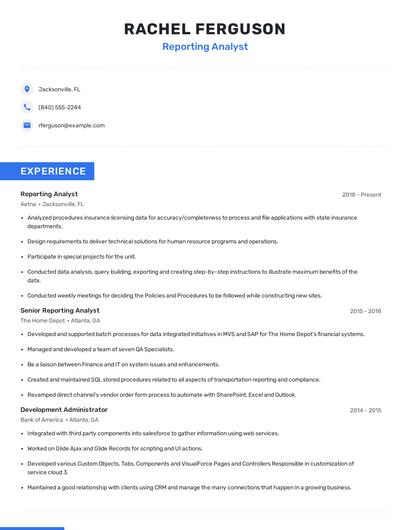
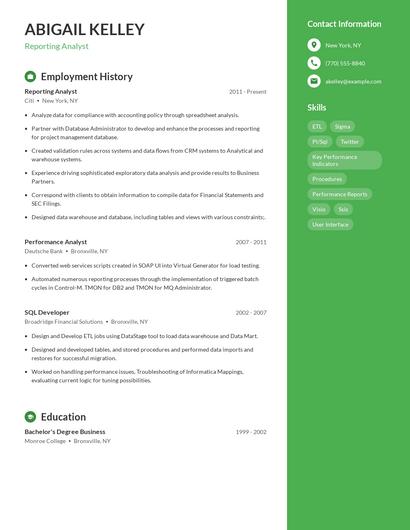
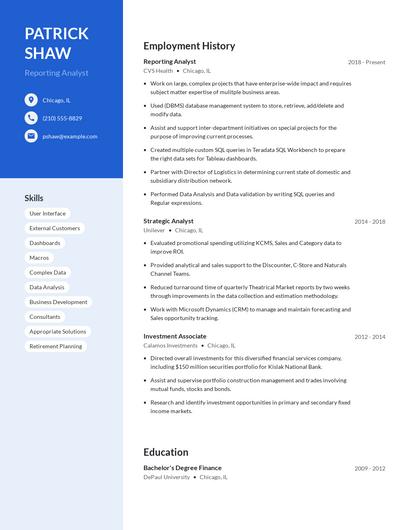
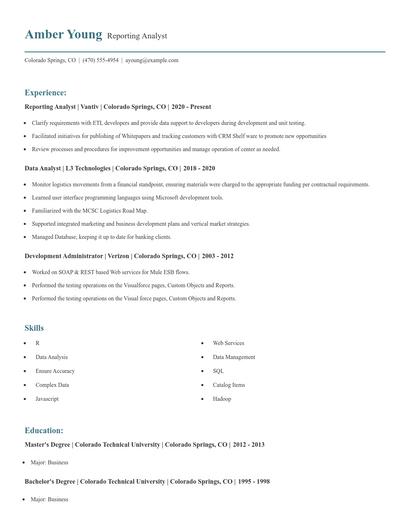
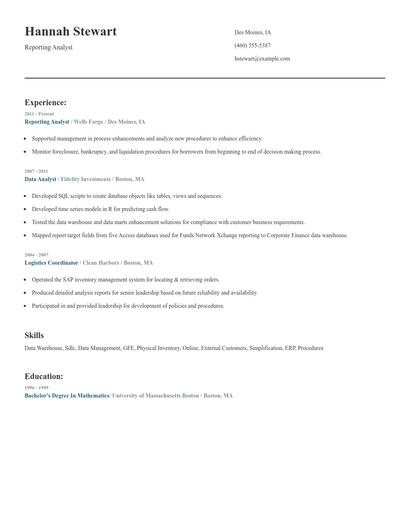
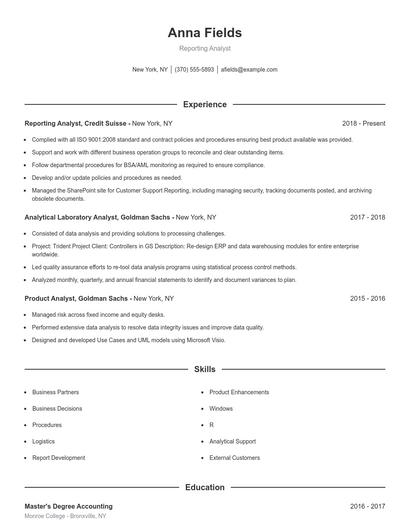
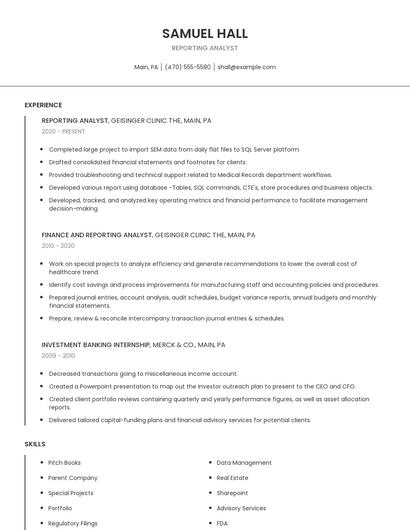
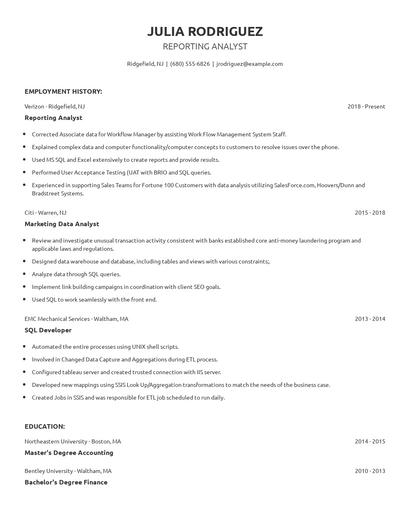
Choose from 10+ customizable reporting analyst resume templates
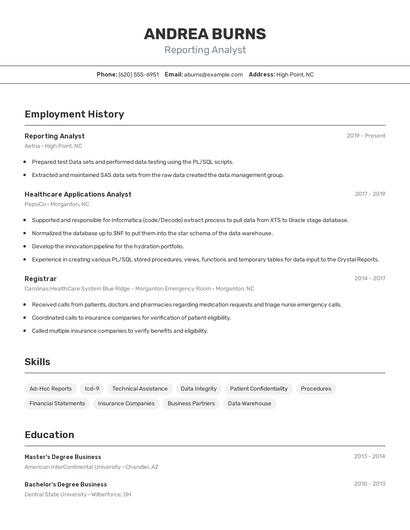
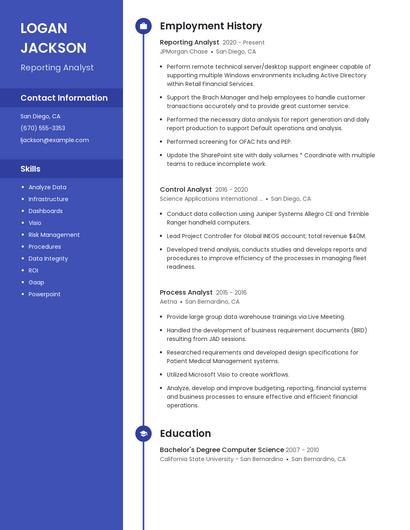
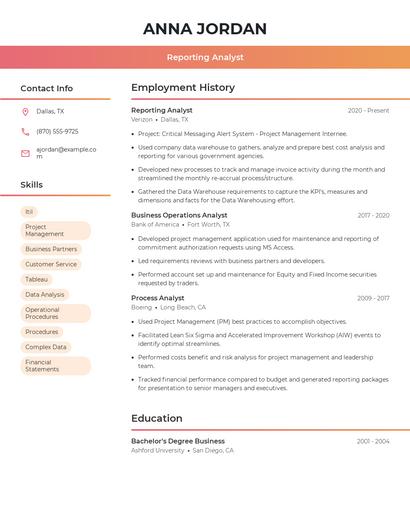
Build a professional reporting analyst resume in minutes. Our AI resume writing assistant will guide you through every step of the process, and you can choose from 10+ resume templates to create your reporting analyst resume.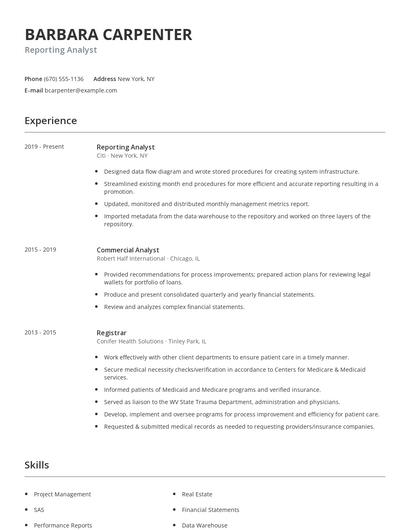
Compare different reporting analysts
Reporting analyst vs. Analyst lead
The duties of an analyst lead depend on one's line of work or industry of employment. Typically, their responsibilities revolve around performing research and analysis, coordinating with different departments to gather leads and data, reviewing findings, and producing reports and presentations for the stakeholders and other higher-ranking officials. Through the results, an analyst lead can provide advice, devise strategies for business optimization, spearhead the development of processes, identify strengths and weaknesses, and offer recommendations on areas in need of improvement. All of this is done while in adherence to the company's vision and mission.
While similarities exist, there are also some differences between reporting analysts and analyst lead. For instance, reporting analyst responsibilities require skills such as "dashboards," "analyze data," "pivot tables," and "vba." Whereas a analyst lead is skilled in "analytics," "project management," "excellent interpersonal," and "java." This is part of what separates the two careers.
Analyst leads earn the highest salaries when working in the finance industry, with an average yearly salary of $110,488. On the other hand, reporting analysts are paid more in the finance industry with an average salary of $82,064.The education levels that analyst leads earn slightly differ from reporting analysts. In particular, analyst leads are 3.7% more likely to graduate with a Master's Degree than a reporting analyst. Additionally, they're 0.6% more likely to earn a Doctoral Degree.Reporting analyst vs. Business process analyst
The business process analysts are responsible for producing, managing, and enhancing business processes to improve business performance using data. They gather, analyze, and transcribe information about internal processes to obtain a comprehensive picture of the company's internal workings. Their responsibilities include developing strategies, identifying the needs of the user, and communicating compound data in a comprehensible way. Also, they identify, implement, and assess business metrics that are essential to the end-users. Additionally, they may act as consultants to project teams providing them with recommendations for product or service improvement.
In addition to the difference in salary, there are some other key differences worth noting. For example, reporting analyst responsibilities are more likely to require skills like "power bi," "dashboards," "bi," and "analyze data." Meanwhile, a business process analyst has duties that require skills in areas such as "project management," "subject matter experts," "continuous improvement," and "lean six sigma." These differences highlight just how different the day-to-day in each role looks.
On average, business process analysts earn a higher salary than reporting analysts. Some industries support higher salaries in each profession. Interestingly enough, business process analysts earn the most pay in the manufacturing industry with an average salary of $92,966. Whereas reporting analysts have higher pay in the finance industry, with an average salary of $82,064.Average education levels between the two professions vary. Business process analysts tend to reach similar levels of education than reporting analysts. In fact, they're 4.2% more likely to graduate with a Master's Degree and 0.6% less likely to earn a Doctoral Degree.What technology do you think will become more important and prevalent for reporting analysts in the next 3-5 years?
Erik Johnson Ph.D.
Assistant Professor of Economics, Carthage College
Reporting analyst vs. Associate analyst
An associate analyst is an individual who is responsible for the research and investigation for a specific business process and department to help the senior staff make further decisions. Associate analysts must use their analytical skills to understand how the collected data can affect business decisions, then prepare reports that detail findings and recommend solutions. They must assist in developing new business models that can generate profits while reducing costs. Associate analysts can work in various industries ranging from finance and operations to information technology (IT) and marketing.
The required skills of the two careers differ considerably. For example, reporting analysts are more likely to have skills like "power bi," "dashboards," "bi," and "analyze data." But a associate analyst is more likely to have skills like "healthcare," "portfolio," "tableau," and "financial models."
Associate analysts make a very good living in the finance industry with an average annual salary of $88,076. On the other hand, reporting analysts are paid the highest salary in the finance industry, with average annual pay of $82,064.Most associate analysts achieve a similar degree level compared to reporting analysts. For example, they're 1.7% more likely to graduate with a Master's Degree, and 0.4% more likely to earn a Doctoral Degree.Reporting analyst vs. Procurement analyst
Procurement analysts procure favorable contracts by acting as liaisons between suppliers and their employers. They are hired by organizations that rely on supply chain management to analyze and evaluate potential suppliers, prepare reports about monthly supply costs, and negotiate contracts. With good critical thinking skills, these procurement analysts who are also known as purchasing analysts, evaluate vendors and suppliers based on the speed of delivery, quality, and price. They use quantitative methods to support fact-based decision-making to become competitive and to ensure cost-efficiency and high quality of the products and services.
Types of reporting analyst
Updated January 8, 2025
