What does a research and development specialist do?
Research and development are an integral part of any company. Providing new products and services consistently is a trait of a vibrant business ready for expansion. A research and development specialist focuses on collating data from different sources, analyzing information, and creating new ideas and development concepts. A research and development specialist's task is to support the R&D; department in management and generate updates and reports on each research task's status. The research and development process is vital, especially in medicine, technology, services and utilities, and consumer products.
Research and development specialist responsibilities
Here are examples of responsibilities from real research and development specialist resumes:
- General laboratory duties; coordinate maintenance of equipment, maintain ingredient and prototype inventory, manage shipping and receiving.
- Process scale-up under GLP conditions and assist technology transfer to GMP conditions.
- Assist with FDA submission drafting, assembly, and review.
- Organize engineering schematics using Orcad for a clean input to PCB layout.
- Interact and tour stability units with the FDA during inspection during the filing of a new product.
- Generate fundraising reports, prospect lists, briefings and PowerPoint presentations for various funding initiatives, meetings and regional travel visits.
- Fast prototyping of alternate energy devices.
- Make recommendations for desire and require instrument attributes for new GC and automation instrumentation.
- Optimize synthesis of multiple materials for industrial scale-up and implement procedures, testing methods and specifications for large scale production.
- Authore relevant CMC sections (process / formulation) for a Canadian regulatory filing
- Generate, analyze and report data for CMC section of drug submission application.
- Champion the adoption of USB, and develop the IP to make it a viable communications option for new products.
- Work closely with boston-base firm to develop protection strategies, monitor competitive IP, and identify business-critical jurisdictions for patent filing.
Research and development specialist skills and personality traits
We calculated that 13% of Research And Development Specialists are proficient in Data Analysis, R, and Elisa. They’re also known for soft skills such as Detail oriented, Analytical skills, and Technical skills.
We break down the percentage of Research And Development Specialists that have these skills listed on their resume here:
- Data Analysis, 13%
Conduct quantitative data analysis/statistical sampling and analysis and qualitative/emergent theme analysis for multiple research projects.
- R, 10%
Develop statistical analysis solutions using Bayes Statistics and R for quality control and marketing
- Elisa, 7%
Evaluated Quantitative ELISA protocol by Plackett-Burman Analysis.
- PCR, 6%
Project Management for Assay Development and Qualification of Real-Time PCR assays for relative gene expression level determination in cross-pollinated plants.
- Troubleshoot, 6%
Provide support in validation process into of troubleshoot systemic validation issues.
- Harvest, 6%
Conduct celery and radish trials, from planting to harvest.
Most research and development specialists use their skills in "data analysis," "r," and "elisa" to do their jobs. You can find more detail on essential research and development specialist responsibilities here:
Detail oriented. One of the key soft skills for a research and development specialist to have is detail oriented. You can see how this relates to what research and development specialists do because "market research analysts must pay attention to minutiae to evaluate data." Additionally, a research and development specialist resume shows how research and development specialists use detail oriented: "conducted detailed patent landscape studies and competitor patent research through data analysis to inform ourcompany's own practices. "
Analytical skills. Many research and development specialist duties rely on analytical skills. "market research analysts must evaluate large amounts of data and information related to market conditions.," so a research and development specialist will need this skill often in their role. This resume example is just one of many ways research and development specialist responsibilities rely on analytical skills: "performed quality review of colleagues assay results, data entry and verified equipment and reagents on data forms. "
Communication skills. A big part of what research and development specialists do relies on "communication skills." You can see how essential it is to research and development specialist responsibilities because "market research analysts must be able to clearly convey information when gathering material, interpreting data, and presenting results to clients." Here's an example of how this skill is used from a resume that represents typical research and development specialist tasks: "provided analysis, troubleshooting, & technical support for nearly 5, 000 employees with effective communication & organizational management. "
The three companies that hire the most research and development specialists are:
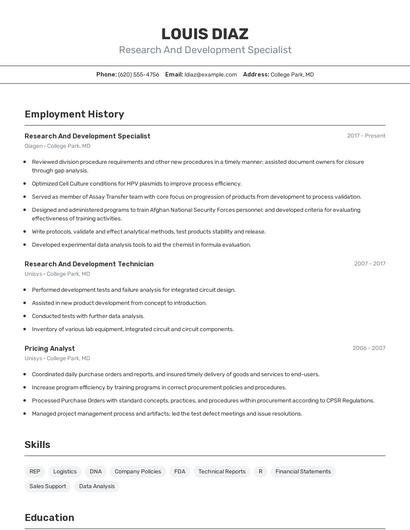
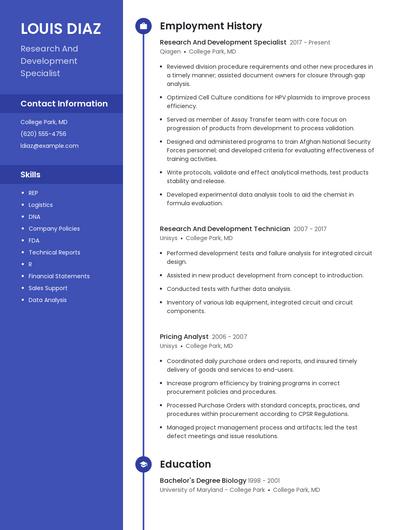
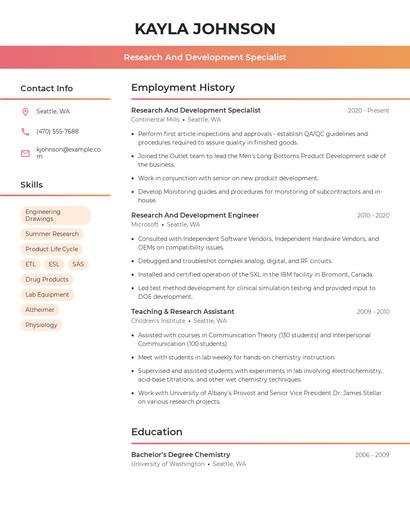
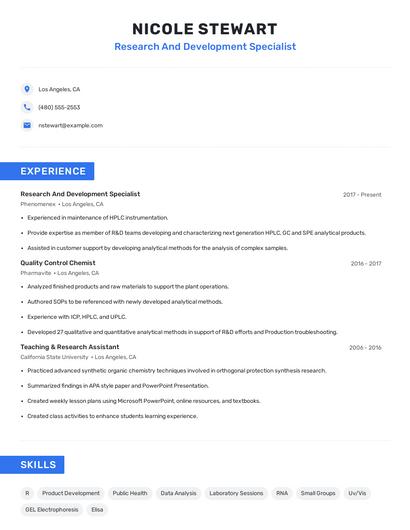
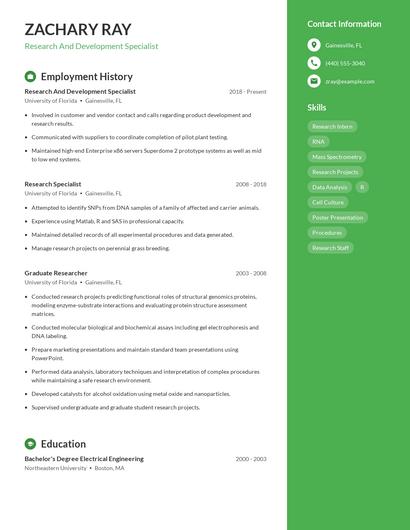
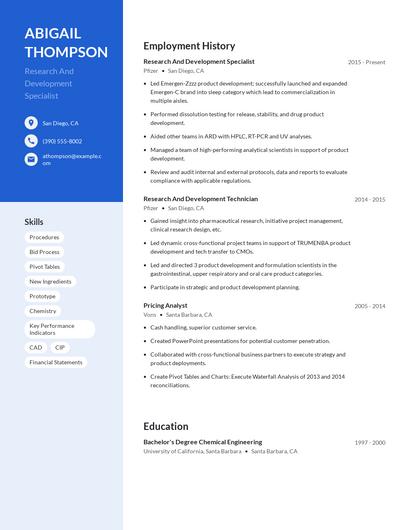
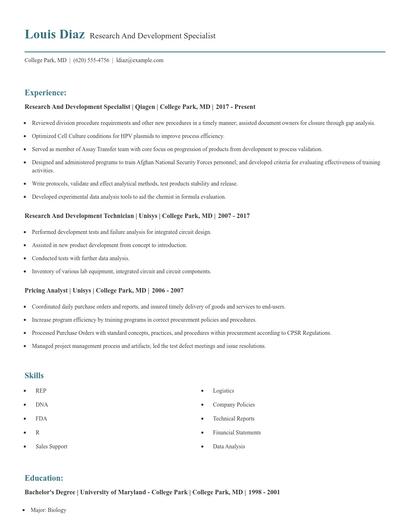
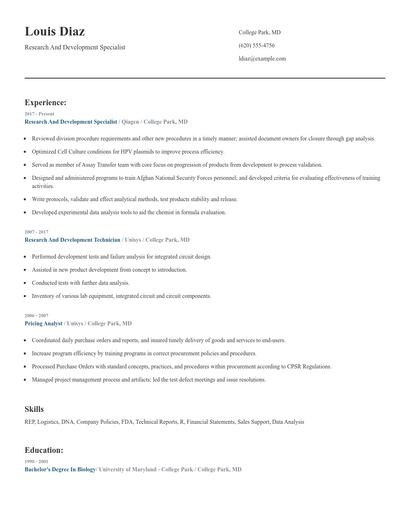
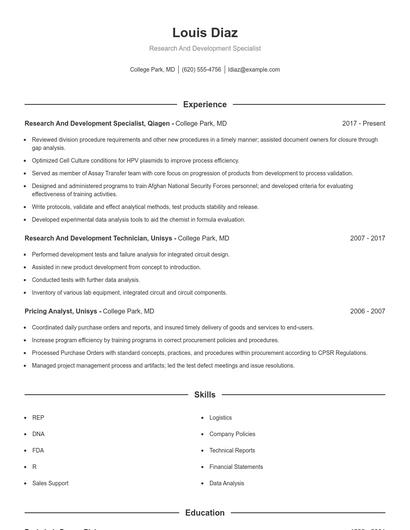
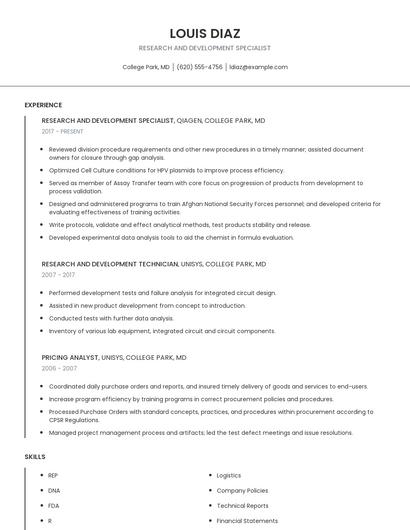
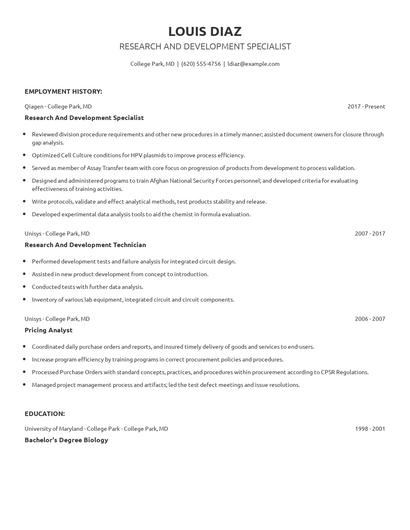
Choose from 10+ customizable research and development specialist resume templates
Build a professional research and development specialist resume in minutes. Our AI resume writing assistant will guide you through every step of the process, and you can choose from 10+ resume templates to create your research and development specialist resume.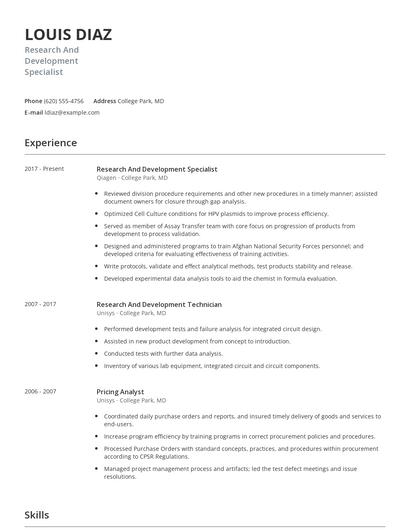
Compare different research and development specialists
Research and development specialist vs. Marketing coordinator
A marketing coordinator supports the marketing department on deciding strategies and business efforts to develop the brand image and boost customer satisfaction. Marketing coordinators' duties include assisting in advertising campaigns, scheduling promotional events, monitoring sales status, researching current market trends, maintaining a record of existing and potential clients, and contributing ideas to improve the brand's profitability. A marketing coordinator must have excellent critical thinking and writing skills to help with the creation of social media advertisements and marketing content. It also requires impressive time-management and multi-tasking skills, especially on meeting deadlines and making adjustments on the initial plans as needed.
There are some key differences in the responsibilities of each position. For example, research and development specialist responsibilities require skills like "data analysis," "r," "elisa," and "pcr." Meanwhile a typical marketing coordinator has skills in areas such as "digital marketing," "customer service," "marketing campaigns," and "email campaigns." This difference in skills reveals the differences in what each career does.
On average, marketing coordinators reach lower levels of education than research and development specialists. Marketing coordinators are 7.9% less likely to earn a Master's Degree and 3.0% less likely to graduate with a Doctoral Degree.Research and development specialist vs. Marketing internship
Marketing interns are usually marketing students or fresh graduates who are interested in getting actual work experiences before taking on a full-time job. They usually have an interest or academic background related to marketing. They assist marketing teams in most of their daily activities, sit in their meetings, record minutes of these meetings, take note of action plans, and attend other events related to marketing. They also assist in preparing collateral and other marketing materials, join brainstorming sessions, or any other activity that will help enrich their experience.
In addition to the difference in salary, there are some other key differences worth noting. For example, research and development specialist responsibilities are more likely to require skills like "r," "elisa," "pcr," and "troubleshoot." Meanwhile, a marketing internship has duties that require skills in areas such as "digital marketing," "facebook," "marketing campaigns," and "press releases." These differences highlight just how different the day-to-day in each role looks.
In general, marketing interns achieve lower levels of education than research and development specialists. They're 8.8% less likely to obtain a Master's Degree while being 3.0% less likely to earn a Doctoral Degree.What technology do you think will become more important and prevalent for research and development specialists in the next 3-5 years?
Dr. Gail Hudson Ph.D.
Director, College of Business Internship Program, Arkansas State University
Research and development specialist vs. Marketing assistant
A marketing assistant's general responsibility is to support the marketing programs and campaigns by sharing recommendations and useful insights to improve the brand's image. Marketing assistants' duties also include reaching out to other personnel for necessary files needed on promotional advertisements, assist the team in creating designs and developing content, publishing brochures for potential clients, analyzing sales reports, and researching the current market trends. A marketing assistant should have excellent organizational and time-management skills to meet deadlines and perform various tasks as required.
The required skills of the two careers differ considerably. For example, research and development specialists are more likely to have skills like "data analysis," "r," "elisa," and "pcr." But a marketing assistant is more likely to have skills like "customer service," "marketing campaigns," "facebook," and "email campaigns."
When it comes to education, marketing assistants tend to earn lower degree levels compared to research and development specialists. In fact, they're 9.3% less likely to earn a Master's Degree, and 3.0% less likely to graduate with a Doctoral Degree.Research and development specialist vs. Research manager
A Research Manager performs research, data collection, and economic, statistical, and demographic analysis. They also determine and implement research and development strategies, policies, and plans.
Even though a few skill sets overlap between research and development specialists and research managers, there are some differences that are important to note. For one, a research and development specialist might have more use for skills like "elisa," "pcr," "troubleshoot," and "harvest." Meanwhile, some responsibilities of research managers require skills like "market research," "analytics," "quantitative research," and "patients. "
The average resume of research managers showed that they earn higher levels of education compared to research and development specialists. So much so that theyacirc;euro;trade;re 5.7% more likely to earn a Master's Degree and more likely to earn a Doctoral Degree by 1.3%.Types of research and development specialist
Updated January 8, 2025
