
Automatically apply for jobs with Zippia
Upload your resume to get started.
Respiratory supervisor skills for your resume and career

15 respiratory supervisor skills for your resume and career
1. Patients
- Assisted in developing post-operative care as the organization started a pediatric open-heart program and worked clinically with these patients.
- Performed home set-ups, patient / family education, clinically monitored home patients and performed related equipment management functions.
2. BLS
- Served as home based NRP instructer, BLS instructor, Pals instructor.
- Maintain certifications in BLS, PALS, ACLS, NRP as well as an active license for a Registered Respiratory Therapist.
3. Acls
- Certified in ACLS and CPR -My duties consist of patient assessments, daily physician's interventions, and chart reviews.
- Responded to all cardiopulmonary emergency requests and rendered care as per ACLS standards with strong knowledge of the process.
4. Acute Care
The branch of secondary healthcare which is responsible for giving short-term care to patients recovering from severe injuries or urgent medical problems is known as acute care. Acute care comprises multiple domains like; emergency care, urgent care, short-term stabilization, pre-hospital care, critical care, and trauma care.
- Assess and provide medically necessary respiratory treatments and services to patients in the neonatal/pediatric intensive care and acute care setting.
- Assess and provide medically necessary respiratory treatments and services to patients in the neonatal/pediatric intensive care and acute care setting.
5. NRP
Neonatal Resuscitation Program refers to a training program for providers of newborn resuscitation. It's a program created by the AAP and the American Heart Association to provide a comprehensive stepwise algorithm for assessing and resuscitating the infant at delivery.
- Stabilize patient and initiate NRP as needed including resuscitation, ventilator initiation and management, and oxygen administration.
- Involved in all labor and deliveries, utilizing NRP skills in a fast paced environment with quick decisions.
6. CPR
Cardiopulmonary resuscitation or CPR is a medical procedure that involves chest compression to help a patient breathe. This artificial ventilation helps in keeping the brain function in place and regulates blood throughout the body. CPR is a lifesaving procedure that is used in emergencies.
- Provide emergency care such as manual ventilation, intubation,and CPR.
- Participated in shift reports, CPR, ventilator management, administration of aerosol medications, oxygen administration, and patient assessments.
Choose from 10+ customizable respiratory supervisor resume templates
Build a professional respiratory supervisor resume in minutes. Our AI resume writing assistant will guide you through every step of the process, and you can choose from 10+ resume templates to create your respiratory supervisor resume.7. Advanced Life Support
- Developed and delivered respiratory training to hospital staff and qualified 20 personnel in Basic Life Support and pediatric Advanced Life Support.
8. Ventilation
- Experience in Arterial Blood Gases, Electrocardiograms, Bronchoscopy, Pulmonary function testing, Mechanical Ventilation etc.
- Conducted therapeutic procedures to maintain a patent airway, removed via suctioning of secretions, to achieve adequate ventilation & oxygenation.
9. Respiratory Care
Respiratory care is the medical care discipline of having expertise in the treatment of illnesses and preventative care related to cardiopulmonary health.
- Monitor branch compliance to quality assurance and control procedures by conducting routine audits of respiratory care services provided.
- Supervised respiratory technicians and therapists in the delivery of respiratory therapy in all areas of respiratory care.
10. NICU
- Assisted in development of staff for new NICU, implemented new protocols.
- General respiratory patient care (Adults, PICU, and NICU).
11. Resuscitation
- Perform cardiopulmonary resuscitation and related Respiratory Care responsibilities.
- Perform cardiopulmonary resuscitation according to resuscitation guidelines.
12. Departmental Policies
- Assist in the development and implementation of departmental policies and procedures.
13. Direct Patient Care
- Shift supervisor for 5-10 respiratory therapist per shift, provided direct patient care and staff resources.
- Managed the day to day direct patient care provided by a minimum of ten respiratory care practitioners.
14. Performance Evaluations
Performance evaluation is a formal and productive process to measure an employee's work and results based on their job responsibilities over a defined period of time and to properly measure an employee's contribution to the workforce and employers and achieve a high level of quality and quantity of work produced. The evaluation also helps employees provide information about deficiencies in job performance and the company's expectations for the future.
- Performed human resource functions such as interviewing candidates, performance evaluations, and disciplinary actions.
- Conducted performance evaluations, and scheduled assignments.
15. Staff Development
- Direct professional Respiratory Therapy personnel; participate in staff development and evaluation of job skills.
5 Respiratory Supervisor resume examples
Build a professional respiratory supervisor resume in minutes. Browse through our resume examples to identify the best way to word your resume. Then choose from 5+ resume templates to create your respiratory supervisor resume.

What skills help Respiratory Supervisors find jobs?
Tell us what job you are looking for, we’ll show you what skills employers want.
List of respiratory supervisor skills to add to your resume
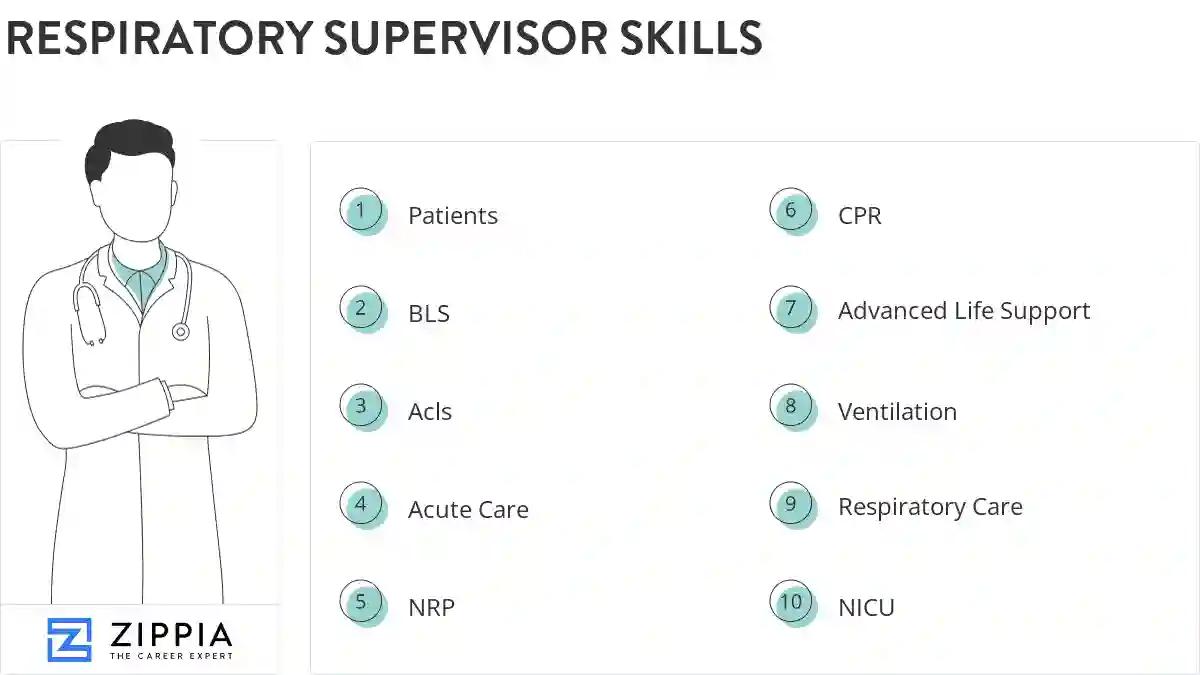
The most important skills for a respiratory supervisor resume and required skills for a respiratory supervisor to have include:
- Patients
- BLS
- Acls
- Acute Care
- NRP
- CPR
- Advanced Life Support
- Ventilation
- Respiratory Care
- NICU
- Resuscitation
- Departmental Policies
- Direct Patient Care
- Performance Evaluations
- Staff Development
- Rehabilitation
- Quality Patient Care
- EKG
- Disciplinary Actions
- Excellent Organizational
- Intubation
- Picu
- Healthcare Professionals
- Medical Equipment
- Infection Control
- Home Health
- Respiratory Therapy
- Oxygen Therapy
- Staff Education
- JCAHO
- Patient Education
- Direct Supervision
- FTE
- Patient Assessment
- COPD
- ABG
- Performance Appraisals
- Resource Person
- CPT
- Nebulizer
- Respiratory Equipment
- Performance Reviews
- Critical Care
- Asthma
- CPAP
- BiPAP
- Staff Scheduling
Updated January 8, 2025
