
Automatically apply for jobs with Zippia
Upload your resume to get started.
Revenue collector skills for your resume and career
15 revenue collector skills for your resume and career
1. Customer Service
Customer service is the process of offering assistance to all the current and potential customers -- answering questions, fixing problems, and providing excellent service. The main goal of customer service is to build a strong relationship with the customers so that they keep coming back for more business.
- Served as primary customer service representative for payer inquiries/calls and secondary for patient inquiries/calls.
- Field investigator and customer service agent.
2. Motor Vehicle
A motor vehicle is a mode of transportation such as a car, truck or bus.
- Stayed abreast with all rules and regulations regarding tags, and titles both from Tallahassee and Department of Motor Vehicles.
- Prepared and processed registrations, titles, lien applications and related documents for motor vehicles and boats.
3. Driver License
- Examined legal presence/Immigration documents to process Driver License transactions.
- Remove sanctions from Driver Licenses using appropriate documentation.
4. DMV
DMV is the department of motor vehicles in the United States of America. DMV is an agency that is state level and is under the control of the government. It deals with driver's license and registration of vehicles.
- Accessed DMV software to assist in providing information on vehicles.
- Branch Manager* Supervised, directed, and motivated staff of 25 to act as agents of the DMV and the Dept.
5. Business Licenses
- Conduct asset and business license research
- Attend meetings for Business License Officials Association, Bankruptcy, and Tax Collector's Association of the Palmetto State.
6. Property Tax Payments
- Informed tax payers of laws, rules, and regulations governing the receipt and processing of property tax payments.
- Collect property tax payments, issue electrical, gas, and building permits, and handle city's insurance claims.
7. Payment Arrangements
- Negotiate payment arrangements on past due accounts while leveraging auto-dial system to initiate customer contact and determine reason for delinquency.
- Managed multiple accounts and developing professional relationships with debtors by working with them to develop repayment arrangements for delinquent accounts.
8. Real Estate
Real estate is land that has buildings on it. This kind of property consists of permanent improvements either natural or man-made, which include, houses, fences, bridges, water trees, and minerals. There are 4 types of real estate namely; residential real estate, commercial real estate, industrial real estate, and vacant land.
- Estimated commercial and noncommercial real estate
- Estimate commercial and noncommercial real estate values and the probable forced-sale value of assets.
9. Property Taxes
- Processed and collected payments on tag & title work, parking tickets, property taxes, and business taxes.
- Collected property taxes for every local government agency with the power to levy taxes.
10. EOB
EOB stands for explanation of benefits. This is a common outline provided as part of many health insurance plans to explain what services were completed, the co-pay required for each appointment, and how much of your payment is covered by health insurance. EOB is an indication that your insurance claim has already been processed.
- Reviewed and interpreted Explanation of Benefits (EOB) for denials and underpayment of codes.
- Worked appeals, denials, and made adjustments according to EOB.
11. Birth Certificates
- Process Animal Licenses, Hunting and Fishing License, Birth Certificates and JEA payments.
12. Medicare
Medicare is a federal government insurance program that offers health care coverage to people who are 65 and above. In some cases, younger people with disabilities whose status is identified by the SSA can also avail the insurance program. Medicare covers the health expenses of people who are not able to afford it plus it protects the payee from rising health care costs.
- Partnered with Medicare, Medicaid, and Blue Cross insurance companies regarding denials.
- Partnered with Medicaid, Medicare, Blue Cross, Aetna and other major payers to improve denial management.
13. Bank Deposits
Any money that a customer chooses to leave with their bank account is a deposit. Deposits can vary in amounts and different banks have limits on the deposits their customers can have as a minimum. Banks charge customers for deposits especially when a teller is used by the customer to deposit money into their account.
- Collect taxes, data entry on multiple spreadsheets, calculate monthly collections, bank deposits, balance bank account.
- Reconcile daily cash drawer to receipts and prepare bank deposits to turn over to Treasurer's office.
14. Customer Complaints
- Handled customer complaints and questions at the stations.
- Skilled in problem solving and handling customer complaints.
15. Outbound Calls
An outbound call is made by the call center representative to the customers on behalf of the company. Such calls help increase sales and generate revenue for the organization.
- Formulated solutions to delinquent financial situations, effectively conducting outbound calls to retrieve funds on delinquent consumer loan accounts.
- Utilized time management skills to effectively handle large volume of inbound/outbound calls while managing accounts

What skills help Revenue Collectors find jobs?
Tell us what job you are looking for, we’ll show you what skills employers want.
List of revenue collector skills to add to your resume
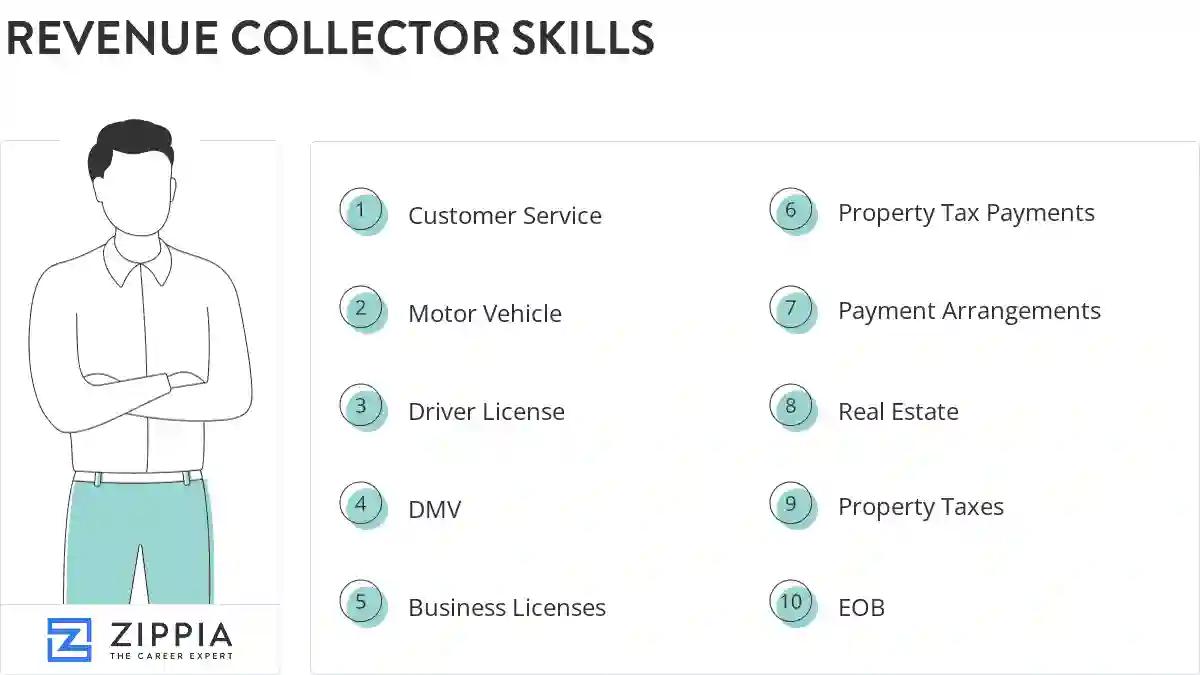
The most important skills for a revenue collector resume and required skills for a revenue collector to have include:
- Customer Service
- Motor Vehicle
- Driver License
- DMV
- Business Licenses
- Property Tax Payments
- Payment Arrangements
- Real Estate
- Property Taxes
- EOB
- Birth Certificates
- Medicare
- Bank Deposits
- Customer Complaints
- Outbound Calls
- Healthcare
Updated January 8, 2025
