Explore jobs
Find specific jobs
Explore careers
Explore professions
Best companies
Explore companies
Job outlook for senior healthcare consultants in the United States
Are senior healthcare consultant jobs in demand?
Senior healthcare consultant job and salary trends over time
Senior healthcare consultant jobs over time
Senior healthcare consultant job growth rate over time
| Year | # of jobs | % of population |
|---|---|---|
| 2021 | 2,709 | 0.00% |
| 2020 | 2,588 | 0.00% |
| 2019 | 2,502 | 0.00% |
| 2018 | 2,413 | 0.00% |
| 2017 | 2,324 | 0.00% |
Average senior healthcare consultant salary over time
Senior healthcare consultant salary by year
| Year | Avg. salary | Hourly rate | % Change |
|---|---|---|---|
| 2026 | $88,362 | $42.48 | +2.8% |
| 2025 | $85,943 | $41.32 | +2.0% |
| 2024 | $84,279 | $40.52 | +1.4% |
| 2023 | $83,110 | $39.96 | +1.4% |
| 2022 | $81,981 | $39.41 | +0.0% |
Senior healthcare consultant jobs by state
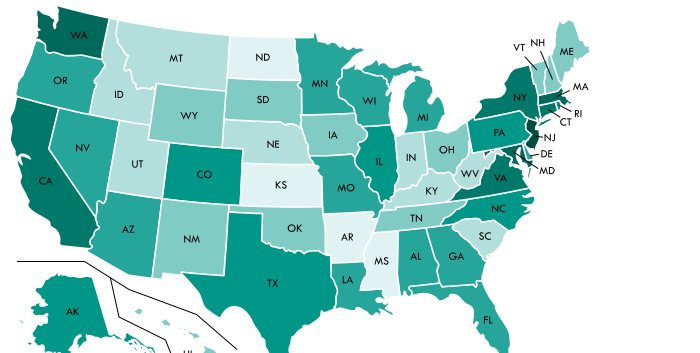
Most common states for senior healthcare consultants
| Rank | State | Population | # of jobs | Employment/ 1000ppl |
|---|---|---|---|---|
| 1 | District of Columbia | 693,972 | 462 | 67% |
| 2 | South Dakota | 869,666 | 162 | 19% |
| 3 | Vermont | 623,657 | 121 | 19% |
| 4 | Rhode Island | 1,059,639 | 171 | 16% |
| 5 | New Mexico | 2,088,070 | 307 | 15% |
| 6 | West Virginia | 1,815,857 | 264 | 15% |
| 7 | Tennessee | 6,715,984 | 930 | 14% |
| 8 | Maine | 1,335,907 | 191 | 14% |
| 9 | Indiana | 6,666,818 | 900 | 13% |
| 10 | Delaware | 961,939 | 122 | 13% |
| 11 | South Carolina | 5,024,369 | 598 | 12% |
| 12 | Alabama | 4,874,747 | 587 | 12% |
| 13 | Kentucky | 4,454,189 | 530 | 12% |
| 14 | Utah | 3,101,833 | 383 | 12% |
| 15 | New Hampshire | 1,342,795 | 166 | 12% |
| 16 | Wyoming | 579,315 | 71 | 12% |
| 17 | Michigan | 9,962,311 | 1,094 | 11% |
| 18 | Virginia | 8,470,020 | 932 | 11% |
| 19 | Massachusetts | 6,859,819 | 771 | 11% |
| 20 | Connecticut | 3,588,184 | 402 | 11% |
Most common cities for senior healthcare consultants
| Rank | City | # of jobs | Employment/ 1000ppl | Avg. salary |
|---|---|---|---|---|
| 1 | Annapolis | 9 | 23% | $98,781 |
| 2 | Frankfort | 6 | 22% | $77,066 |
| 3 | Dover | 5 | 13% | $82,807 |
| 4 | Juneau | 4 | 12% | $90,024 |
| 5 | Lansing | 9 | 8% | $86,825 |
| 6 | Cypress | 4 | 8% | $93,657 |
| 7 | Little Rock | 5 | 3% | $67,354 |
| 8 | Des Moines | 5 | 2% | $81,085 |
| 9 | Saint Paul | 5 | 2% | $83,951 |
| 10 | Baton Rouge | 4 | 2% | $83,308 |
| 11 | Montgomery | 4 | 2% | $86,799 |
| 12 | Tallahassee | 4 | 2% | $86,043 |
| 13 | Boston | 7 | 1% | $100,942 |
| 14 | Atlanta | 5 | 1% | $84,269 |
| 15 | Indianapolis | 5 | 1% | $75,713 |
| 16 | Sacramento | 5 | 1% | $103,393 |
| 17 | Denver | 4 | 1% | $90,801 |
| 18 | Phoenix | 4 | 0% | $85,908 |
Senior Healthcare Consultant job outlook: Expert opinions
Our panel of senior healthcare consultant experts
Oklahoma State University - Oklahoma City
Spalding University
University of Alabama at Birmingham
University of Nevada - Las Vegas
The University of Texas Medical Branch
University of West Florida

Lewis-Clark State College

Coastal Carolina University
Florida State University

Lasell University
Bucknell University
Clarion University of Pennsylvania
University of Texas at El Paso
University of Central Missouri
University of Michigan
Southern Utah University

Chapman University
Villanova University
Indiana University South Bend
Penny Ridenour
Dean of School of Health SciencesOklahoma State University - Oklahoma City
Health Services/Allied Health/Health Sciences
What general advice would you give to a Senior Healthcare Consultant?
Penny Ridenour: Maximize earnings by being flexible to fit the employer's needs. Accept assignments that promote growth in your desired specialization.
What Senior Healthcare Consultant skills would you recommend for someone trying to advance their career?
Penny Ridenour: Commit to lifelong learning in healthcare due to its innovative nature. Technological proficiency is crucial for adapting to changes.
What will help Senior Healthcare Consultants increase their earning potential?
Penny Ridenour: Pay attention to soft skills such as listening, empathy, and communication. Develop skills in resiliency to excel in healthcare.
Craig Kimble PHARMD, MBA, MS, BCACP, TTS
Associate ProfessorWhat general advice would you give to a Senior Healthcare Consultant?
Craig Kimble PHARMD, MBA, MS, BCACP, TTS: -Be open minded and willing to explore areas of practice. Many employers start you out in a high needs area and move you as positions come open.
-If you are not geographically restricted, the sky is the limit. Discuss what your goals are with recruiters.
-Be willing to learn new skills and put them to work. An entrepreneurial mindset will facilitate communication with supervisors. Present ideas and take their advice.
What Senior Healthcare Consultant skills would you recommend for someone trying to advance their career?
Craig Kimble PHARMD, MBA, MS, BCACP, TTS: -Healthcare informatics
-Ability to be bilingual
-Clinical skills to practice at an advanced level
-Good communication skills
-Entrepreneurial mindset – healthcare is changing and how we deliver it will to; we must all become efficient and cost-effective providers of quality care.
What will help Senior Healthcare Consultants increase their earning potential?
Craig Kimble PHARMD, MBA, MS, BCACP, TTS: -Be willing to be flexible (shifts, locations, etc..). Be willing to cover extra shifts if needed. Consider floating if needed as well. This is very needed by many employers
-Ask a recruiter/interviewer, what a successful employee looks like for that organization. Spell out success.
-Set goals with your new supervisor. What do we need to achieve and what are some stretch goals?
Jacey Maple MSN, RN
Assistant ProfessorSpalding University
Health Services/Allied Health/Health Sciences
What general advice would you give to a Senior Healthcare Consultant?
Jacey Maple MSN, RN: Looking at trends in healthcare I would focus on the following skills to hone over the next 3-5 years: Strong Communication and Interpersonal Collaboration, Emotional Resilience, Networking and building professional relationships.
What Senior Healthcare Consultant skills would you recommend for someone trying to advance their career?
Jacey Maple MSN, RN: Starting out I would consider and implement the following practices: Acquire relevant education and build up certifications, research salary trends to communicate them at interviews, continue to polish and build your resume and/or CV, stay updated on industry changes, and lastly seek out all opportunities to grow your experience and expertise in your field.
What will help Senior Healthcare Consultants increase their earning potential?
Jacey Maple MSN, RN: My best advice for those entering any health service field is to seek out mentorship and guidance. Find mentors who can guide you in your career journey. Look for experienced professionals who can offer insights, advice, and support. A mentor can help you navigate challenges, make informed decisions, and provide valuable connections.
What general advice would you give to a Senior Healthcare Consultant?
J'Aime Jennings PhD: These are not concrete rules, but individuals at the start of their career can maximize their salary potential by gaining experience and growing their skillset to be of benefit to their respective organizations. In the beginning say “yes” to participating on projects whether you are excited about them or not. The knowledge gained may be invaluable to the next project that does excite you. Consider various certifications (e.g., LEAN Six Sigma, Project Management, etc.) that help you grow your knowledge base while also helping you stand out from others.
What Senior Healthcare Consultant skills would you recommend for someone trying to advance their career?
J'Aime Jennings PhD: My general advice would be to pursue all the opportunities available to you and don’t shy away from the challenging tasks. Additionally, graduates should know that the learning never ends; the classroom gives you the foundation upon which to build your knowledge and skills, but it cannot capture the myriad of scenarios and tough decisions you are bound to face throughout your career.
What will help Senior Healthcare Consultants increase their earning potential?
J'Aime Jennings PhD: I believe that interpersonal and communication skills that aid you in interacting with individuals and teams and allow for you to convey important information coherently across varied stakeholder audiences will be crucial for any graduate pursuing a career in healthcare administration. In addition, adaptability is another vital skill. Healthcare is ever changing, and administrators must have a plan but also be ready for contingencies when new developments occur. Critical thinking and analytic skills, as well as knowledge about artificial intelligence (AI) capabilities will certainly be prevalent skills for the field.
Jay Shen
Professor and Association DeanUniversity of Nevada - Las Vegas
Health And Medical Administrative Services
What general advice would you give to a Senior Healthcare Consultant?
Jay Shen: Understand that your career is a marathon, not a sprint. Get any job in a healthcare organization and learn what you like and don’t like.
What Senior Healthcare Consultant skills would you recommend for someone trying to advance their career?
Jay Shen: There is a 2015 Carnegie Institute study that shows 85% of your financial success is based on your soft skills. As a healthcare executive you need to be able to bring diverse professionals together to solve complex problems for the good of the patient and the organizations. Continue to polish your soft skills, e.g., effective leadership, goal setting and achievement, leading meetings for positive results.
What will help Senior Healthcare Consultants increase their earning potential?
Jay Shen: Don’t chase salary. Do what you love and get the best you can be. Salary fails to motivate past getting your basic needs met.
What general advice would you give to a Senior Healthcare Consultant?
Dr. K. Garling-Nañez Pharm.D.: Resilience and self-awareness are currently essential and will continue to be necessary. Burnout is very high in healthcare-related fields. Therefore, it is vital to have the coping skills and the ability to communicate to ensure your job is healthy and productive.
Flexibility and a growth mindset will also be an asset to most industries. In healthcare, most opportunities exist where other people may feel unqualified or need more experience. The more out-of-the-box tasks and opportunities you take, the more tools you'll have to get significant positions in the future.
Don't be afraid of something you aren't familiar with or perceive that you are not 'good at' since those areas are often where you can thrive the most. Being fearless in your pursuits and learning from perceived failures will put you in the upper ranks of your peers.
What Senior Healthcare Consultant skills would you recommend for someone trying to advance their career?
Dr. K. Garling-Nañez Pharm.D.: Take the initiative to be well-versed in the areas for advancement in your field or the positions of interest, paving your path to success. If you have to take a position out of necessity, continue to build your CV with a goal in mind for the future. If you continue to learn and grow, you'll be more flexible and be able to take positions others shy away from.
Make sure the salary you expect aligns with the location, the need, and your experience. High salaries often do not equal job satisfaction; therefore, before applying, decide your career priorities. Quality of life frequently requires compromise in other areas, including commutes, schedule, salary, and responsibilities.
Lastly, salary potential is often tied to corporate culture and opportunities for advancement. In offices or facilities with a 'more with less' mindset, where efficiency and cost-cutting are prioritized, fewer salary benefits may be available, and more 'thankless' tasks may be assigned.
What will help Senior Healthcare Consultants increase their earning potential?
Dr. K. Garling-Nañez Pharm.D.: When seeking a position, it's crucial to physically visit the facility or location and interact with the employees before applying or interviewing. This personal touch provides a realistic view of the working conditions and internal culture and introduces you to your potential coworkers, aiding in your decision-making process.
Always apply to positions that fit your ideals and how you want to practice in your career. For example, it may only be possible if you value relationships with clients/patients in relatively low-volume or less busy locations. Research the values and goals of the company or discuss upcoming changes or aims with management.
Lastly, pay attention to the potential of rural locations. They often provide exceptional opportunities for standing out, growing, and advancing in your career, which is a significant advantage for recent graduates.
What will help Senior Healthcare Consultants increase their earning potential?
Dr. Haris Alibašić Ph.D., MPA: "In the next 3-5 years, specific skills are poised to become increasingly important in business: Data Literacy, Digital Proficiency, Emotional Intelligence, Sustainability, Resilience, and Social Responsibility. However, the most necessary lasting skill that benefited my career is Effective Communication. Being able to communicate effectively is an indispensable skill."
What skills will help Senior Healthcare Consultants earn the most?
Jenny Scott: -Emotional Intelligence
-Relevant industry experience (expertise)
-Written and oral presentation communication
-Ability to relate and connect . . .the best strategy in the world will live on paper only if the leader is not able to relate to their people (all stakeholder groups) and connect. Leadership involves three key elements: People - Influence - Goals. The most effective leaders are able to ethically influence their followers for the purpose of attaining the organization's mission and goals.
Sourav Batabyal Ph.D.
Assistant Professor, Finance and EconomicsCoastal Carolina University
Finance and Economics Department
What skills stand out on Senior Healthcare Consultant resumes?
Sourav Batabyal Ph.D.: Problem-solving, Creative thinking, Data Analytics, Competitive Strategies, Communication, Leadership and Team Building, Decision making.
What soft skills should all Senior Healthcare Consultants possess?
Sourav Batabyal Ph.D.: Creative thinking, Leadership, Adaptability, Communication, Empathy, Conflict Resolution, Work Ethic.
C. Darren Brooks Ph.D.
Assistant Department Chair and Executive Director, Center for Human Resource ManagementFlorida State University
Department of Management and the Center for Human Resource Management
What soft skills should all Senior Healthcare Consultants possess?
C. Darren Brooks Ph.D.: While advancements in technology, artificial intelligence (AI), and data analytics occupy center stage in many areas of management practice, soft skills continue to be seen as equally or even more important skills for success in the field of management. Soft skills are typically described as personal attributes, qualities, and characteristics that enable us to interact more effectively with others. In most fields of management, our ability to communicate, work with, and interact with other people constitutes a significant portion of the work we do. Consequently, employers are focused on identifying candidates who possess strong skills are areas of communication (verbal, written, and non-verbal), leadership and followership, collaboration, an ability to work in teams, intellectual curiosity, adaptability, conflict management, problem-solving, creativity.
Dr. Brian Wardyga
Professor of Communication; General Manager, 109.2FM WLAS & LCTVLasell University
School of Communication and The Arts
What skills will help Senior Healthcare Consultants earn the most?
Dr. Brian Wardyga: That answer is dependent on the specific market, really. Any combination of the above and the more of those skills, the better chance at negotiating higher earnings.
What hard/technical skills are most important for Senior Healthcare Consultants?
Dr. Brian Wardyga: Technical skills such as accounting and project management and other computer skills demanded by the particular market. Beyond typical Microsoft Office skills would be Analytical software and marketing and presentation skills/tools.
Neil Boyd Ph.D.
David J. & Deborah West Professor of Management; Chair, Management and Organizations DepartmentBucknell University
Management and Organizations Department
What skills will help Senior Healthcare Consultants earn the most?
Neil Boyd Ph.D.: A combination of hard and soft skills, but at the end of the day, soft skills are critical to truly helping clients. And, for sure, they can be learned. This is a challenge for management education, but places like the Freeman College of Management at Bucknell work hard to develop soft skills in students primarily through coaching, experiential and community-based pedagogies, and professional development programming.
What are the biggest trends we'll see in the Senior Healthcare Consultant job market given the pandemic?
Dr. Miguel Olivas-Luján Ph.D.: As the economy "reopens" (thanks to appeased fears of contagion driven by vaccination, herd immunity, people worn out by the lockdowns, warmer weather, etc.), we should see workforce adjustments across industries and occupations. Already in March, unemployment was returning to 6% (from a high of 14.8% in April 2020, but after a low of 3.5 in February 2020; https://data.bls.gov/timeseries/LNS14000000). Barring unexpected resistance in the virus variants or other influences, the summer and fall months should give us better job market numbers, but this recovery seems to be benefitting some population segments more than others. The unemployed rate for teenagers was at 13%, followed by Blacks (9.6%), Hispanics (7.9%), Asians (6%), adult men (5.8%), and adult women (5.7%; more detail is available at https://www.bls.gov/news.release/empsit.nr0.htm).
What technical skills for a Senior Healthcare Consultant stand out to employers?
Dr. Miguel Olivas-Luján Ph.D.: Of course, there is variation across industries, but the long lockdown months have highlighted the need for skills that make telecommuting and work from home more efficient and effective. The ability to use not just technologies but also work habits that allow collaboration mediated by information and communication tools has only become more valuable. With this, I mean that it is important to use Zoom, Teams, Skype, and similar technologies, but even more than that, scheduling, collaboration, creative, professional-grade, and timely delivery (in the absence of face-to-face interaction) is vital. If a higher proportion of work-from-home becomes predominant (as many commentators expect), these skills are likely to differentiate high-performers from their counterparts.
What's a day at work look like for a Senior Healthcare Consultant?
Tom Fullerton: Work days may differ substantially every week of the year. Some days may involve working in largely empty office suites as human resource departments try to ensure that social distancing minimizes infection rates. Many days will involve working from home using laptop computers, tablets, and other electronic devices. Zoom and Skype meetings will remain part of the landscape.
Will there be an enduring impact of the coronavirus pandemic on Senior Healthcare Consultants?
Tom Fullerton: Unfortunately, whenever there is a weak labor market, it can hinder career trajectories for at least some subsets of any graduating class. While that is worrisome, the federal stimulus programs of 2020 have prevented labor market conditions from disintegrating too badly. Many graduates this year will have to creative and versatile as they embark on their professional career paths.
What are the biggest trends we'll see in the Senior Healthcare Consultant job market given the pandemic?
Dr. Dan Jensen: There will be a combination of opportunities and losses across the next 3-5 years because of the COVID-19 pandemic. Many industries will find it difficult to recover such as hospitality (hotels, restaurants, etc.), entertainment (movie theatres, night clubs, casinos, etc.), manufacturing, and educational services. But many industries and career pathways are opening up because of the use of online technologies. Positions that include remote work that leverage technology will remain and probably increase across time. Supply chain, project management, eCommerce, computer science, data science ("big data"), digital content, and artificial intelligence specialists will continue to increasingly be in demand. The healthcare industry has been in flux because of increasing costs but will emerge on the other side of the pandemic with opportunities for nurses, healthcare support staff, and related technologies (e.g., the "electronic healthcare record"). Irrespective of the pandemic, careers in sales or customer relationship management (CRM) will continue to be a popular launching point for recent college graduates.
The recruitment/hiring process is likely to become much longer than in the past and will rely on virtual interviews instead of face-to-face. With a high unemployment rate, it will be more difficult for younger, less experienced candidates to get hired. This is not great news for recent college graduates, but all is not lost.
Networking has always been the number one way that people find work opportunities. The skill is more important than ever. My recommended approach is to: identify a list of companies where you would like to work; research job postings within the company (and apply!) while simultaneously identifying contacts at the company (LinkedIn is a great tool to do this); then reaching out to contacts by using your existing network for an introduction (identify someone you know is already connected to the person you want to meet and ask them to forward a letter of introduction on your behalf). This leads to an "informational interview" (not a job interview); a chance to speak with someone about the company and its culture.
Will there be an enduring impact of the coronavirus pandemic on Senior Healthcare Consultants?
David Miller: While there may be broadly low demand in the labor market at the moment, the economy is likely to rebound as the proportion of the population that is vaccinated against COVID rises. So graduates who stay flexible may be able to take advantage of a strong labor market later in the year. That said, I anticipate a weak labor market in spring 2021. That will probably exacerbate inequality within this cohort of graduates.
What are the biggest trends we'll see in the Senior Healthcare Consultant job market given the pandemic?
Camille Thomas Ph.D.: There will be several trends in the job market, especially for Exercise Science majors, making it difficult for recent graduates to find employment. We have seen health care employment decline, gyms shut down, and athletics postponed. Yet, as the country turns the corner on COVID-19, exercise scientists' demands will improve as the nation directs its efforts to protect and enhance its citizens' health and well-being. Job opportunities in the exercise science field are predicted to grow faster than jobs overall, especially in clinical exercise physiology, health/ wellness coaching, corporate wellness, fitness trainers and instructors, and public health. Also, exercise science majors, who continue to graduate school and professional school, will see projected growth in Physical Therapy, Occupational Therapy, Athletic Training, Nursing, and Medicine.
What technical skills for a Senior Healthcare Consultant stand out to employers?
Camille Thomas Ph.D.: Exercise Science majors will want to be skilled in remote instruction, tele-health platforms, technical writing, and data analysis to stand out to employers. Also, in light of what we have learned from the pandemic, students should improve their communication, problem-solving, innovation, and resourcefulness. Employers will be looking for individuals that can be flexible and adapt.
What's a good job out of college for Senior Healthcare Consultants?
Camille Thomas Ph.D.: A student with a bachelor's degree in Exercise Science should consider, in order of projected growth,
(1) Respiratory Therapy. COVID-19 and the growth in the middle-aged and older population will increase respiratory conditions and demand for respiratory therapy services and treatments in hospitals.
(2) Fitness Trainer/ Instructors/ Coach. The demand for fitness trainers, instructors, and coaches will increase as businesses, governments, and insurance organizations continue to recognize the benefits of health and fitness programs for their employees and provide incentives to join gyms or other types of health clubs.
(3) Health Educators (e.g., health coach, corporate wellness, public health). Growth will be driven by efforts to improve health outcomes and reduce healthcare costs by teaching people healthy behaviors and explaining how to use available healthcare services.
(4) Exercise Physiology (e.g., cardiac rehabilitation). The growth in the middle-aged and older population will increase cardiac events and clinical exercise physiologists' demand. Demand may also rise as healthcare providers emphasize exercise and preventive care to help patients recover from cardiovascular and pulmonary diseases and improve their overall health.
(5) Kinesiotherapy. Like Exercise Physiology, the aging population and healthcare's emphasis on preventing disease and injury may increase the demand for kinesiotherapy, which enhances the strength, endurance, and mobility of individuals with functional limitations or those requiring extended physical conditioning.
These careers focus on protecting and improving the health of our society.
Will there be an enduring impact of the coronavirus pandemic on Senior Healthcare Consultants?
Dr. Abel Winn: It all depends on the scale you want to look at. Twenty years from now economists may find that, in aggregate, 2021 graduates earn less than graduates from right before the pandemic and right after it. But I don't expect the effect to be large, and for any individual graduate the impact of COVID will be swamped by any number of individual decisions: the city they choose to work in, the number of hours they put in at the office, etc.
What are the biggest trends we'll see in the Senior Healthcare Consultant job market given the pandemic?
Mary Kelly Ph.D.: In my opinion, the type of work we do will not change or change significantly because of the pandemic. Demand for business school graduates in economics and other disciplines will continue to be strong. What we will see a permanent shift in is how we work. Being remote (or working from home) creates challenges for all, but particularly so for those just entering the workforce. Even assuming offices begin opening again in 2021, a higher percentage of work will be conducted remotely. Consequently, new hires will have to take advantage of more limited in-office time to network, ask questions of managers, and observe corporate norms. When working remotely, they will have to do the same. It is a just a bit more difficult. With email communications, they will need to be mindful of tone and grammar/spelling. Since some of their work will be unobservable, workers will need to keep track of what they are doing for "check-in" conversations with managers and performance reviews.
What soft skills should all Senior Healthcare Consultants possess?
Mary Kelly Ph.D.: My big three here are communication skills (oral and written), critical-thinking, and the ability to work effectively in teams.
What are the biggest trends we'll see in the Senior Healthcare Consultant job market given the pandemic?
Huanan Xu Ph.D.: I think the biggest trend will be a more flexible working environment. With that said, the job market will also demand candidates with greater self-disciplined work ethic. The pandemic brings challenges to both job seekers and employers, it especially disturbs the work-life balance in a normal life. Almost 40 percent of jobs are categorized as teleworkable and are performed at home during the pandemic. [1] With the trend moving forward, people with the ability to budget time and deliver quality outcome without a forcing stare will stand out.
What technical skills for a Senior Healthcare Consultant stand out to employers?
Huanan Xu Ph.D.: The ability to gather effective data. Being able to create table or chart full of numbers doesn't mean collecting or presenting effective information. During this era of information being "more than enough", employers would appreciate the skills of digging useful information rather than a simple translating of the existing information.
The ability to interpret data. This is more demanding than the first point. The first point is to show the descriptive information of data while the second point requires stronger statistical and econometric skills to interpret data in a meaningful way. For example, conduct hypothesis test, build casual relationships, etc. This is also what we are emphasizing in our economics program to teach students data analytical skills and data processing skills.