What does a senior infrastructure engineer do?

A senior infrastructure engineer specializes in designing and developing systems and infrastructures based on client preferences and industry standards. They have the duty to identify and understand the project's needs, streamline project requirements, produce drafts, create prototypes and models, and establish tests to identify potential issues and ensure the projects' quality. Additionally, a senior infrastructure engineer has the authority to make decisions, train and supervise junior engineers, establish goals and timelines, provide technical support, and implement policies and guidelines.
Senior infrastructure engineer responsibilities
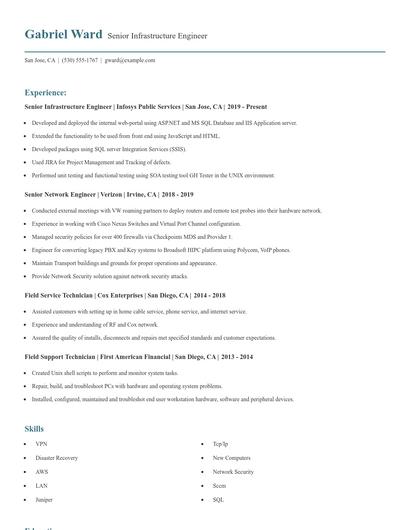
Here are examples of responsibilities from real senior infrastructure engineer resumes:
- Install, configure, and administering multiple VMWare environments and managing multiple virtual server instances.
- Manage all DNS and DHCP servers and scopes as well as domain controllers and member servers.
- Correct Java relate problems that lead to overall better productivity of the server, storage and network teams.
- Establish and manage VLAN and IP addressing standards (components, design) supporting IPT and other technologies.
- Manage Cisco ASA firewalls and Microsoft ISA firewalls in production environment providing secure configurations and monitoring of the firewall logs.
- Manage development, manufacturing, test and delivery of custom broadband RF electronic test systems for military and aerospace customers.
- Lead a team of Sr.
- Used WebSphere to start/stop Java applications and queues.
- Perform LAN traffic analysis on major network segments.
- Experience with server patching and network maintenance of LAN.
- Create Jenkins build and packaging jobs for all C++ components on CentOS.
- Monitor network traffic via sniffers to ensure encryption and proper data flow.
- Administer all IIS server's and added/modify websites as they become live.
- Monitor all the elements and instances using Perl script, k or c shell script.
- Install WebSphere MQ 7 and upgrade till 7.0.1.3 on n-tier architecture on Linux 32/64 bit machines.
Senior infrastructure engineer skills and personality traits
We calculated that 9% of Senior Infrastructure Engineers are proficient in Cloud, AWS, and Linux. They’re also known for soft skills such as Multitasking skills, Analytical skills, and Communication skills.
We break down the percentage of Senior Infrastructure Engineers that have these skills listed on their resume here:
- Cloud, 9%
Evaluated and piloted new technologies such as converged, hyper-converged infrastructure, monitoring solution and cloud integration.
- AWS, 7%
Worked with the documentation of Migration process, AWS Deployment setup, Application Stack deployments and Troubleshooting Scenarios.
- Linux, 6%
Administered and maintained 700+ Linux servers in clustered data center environment.
- Customer Service, 6%
Provided highly effective customer service to diverse clientele *Conducted responsible reconciliation of daily monetary transactions *Trained new employees
- Azure, 5%
Deployed test and sample applications into Microsoft Azure, and Amazon Web Services.
- Java, 5%
Optimize configurations of web applications by adjusting Java, Apache and Tomcat configurations.
"cloud," "aws," and "linux" are among the most common skills that senior infrastructure engineers use at work. You can find even more senior infrastructure engineer responsibilities below, including:
Multitasking skills. One of the key soft skills for a senior infrastructure engineer to have is multitasking skills. You can see how this relates to what senior infrastructure engineers do because "administrators may have to work on many problems and tasks at the same time." Additionally, a senior infrastructure engineer resume shows how senior infrastructure engineers use multitasking skills: "refined skills in multitasking and customer service. "
Analytical skills. Many senior infrastructure engineer duties rely on analytical skills. "administrators need to evaluate networks and systems to make sure that they perform reliably and to anticipate new requirements as customers’ needs change.," so a senior infrastructure engineer will need this skill often in their role. This resume example is just one of many ways senior infrastructure engineer responsibilities rely on analytical skills: "created cisco ivrs for integration into our self-service systems using java for data dips and data manipulation. "
Communication skills. Another skill that relates to the job responsibilities of senior infrastructure engineers is communication skills. This skill is critical to many everyday senior infrastructure engineer duties, as "administrators must describe problems and their solutions to non-it workers." This example from a resume shows how this skill is used: "developed excellent communication, customer service and motivational skills as both a server and training assistant in a high-volume restaurant chain"
Problem-solving skills. senior infrastructure engineer responsibilities often require "problem-solving skills." The duties that rely on this skill are shown by the fact that "administrators must quickly resolve problems that arise with computer networks." This resume example shows what senior infrastructure engineers do with problem-solving skills on a typical day: "managed backup solutions with emc data domain and emc networker. "
The three companies that hire the most senior infrastructure engineers are:
- American Express120 senior infrastructure engineers jobs
- Wells Fargo120 senior infrastructure engineers jobs
- SADA100 senior infrastructure engineers jobs
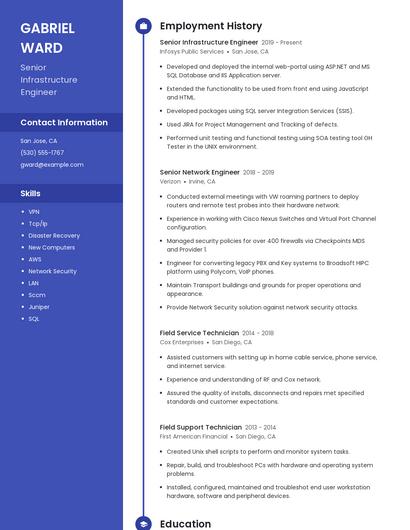
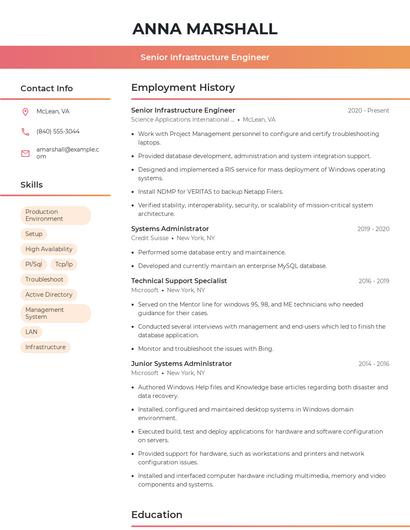
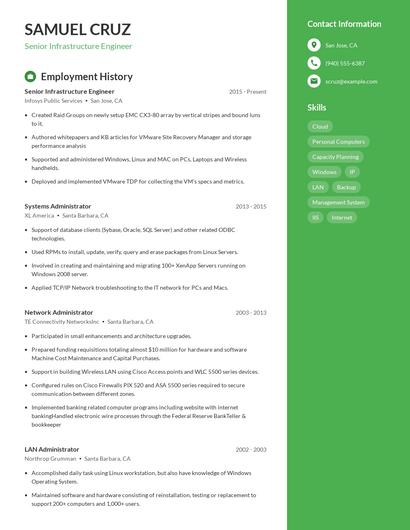
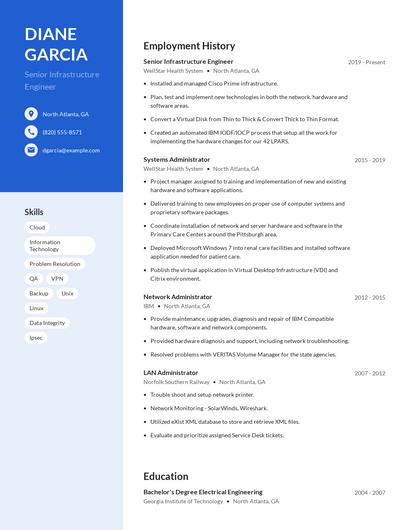
Choose from 10+ customizable senior infrastructure engineer resume templates
Build a professional senior infrastructure engineer resume in minutes. Our AI resume writing assistant will guide you through every step of the process, and you can choose from 10+ resume templates to create your senior infrastructure engineer resume.






Compare different senior infrastructure engineers
Senior infrastructure engineer vs. Systems architect
A systems architect specializes in designing and developing computer networks and systems for company operations. Typically, their responsibilities revolve around conducting research and analysis to identify a company's needs, devising strategies to reach particular goals, improving existing systems, and implementing solutions for optimal processes. A systems architect must also monitor the progress of all implementations, prepare progress reports and presentations, provide technical support as needed, and train new workforce members, all while adhering to the company's policies and regulations, including vision and mission.
While similarities exist, there are also some differences between senior infrastructure engineers and systems architect. For instance, senior infrastructure engineer responsibilities require skills such as "aws," "customer service," "powershell," and "troubleshoot." Whereas a systems architect is skilled in "python," "c++," "c #," and "system architecture." This is part of what separates the two careers.
Systems architects earn the highest salaries when working in the automotive industry, with an average yearly salary of $116,386. On the other hand, senior infrastructure engineers are paid more in the hospitality industry with an average salary of $123,360.On average, systems architects reach higher levels of education than senior infrastructure engineers. Systems architects are 11.0% more likely to earn a Master's Degree and 1.9% more likely to graduate with a Doctoral Degree.Senior infrastructure engineer vs. Solutions architect
A solutions architect specializes in creating and implementing software systems that improve business operations and resolve network issues. They are primarily responsible for conducting research and analysis to assess the business's needs, develop specific designs for the company, provide solutions should there be any system issues, and keep company officials informed with all changes and updates. Furthermore, a solutions architect must lead and encourage development teams, stay up to date with the newest trends to continue innovations within the systems, and implement its policies and guidelines.
While some skills are similar in these professions, other skills aren't so similar. For example, resumes show us that senior infrastructure engineer responsibilities requires skills like "customer service," "powershell," "troubleshoot," and "windows server." But a solutions architect might use other skills in their typical duties, such as, "infrastructure," "analytics," "digital transformation," and "c #."
On average, solutions architects earn a lower salary than senior infrastructure engineers. Some industries support higher salaries in each profession. Interestingly enough, solutions architects earn the most pay in the retail industry with an average salary of $122,080. Whereas senior infrastructure engineers have higher pay in the hospitality industry, with an average salary of $123,360.In general, solutions architects achieve higher levels of education than senior infrastructure engineers. They're 13.4% more likely to obtain a Master's Degree while being 1.9% more likely to earn a Doctoral Degree.Senior infrastructure engineer vs. Network/server administrator
A Network Administrator ensures an organizations' network is operational and up to date. They solve problems that arise within computer networks, maintaining computer networks, interacting with clients, and consulting with them to determine their system requirements.
The required skills of the two careers differ considerably. For example, senior infrastructure engineers are more likely to have skills like "cloud," "aws," "java," and "ruby." But a network/server administrator is more likely to have skills like "server administration," "microsoft windows," "server hardware," and "server environment."
Network/server administrators earn the best pay in the manufacturing industry, where they command an average salary of $84,609. Senior infrastructure engineers earn the highest pay from the hospitality industry, with an average salary of $123,360.network/server administrators typically earn similar educational levels compared to senior infrastructure engineers. Specifically, they're 4.7% less likely to graduate with a Master's Degree, and 0.3% less likely to earn a Doctoral Degree.Senior infrastructure engineer vs. Software architect
A Software Architect develops new programs for a variety of technological devices for businesses, computer games, mobile networks, and/or operating systems. They ensure architectural integrity and consistency across the entire product and work closely with executives to explain the benefits of the software.
Types of senior infrastructure engineer
Updated January 8, 2025
