Explore jobs
Find specific jobs
Explore careers
Explore professions
Best companies
Explore companies
Job outlook for senior java consultants in the United States
Senior java consultant job growth summary. After extensive research, interviews, and analysis, Zippia's data science team found that:
The projected senior java consultant job growth rate is 13% from 2018-2028.
About 20,900 new jobs for senior java consultants are projected over the next decade.
Senior java consultant salaries have increased 11% for senior java consultants in the last 5 years.
There are over 40,465 senior java consultants currently employed in the United States.
There are 95,697 active senior java consultant job openings in the US.
The average senior java consultant salary is $99,543.
Are senior java consultant jobs in demand?
Senior java consultant job and salary trends over time
Senior java consultant jobs over time
Senior java consultant job growth rate over time
| Year | # of jobs | % of population |
|---|---|---|
| 2021 | 40,465 | 0.01% |
| 2020 | 82,705 | 0.02% |
| 2019 | 53,506 | 0.02% |
| 2018 | 39,187 | 0.01% |
| 2017 | 38,728 | 0.01% |
Average senior java consultant salary over time
Senior java consultant salary by year
| Year | Avg. salary | Hourly rate | % Change |
|---|---|---|---|
| 2025 | $99,543 | $47.86 | +3.4% |
| 2024 | $96,263 | $46.28 | +2.3% |
| 2023 | $94,084 | $45.23 | +2.1% |
| 2022 | $92,133 | $44.29 | +2.8% |
| 2021 | $89,612 | $43.08 | +1.8% |
Senior java consultant jobs by state
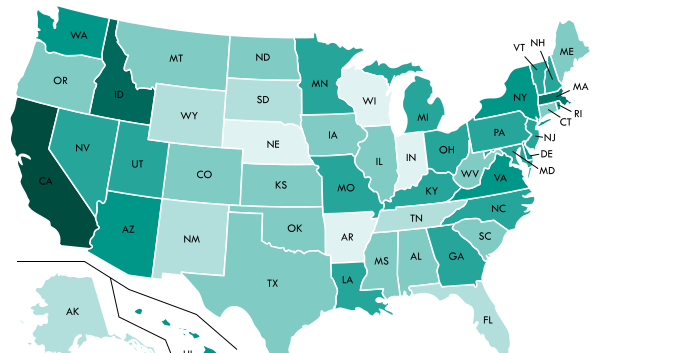
Most common states for senior java consultants
| Rank | State | Population | # of jobs | Employment/ 1000ppl |
|---|---|---|---|---|
| 1 | District of Columbia | 693,972 | 349 | 50% |
| 2 | South Dakota | 869,666 | 232 | 27% |
| 3 | Delaware | 961,939 | 195 | 20% |
| 4 | Alabama | 4,874,747 | 809 | 17% |
| 5 | Rhode Island | 1,059,639 | 184 | 17% |
| 6 | Massachusetts | 6,859,819 | 1,125 | 16% |
| 7 | Virginia | 8,470,020 | 1,270 | 15% |
| 8 | Washington | 7,405,743 | 1,035 | 14% |
| 9 | Maryland | 6,052,177 | 861 | 14% |
| 10 | Oregon | 4,142,776 | 573 | 14% |
| 11 | Oklahoma | 3,930,864 | 553 | 14% |
| 12 | Vermont | 623,657 | 86 | 14% |
| 13 | Utah | 3,101,833 | 406 | 13% |
| 14 | New Hampshire | 1,342,795 | 179 | 13% |
| 15 | Indiana | 6,666,818 | 767 | 12% |
| 16 | Minnesota | 5,576,606 | 663 | 12% |
| 17 | New Jersey | 9,005,644 | 954 | 11% |
| 18 | Colorado | 5,607,154 | 634 | 11% |
| 19 | Mississippi | 2,984,100 | 333 | 11% |
| 20 | North Dakota | 755,393 | 85 | 11% |
Most common cities for senior java consultants
| Rank | City | # of jobs | Employment/ 1000ppl | Avg. salary |
|---|---|---|---|---|
| 1 | Plano | 9 | 3% | $90,953 |
| 2 | Bothell | 1 | 2% | $105,039 |
| 3 | McLean | 1 | 2% | $100,678 |
| 4 | Atlanta | 3 | 1% | $95,151 |
| 5 | Austin | 1 | 0% | $94,233 |
| 6 | Minneapolis | 1 | 0% | $94,680 |
| 7 | Richmond | 1 | 0% | $100,266 |
| 8 | San Jose | 1 | 0% | $130,190 |
| 9 | Seattle | 1 | 0% | $105,166 |
Senior Java Consultant job outlook: Expert opinions
Our panel of senior java consultant experts
Nova Southeastern University
Mount St. Joseph University

University of Hawaii at Hilo
Southeastern Louisiana University
University of Tulsa
University of Minnesota - Crookston

Gannon University

Rose-Hulman Institute of Technology
Metropolitan State University of Denver
Keiser University Latin American Campus.

Bucknell University

Eastern Washington University

Landmark College
Florida Atlantic University
Auburn University at Montgomery

University of New Haven
University of Central Missouri

Furman University
What general advice would you give to a Senior Java Consultant?
Sepehr Mohammadian: 2. Computer science remains in high demand in today's job market, with California exemplifying this trend. In recent years, the number of open positions in the state has exceeded the average demand rate by 1.5 times. At the University of the Pacific, our CS program is designed to equip students with the necessary skills and experiences to thrive in this landscape. Through our co-op program, in collaboration with recruiters such as Nvidia, HP, and Lawrence Livermore National Lab, students have the opportunity to participate in paid internships lasting approximately 8 months. These internships provide invaluable exposure to real-world work settings and allow students to apply their knowledge in practical contexts and gain valuable industry insights. It is worth noting that many of our graduates choose to return to the same company post-graduation.
What Senior Java Consultant skills would you recommend for someone trying to advance their career?
Sepehr Mohammadian: 1. This is a pretty broad question. CS degree graduates can engage in different tasks and responsibilities based on the nature of their profession. Examples include 1) software engineering, in which the individual's efforts are toward leading or contributing to software development projects, 2) IT management, where the individual mainly oversees technology strategies and their implementation, 3) cybersecurity, where the individual's responsibilities are associated with the protection of systems and data from cyber threats, and 4) data and AI engineering, where the individual works on machine learning applications and analyze and derive insights from large datasets.
Junping Sun Ph.D.
ProfessorNova Southeastern University
Computer Software And Media Applications
What Senior Java Consultant skills would you recommend for someone trying to advance their career?
Junping Sun Ph.D.: Computer Science and its applications in various fields are very dynamic and constantly evolving, and anyone in the fields needs to prepare to be adaptive by lifelong learning.
MARLA KRAMER
Assistant Vice President of Marketing and CommunicationsWhat Senior Java Consultant skills would you recommend for someone trying to advance their career?
MARLA KRAMER: Computer Science, and IS in general, is a field that is constantly evolving. It is not enough to know what everybody else knows. Becoming a subject matter expert with deep knowledge is important to be successful in the long run. You have to pick your area of expertise carefully, keep yourself focused and educated in that specific area, and be prepared for a career of continuous learning.
What will help Senior Java Consultants increase their earning potential?
MARLA KRAMER: It is unlikely that software development will be fully automated in the near future. Writing correct and efficient applications is a skill set that will only grow as we invent more ways to improve the quality of our lives. As more and more commerce and critical services migrate onto the internet, IS development will require a deeper knowledge of cybersecurity, data analytics, and cloud computing. According to the U.S. Bureau of Labor Statistics (BLS), Information Security Analysis jobs are expected to grow by 32% over the next 10 years. The BLS estimates Software Developers, Quality Assurance and Testing will grow by 25% over the next decade.
Right now, however, software development is going through a lull because of competition from abroad. Being an expert in at least two popular programming languages, having a solid theoretical foundation, and being able to innovate is pivotal. Artificial Intelligence is being deployed to solve some problems now, thanks to the powerful computers we have today. Learning to effectively use AI frameworks as part of your application development will add a lot of value to your skillset.
Rebecca Allen
Mount St. Joseph University
Special Education And Teaching
What general advice would you give to a Senior Java Consultant?
Rebecca Allen: AI, for sure. I have heard it said that AI might not replace humans, rather humans who know how to use AI well may replace humans who don't.
Travis Mandel Ph.D.
Assistant ProfessorUniversity of Hawaii at Hilo
Department of Computer Science
What skills stand out on Senior Java Consultant resumes?
Travis Mandel Ph.D.: The number one thing that employers typically look for is a project that demonstrates your ability to program something new and useful. The best projects are ones that someone undertakes independently or with a small group of others - if it is the latter, you need to clarify what you contributed. It's even better if you include a link to public code on Github so that employers can look around your Github page and get a sense of your coding style. A working demo is also very impressive. Ideally, this wouldn't be something you were forced to do for a class but rather something you took the independent initiative to do.
College GPA doesn't matter as much as people think it does - most companies care much more about what you can do than how well you did in class. Unless it is extremely low, it shouldn't be a problem. Listing courses can be useful, but even better would be listing skills you learned in classes. For instance, the class "Artificial Intelligence" means completely different things at institutions. So employers may not necessarily understand what skills you learned in that class unless you highlight them.
What soft skills should all Senior Java Consultants possess?
Travis Mandel Ph.D.: Although computer science seems like a highly technical field, soft skills are really what differentiates software engineers. One of the most important qualities of any software engineer is explaining their code clearly at various levels of technical depth and explaining why certain design decisions were made. You could write code that does amazing things, but if that code consists of snippets you pasted from StackOverflow without really fully understanding them, it will be a huge headache for anyone who needs to come into the codebase later and maintain or update it.
Another one is asking the right questions. Imagine you are dropped into a huge codebase and asked to add a new feature (very common!). There's no time to understand everything that is going on, but on the other hand, you need to understand enough of the code to do your task effectively, which involves asking questions. A failure to ask questions will likely result in you wasting a huge amount of time working on something that is ultimately not useful, for instance, re-implementing a complex function that already exists somewhere in the codebase.
Dr. Ghanssan Alkadi Ph.D.
Professor of Computer ScienceSoutheastern Louisiana University
Department of Computer Science
What skills stand out on Senior Java Consultant resumes?
Dr. Ghanssan Alkadi Ph.D.: Working on Software projects that involve team communication, Agile Process, and working with either the MERN, MEAN, or .Net stacks.
What skills will help Senior Java Consultants earn the most?
Dr. Ghanssan Alkadi Ph.D.: Web and Mobile App development will help you earn the most.
Sal Aurigemma Ph.D.
Associate Professor of CIS, J. Bradley Oxley Professor of Computer Information SystemsUniversity of Tulsa
School of Accounting and CIS at the Collins College of Business
What soft skills should all Senior Java Consultants possess?
Sal Aurigemma Ph.D.: All the soft skills are important, but a few are absolutely critical in today's hybrid workforce. With the uncertainty of COVID delaying the return to the office, many companies are embracing hybrid work and/or 100% remote for some or all of their employees. Today's employees must be able to effectively communicate over a range of different modalities, both synchronously and asynchronously, while still being able to actively build and maintain relationships as they participate in one or more teams of coworkers, customers, and other stakeholders. Today's IT workers need to be honest with themselves on the work environments they can and cannot succeed within.
What hard/technical skills are most important for Senior Java Consultants?
Sal Aurigemma Ph.D.: Students graduating with Information Systems and related degrees usually have little problem finding employment upon graduation. However, the pandemic upended that paradigm for some. For those who recently graduated and are still looking for employment, keep the faith and develop your technical skills. Developers should show prospective employers that they are familiar with agile programming methodologies and modern DevOps stacks and processes. Data analysts should be focused on presenting their ability to work with structured and unstructured data, effectively query data using SQL & NoSQL, and, most importantly, provide actionable insight by making data accessible and relatable to decision-makers at all levels of an organization. Those interested in cloud architecture and cyber security careers have to keep current on their skills and certifications. Cloud engineers need to stay aware of the constant changes happening at the major providers (AWS, Azure, GCP) and, as with all other IT fields, provide tangible evidence of your skills via real projects that you have worked on. Prospective cyber security analysts should first focus on identifying their first specialization because there are too many security roles to learn them all at once, especially as beginners. Two popular entry-level cyber security jobs include information security consultant and Security Operations Center (SOC). Both of these roles require a sound foundation in networking fundamentals, vulnerability identification and mitigation, and an understanding of organizationally relevant security and privacy frameworks and regulations.
What skills will help Senior Java Consultants earn the most?
Sal Aurigemma Ph.D.: Each of the areas and skills mentioned above is important. The way to earn the most in any of the varied specialties in IT depends on having the right blend of technical and soft skills for a particular employer and, frankly, being the right person at the right time for the right employer. That sounds ambiguous, but the point is that those looking for IT work need to research which companies, locations, and specific jobs pay the most with open positions that match their skillset. And, if you find that dream job with the dream pay but you don't have the requisite skills, there are plenty of opportunities to show a potential employer that you are willing to learn the skills to succeed in that position.
Christine Bakke
LecturerUniversity of Minnesota - Crookston
Math, Science & Technology Department
What certifications/licenses/courses can have the biggest impact for Senior Java Consultants?
Christine Bakke: MIS is a technical business degree which is offered with slightly different emphasis depending on the school's home department. For example, if a business department houses the degree it is often referred to as MIS; however, when Information Technology or Computer Science departments house this degree, the program would be called Information Technology Management (ITM) or Computer Information Systems (CIS). Each university has the autonomy to offer variations based on their specializations. Even though the programs can differ slightly, in general students receiving any of these three degrees receive an education in three areas: technical, management/business, and soft skills. Note that the US Bureau of Labor Statistics directs queries for all three fields (ITM, MIS and CIS) to the same data page (see answer to question 3).
Are there any particularly good places in the United States for Senior Java Consultants to find work opportunities?
Dr. Stephen Frezza Ph.D.: Computing is ubiquitous, and with more industries moving to remote work, location is becoming less critical. If the internet reaches a place reliably, computing jobs can be located there.
How do you envision technology impacting Senior Java Consultants in the next 5 years?
Dr. Stephen Frezza Ph.D.: Breadth and depth: Computing is becoming more like engineering; where the value of the product, its lifetime risks, costs, and benefits are more critical than just it's roll-out. So the engineering competencies that have always been a part of computing will become more central. Computing is also expanding; the role of data and the shift of once-research technologies (like machine learning) into production applications will continue to require computing graduates to broaden their base and continue as learners. This will cause shifts in what is considered 'fundamental' and the need for professionals to continue to hone and redevelop their technical skill sets.
Will there be an enduring impact of the coronavirus pandemic on Senior Java Consultants?
J.P. Mellor: I'm sure the pandemic will have an enduring impact on all of us. Our students are certainly experiencing new challenges as they strive to learn during the pandemic. They are aquiring skills and competencies associated with working remotely and engaging while doing so. These are skills that students in past years did not attain.
Janos Fustos Ph.D.
ProfessorMetropolitan State University of Denver
Department of Computer Information Systems and Business Analytics
What's a good job out of college for Senior Java Consultants?
Janos Fustos Ph.D.: I hope students are asking that question before they enroll in the first course at a college because otherwise, they would waste lot of time and money to work on a degree or a career path that does not fulfill their goals and personal interest. In that sense any job is a good job that somebody understands, feels that he/she is a good fit and can live up to the imposed challenges, and has the knowledge/skills to work in the field. There are interesting and self-fulfilling jobs to choose from. Certainly, it starts with the definition what a "good" means to an individual, what are the attributes of that definition: is that the professional area, is the salary, is it the challenging nature, is it more about the working environment and the people they can work with, is it the promotion options, the high impact etc. There are several lists available on the internet that provide recommendations and track the different aspects of job selection options for seekers.
Elio Rivas
Department Chair – Software Engineering & MIS Keiser University Latin American CampusKeiser University Latin American Campus.
Software Engineering and Management Information Systems (MIS) Department
What certifications/licenses/courses can have the biggest impact for Senior Java Consultants?
Elio Rivas: English is 95% percent required in most of the applications. The new graduates face the challenges to know and have experience in almost all the programming languages and companies ask to be certified in most of the cases.
Companies in Nicaragua don't have a culture for training their workforce. This means that neither new graduates have the budget to get certified nor experienced workforce.
What soft skills should all Senior Java Consultants possess?
Elio Rivas: All the graduates should have customer services-oriented, teamwork, emotional intelligence, patient, persistency, audacity. Negotiation skills to get better paid.
Will there be an enduring impact of the coronavirus pandemic on Senior Java Consultants?
Elio Rivas: Of course, due to the pandemic impact, a lot of companies have been forced to downsize. Nowadays the companies are looking for highly experienced professionals instead of new graduates. Even though the working modality has changed to remote, the exigencies/requirements for job applications are getting harder for new graduates.
What's a good job out of college for Senior Java Consultants?
Alan Cheville Ph.D.: A good job is always one that aligns with a student's interests and has the possibility for advancement. There are so many individual factors unique to each graduate that it is nearly impossible to broadly identify "a good job". Students come out of college with different levels of debt, ability to relocate, etc. so what may be a good job for one is not for another.
Christian Hansen Ph.D.
Professor and Department ChairEastern Washington University
Department of Mathematics
What soft skills should all Senior Java Consultants possess?
Christian Hansen Ph.D.: The soft skills that all graduates should possess include strong communication and teamwork skills regardless of the discipline. Analytical skills will be in high demand, as well as the ability to adapt and learn new technology. Data will continue to play a bigger role in almost any type of business; therefore, the ability to analyze and interpret data for decision making will be increasingly critical. Many jobs in the future are jobs that do not yet exist and as a result, new graduates must have the ability to adapt.
What's a day at work look like for a Senior Java Consultant?
Christian Hansen Ph.D.: In the post-pandemic era, a typical workday for a recent graduate will likely involve some form of remote work. I predict that many businesses will benefit from the reduced cost of remote infrastructure compared to the cost of maintaining brick and mortar office space. Many new graduates will continue to spend their day on a computer while collaborating in teams via Zoom and other teleconference tools. People working in disciplines that have traditionally been "on the ground" will move towards more hybrid modes of work, reducing the need for travel and participating in face-to-face meetings and training.
John Russo
Associate Professor and Program Coordinator of Computer ScienceLandmark College
STEM Department
What technical skills for a Senior Java Consultant stand out to employers?
John Russo: As I mentioned above, the ability to adapt to change. My favorite course is database management systems. I tell my students that the software that we use today likely will not be around for the entire span of their careers. They really need to learn how to quickly work with new technologies, languages and systems. In the span of my career much has changed. I have always found new technologies exciting and refreshing. Employers want to hire graduates who have a set of technical skills in programming languages, database management systems and techniques (such as data mining) but also can learn on the job and be excited to learn new things.
Maria Larrondo Petrie Ph.D.
ProfessorFlorida Atlantic University
Department of Computer and Electrical Engineering and Computer Science
Will there be an enduring impact of the coronavirus pandemic on Senior Java Consultants?
Maria Larrondo Petrie Ph.D.: Students graduating during the pandemic are missing career fair and career service events that the universities and professional association offer, which are very important to get an internship and an entry level position. So their entry-level position may be not in their major and not at the salary and responsibilities that they had hoped. This impacts subsequent offers.
What technical skills for a Senior Java Consultant stand out to employers?
Maria Larrondo Petrie Ph.D.: The potential employee needs to be comfortable and flexible to learn different technologies needed to be successful in the virtual work environment. More importantly than the technical schools are the soft skills that give the employee the self-discipline and communications skills to be effective and productive in a virtual work environment. The non-technical major needs to be computer literate and have the mindset to learn new technical skills.
Will there be an enduring impact of the coronavirus pandemic on Senior Java Consultants?
Dr. Semih Dinc: I personally think there may be a positive impact of this pandemic for CS graduates in medium/long term. Even if many companies have frozen or slowed down their hiring process now, I believe this is a temporary decision. There is still a big need for new CS graduates in the industry. And to me it is more clear that people realized they can work remotely for many CS related positions. This means that many companies can cut their physical office budgets and hire more remote people. One of the factors for our students is the challenges/expenses of the city they would work. Some of them do not want to move to big cities. I am assuming with more remote working opportunities graduates will have more options.
What type of skills will young Senior Java Consultants need?
Dr. Semih Dinc: I may be little biased on this question maybe because of my research field. But I notice a significant demand on machine learning experts in the industry. Today I think a CS graduate should have skills such as machine learning, computer vision, and programming for mobile environments.
What experience really stands out on Senior Java Consultant resumes?
Dr. Semih Dinc: According to my experience, most companies are not looking for "straight A" students. Instead, they look for someone with real world experience in their field. A recent graduate will most likely stand out if he/she has somehow contributed real projects. This can be achieved through internships. For many students, who do not have this option, they can still stand out by sharing their "good" school projects to platforms like GitHub. This way they can show companies that they are aware of these tools, and they will be ready to adopt the new company environment.
What certifications/licenses/courses can have the biggest impact for Senior Java Consultants?
Christopher Martinez Ph.D.: Courses that have a heavy emphasis on hands-on projects can have a massive impact on your job prospects. In the technology field, you want to make sure your resume has many tools/skills that the industry uses, from hardware, test equipment, software tools, and programming languages. If you can take a course that will allow you to learn what industry uses while teaching you theory, you should run to take the course.
What's a good job out of college for Senior Java Consultants?
Christopher Martinez Ph.D.: The best job you can have out of college is a job you have passion for and will set you up to advance your career. If you have always wanted to work in aerospace, then you should seek out that field from the start. I hate to see students settle for a job because of pay or because they feel they can move to their dream field later.
What are the biggest trends we'll see in the Senior Java Consultant job market given the pandemic?
Christopher Martinez Ph.D.: I always tell students to practice for an interview by thinking about how they will answer behavior questions such as how to do your work on a team, how you lead a team, how you learn from a failure, etc. This year I would add a new question to this list, and that is how you work remotely. Students should consider how they work with classmates to find a remote work style that works for them. They should explore how to work with Slack or Microsoft Teams to communicate and organize their team. I think we will see that remote work is a trend that will remain with us for the foreseeable future so students should work to become more comfortable with this new work style.
Dr. Phoebe McLaughlin
Professor of Statistics & Mathematics Assistant Chair of Mathematics Programs Actuarial Science and Statistics Program CoordinatorUniversity of Central Missouri
School of Computer Science and Mathematics
What's a good job out of college for Senior Java Consultants?
Dr. Phoebe McLaughlin: A good job out of college is some sort of entry-level actuarial job as an analyst. Typically, this is the first position in a traditional rotational program for insurance companies. Also, most employers will only expect this candidate to have 0-2 exams with a possible internship.
In general, any job within the field that pays would be good; experience is great, even if it's underwriting. An employee can always jump from job to job within a company. I just need to find a company where this is expected.
To be more specific, students should look for a work team that fits well. Some work teams are very distant, while others spend a lot of time together even outside of work. Also, they should consider the company and its values. They need to make sure that their personal goals fit within the values of the company.
What technical skills for a Senior Java Consultant stand out to employers?
Dr. Phoebe McLaughlin: Most employers we work with look for candidates with experience in programmings such as Excel/VBA, Access/SQL, and others such as R and SAS. It is noted that life insurers are more likely to use SQL and SAS since their data is much bigger, while health insurers typically rely mostly on Excel and VBA.
What technology do you think will become more important and prevalent for Senior Java Consultants in the next 3-5 years?
Dr. Phoebe McLaughlin: It seems like more employers will start looking away from expensive programs like SAS and transition towards free, open-source programs like R. The SOA is already starting to do this with their PA exam, we expect employers are going to follow.
What general advice would you give to a Senior Java Consultant?
Kevin Treu Ph.D.: Be a sponge! Use every resource at your disposal to learn all you can, not only about the tools and techniques for the projects you've been assigned but for everything your new company does. These resources will most likely include in-house training, but don't stop there. Do online research, work through tutorials, pick the brains of your new colleagues. Never stop learning! That is a huge key to success.
Also, start your career with attention to a healthy work-life balance. Most companies explicitly value this concept and provide opportunities for you to tend to your own mental and physical wellness through various programs. Take the time to rest and recharge, and most importantly, enjoy what you're doing!
What's a day at work look like for a Senior Java Consultant?
Kevin Treu Ph.D.: I'm least confident about answering this question. I have talked to alums about this, however, so I'll give it a go. Recent Computer Science and Information Technology grads might be surprised about the flexibility that they'll find in a typical day working a tech job. The classic 9-to-5 expectation isn't predominant any more. You'll be assigned to a team that is responsible for multiple projects. For the most part, you'll be expected to deliver those completed projects by a deadline while working and communicating effectively with your team. If you can do that best on a non-traditional schedule - working evenings, perhaps, or powering through in a marathon session and then taking some time off - most jobs are going to be fine with that. Expect to use your verbal and written communication skills! There will be lots of team meetings.