What does a senior program analyst do?
A senior program analyst specializes in developing and recommending strategies to optimize the operations of different programs in a company. They coordinate with various departments to collect and analyze data, identify the strengths and weaknesses of existing programs, perform extensive research and analysis, conduct risk assessments, determine the trends, and address issues and concerns, resolving them promptly and efficiently. Moreover, as a senior program analyst, it is essential to lead and serve as a mentor to junior analysts, all while promoting the company's policies and regulations.
Senior program analyst responsibilities
Here are examples of responsibilities from real senior program analyst resumes:
- Create and manage document repositories and user permissions in Microsoft SharePoint.
- Design system architecture for managing and deploying distribute databases to sales representatives.
- Brief the local media on system specifications and upgrades as the resident SME.
- Subject matter expert (SME) concerning company fund projects /RFP s and general training resource.
- Develop and present a business case analysis to the director on options for DOD EMALL to become self-fund.
- Maintain knowledge of DOD, DA, and ASC missions and functions to provide authoritative advice and guidance to others.
- Schedule a task run under SAS EG to update the quarterly tenant data and process tenant skillet reports as required.
- Create and maintain more efficient business processes for utilizing SharePoint.
- Develop and organize UNIX administration and internal resources to implement plan.
- Develop EIS systems and performance reporting systems for senior management utilizing SAS software.
- Assure all critical actions are integrated and properly execute to provide a cohesive approach for all logistics support requirements.
- Provide international logistics programs policy analysis, program planning, policy evaluation, policy development and international agreements review.
- Develop prototype system with consultants which allow clients to preview and modify mock-up windows before substantial coding are completed.
- Perform administrative and clinical oversight reviews of Medicaid contract providers' medical records in various restrictive levels of care.
- Conclude decisions regarding utilization of services to other internal or external providers/facilities while adhering to Medicare and Medicaid guidelines.
Senior program analyst skills and personality traits
We calculated that 10% of Senior Program Analysts are proficient in Project Management, DOD, and Logistics. They’re also known for soft skills such as Creativity, Analytical skills, and Communication skills.
We break down the percentage of Senior Program Analysts that have these skills listed on their resume here:
- Project Management, 10%
Assisted with project management including MS Project and operations support during development formulation and representation of system development.
- DOD, 8%
Provide space acquisition expertise to DoD organizations and external agencies related to National Security Space and space acquisition issues.
- Logistics, 7%
Assured all critical actions were integrated and properly executed to provide a cohesive approach for all logistics support requirements.
- SR, 5%
Developed Del Monte Learning University, goals, objective, and provide Business Plan to Sr. Management for Launch in 2018.
- Data Analysis, 4%
Support marketing and communications initiatives through email marketing efforts and market data analysis.
- Earned Value Management, 4%
Maintained databases for all the projects to ensure the integration of cost and schedule per the Earned Value Management System requirements.
"project management," "dod," and "logistics" are among the most common skills that senior program analysts use at work. You can find even more senior program analyst responsibilities below, including:
Creativity. The most essential soft skill for a senior program analyst to carry out their responsibilities is creativity. This skill is important for the role because "because analysts are tasked with finding innovative solutions to computer problems, an ability to “think outside the box” is important." Additionally, a senior program analyst resume shows how their duties depend on creativity: "directed inventory, distance support, and financial management for logistical readiness and automated supply for the u.s. Navy. "
Analytical skills. Many senior program analyst duties rely on analytical skills. "analysts must interpret complex information from various sources and decide the best way to move forward on a project," so a senior program analyst will need this skill often in their role. This resume example is just one of many ways senior program analyst responsibilities rely on analytical skills: "support evm and contract performance analysis for the space and missile defense command (smdc's) command analysis group. "
Communication skills. This is an important skill for senior program analysts to perform their duties. For an example of how senior program analyst responsibilities depend on this skill, consider that "analysts work as a go-between with management and the it department and must explain complex issues in a way that both will understand." This excerpt from a resume also shows how vital it is to everyday roles and responsibilities of a senior program analyst: "streamlined communications between several dod departments to better service contracts. ".
The three companies that hire the most senior program analysts are:
- General Dynamics198 senior program analysts jobs
- General Dynamics Mission Systems
125 senior program analysts jobs
- Change Healthcare36 senior program analysts jobs
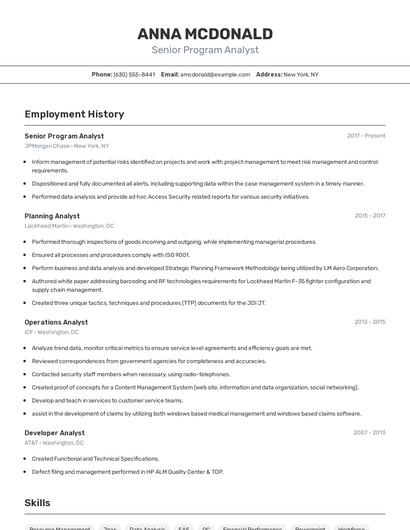
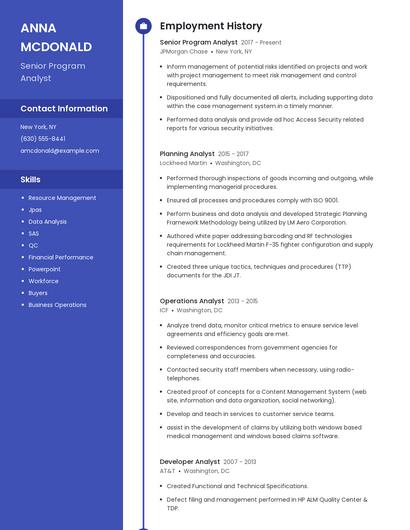
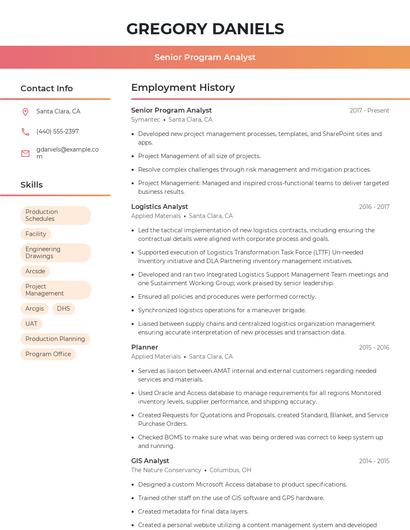
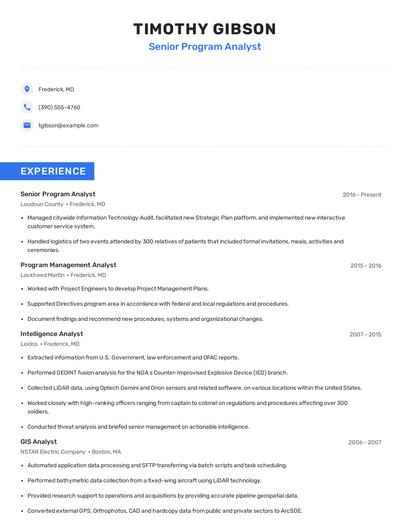
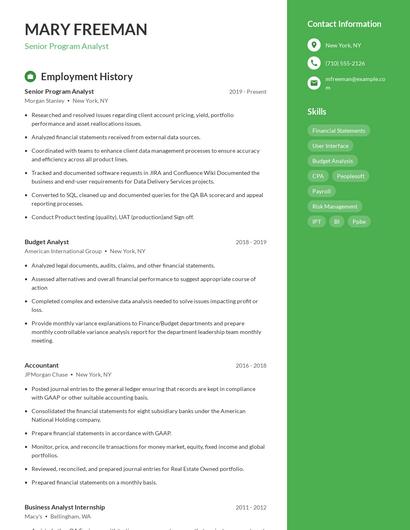
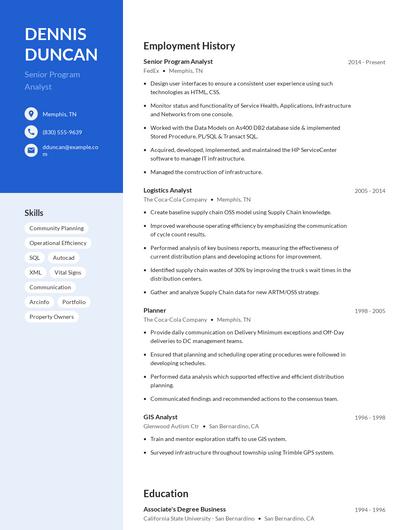
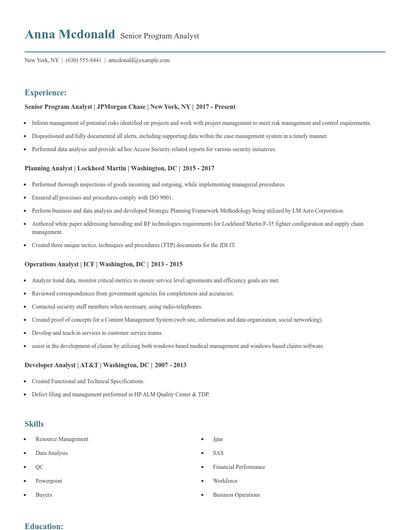
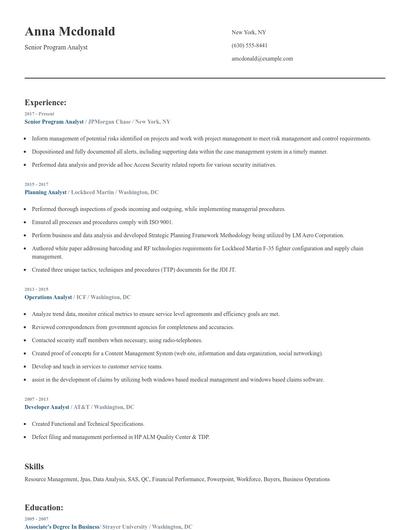
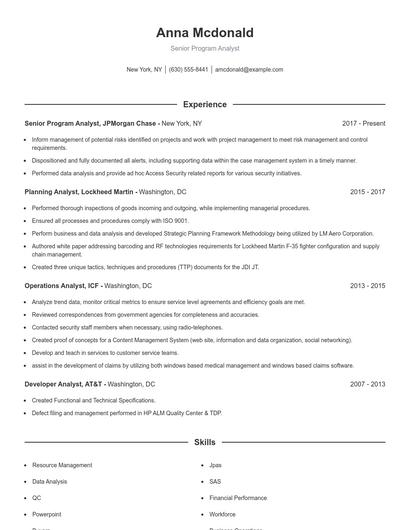
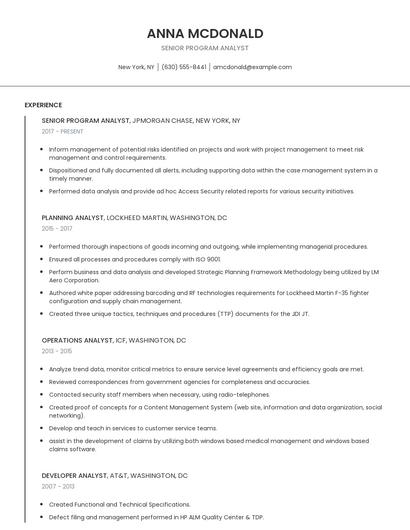
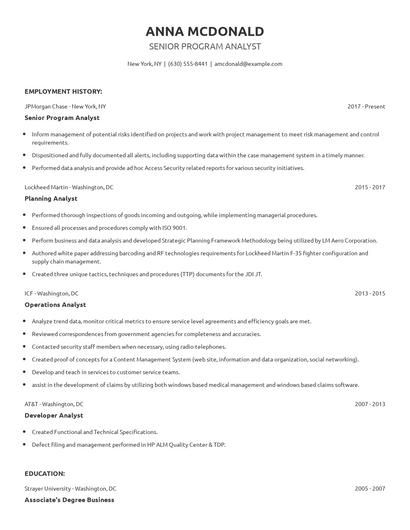
Choose from 10+ customizable senior program analyst resume templates
Build a professional senior program analyst resume in minutes. Our AI resume writing assistant will guide you through every step of the process, and you can choose from 10+ resume templates to create your senior program analyst resume.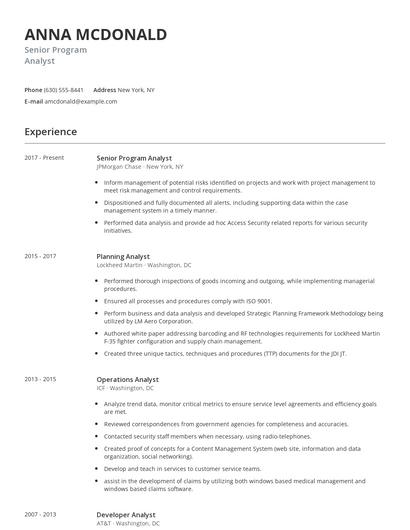
Compare different senior program analysts
Senior program analyst vs. Analyst lead
The duties of an analyst lead depend on one's line of work or industry of employment. Typically, their responsibilities revolve around performing research and analysis, coordinating with different departments to gather leads and data, reviewing findings, and producing reports and presentations for the stakeholders and other higher-ranking officials. Through the results, an analyst lead can provide advice, devise strategies for business optimization, spearhead the development of processes, identify strengths and weaknesses, and offer recommendations on areas in need of improvement. All of this is done while in adherence to the company's vision and mission.
These skill sets are where the common ground ends though. The responsibilities of a senior program analyst are more likely to require skills like "logistics," "sr," "earned value management," and "risk management." On the other hand, a job as an analyst lead requires skills like "analytics," "customer service," "excellent interpersonal," and "java." As you can see, what employees do in each career varies considerably.
Analyst leads really shine in the finance industry with an average salary of $110,488. Comparatively, senior program analysts tend to make the most money in the professional industry with an average salary of $100,697.On average, analyst leads reach similar levels of education than senior program analysts. Analyst leads are 1.3% less likely to earn a Master's Degree and 0.4% less likely to graduate with a Doctoral Degree.Senior program analyst vs. Business systems senior analyst
Business systems senior analysts are responsible for resolving problems and requirements related to organizational information. They perform various duties that include determining operational objectives, designing computer programs, and improving business systems by designing modifications and studying current practices. Additionally, they are responsible for defining project requirements, maintaining user confidence and information confidentiality, and preparing technical reports. These professionals are also expected to maintain their knowledge by participating in professional associations or attending educational workshops. The skills and qualifications required for this position include previous work experience, software design and development, and problem-solving skills.
In addition to the difference in salary, there are some other key differences worth noting. For example, senior program analyst responsibilities are more likely to require skills like "dod," "logistics," "sr," and "earned value management." Meanwhile, a business systems senior analyst has duties that require skills in areas such as "business process," "scrum," "user acceptance," and "business stakeholders." These differences highlight just how different the day-to-day in each role looks.
On average, business systems senior analysts earn a higher salary than senior program analysts. Some industries support higher salaries in each profession. Interestingly enough, business systems senior analysts earn the most pay in the health care industry with an average salary of $108,902. Whereas senior program analysts have higher pay in the professional industry, with an average salary of $100,697.business systems senior analysts earn similar levels of education than senior program analysts in general. They're 2.3% more likely to graduate with a Master's Degree and 0.4% less likely to earn a Doctoral Degree.What technology do you think will become more important and prevalent for senior program analysts in the next 3-5 years?
Eduardo Zambrano
Professor of Economics, Orfalea College of Business
Senior program analyst vs. Information analyst
Information Analysts are employees who collect data and analyze the information from the data they collected. They are usually found in companies with information technology departments. They collect network, software, or hardware performance data and analyze these data. The data that Information Analysts collect would help in identifying and anticipating problems in the system. As such, they will be able to troubleshoot and provide a sound analysis of the systems and networks. They would then be able to give recommendations to address problems, based on what they analyzed.
There are many key differences between these two careers, including some of the skills required to perform responsibilities within each role. For example, a senior program analyst is likely to be skilled in "dod," "logistics," "sr," and "earned value management," while a typical information analyst is skilled in "patients," "work ethic," "strong work ethic," and "data integrity."
Information analysts make a very good living in the technology industry with an average annual salary of $86,848. On the other hand, senior program analysts are paid the highest salary in the professional industry, with average annual pay of $100,697.information analysts typically earn lower educational levels compared to senior program analysts. Specifically, they're 7.6% less likely to graduate with a Master's Degree, and 0.6% less likely to earn a Doctoral Degree.Senior program analyst vs. Program manager
A program manager is responsible for monitoring the project's progress, improving and developing new strategies, and coordinate various projects across the organization to ensure the success of the business objective. Program managers also manage the program's expenses, ensuring that the projects adhere to the budget goals without compromising the quality and accuracy of the result. A program manager should regularly connect with the different teams of every project under the program to keep track of the processes and procedures for the timely delivery of the product.
Types of senior program analyst
Updated January 8, 2025
