What does a senior safety engineer do?
A senior safety engineer mitigates software vulnerabilities. They also prevent cybercrime. A senior safety engineer configures and installs network software and genuinely monitors network performance. They report software malfunctions to a chief officer.
Senior safety engineer responsibilities
Here are examples of responsibilities from real senior safety engineer resumes:
- Manage hazardous and special waste programs and profiles including audits/inspections, vendor compliance, documentation and recordkeeping.
- Resolve compliance questions (from both OSHA and company requirements) and comment on propose OSHA regulations.
- Provide training at all levels of the operation including OSHA compliance, behavior-base safety, and ergonomics.
- Review contractors' and subcontractors' asbestos and leadrelate submittals for compliance with contract documents and applicable laws/ regulations.
- Perform accident investigations involving PSM cover processes.
- Perform computer-based chemical dispersion modeling to support RMP reporting.
- Consult with contractors and project monitors for asbestos abatement projects.
- Work closely with engineering department on major capital projects to ensure PSM requirements are implemented in appropriate phase.
- Monitor and measure key EHS indicators, including waste reduction plans, and communicate performance to manufacturing management personnel.
- Develop training and facilitate implementation of first EHS web base e-tool for online accident investigation, corporate metrics, and reporting.
- Provide oversight and technical guidance to facilities, systems, associate support equipment and operations to ensure adherence to safety guidelines.
- Restructure and administer a uniform program for customer RCRA waste retrievals due to expire, damage or off-spec chemicals.
- Reorganize all elements of RCRA policies relate to facility waste storage practices, inspections, labeling, training and vendor management.
- Experience conferencing and negotiating MSHA issue violations.
Senior safety engineer skills and personality traits
We calculated that 8% of Senior Safety Engineers are proficient in OSHA, Safety Standards, and ISO. They’re also known for soft skills such as Creativity, Communication skills, and Problem-solving skills.
We break down the percentage of Senior Safety Engineers that have these skills listed on their resume here:
- OSHA, 8%
Maintain training records, OSHA 300 log, SWPP and SPPP and all company, state and federal records as required.
- Safety Standards, 7%
Assisted project engineers and designers to implement safety standards in products at design and development stages.
- ISO, 6%
Lead ISO 14001, 18001 and 50001 certified operation of automotive filter manufacturing operations.
- Safety Analysis, 5%
Performed probabilistic risk assessment and safety analysis work for the Safety Analysis Report Program at the DOE Y-12 Plant.
- Safety Engineering, 5%
Participate in development of safety engineering documents for KSC programs and processes.
- Safety Regulations, 4%
Instituted internal audit protocols for Valvoline packaging facilities to ensure compliance with Environmental, Health and Safety regulations.
Common skills that a senior safety engineer uses to do their job include "osha," "safety standards," and "iso." You can find details on the most important senior safety engineer responsibilities below.
Creativity. To carry out their duties, the most important skill for a senior safety engineer to have is creativity. Their role and responsibilities require that "health and safety engineers produce designs showing potential problems and remedies for them." Senior safety engineers often use creativity in their day-to-day job, as shown by this real resume: "invented a proprietary fire protection system used in the photoreceptor manufacturing process. "
Communication skills. Another soft skill that's essential for fulfilling senior safety engineer duties is communication skills. The role rewards competence in this skill because "health and safety engineers must be able to interpret federal and state regulations and their intent so that they can propose proper designs for specific work environments." According to a senior safety engineer resume, here's how senior safety engineers can utilize communication skills in their job responsibilities: "developed/delivered numerous ehs communications ranging from training/drills for all levels of the employee population. "
Problem-solving skills. senior safety engineers are also known for problem-solving skills, which are critical to their duties. You can see how this skill relates to senior safety engineer responsibilities, because "in designing solutions for entire organizational operations, health and safety engineers must take into account processes from more than one system at the same time." A senior safety engineer resume example shows how problem-solving skills is used in the workplace: "conducted ehs audits in asia and collaborated with sites to find solutions to audit deficiencies. "
The three companies that hire the most senior safety engineers are:
- Boeing45 senior safety engineers jobs
- Lucid Motors13 senior safety engineers jobs
- Wsp USA Buildings Inc.6 senior safety engineers jobs
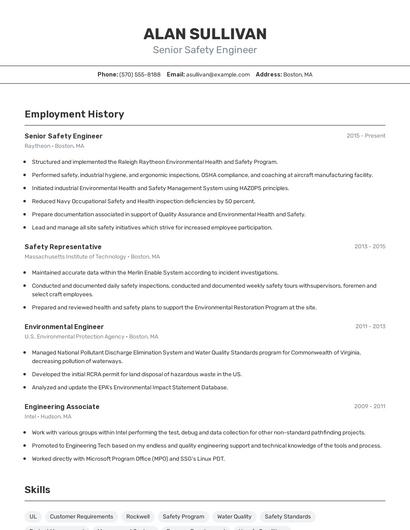
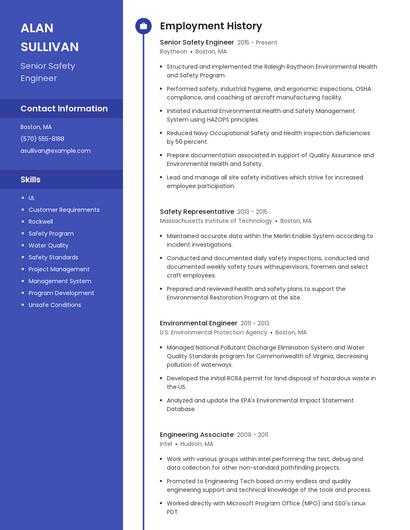
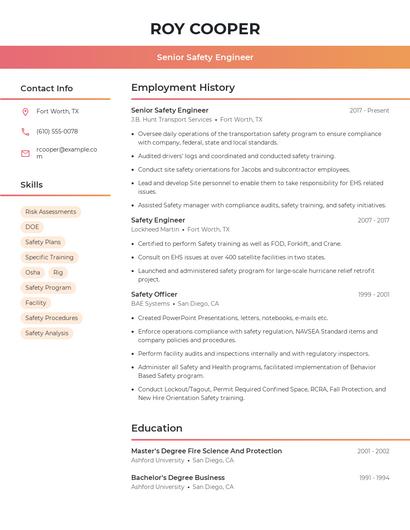
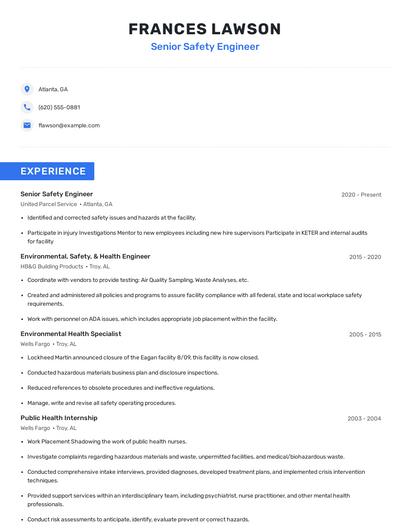
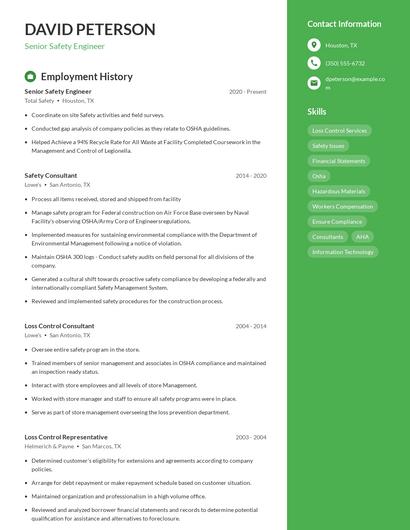
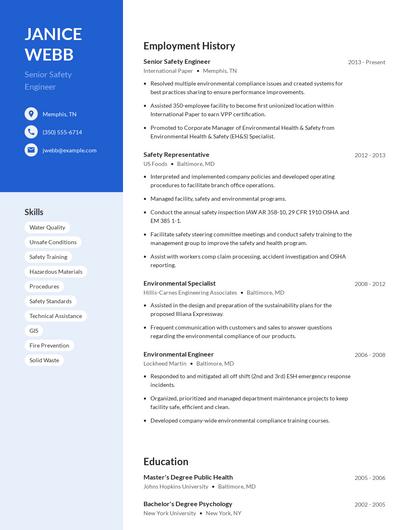
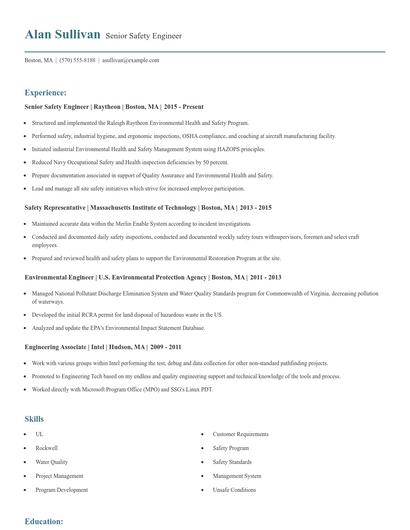
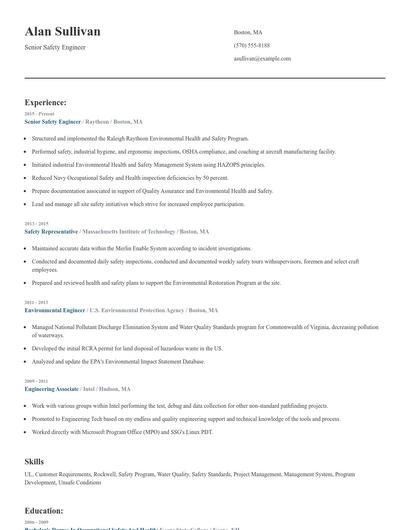
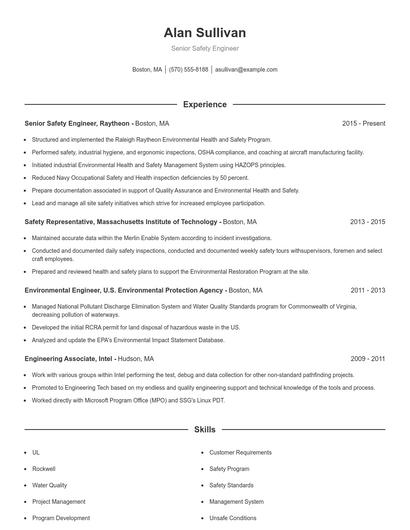
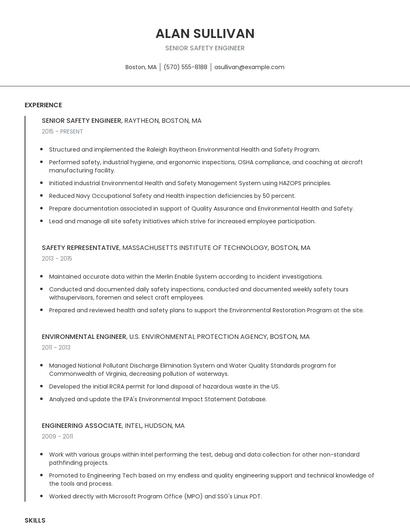
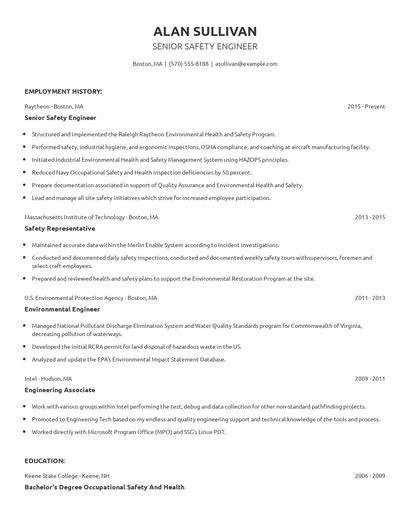
Choose from 10+ customizable senior safety engineer resume templates
Build a professional senior safety engineer resume in minutes. Our AI resume writing assistant will guide you through every step of the process, and you can choose from 10+ resume templates to create your senior safety engineer resume.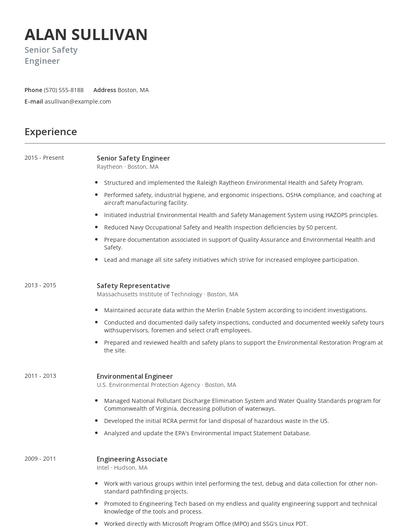
Compare different senior safety engineers
Senior safety engineer vs. Industrial hygienist
An Industrial Hygienist plans and conducts health programs to educate employees about cleanliness, safety, and sanitation in the workplace. They investigate adequacy of ventilation, exhaust equipment, lighting, and other conditions that can affect employees' health, comfort, or efficiency.
There are some key differences in the responsibilities of each position. For example, senior safety engineer responsibilities require skills like "safety analysis," "safety engineering," "safety regulations," and "safety issues." Meanwhile a typical industrial hygienist has skills in areas such as "environmental health," "indoor air quality," "ventilation," and "safety program." This difference in skills reveals the differences in what each career does.
Industrial hygienists earn the highest salaries when working in the energy industry, with an average yearly salary of $93,692. On the other hand, senior safety engineers are paid more in the technology industry with an average salary of $97,792.On average, industrial hygienists reach similar levels of education than senior safety engineers. Industrial hygienists are 0.1% more likely to earn a Master's Degree and 0.9% less likely to graduate with a Doctoral Degree.Senior safety engineer vs. Manager, environmental and safety
An Environmental and Safety manager is responsible for overseeing environmental sustainability concerning production and manufacturing processes and mitigating nature's hazardous effects. Environmental and Safety managers evaluate the methods and resources used to produce and eliminate procedures that violate safety laws and internal regulations. They also facilitate training and programs for the employees to ensure adherence to protocols and prevent accidents during operations. An Environmental and Safety Manager must have excellent communication and leadership skills, especially in reviewing incident reports and conducting root-cause analysis to avoid reoccurrence.
While some skills are similar in these professions, other skills aren't so similar. For example, resumes show us that senior safety engineer responsibilities requires skills like "safety standards," "safety analysis," "safety engineering," and "dod." But a manager, environmental and safety might use other skills in their typical duties, such as, "environmental health," "environmental compliance," "safety program," and "oversight."
On average, managers, environmental and safety earn a higher salary than senior safety engineers. Some industries support higher salaries in each profession. Interestingly enough, managers, environmental and safety earn the most pay in the construction industry with an average salary of $85,529. Whereas senior safety engineers have higher pay in the technology industry, with an average salary of $97,792.managers, environmental and safety earn similar levels of education than senior safety engineers in general. They're 2.2% less likely to graduate with a Master's Degree and 0.9% less likely to earn a Doctoral Degree.What technology do you think will become more important and prevalent for senior safety engineers in the next 3-5 years?
Linsay Hale
Professional Standards Director/Interim Training Division Director, IADLEST Member - International Association of Directors of Law Enforcement Standards and Training
Senior safety engineer vs. Ehs manager
An environmental health & safety (EHS) manager is in charge of developing and implementing safety programs for a company's workforce and work environment. Their responsibilities revolve around conducting regular inspections to ensure compliance with safety and environmental regulations, devising preventive measures, spearheading training and seminars, and investigating workplace accidents and identify causes to ensure that it would not happen again. Furthermore, as a manager, it is essential to lead and encourage the team to reach goals, all while implementing every policy and safety regulation of the company.
There are many key differences between these two careers, including some of the skills required to perform responsibilities within each role. For example, a senior safety engineer is likely to be skilled in "osha," "safety standards," "safety analysis," and "safety engineering," while a typical ehs manager is skilled in "environmental health," "local regulations," "oversight," and "safety policies."
Ehs managers make a very good living in the technology industry with an average annual salary of $96,976. On the other hand, senior safety engineers are paid the highest salary in the technology industry, with average annual pay of $97,792.ehs managers typically earn similar educational levels compared to senior safety engineers. Specifically, they're 0.2% more likely to graduate with a Master's Degree, and 1.5% more likely to earn a Doctoral Degree.Senior safety engineer vs. Safety specialist
Safety specialists examine various types of work procedures and environments. They observe if workplaces stick to the regulations on health, safety, and the environment. Also, they create programs to prevent injury or disease to workers and harm to the environment. Their duties include identifying hazards at the workplace and collecting samples of potentially toxic materials for examination. Another task they do is conduct training on emergency preparedness. Additionally, they explore and identify the causes of an accident to determine their preventative measures.
Types of senior safety engineer
Updated January 8, 2025
