What does a senior support engineer do?
A senior support engineer specializes in providing technical support to clients. They are typically in charge of working on complicated technical issues, resolving them promptly and efficiently. Their responsibilities include communicating with clients, addressing their needs, troubleshooting, and providing step by step solutions. They may also arrange repair appointments or refer clients to other services. Furthermore, as a senior support engineer, it is essential to lead and serve as a mentor to junior engineers, all while implementing the company's policies and regulations.
Senior support engineer responsibilities
Here are examples of responsibilities from real senior support engineer resumes:
- Manage adherence to SOX compliance guidelines including segregation of duties.
- Maintain ownership and manage support case from start to finish working with stores with POS transactions and orders through web purchases.
- Lead technical operations for an innovative workforce virtualization movement, including initial design and improvement of technical systems and processes.
- Work on multiple UNIX OS installations and customer upgrades.
- Resolve network and DNS issues.
- Target specific issues and assist with resolution in the Linux environment.
- Train junior staff on ghost image deployment and workstation OS configuration.
- Trouble shoots VOIP issues utilizing packet capture tools and server logs.
- Maintain inventory and managed/deployment of all VOIP phones for the site.
- Execute batch scripts in Linux environment to process campaign data and generate files.
- Work on PPPOE and 24online servers, remotely troubleshooting and providing support to field engineers.
- Head team of support engineers to help reduce the physical footprint in the lab, utilizing VMware.
- Perform enterprise analysis and remote-hands service for SaaS host applications, IPv6, DNS and DC infrastructure.
- Perform SQL table modifications to all environments in order to help test, research and resolve issues.
- Experience also include quality assurance of product's migration to a new software language (Java) and architecture.
Senior support engineer skills and personality traits
We calculated that 12% of Senior Support Engineers are proficient in Java, Customer Service, and Troubleshoot. They’re also known for soft skills such as Customer-service skills, Listening skills, and Speaking skills.
We break down the percentage of Senior Support Engineers that have these skills listed on their resume here:
- Java, 12%
Implemented software features in Java, C/C++, Perl, and Shell Scripts.
- Customer Service, 8%
Created knowledge base articles for undocumented issues and provided excellent customer service while working effectively in team environment.
- Troubleshoot, 7%
Traveled extensively to troubleshoot product anomalies and report them to senior management and engineering.
- Cloud, 6%
Supported Object Storage environments which delivered distributed and decentralized Cloud Storage, Secure Backup, Disaster Recovery and Storage-as-a-Service solutions.
- Technical Support, 6%
Work with management on the allocation of personnel to effectively and confidently provide superior technical support in the Midwest Division region.
- Linux, 5%
Designed infrastructure, integration, & processes for LTE TBS (Test Base Station) hardware, software & Linux OS.
"java," "customer service," and "troubleshoot" are among the most common skills that senior support engineers use at work. You can find even more senior support engineer responsibilities below, including:
Customer-service skills. To carry out their duties, the most important skill for a senior support engineer to have is customer-service skills. Their role and responsibilities require that "computer support specialists must be patient and sympathetic." Senior support engineers often use customer-service skills in their day-to-day job, as shown by this real resume: "conducted all aspects of customer support within the company to ensure positive customer relationships and satisfied customers. "
Listening skills. Many senior support engineer duties rely on listening skills. "support workers must be able to understand the problems that their customers are describing and know when to ask questions to clarify the situation.," so a senior support engineer will need this skill often in their role. This resume example is just one of many ways senior support engineer responsibilities rely on listening skills: "communicated with users via telephone, email, & personal requests in regards to technical support. "
Speaking skills. Another skill that relates to the job responsibilities of senior support engineers is speaking skills. This skill is critical to many everyday senior support engineer duties, as "support workers must describe the solutions to computer problems in a way that a nontechnical person can understand." This example from a resume shows how this skill is used: "presented company-wide internal training for new confluence wiki showcasing basic and advanced topics covering xslt and jira integration. "
Writing skills. A big part of what senior support engineers do relies on "writing skills." You can see how essential it is to senior support engineer responsibilities because "strong writing skills are useful for preparing instructions and email responses for employees and customers, as well as for real-time web chat interactions." Here's an example of how this skill is used from a resume that represents typical senior support engineer tasks: "provided technical support to government test agencies in writing, editing and evaluating individual test plans for technical accuracy. "
Problem-solving skills. Another crucial skill for a senior support engineer to carry out their responsibilities is "problem-solving skills." A big part of what senior support engineers relies on this skill, since "support workers must identify both simple and complex computer problems, analyze them, and solve them." How this skill relates to senior support engineer duties can be seen in an example from a senior support engineer resume snippet: "trained new premium engineers in customer support roles and issue resolution. "
The three companies that hire the most senior support engineers are:
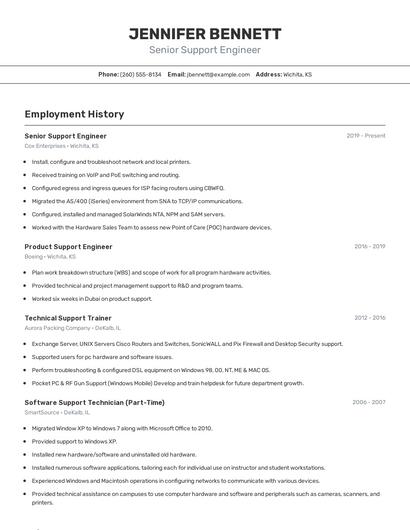
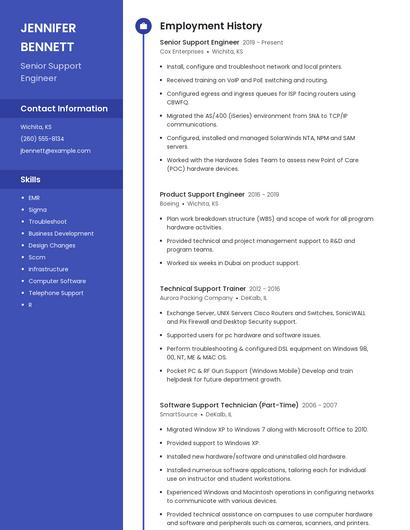
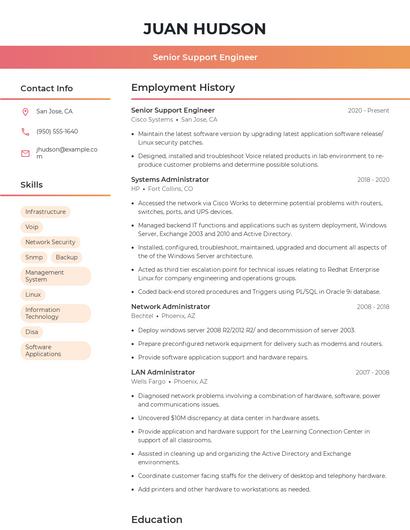
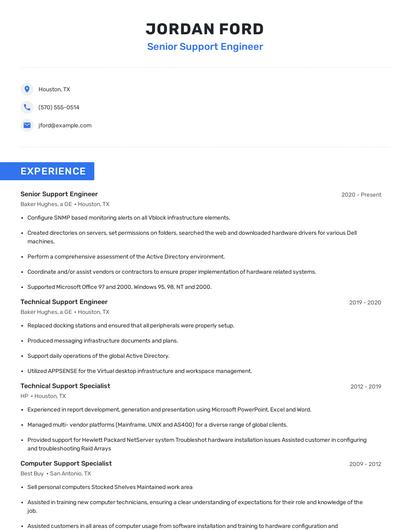
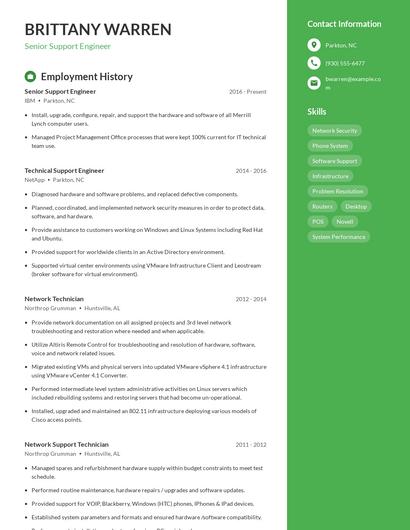
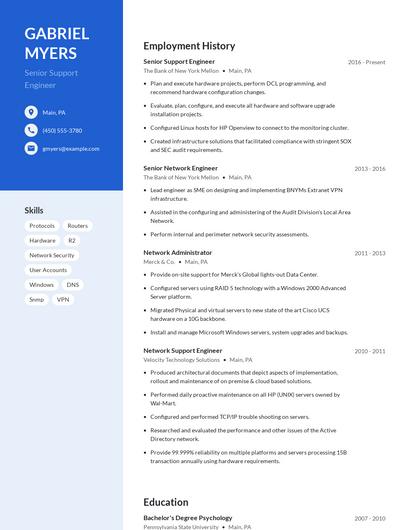
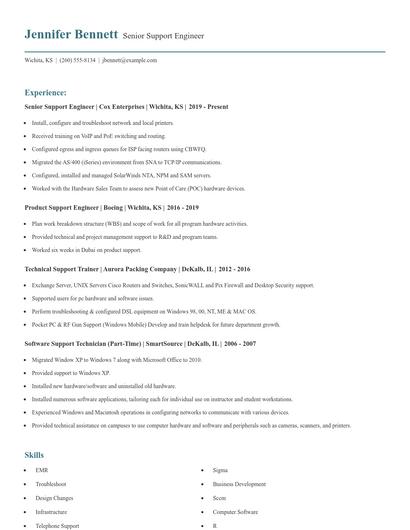
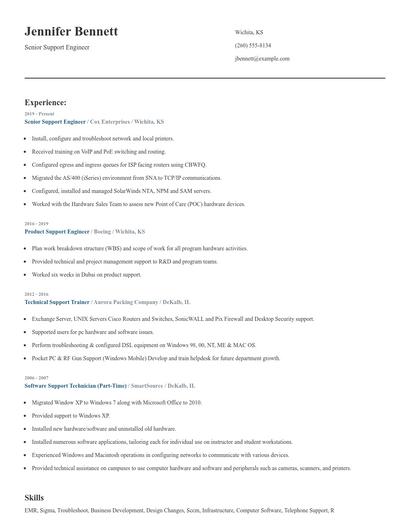
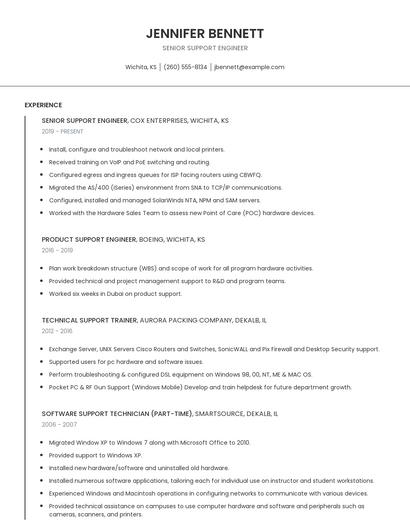
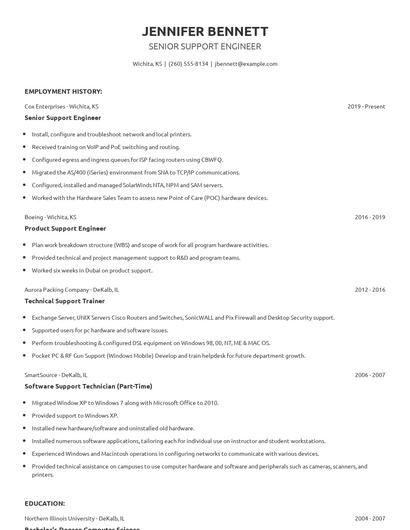
Choose from 10+ customizable senior support engineer resume templates
Build a professional senior support engineer resume in minutes. Our AI resume writing assistant will guide you through every step of the process, and you can choose from 10+ resume templates to create your senior support engineer resume.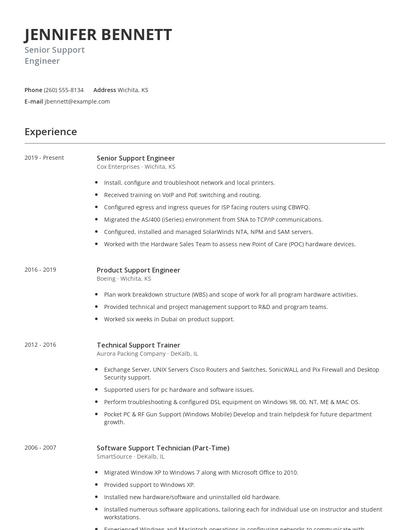

Compare different senior support engineers
Senior support engineer vs. Support analyst
The role of support analysts is to resolve problems with hardware, computer programs, and peripherals. They may focus on a particular aspect of the information technology (IT) department or give technical support to end-users. They mainly detect issues with IT equipment and software and devise solutions to resolve these issues. Also, they are responsible for answering queries from users, preparing service records, and handling escalations. Support analysts also support the company's IT operations and best practices by creating and distributing relevant IT documents.
There are some key differences in the responsibilities of each position. For example, senior support engineer responsibilities require skills like "cloud," "database," "c #," and "lifecycle management." Meanwhile a typical support analyst has skills in areas such as "patients," "issue resolution," "excellent interpersonal," and "strong customer service." This difference in skills reveals the differences in what each career does.
Support analysts earn the highest salaries when working in the finance industry, with an average yearly salary of $93,871. On the other hand, senior support engineers are paid more in the technology industry with an average salary of $107,982.support analysts tend to reach similar levels of education than senior support engineers. In fact, support analysts are 3.3% less likely to graduate with a Master's Degree and 0.1% more likely to have a Doctoral Degree.Senior support engineer vs. Support lead
A support lead is typically in charge of overseeing the performance of a technical support team, ensuring efficiency and customer satisfaction. Their responsibilities revolve around assessing the performance of the workforce, resolving complex issues, identifying customer needs and sales opportunities, and training new team members. They may also perform calls and correspondence, respond to inquiries, and resolve issues promptly. Furthermore, as a support lead, it is essential to perform clerical tasks such as preparing progress reports, managing schedules, and maintaining records of transactions.
In addition to the difference in salary, there are some other key differences worth noting. For example, senior support engineer responsibilities are more likely to require skills like "cloud," "database," "c #," and "lifecycle management." Meanwhile, a support lead has duties that require skills in areas such as "cash management," "pos," "sales floor," and "payroll." These differences highlight just how different the day-to-day in each role looks.
In general, support leads achieve similar levels of education than senior support engineers. They're 1.9% less likely to obtain a Master's Degree while being 0.1% more likely to earn a Doctoral Degree.Senior support engineer vs. Systems support
A systems support agent is responsible for resolving system applications and network issues, performing technical configuration, and upgrading systems infrastructure. A systems support representative conducts regular maintenance and diagnostic tests on the computer applications to ensure its optimal performance and efficiency to support business operations and avoid delays in deliverables. They also assist the technology team in designing backup systems and improve existing networks according to business requirements and specifications. They write resolution reports for reference to prevent the reoccurrence of system malfunction and inconsistencies.
There are many key differences between these two careers, including some of the skills required to perform responsibilities within each role. For example, a senior support engineer is likely to be skilled in "cloud," "database," "customer issues," and "c #," while a typical systems support is skilled in "desktop support," "end user support," "system support," and "pc support."
Systems supports earn the best pay in the professional industry, where they command an average salary of $72,760. Senior support engineers earn the highest pay from the technology industry, with an average salary of $107,982.systems supports typically earn similar educational levels compared to senior support engineers. Specifically, they're 4.4% less likely to graduate with a Master's Degree, and 0.1% less likely to earn a Doctoral Degree.Senior support engineer vs. Team lead engineer
A team leads engineer is in charge of spearheading and overseeing the efforts of an engineering team, ensuring efficiency and smooth workflow. Although the duties may depend on one's industry of employment, it typically includes designing and developing systems according to project requirements, setting objectives and construction guidelines, delegating tasks, managing budgets and schedules, and monitoring the workflow, performing corrective measures as needed. Furthermore, as a team leads engineer, it is essential to encourage the workforce to reach goals, all while enforcing the company's safety standards and regulations.
Types of senior support engineer
Updated January 8, 2025
