What does a service planner do?
The duties of a service planner depend on their place or industry of employment. Typically, their responsibilities include performing market research and analysis, gathering and analyzing customer data and feedback, liaising with external parties such as vendors and suppliers, establishing guidelines and timelines, and developing strategies to optimize operations. They must also monitor the progress of operations from planning to execution, resolving problems should any arise. Moreover, a service planner usually works in a team setting, which requires an active communication line for a smooth and efficient workflow.
Service planner responsibilities
Here are examples of responsibilities from real service planner resumes:
- Create budgets, select sites, negotiate contracts, manage logistics, oversee food and beverage, and coordinate vendors
- Generate MRP on a monthly basis; run weekly selective MRP to include any addition requirements receive.
- Review inventory and plan releases for assign accounts using customer's spreadsheets, EDI or MRP releases.
- Generate shop order paperwork including Kanban pull card system and manual shop orders base upon customer demand.
- Use of a RF scanner and floor jack.
- Assist pickers with picking and RF scanner issues.
- Schedule all LTL shipments and provide freight quotes when request.
- Prepare work orders for inspection/replacement of aircraft parts through ERP and phase requirements.
- Create and wave stock withdrawals and perform inventory tasks using client's WMS.
- Enter, organize, track and maintain customer information in require ERP (s).
- Enter orders and follow up with distributors on ship dates and other miscellaneous shipment issues.
- Assist inventory with any issues, so that the pick ticket/customer order will reflect in WMS system.
- Handle incoming phone calls from distributors and sales representatives on problem orders and all other order relate issues.
- Participate in implementation of Kanban system.
- Rectify day-to-day logistics issues and provide rapid responses to customer requests.
Service planner skills and personality traits
We calculated that 10% of Service Planners are proficient in Customer Complaints, Data Entry, and Customer Service. They’re also known for soft skills such as Communication skills, Customer-service skills, and Detail oriented.
We break down the percentage of Service Planners that have these skills listed on their resume here:
- Customer Complaints, 10%
Coordinated and resolved customer complaints.
- Data Entry, 9%
Performed program audits, data analyses, data entry, and created/developed related programmatic reports.
- Customer Service, 9%
Developed and implemented Telemarketing Incentive Program for distribution center customer service teams contributing an additional 10% to total sales.
- Delivery Dates, 8%
Monitor and verify part number revisions, delivery dates, quantity counts and prices to assure accuracy.
- Purchase Orders, 4%
Audited customer purchase orders for accuracy of product, pricing and delivery requirements.
- MRP, 4%
Coordinate with fabrication, paint and assembly to ensure internal sub assemblies are completed per MRP requirements and Customer Commitment Dates.
Common skills that a service planner uses to do their job include "customer complaints," "data entry," and "customer service." You can find details on the most important service planner responsibilities below.
Communication skills. One of the key soft skills for a service planner to have is communication skills. You can see how this relates to what service planners do because "material recording clerks are frequently in contact with suppliers, vendors, or managers and need to convey their company’s needs effectively." Additionally, a service planner resume shows how service planners use communication skills: "maintained cycle counts, released purchase orders for required materials and communication with suppliers. "
Customer-service skills. Another soft skill that's essential for fulfilling service planner duties is customer-service skills. The role rewards competence in this skill because "material recording clerks may interact with customers in order to respond to problems or complaints." According to a service planner resume, here's how service planners can utilize customer-service skills in their job responsibilities: "worked with it department to confirm customer edi interfaces set up correctly avoiding missed customer shipments and their required edi transaction. "
Detail oriented. service planners are also known for detail oriented, which are critical to their duties. You can see how this skill relates to service planner responsibilities, because "material and product inspecting clerks must pay attention to detail when checking items for defects, some of which are small and difficult to spot." A service planner resume example shows how detail oriented is used in the workplace: "communicate frequently with customer service staff, often to give customers details of shipping times and delivery estimates. "
Math skills. For certain service planner responsibilities to be completed, the job requires competence in "math skills." The day-to-day duties of a service planner rely on this skill, as "material recording clerks may need to calculate shipping costs or take measurements." For example, this snippet was taken directly from a resume about how this skill applies to what service planners do: "analyzed production specifications and capacity data and performs mathematical calculations to determine production processes, tools and human resource requirements. "
The three companies that hire the most service planners are:
- Microsoft4 service planners jobs
- ABM Industries3 service planners jobs
- Ameriprise Financial2 service planners jobs
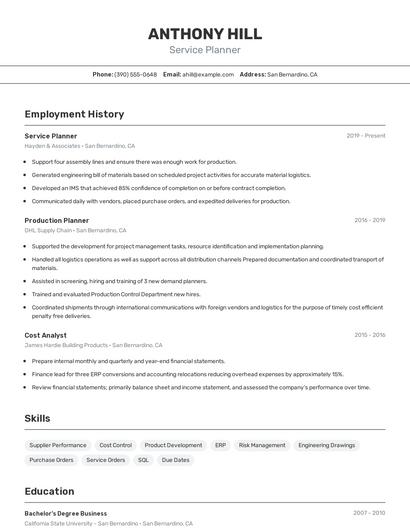
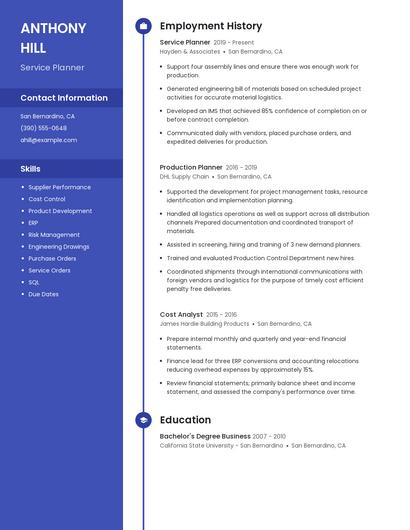
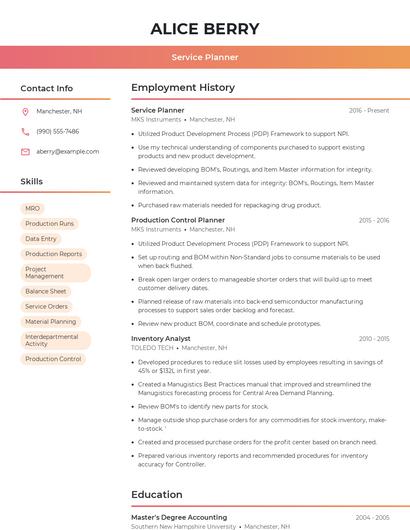
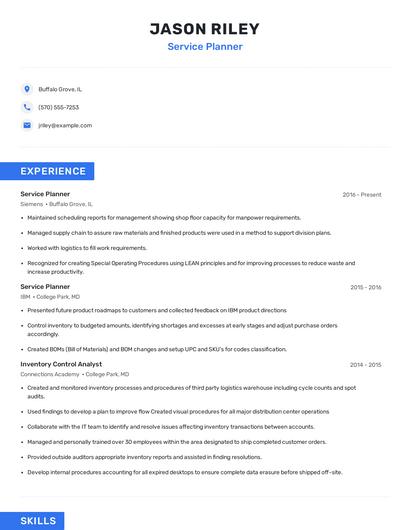
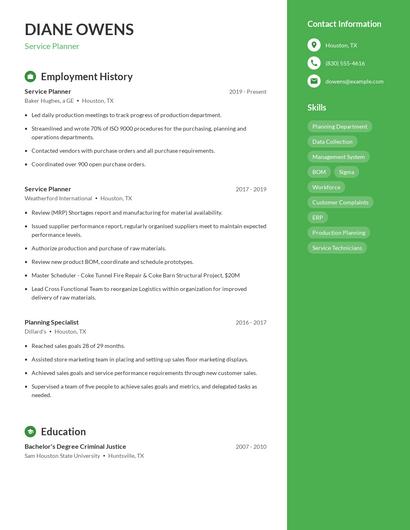
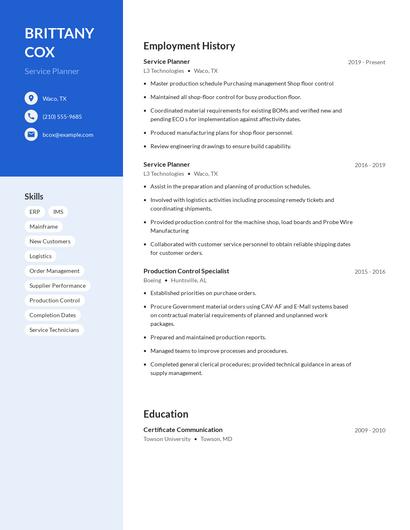
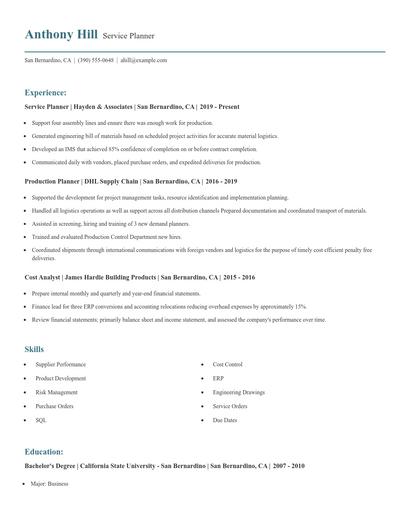
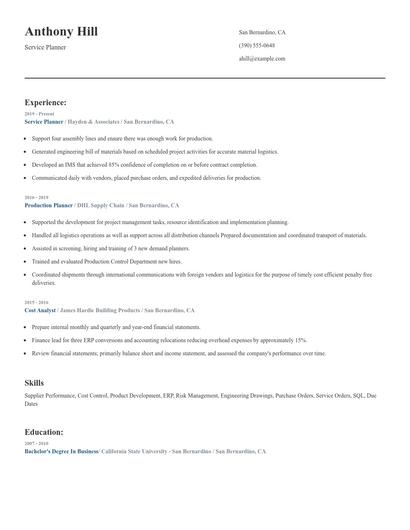
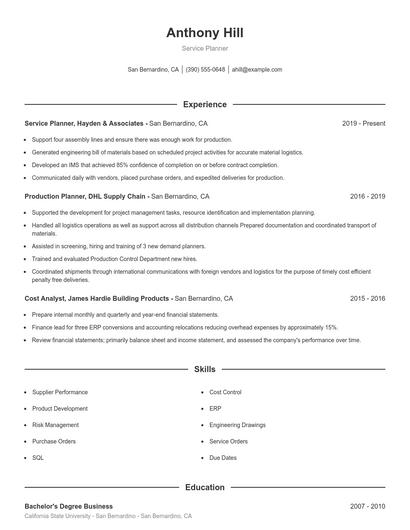
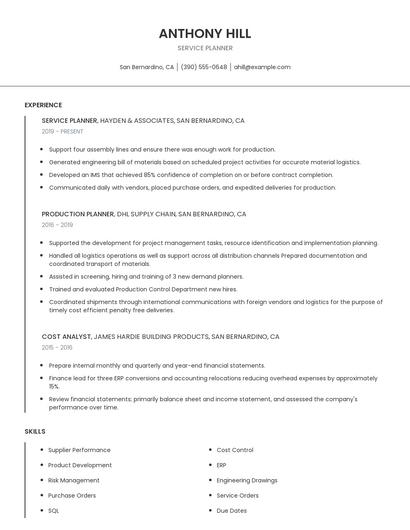
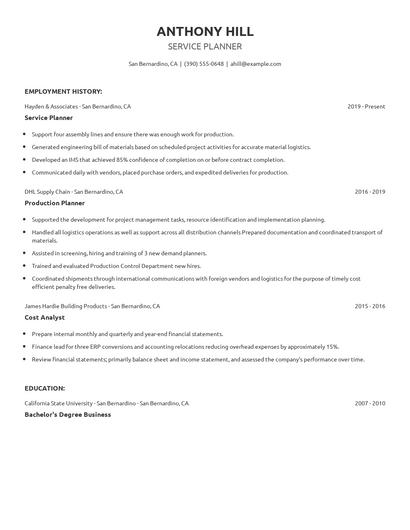
Choose from 10+ customizable service planner resume templates
Build a professional service planner resume in minutes. Our AI resume writing assistant will guide you through every step of the process, and you can choose from 10+ resume templates to create your service planner resume.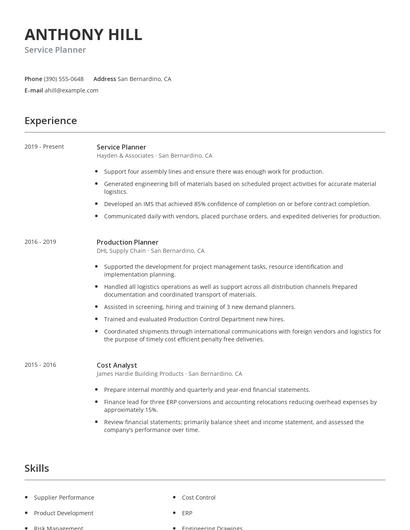
Compare different service planners
Service planner vs. Production control clerk
Production control clerks will need to possess skills in data, entry, drafting customer supports and orders, dealing with production workers, and handling material inventory records. Also, clerical skills are a plus. This career calls for the reviewing and distribution of production work and shipment schedules, conferring with department supervisors on work progress and dates of completion, as well as the compilation of work progress reports, inventory levels, costs, and any issues in production.
While similarities exist, there are also some differences between service planners and production control clerk. For instance, service planner responsibilities require skills such as "customer complaints," "customer service," "delivery dates," and "safety stock." Whereas a production control clerk is skilled in "production reports," "production sheets," "product specifications," and "payroll." This is part of what separates the two careers.
Production control clerks earn the highest salaries when working in the manufacturing industry, with an average yearly salary of $43,635. On the other hand, service planners are paid more in the energy industry with an average salary of $76,069.production control clerks tend to reach lower levels of education than service planners. In fact, production control clerks are 7.6% less likely to graduate with a Master's Degree and 0.9% less likely to have a Doctoral Degree.Service planner vs. Production controller
A production controller is in charge of overseeing manufacturing operations, ensuring the workflow adheres to the quality standards, budgets, and deadlines. It is their duty to develop production and inventory control techniques, coordinate with managers to establish objectives and guidelines, review production plans and job orders, and supervise the supply chain operations. They also monitor every procedure, implement solutions in problem areas, and produce progress reports as needed. Furthermore, as a production controller, it is essential to maintain an active communication line with the production team while implementing the company's protocols and policies.
While some skills are similar in these professions, other skills aren't so similar. For example, resumes show us that service planner responsibilities requires skills like "customer complaints," "customer service," "purchase orders," and "safety stock." But a production controller might use other skills in their typical duties, such as, "production control," "production planning," "control procedures," and "respirators."
Production controllers earn a lower average salary than service planners. But production controllers earn the highest pay in the technology industry, with an average salary of $58,093. Additionally, service planners earn the highest salaries in the energy with average pay of $76,069 annually.production controllers earn lower levels of education than service planners in general. They're 5.1% less likely to graduate with a Master's Degree and 0.9% less likely to earn a Doctoral Degree.Service planner vs. Production clerk
Production clerks are involved with parts, warehousing, and inventory management operations. Those who choose this career path will be required to review and distribute production, work, and shipment schedules, as well as confer with department supervisors in order to determine the progress of work and completion dates. Production clerks also compile reports on things like work progress, inventory levels, cost, and production issues.
There are many key differences between these two careers, including some of the skills required to perform responsibilities within each role. For example, a service planner is likely to be skilled in "customer complaints," "customer service," "delivery dates," and "mrp," while a typical production clerk is skilled in "basic math," "safety procedures," "math," and "production reports."
Production clerks earn the highest salary when working in the manufacturing industry, where they receive an average salary of $33,145. Comparatively, service planners have the highest earning potential in the energy industry, with an average salary of $76,069.When it comes to education, production clerks tend to earn lower degree levels compared to service planners. In fact, they're 8.3% less likely to earn a Master's Degree, and 0.9% less likely to graduate with a Doctoral Degree.Service planner vs. Expeditor
The role of expeditors is to ensure the timely and efficient preparation and delivery of food. To accomplish this task, they also perform other duties, including managing inventory levels, managing supply requisition, and coordinating with subcontractors. They are also responsible for streamlining interdepartmental communication, monitoring job progress, and collaborating with project managers to collect relevant information about job status. This role requires specific skills and qualifications, including a high school diploma or an associate degree in food service, business management, and hospitality management, relevant work experience, and certifications in CCP, CPSM, or CPPB.
Types of service planner
Updated January 8, 2025
