Explore jobs
Find specific jobs
Explore careers
Explore professions
Best companies
Explore companies
Job outlook for social security specialists in the United States
Are social security specialist jobs in demand?
Social security specialist job and salary trends over time
Social security specialist jobs over time
Social security specialist job growth rate over time
| Year | # of jobs | % of population |
|---|---|---|
| 2021 | 1,183 | 0.00% |
| 2020 | 1,144 | 0.00% |
| 2019 | 1,271 | 0.00% |
| 2018 | 1,280 | 0.00% |
| 2017 | 1,319 | 0.00% |
Average social security specialist salary over time
Social security specialist salary by year
| Year | Avg. salary | Hourly rate | % Change |
|---|---|---|---|
| 2025 | $49,946 | $24.01 | +6.8% |
| 2024 | $46,764 | $22.48 | +2.7% |
| 2023 | $45,514 | $21.88 | +2.5% |
| 2022 | $44,393 | $21.34 | --3.6% |
| 2021 | $46,048 | $22.14 | +2.9% |
Social security specialist jobs by state
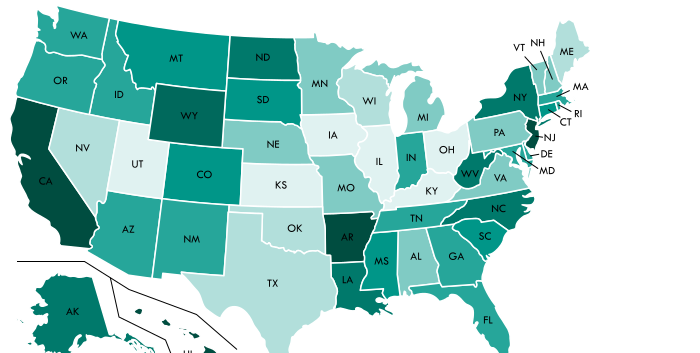
Most common states for social security specialists
| Rank | State | Population | # of jobs | Employment/ 1000ppl |
|---|---|---|---|---|
| 1 | District of Columbia | 693,972 | 257 | 37% |
| 2 | Delaware | 961,939 | 290 | 30% |
| 3 | Alaska | 739,795 | 197 | 27% |
| 4 | Vermont | 623,657 | 166 | 27% |
| 5 | New Hampshire | 1,342,795 | 353 | 26% |
| 6 | Rhode Island | 1,059,639 | 279 | 26% |
| 7 | Minnesota | 5,576,606 | 1,384 | 25% |
| 8 | North Dakota | 755,393 | 186 | 25% |
| 9 | Nebraska | 1,920,076 | 467 | 24% |
| 10 | Montana | 1,050,493 | 240 | 23% |
| 11 | Wyoming | 579,315 | 135 | 23% |
| 12 | Washington | 7,405,743 | 1,625 | 22% |
| 13 | Iowa | 3,145,711 | 705 | 22% |
| 14 | Maine | 1,335,907 | 295 | 22% |
| 15 | South Dakota | 869,666 | 194 | 22% |
| 16 | Illinois | 12,802,023 | 2,635 | 21% |
| 17 | Pennsylvania | 12,805,537 | 2,526 | 20% |
| 18 | Georgia | 10,429,379 | 1,954 | 19% |
| 19 | North Carolina | 10,273,419 | 1,948 | 19% |
| 20 | New Jersey | 9,005,644 | 1,725 | 19% |
Most common cities for social security specialists
| Rank | City | # of jobs | Employment/ 1000ppl | Avg. salary |
|---|---|---|---|---|
| 1 | Farmington | 1 | 4% | $48,458 |
| 2 | Frankfort | 1 | 4% | $35,298 |
| 3 | Annapolis | 1 | 3% | $48,102 |
| 4 | Dover | 1 | 3% | $48,051 |
| 5 | Juneau | 1 | 3% | $52,627 |
| 6 | Hartford | 1 | 1% | $48,360 |
| 7 | Lansing | 1 | 1% | $44,826 |
| 8 | Little Rock | 1 | 1% | $58,943 |
| 9 | Springfield | 1 | 1% | $35,981 |
| 10 | Denver | 2 | 0% | $51,305 |
| 11 | Atlanta | 1 | 0% | $45,446 |
| 12 | Baton Rouge | 1 | 0% | $53,139 |
| 13 | Boston | 1 | 0% | $46,197 |
| 14 | Des Moines | 1 | 0% | $35,906 |
| 15 | Indianapolis | 1 | 0% | $45,449 |
| 16 | Montgomery | 1 | 0% | $42,125 |
| 17 | Phoenix | 1 | 0% | $47,479 |
| 18 | Sacramento | 1 | 0% | $61,966 |
Social Security Specialist job outlook: Expert opinions
Our panel of social security specialist experts
Colorado State University - Pueblo
College of Saint Scholastica
Virginia Wesleyan University
Pennsylvania State University
Siena College
Nazareth College of Rochester
Nebraska Christian College
Kennesaw State University
Azusa Pacific University
Idaho State University

The University of Texas Permian Basin
University of Nevada - Reno
What general advice would you give to a Social Security Specialist?
Emily McCave PhD, MSW, LCSW: Most people find social work to be incredibly rewarding, knowing that you are a facilitator of positive change, whether be within an individual, organization, or at a larger community or societal level. For many, being able to help people reach their full capacity is fulfilling. The amount of documentation we must complete in clinical settings is often what is liked the least.
What Social Security Specialist skills would you recommend for someone trying to advance their career?
Emily McCave PhD, MSW, LCSW: The need for social workers is high, particularly after the pandemic. A shortage of social workers means that there's an increasing demand in the field. According to the Bureau of Labor Statistics social work jobs are expected to increase 13% between 2020 and 2030.
What will help Social Security Specialists increase their earning potential?
Emily McCave PhD, MSW, LCSW: For clinical positions, which is what most social workers do, daily tasks typically include conducting assessments and providing individual, family, and/or group therapy to children and/or adults, while collaborating with other providers working with the client. There is also daily clinical documentation that needs to be completed.
What general advice would you give to a Social Security Specialist?
Pamela Richmond Ph.D.: Challenges social workers can face are high caseloads, not enough resources to assist clients and exposure to horrific aspects of humanity. Social workers enjoy being a part of the change process by recognizing the strengths and resiliency of individuals, families, groups, organizations and communities. Workers advocate for individuals that are marginalized and oppressed, ensuring they have a voice. They enjoy looking at solutions to problems and empowering others to make changes beneficial for their lives.
What will help Social Security Specialists increase their earning potential?
Dr. Michele Sneed DSW, LGSW: The concern frequently voiced by social workers is the documentation aspect of their work. While acknowledging its crucial role in accountability and transparency, social workers often find documentation to be time-consuming and tedious. This stems from the perception that excessive time spent on paperwork detracts from the meaningful interactions they could be having with the individuals and communities they serve.
Dr. Jennifer Slivka
Associate Professor of EnglishVirginia Wesleyan University
Ethnic, Cultural Minority, Gender, And Group Studies
What will help Social Security Specialists increase their earning potential?
Dr. Jennifer Slivka: Because of its interdisciplinary nature, Gender, Women, and Sexuality Studies already offers students diverse perspectives that prepare them for the multi-faceted, complex viewpoints they will encounter in graduate study and in the workplace. In particular, soft skills will become even more important. These skills include communication, critical thinking and problem solving, empathy, collaboration, community-building, leadership, and adaptability. The field is dynamic, so being able to continue to learn and grow after graduation is a necessity.
What will help Social Security Specialists increase their earning potential?
Dr. J. Lendrum PhD: Trust yourself and follow your passions. It is possible to find a meaningful career that aligns with your core interests and values.
What Social Security Specialist skills would you recommend for someone trying to advance their career?
James Andrews LCSW, LICSW, BCD: It is always dangerous to attempt to predict the future; even as little as 3-5 years. However, there are a few skills sets and knowledge areas I would recommend new graduates consciously focus upon for development. First and foremost, I would identify digital literacy and cybersecurity knowledge as critical over the next five years. The recent pandemic had at least one positive outcome: it accelerated and propelled society’s acceptance of virtual platforms and environments across multiple industries. And social work is no exception. Developing proficiency with digital tools and platforms including an understanding of cybersecurity, social media and telehealth technologies will be critical for new social workers. It may surprise some folks to hear this, but such proficiency extends to data analysis and interpretation. I’m not saying social workers need to learn computer programming. However, the rapid emergence of various types of artificial intelligence to assist and enhance people’s ability to analyze and make sense of data will only become increasingly important. Skills and knowledge in data science, machine learning, and artificial intelligence as they apply to clinical services will be highly sought after. Another area I see as becoming increasingly important over the next five years is the cultivation of interdisciplinary knowledge and practice. The combining of expertise from multiple fields can lead to innovative solutions. This involves one’s own knowledge as well as the ability to foster cross-disciplinary relationships and collaborations. For example, knowledge in both technology and business management can give one an edge in pursuing leadership roles that require strategic decision-making.
What will help Social Security Specialists increase their earning potential?
James Andrews LCSW, LICSW, BCD: Completing the MSW and graduating as a professional social worker is exciting and can be overwhelming. There are some general areas of professional development that I would strongly recommend new social workers entering the workforce focus on addressing. The first (and in many ways perhaps the most important) is to actively network. Connect with peers and mentors by building and maintaining professional relationships through joining professional organizations and attending industry events such as conferences and other professional events. Join your state chapter of the National Association of Social Workers (NASW) and become active; don’t just pay your dues every year. Contact the chapter office and volunteer for a committee and run for a volunteer leadership position. Get involved! Next, be adaptable! If the social service field is characterized by any one quality, it is change. Cultivating the ability to grow, adapt to new technologies, methodologies, and work environments will be crucial to one’s career success. Not only does the quality of flexibility makes one a valuable employee and prepares you for unexpected challenges and opportunities, but it is also a central trait needed for those who desire to open their own clinical practices one day. Related to adaptability is the practice of continuous learning. Social work and the larger industry of social services ever evolving, so it is imperative that new graduates embrace the idea that even though they have graduated, they must always be students, ever learning and developing new skills. This involves a commitment to lifelong learning which involves pursuing certifications, workshops attendance, and staying updated with the latest industry trends and technologies through independent reading and research. This not only keeps your skills relevant but also demonstrates your commitment to professional growth. And finally, and too often ignored, is the importance of developing and cultivating what are called “soft skills”. Skills such as communication, teamwork, problem-solving, and time management a(and others) are essential. For the successful social worker. Such soft skills complement one’s technical abilities and are highly valued by employers. And in many ways are what will enable a person to advance in their career.
Elisa Martin Ph.D., MSW
Associate Professor of Social Work, Department Chair & Program DirectorSiena College
Social Sciences
What general advice would you give to a Social Security Specialist?
Elisa Martin Ph.D., MSW: The U.S. Bureau of Labor Statistics projects that the need for social workers will grow faster than many other professions, which means finding employment upon graduation will not be a problem.
What Social Security Specialist skills would you recommend for someone trying to advance their career?
Elisa Martin Ph.D., MSW: Social workers are committed to creating a more socially just world through social change. People who are invested in helping others find social work values resonate and pursue their careers with passion. That said, social work is a demanding profession, and it is important to take care of yourself so you can stay committed to the work without burning out.
What Social Security Specialist skills would you recommend for someone trying to advance their career?
Erin Cole DSW, LCSW: When you're looking for jobs, don't look for a forever job. Find something that seems like a good fit right now. The pressure for it to be forever is too much. Do it for as long as it feels right and move on when it doesn't. Also, remember that being a new graduate is an asset! You are more current on trends in social work, literature, and evidence-based practices than many seasoned professionals. You add value to the setting and should not minimize that by falling back on being new in the field.
What Social Security Specialist skills would you recommend for someone trying to advance their career?
Cynthia Peters MSW: It is a good profession to enter now, due to the need for social workers in some of the jobs that I mentioned in the previous question. Social Workers can provide a different perspective on service delivery. Meeting the clients where they are at; developing relationships with the community; advocating for client services; writing grants; monitoring grants; brokering services......
What will help Social Security Specialists increase their earning potential?
Cynthia Peters MSW: Social Work is a profession that can be in many places: hospital, university, government agencies, fire departments, court systems, homeless shelters, behavioral health facilities, schools, private practices, non-profit agencies, hospice care, senior programs, just to name a few. So depending on where a social workers find a job will determine what they do on a day to day basis.
Christine Kiewra
Associate Professor of PracticeNebraska Christian College
Human Development, Family Studies, And Related Services
What general advice would you give to a Social Security Specialist?
Christine Kiewra: The HDFS program is a flexible degree that offers the “human” element that is necessary but often missing from pre-health and pre-law tracks. The flexibility also allows for students to double major and broaden their learning outcomes.
What general advice would you give to a Social Security Specialist?
Cindy Snell: Be able to articulate the skills and experience you have that are relevant to the jobs you are seeking - tell your story! Learn another language than English. Negotiate your hiring terms. Learn about loan forgiveness options.
What Social Security Specialist skills would you recommend for someone trying to advance their career?
Cindy Snell: Your first job out of school is not often your “dream job”. Consider it as an important step in your career journey. Evaluate job offers holistically, including salary & benefits, skill building, moving towards advanced licensure, good supervision and office culture. There are many ways to contribute to the field of social work. You will find your way on the way. Create a support network. This can include friends to have fun with, social work classmates to form a peer advising group, a mentor to help you chart your career path. Create your self-care strategy and stick with it. Bring joy, reduce stress, step away. Use continuing education requirements to advance your career.
What will help Social Security Specialists increase their earning potential?
Cindy Snell: Working effectively with diverse populations. This includes knowing your own biases, speaking another language, and continually striving for cultural competence. Openness to learning/integrating new technologies and careful consideration of their impact on the services you provide clients. These could include telehealth, record keeping, and the use of AI. Advocacy. Social workers need to advocate for their clients but also for policies that affect their clients and the field of social work. Social workers also need to remember to advocate for themselves and know this is not selfish but often allows them to be more effective social workers.
What general advice would you give to a Social Security Specialist?
Camille Coleman: Do your research within the state and or country, and or agency you are seeking potential employment. Look up the laws, compare them to other states, don't be afraid to look at all careers within the social work field, for example research in social work gets overlooked, facilitation, curriculum development, etc. Future social workers should seek reciprocity in multiple states to practice counseling services after obtaining one's licensure, if wanting to provide therapeutic services. This will give one leverage to negotiate higher salary requests.
What will help Social Security Specialists increase their earning potential?
Camille Coleman: Organizational management is a more necessary prevalent skill due to the importance of documentation and the advancement of telehealth services. Learning multiple EHR (electronic health records) systems as well as being proactive in knowing the laws as it pertains to provide therapeutic services within multiple states.
What general advice would you give to a Social Security Specialist?
Dr. Aimée Vadnais Psy.D, LMFT: Keep in touch with your professors and classmates. They will be able to provide you with letters of recommendations in the future, connect you with job leads, and can make introductions to you to people in the field. Keep your resume current with any trainings or seminars that you attend and include additional certifications you obtain. Keep educating yourself by taking continuing education to learn more about certain topics, theories, interventions, or populations you are interested in learning more about. Network through CAMFT or AAMFT by attending their local chapter events, where you can meet others in the field in your area. Lastly, create a Linked In page so you can advertise about yourself and form local connections with others in your field.
What will help Social Security Specialists increase their earning potential?
Dr. Aimée Vadnais Psy.D, LMFT: Research the going rates in your industry and ask colleagues to have a good idea. Recognize your worth and advocate for yourself during pay discussions. Highlight unique skill sets that may be valuable to the agency. Provide free education nights to benefit the community, potentially leading to clients. Find a niche population you enjoy working with and market your services specifically to this area.
What general advice would you give to a Social Security Specialist?
Andrew Schoolnik: Saying 'yes' to as many challenges and tasks as possible. The accumulation of these experiences will create new opportunities and the cumulation of myriad opportunities is central to career advancement. The 2021 revision to the Social Work Code of Ethics includes the importance of self-care, and saying 'yes' must be balanced with this.
What Social Security Specialist skills would you recommend for someone trying to advance their career?
Andrew Schoolnik: Dialogue and compromise. There are many apparatuses in today's society which are designed to pull people apart. Cable news and online news sites are famous examples of this. Add to this the echo chambers of social media where people largely associate with like-minded people while looking negatively at those with a different world view. This silo-ing of society is the antithesis of dialogue and compromise. Instead, it creates a class system of those who agree (the favored class) and those who disagree (the unfavored class).
On a macro level, the more the social worker dialogues with all stakeholders (those in favor and those opposed) the more that person gains knowledge and goodwill. This is at the heart of compromise - winning being defined as doing the most good for the most people.
On a clinical level, social workers work mutually with their clients. Learning about a client's values begins with dialogue (even when our values are different) and creating treatment plans is often-based on compromise (agency policy/goals, and client goals).
What general advice would you give to a Social Security Specialist?
Alexis Henderson M.S., OTR/L, CLT, OCC: Learning how to incorporate and utilize AI and other technologies in human professions while ensuring we keep the human touch is going to be very prevalent. Having a good understanding of technology as well as the human experience and being able to incorporate both into your work will be priceless.
What Social Security Specialist skills would you recommend for someone trying to advance their career?
Alexis Henderson M.S., OTR/L, CLT, OCC: Never take the first salary offer but also do not get hung up on salary right out of the gate. Remember that helping professions are about more than money. Take every single continuing education and training opportunity that comes your way or that you can find. Training and becoming a master at your craft is how you increase your salary most productively!
What Social Security Specialist skills would you recommend for someone trying to advance their career?
Candace Riddley: I anticipate technological, critical thinking, and communication skills will be most important in the field of social work over the next 3-5 years. AI and digital technologies have become popular in recent years, and new skills will need to be learned or refreshed to maintain in our changing job market. In today's job market, public speaking and problem-solving skills are critical factors when employers are seeking new hires.
What will help Social Security Specialists increase their earning potential?
Candace Riddley: I would encourage a beginning graduate to find a mentor who works in the field of social work. Mentorship is a great way for social workers to enhance their skills, knowledge, and career paths. This is an opportunity to provide guidance, support, feedback, and networking opportunities. Lastly, mentorship provides the opportunity to discuss job-related issues, career concerns, licensure, and challenges within the field. Mentorship is a great way to help graduates grow personally and professionally.
Susan Herrmann Ph.D.
Minnesota State University-Mankato Assistant Professor Department of Social WorkWhat general advice would you give to a Social Security Specialist?
Susan Herrmann Ph.D.: Social work is the most versatile of all human service professions. Social workers utilize a systems framework as they engage their work. Other human service professions look at the individual as the unit of measure, whereas social workers look at client systems and problems in the context in which they find themselves. Social workers take into consideration social, political, historical, psychological, and biological factors when problem solving. Social workers are prepared to effectively work across a variety of domains and in different environments. Social work is an excellent profession to enter now given the rising need for mental health, aging, and substance use services, particularly in rural settings. The social work profession is currently outpacing other professions and approximately 78,000 new jobs will be added to the workforce every year between 2020-2030.
Ines Jindra
Associate Professor of Social Work, BASW Program DirectorIdaho State University
American Indian/Native American Languages, Literatures, And Linguistics
What Social Security Specialist skills would you recommend for someone trying to advance their career?
Ines Jindra: With a BASW in social work, you are eligible for generalist, entry-level positions. In order to maximize your salary potential, look out for training opportunities, and consider going back for an MSW degree in social work a few years down the line (since for many social work positions, you will need an MSW degree).
Sam Terrazas Ph.D.
Professor and Academic Chair Department of Social WorkThe University of Texas Permian Basin
Department of Social Work
What hard/technical skills are most important for Social Security Specialists?
Sam Terrazas Ph.D.: Social workers practice in various areas of practice and organizational auspices that may differ in the hard/technical skills that are most important. In general, the hard/technical skills most important can be categorized based on the level of education-BSW (Bachelors of Social Work) versus MSW (Masters of Social Work).
BSW's practice in a range of organizations providing various types of services; however, in general practice in the realm of case management that requires that ability to demonstrate cultural responsiveness, develop an alliance with clients, apply NASW and a state's ethics and professional standards of practice, conduct assessments, and to develop plans to meet a client's goals.
MSW's practice in many areas such as administration, clinical, public policy and advocacy, child welfare, public safety, and health care. Each of these practice areas requires specific technical skills; however, in general, MSW's are trained to assess individuals, families, groups, and communities. To that end, MSW's must understand the cultural context and how socio/economic local, state, federal policies impact social welfare problems such as poverty, intimate partner violence, and mental illness. MSW's must possess strong engagement skills/therapeutic alliance-building, diagnostic/evaluation skills, ethical application of interventions and therapeutic approaches, and advocacy skills.
Lillian Wichinsky Ph.D.
Associate DeanUniversity of Nevada - Reno
School of Social Work
What soft skills should all Social Security Specialists possess?
Lillian Wichinsky Ph.D.: Social workers need to be prepared to work in integrated health and multidisciplinary settings and act as change agents across systems of care. They work with various communities and people, and therefore soft skills are very important to their success. Some of the most important soft skills include:
-Teamwork. ...
-Communication Skills
-Problem-Solving Skills
-Ethics
-Flexibility/Adaptability
-Leadership skills
What general advice would you give to a Social Security Specialist?
Lillian Wichinsky Ph.D.: A master's degree in social work maximizes the potential of social workers salaries and their level of expertise to provide needed services. Programs offered by CSWE accredited programs like the University of Nevada Reno, School of Social Work can maximize the potential of a social worker's career.