What does a solutions analyst do?
A solutions analyst is an individual who has in-depth knowledge of a wide range of software products. You will perform various tasks that include isolating key issues, defining requirements and scope, and reviewing a few potential solutions. As a solutions analyst, you will refine the company's business objectives into business requirements and move any project ideas from design to delivery. Additional duties include working closely with stakeholders to understand the enterprise impact assessment, working across all products and channels to ensure business success, and facilitating communication between the stakeholders and the business and technology teams.
Solutions analyst responsibilities
Here are examples of responsibilities from real solutions analyst resumes:
- Prepare customized sales proposals, manage forecast and CRM.
- Manage CRM system to track and report sales performance relative to goals and develop improvement action plans.
- Work with internal customers throughout the PC acquisition and deployment process to communicate status and manage expectations.
- Create various Perl, VBscript and batch files to update or manage the registry and configuration of servers.
- Manage and implement VMware infrastructure.
- Develop, test, and modify UNIX programs to support DoD contracts.
- Involve in writing complex Java scripts for better visualization and functions of reports/Dashboards.
- Work briefly with FTP procedures.
- Create schedulers to automatically send to the ftp server.
- Utilize real-time and batch file protocols to process files and HL7 messages.
- Develop and deliver system metrics and weekly reports to prime contractor and DoD leadership.
- Task with planning, coordination, and implementation of VMware and Microsoft server infrastructure.
- Support RFP responses and complex implementation projects or key clients resulting in timely delivery of requests.
- Create automated file movement scripts (cron jobs), between traditional windows networks and UNIX systems.
- Design solutions involving custom windows services, web services, batch applications, data extracts, and user interfaces.
Solutions analyst skills and personality traits
We calculated that 7% of Solutions Analysts are proficient in Project Management, Customer Service, and Java. They’re also known for soft skills such as Creativity, Analytical skills, and Communication skills.
We break down the percentage of Solutions Analysts that have these skills listed on their resume here:
- Project Management, 7%
Coordinated Project Management, Engineering, Professional Services, Operations, Sales teams and other internal partners for opportunity development.
- Customer Service, 7%
Increased customer service levels for General Motors by developing process improvements that reduced order-to-delivery time and increased end-customer and dealer satisfaction.
- Java, 7%
Developed client slide components utilizing Java Swing framework.
- Visualization, 6%
Consulted client with different visualization mockups & presented the same to get project sign off.
- Data Analysis, 5%
Used a variety of cost estimating methodologies and data analysis techniques related to new-business opportunities for medium to large size projects.
- Salesforce, 4%
Administer cases and customer information within Salesforce, quickly develop deep business and technical knowledge of Rainmaker products.
Most solutions analysts use their skills in "project management," "customer service," and "java" to do their jobs. You can find more detail on essential solutions analyst responsibilities here:
Creativity. To carry out their duties, the most important skill for a solutions analyst to have is creativity. Their role and responsibilities require that "because analysts are tasked with finding innovative solutions to computer problems, an ability to “think outside the box” is important." Solutions analysts often use creativity in their day-to-day job, as shown by this real resume: "created business processes improvements and enhancements to store replenishment systems within inventory planning and replenishment. "
Analytical skills. Another soft skill that's essential for fulfilling solutions analyst duties is analytical skills. The role rewards competence in this skill because "analysts must interpret complex information from various sources and decide the best way to move forward on a project." According to a solutions analyst resume, here's how solutions analysts can utilize analytical skills in their job responsibilities: "collaborated with registration configuration team by focusing on data analysis, visualization, and reporting. "
Communication skills. solutions analysts are also known for communication skills, which are critical to their duties. You can see how this skill relates to solutions analyst responsibilities, because "analysts work as a go-between with management and the it department and must explain complex issues in a way that both will understand." A solutions analyst resume example shows how communication skills is used in the workplace: "designed business process flow for message center platform, thus improving communication between customer service and agents. "
The three companies that hire the most solutions analysts are:
- Deloitte694 solutions analysts jobs
- Pwc127 solutions analysts jobs
- McKinsey & Company Inc94 solutions analysts jobs
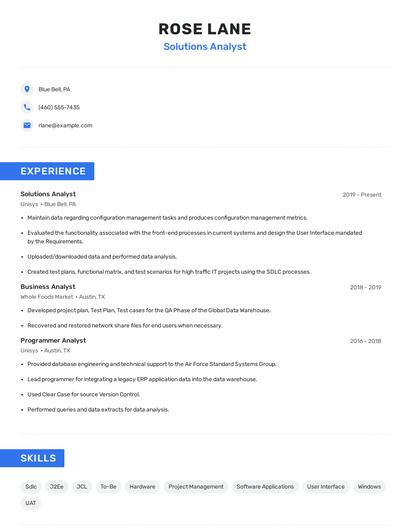
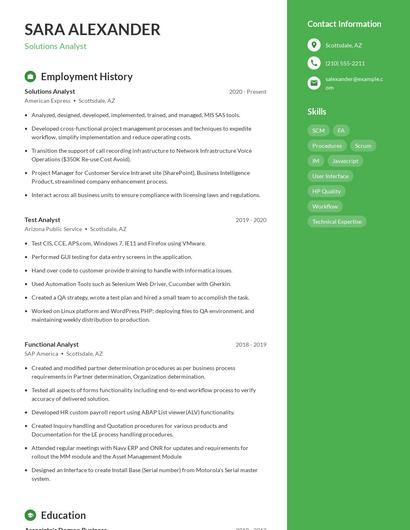
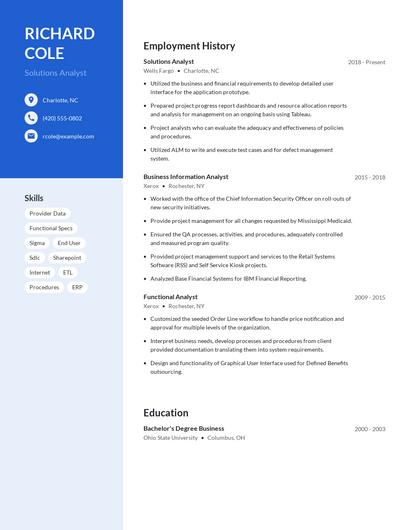
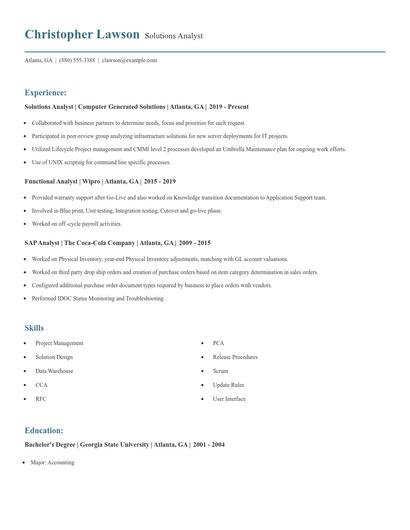
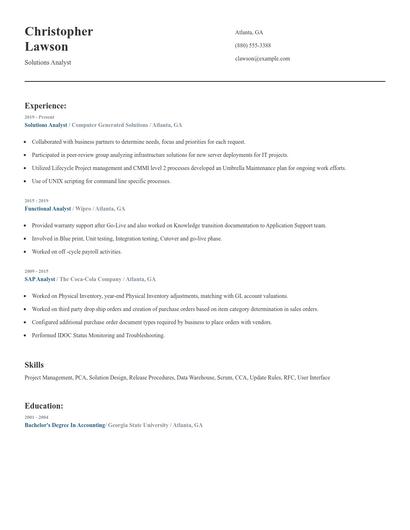
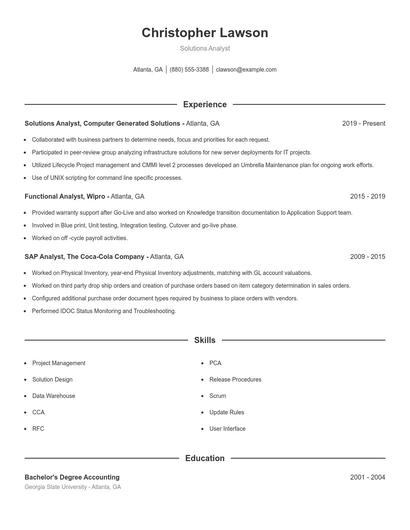
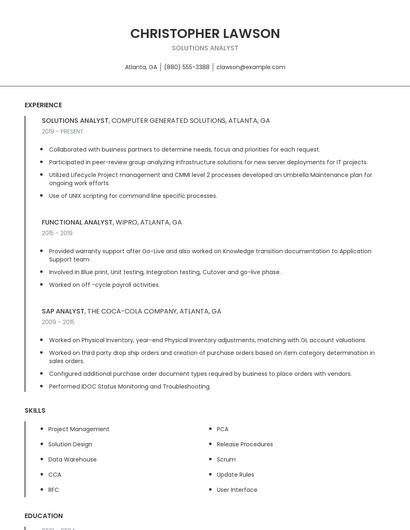
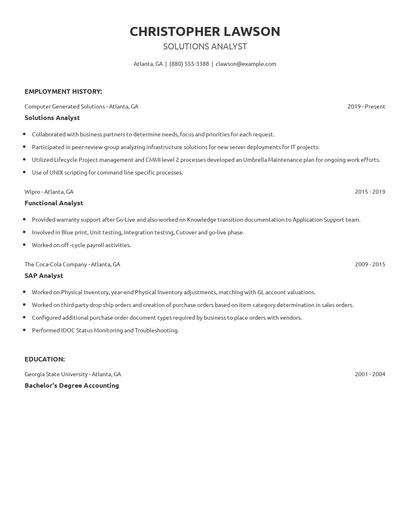
Choose from 10+ customizable solutions analyst resume templates
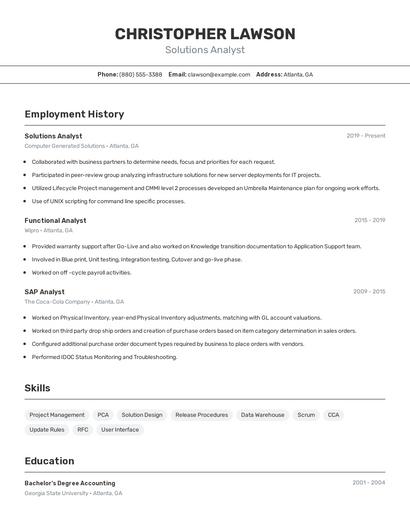
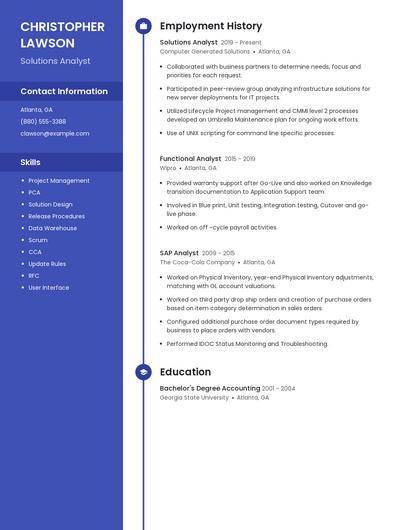
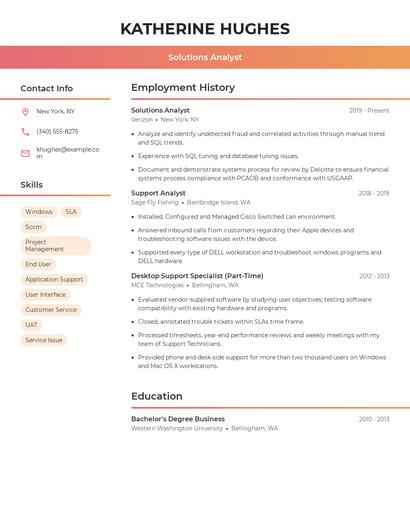
Build a professional solutions analyst resume in minutes. Our AI resume writing assistant will guide you through every step of the process, and you can choose from 10+ resume templates to create your solutions analyst resume.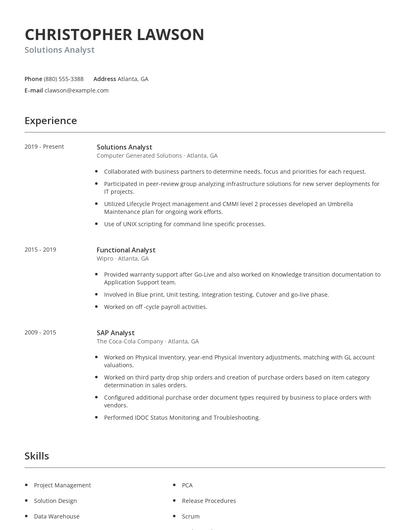
Compare different solutions analysts
Solutions analyst vs. Analyst lead
The duties of an analyst lead depend on one's line of work or industry of employment. Typically, their responsibilities revolve around performing research and analysis, coordinating with different departments to gather leads and data, reviewing findings, and producing reports and presentations for the stakeholders and other higher-ranking officials. Through the results, an analyst lead can provide advice, devise strategies for business optimization, spearhead the development of processes, identify strengths and weaknesses, and offer recommendations on areas in need of improvement. All of this is done while in adherence to the company's vision and mission.
These skill sets are where the common ground ends though. The responsibilities of a solutions analyst are more likely to require skills like "client facing," "salesforce," "post implementation," and "shared services." On the other hand, a job as an analyst lead requires skills like "analytics," "excellent interpersonal," "powerpoint," and "cloud security." As you can see, what employees do in each career varies considerably.
Analyst leads earn the highest salaries when working in the finance industry, with an average yearly salary of $110,488. On the other hand, solutions analysts are paid more in the retail industry with an average salary of $91,045.The education levels that analyst leads earn slightly differ from solutions analysts. In particular, analyst leads are 5.0% more likely to graduate with a Master's Degree than a solutions analyst. Additionally, they're 0.9% more likely to earn a Doctoral Degree.Solutions analyst vs. Analyst
Analysts are employees or individual contributors with a vast experience in a particular field that help the organization address challenges. They help the organization improve processes, policies, and other operations protocol by studying the current processes in place and determining the effectiveness of those processes. They also research industry trends and data to make sound inferences and recommendations on what the company should do to improve their numbers. Analysts recommend business solutions and often help the organization roll out these solutions. They ensure that the proposed action plans are effective and produce the desired results.
In addition to the difference in salary, there are some other key differences worth noting. For example, solutions analyst responsibilities are more likely to require skills like "visualization," "client facing," "salesforce," and "post implementation." Meanwhile, an analyst has duties that require skills in areas such as "strong analytical," "digital transformation," "data entry," and "excellent interpersonal." These differences highlight just how different the day-to-day in each role looks.
Analysts may earn a lower salary than solutions analysts, but analysts earn the most pay in the technology industry with an average salary of $79,330. On the other hand, solutions analysts receive higher pay in the retail industry, where they earn an average salary of $91,045.Average education levels between the two professions vary. Analysts tend to reach similar levels of education than solutions analysts. In fact, they're 0.3% less likely to graduate with a Master's Degree and 0.9% more likely to earn a Doctoral Degree.What technology do you think will become more important and prevalent for solutions analysts in the next 3-5 years?
Erik Johnson Ph.D.
Assistant Professor of Economics, Carthage College
Solutions analyst vs. Application support analyst
An application support analyst is responsible for responding to and resolving customer issues about smartphone or computer applications. They do a variety of applications ranging from banking software and mobile games, and they usually deal with a great number of clients daily. It is also their task to report to a next level member of staff, such as an information technology (IT) manager or a senior systems analyst. Moreover, they spend their time working in an office setting and can be employed by software companies, game developers, technology creators, and other types of organizations.
The required skills of the two careers differ considerably. For example, solutions analysts are more likely to have skills like "visualization," "shared services," "architecture," and "business process." But a application support analyst is more likely to have skills like "application support," "infrastructure," "linux," and "itil."
Application support analysts make a very good living in the finance industry with an average annual salary of $108,929. On the other hand, solutions analysts are paid the highest salary in the retail industry, with average annual pay of $91,045.Most application support analysts achieve a similar degree level compared to solutions analysts. For example, they're 2.0% less likely to graduate with a Master's Degree, and 0.1% less likely to earn a Doctoral Degree.Solutions analyst vs. Database analyst
A database analyst is primarily responsible for devising strategies on how to handle a company's collection of data and information. Typically, they are in charge of designing and implementing databases, evaluating existing ones, and providing recommendations for improvement. They are also responsible for testing, populating, and maintaining databases, ensuring accuracy and timeliness. Furthermore, as a database analyst, it is essential to adhere to the company's policies and regulations, all while coordinating with other administrators to make sure that all processes align with the company's goals.
Types of solutions analyst
Updated January 8, 2025
