What does a staff chemist do?
Staff chemist responsibilities
Here are examples of responsibilities from real staff chemist resumes:
- Test developmental compounds to ASTM standards and manage certification submissions.
- Support manufacturing processes by using HPLC, GC and IR.
- Complete projects in compliance with FDA GLP and cGMP regulations.
- Prepare reports using LIMS databases.
- Create spectral databases for FTIR and Raman systems.
- Operate GC-FID and GC-TID in addition to HPLC for pilot plant support.
- Create an inventory for retention samples for future testing that exceeds GMP compliances.
- Use GC/MS, GC/MS/MS, and HPLC primarily, and can troubleshoot and fix minor instrumentation issues.
- Draft stability testing protocols for all new lots of drug products according to client specifications, in compliance with FDA guidelines.
- Process laboratory data to ensure efficiency of plant operations and troubleshoot unexpect conditions to prevent an upset within the plant.
- Used TGA to determine which flame retardants are most suitable for use in tent materials.
- Perform physical and chemical analyses to determine stability (ICH) of prototype pharmaceuticals.
- Analyze stability samples for development of impurity and degradation products to ensure compliance with ICH guidelines.
Staff chemist skills and personality traits
We calculated that 12% of Staff Chemists are proficient in Chemistry, Ms, and GC. They’re also known for soft skills such as Analytical skills, Communication skills, and Interpersonal skills.
We break down the percentage of Staff Chemists that have these skills listed on their resume here:
- Chemistry, 12%
Investigated synthetic routes towards novel templates for SAR development using traditional medicinal chemistry.
- Ms, 10%
Interpreted FTIR, Raman, and MS spectra.
- GC, 6%
Experience in HPLC, GC, and Preparative LC method development.
- R, 6%
Participate in the preparation of deviation reports as necessary for submission to R &D Management.
- Gas Chromatography, 5%
Manage the Gas Chromatography/Mass Spectrometry and Gas Chromatograph laboratories.
- Liquid Chromatography, 4%
Reversed engineered GP-IB interface and protocols to address issues left unresolved by liquid chromatography vendor.
"chemistry," "ms," and "gc" are among the most common skills that staff chemists use at work. You can find even more staff chemist responsibilities below, including:
Analytical skills. To carry out their duties, the most important skill for a staff chemist to have is analytical skills. Their role and responsibilities require that "chemists and materials scientists need to evaluate the results of experiments to ensure accuracy in their research." Staff chemists often use analytical skills in their day-to-day job, as shown by this real resume: "analyzed unknown materials with ftir, raman, and sem-eds. "
Communication skills. Many staff chemist duties rely on communication skills. "chemists and materials scientists must be able to convey information clearly in reports and presentations for both technical and nontechnical audiences.," so a staff chemist will need this skill often in their role. This resume example is just one of many ways staff chemist responsibilities rely on communication skills: "lead technical support, coordinate relevant activities and projects updates/communication to cross functional teams and stakeholders. "
Interpersonal skills. This is an important skill for staff chemists to perform their duties. For an example of how staff chemist responsibilities depend on this skill, consider that "chemists and materials scientists typically work on teams and need to be cooperative." This excerpt from a resume also shows how vital it is to everyday roles and responsibilities of a staff chemist: "demonstrated interpersonal skills by working with medicinal chemists to solve chemistry problems inherent in scale-up of organic reactions. ".
Math skills. staff chemist responsibilities often require "math skills." The duties that rely on this skill are shown by the fact that "chemists and materials scientists regularly use calculus, algebra, statistics, and other math for calculations." This resume example shows what staff chemists do with math skills on a typical day: "performed qualitative and quantitative analysis of drug substance, in-process and finished products by using usp/nf and standard operating procedures. "
Organizational skills. A commonly-found skill in staff chemist job descriptions, "organizational skills" is essential to what staff chemists do. Staff chemist responsibilities rely on this skill because "chemists and materials scientists must document processes carefully when conducting experiments, tracking outcomes, and analyzing results." You can also see how staff chemist duties rely on organizational skills in this resume example: "prioritized chemistry research and gave scientific advice in order to improve organizational efficiency. "
Problem-solving skills. While "problem-solving skills" is last on this skills list, don't underestimate its importance to staff chemist responsibilities. Much of what a staff chemist does relies on this skill, seeing as "chemists’ and materials scientists’ work involves posing questions during research and finding answers through results." Here is a resume example of how this skill is used in the everyday duties of staff chemists: "experienced in the use of hplc, gc, dissolution, and karl fischer (kf). "
The three companies that hire the most staff chemists are:
- BASF1 staff chemists jobs
- Pacific Architects and Engineers
1 staff chemists jobs
- Seagate Technology1 staff chemists jobs
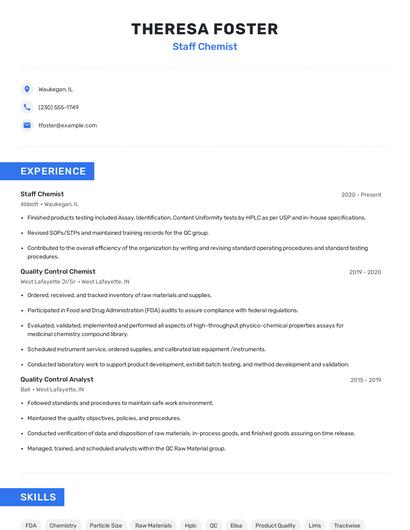
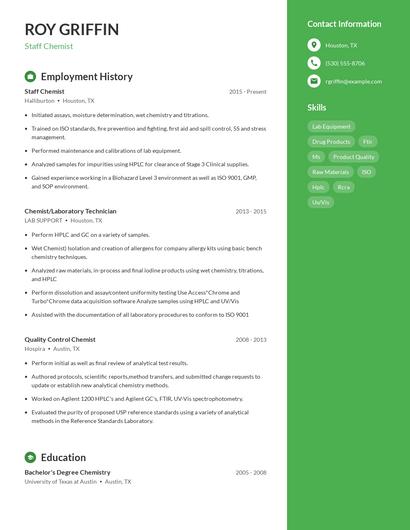
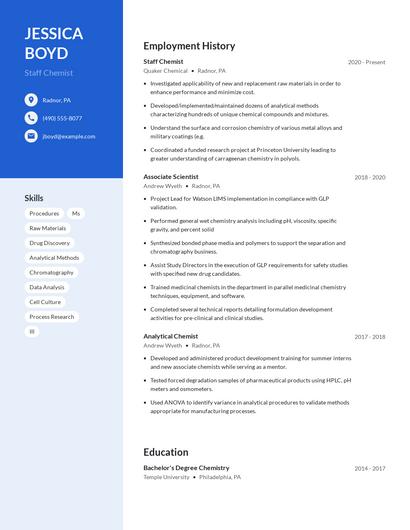
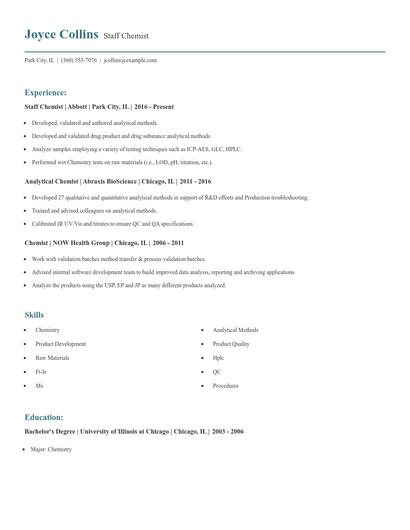
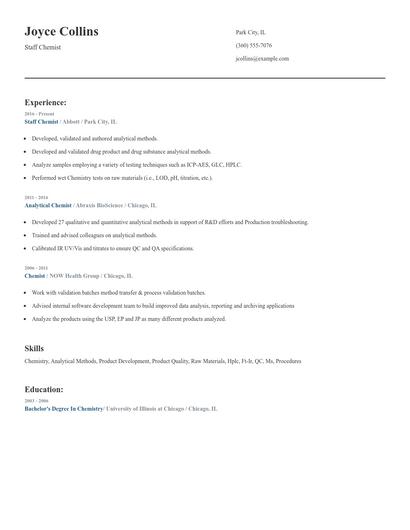
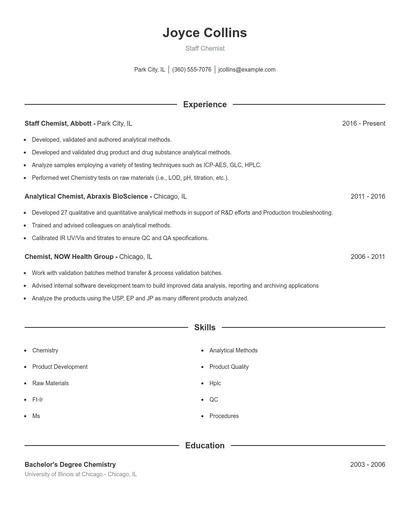
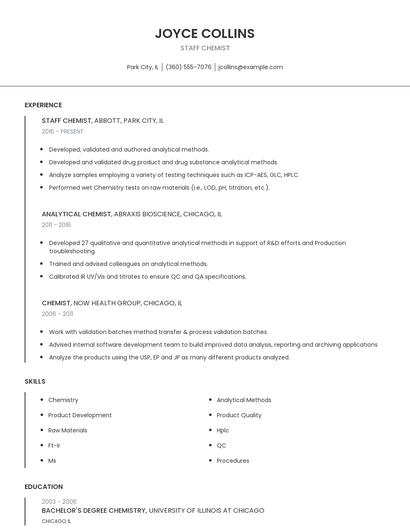
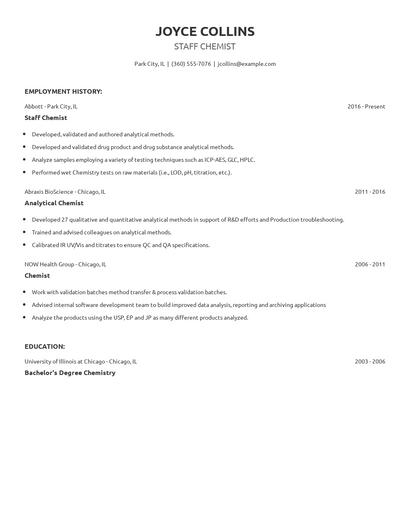
Choose from 10+ customizable staff chemist resume templates
Build a professional staff chemist resume in minutes. Our AI resume writing assistant will guide you through every step of the process, and you can choose from 10+ resume templates to create your staff chemist resume.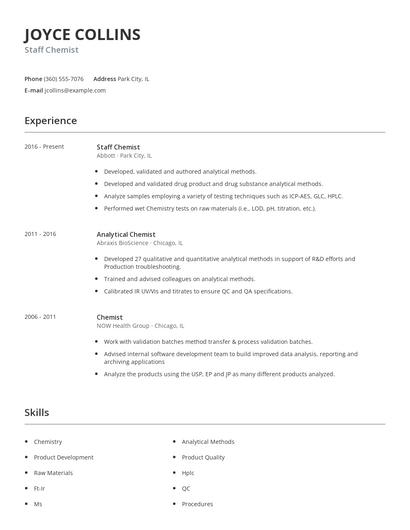
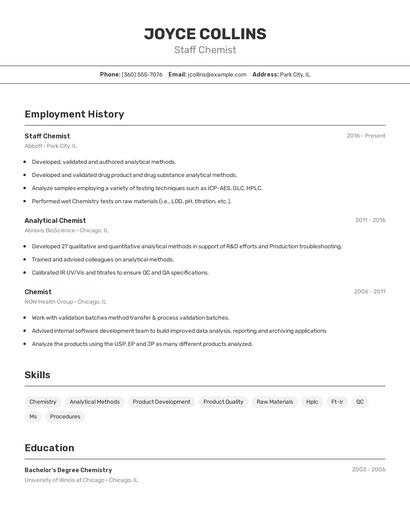
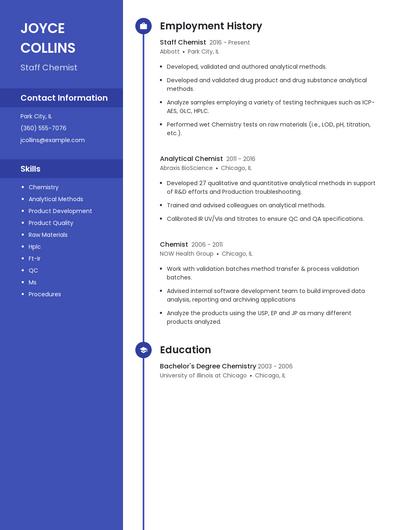
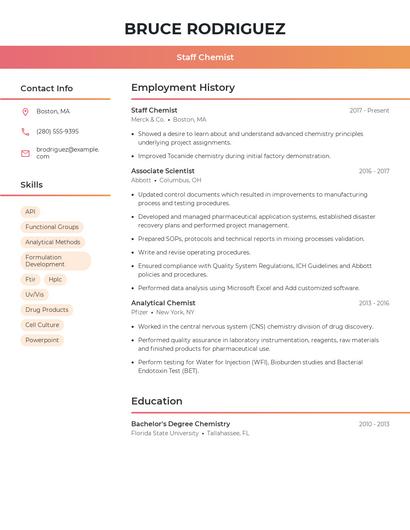
Compare different staff chemists
Staff chemist vs. Research and development chemist
A research and development chemist primarily works at laboratories to conduct extensive tests and experiments aiming to develop new products and technologies. Although the extent of their duties may vary, it typically revolves around conducting research and studies, observing chemical reactions, maintaining records and databases, collaborating with fellow experts, and identifying the strengths and weaknesses of existing components or mixtures. They can find employment in different areas, such as manufacturing companies, private laboratories, government agencies, and even education.
There are some key differences in the responsibilities of each position. For example, staff chemist responsibilities require skills like "chemistry," "analytical method development," "sops," and "lc-ms." Meanwhile a typical research and development chemist has skills in areas such as "laboratory equipment," "analytical methods," "d chemist," and "method development." This difference in skills reveals the differences in what each career does.
Research and development chemists earn the highest salaries when working in the health care industry, with an average yearly salary of $82,941. On the other hand, staff chemists are paid more in the manufacturing industry with an average salary of $93,640.On average, research and development chemists reach similar levels of education than staff chemists. Research and development chemists are 3.8% more likely to earn a Master's Degree and 2.9% less likely to graduate with a Doctoral Degree.Staff chemist vs. Chemist, development
A development chemist is responsible for delivering products that are specially created for a customer. You will be responsible for conducting qualitative and quantitative chemical analyses for process or quality control. Other tasks that you will perform include researching chemical substances, conducting laboratory experiments, and evaluating the effects of chemical compounds in different situations. Additionally, you will be responsible for determining chemical properties by analyzing compounds and helping resolve quality issues. As a development chemist, you are also responsible for evaluating safety procedures in laboratories and maintaining laboratory equipment.
Each career also uses different skills, according to real staff chemist resumes. While staff chemist responsibilities can utilize skills like "chemistry," "ms," "gc," and "analytical method development," chemists, development use skills like "laboratory equipment," "method development," "technical support," and "analytical procedures."
Chemists, development earn a lower average salary than staff chemists. But chemists, development earn the highest pay in the health care industry, with an average salary of $85,660. Additionally, staff chemists earn the highest salaries in the manufacturing with average pay of $93,640 annually.In general, chemists, development achieve similar levels of education than staff chemists. They're 1.9% more likely to obtain a Master's Degree while being 2.9% less likely to earn a Doctoral Degree.What technology do you think will become more important and prevalent for staff chemists in the next 3-5 years?
Dr. Betsy Smith
Assistant Professor of Chemistry, Elmira College
Staff chemist vs. Product development chemist
A Quality Control Chemist uses chemistry lab skills to test and measure materials, usually in a manufacturing or pharmaceutical field. They analyze samples using scientific equipment, prepare study protocols, collect data, and identify and investigate abnormal test results.
Some important key differences between the two careers include a few of the skills necessary to fulfill the responsibilities of each. Some examples from staff chemist resumes include skills like "chemistry," "ms," "gc," and "analytical method development," whereas a product development chemist is more likely to list skills in "lab equipment," "analytical methods," "qc," and "usp. "
Product development chemists make a very good living in the manufacturing industry with an average annual salary of $84,696. On the other hand, staff chemists are paid the highest salary in the manufacturing industry, with average annual pay of $93,640.When it comes to education, product development chemists tend to earn similar degree levels compared to staff chemists. In fact, they're 2.3% more likely to earn a Master's Degree, and 4.4% more likely to graduate with a Doctoral Degree.Staff chemist vs. Quality control chemist
Types of staff chemist
Updated January 8, 2025
