
Automatically apply for jobs with Zippia
Upload your resume to get started.
Stenographer skills for your resume and career
15 stenographer skills for your resume and career
1. Dictation
- Record and transcribe oral dictation through shorthand for Division Manager, Agency Attorney, Deputy Director and Fire Marshal.
- Typed legal correspondences from dictation via headset to attorneys and law firms, 1993 Received Top Gun Award
2. Payroll Functions
- Prepare payroll functions as lead worker over support staff.
3. Proofread
Proofreading simply carefully checking your text for possible errors like typographical errors or mistakes in grammar, style, and spelling before it can be published or shared. This is generally known as the very last stage of any writing process when you need to fix minor spelling and punctuation mistakes, typos, formatting issues,
and inconsistencies.
- Dictated, transcribed and proofread meeting minutes for the Jicarilla Apache Council from council meetings held.
- Computed, recorded, and proofread data, records and reports.
4. Word Processing
- Provided accurate and timely transcription and word processing to the Risk team.
- Provided word processing, stenography, reproduction, and email retrieval.
5. Telephone Calls
Telephone calls are a communication means through which a caller is connected to the called party. The call is done through a telecommunications device called a telephone. The caller can use a landline, mobile phone, or satellite phone to make the call.
- Provided exceptional customer service with telephone calls to the Federal Reserve Banks and other financial institutions
- Answered telephone calls and e-mails typed paper correspondence and maintained appointment schedule.
6. Meeting Minutes
- Assisted Tribal Secretary in transcription of previous years meeting minutes.
- Maintained meeting minutes and distribution of minutes for the compliance manager.
Choose from 10+ customizable stenographer resume templates
Build a professional stenographer resume in minutes. Our AI resume writing assistant will guide you through every step of the process, and you can choose from 10+ resume templates to create your stenographer resume.7. Travel Arrangements
- Handled conference and travel arrangements.
- Handle domestic travel arrangements for both executives to include air, land and hotel accommodations.
8. Computer Programs
A computer program is a set of instructions that can be executed by a computer to perform an operation or task. Computer programs are devised by computer programmers in a programming language. Everything a computer does is through a computer program.
- Train other administrative staff members on office procedures, computer programs and filing systems.
- Assist all levels of staff with the operation of computer programs.
9. Medical Terminology
- Review and edit transcribed reports and dictated material for spelling, grammar, clarity, consistency, and proper medical terminology.
10. Statistical Reports
- Prepared five large statistical reports monthly that was used by over 200 employees.
- Typed letters, memos, statistical reports, polygraph exams, etc.
11. Scheduling Appointments
Scheduling appointments is the practice of finding a free slot with the person(s) you want to meet. The process of scheduling appointments involves finding mutually free time, negotiating follow-ups, sending reminders, and creating new appointments. Scheduling appointments is important to ensure that the timings of consecutive meetings do not clash with each other.
- Operated the counseling/guidance help desk, taking direct phone calls and scheduling appointments for the counseling department.
- Handled large volume calls, providing information, taking messages,scheduling appointments, and forward calls.
12. Office Equipment
- Ordered materials/supplies along with office equipment.
13. PowerPoint
- Compiled information, prepared PowerPoint presentations for reporting of compliance team metrics to executive management.
- Created and modified monthly departmental spreadsheets and PowerPoint presentations.
14. Administrative Functions
Administrative Functions all revolve around planning and managing business operations. Administrators engage in the planning and execution of different business objectives, implementing workplace policies, and organizing resources efficiently. Every action that is a step towards the business's goals is covered by Administrative Functions.
- Analyzed and prepared all reporting to National Operations Manager * Assisted National Support staff with administrative functions as needed.
- Assisted with all administrative functions: Copied, Faxed, Filed, Scanned, Switchboards.
15. Form Letters
- Prepared and typed correspondence, form letters, and documents, stencils and rough draft materials.
5 Stenographer resume examples
Build a professional stenographer resume in minutes. Browse through our resume examples to identify the best way to word your resume. Then choose from 5+ resume templates to create your stenographer resume.

What skills help Stenographers find jobs?
Tell us what job you are looking for, we’ll show you what skills employers want.
List of stenographer skills to add to your resume
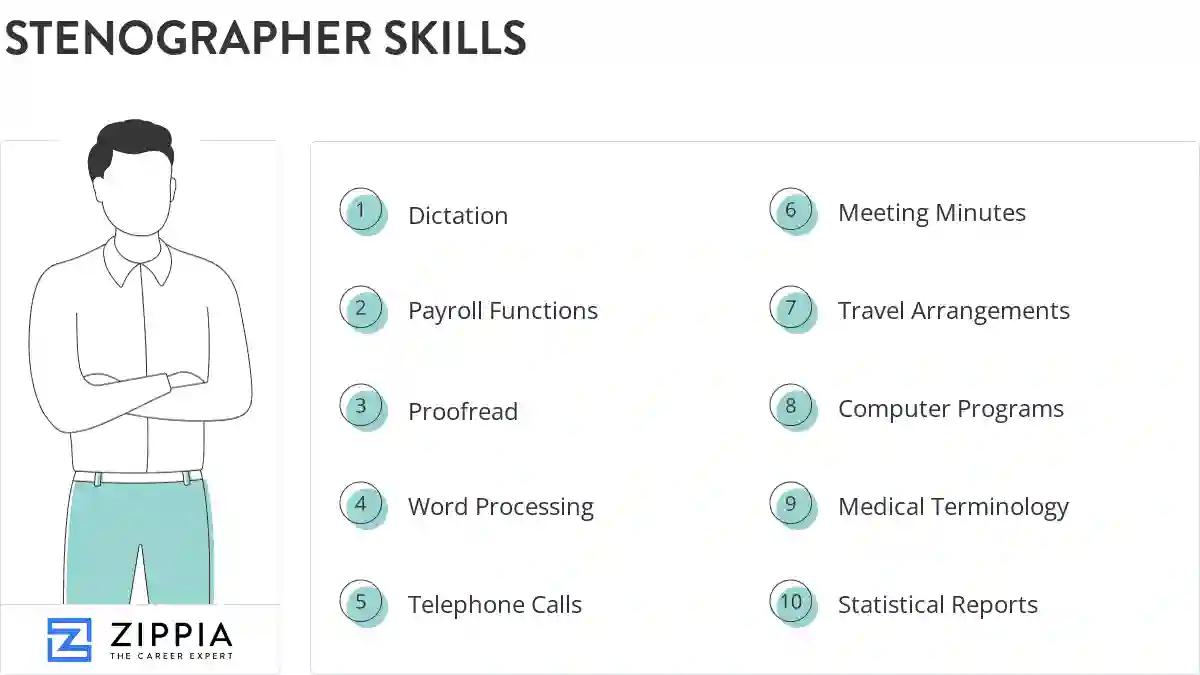
The most important skills for a stenographer resume and required skills for a stenographer to have include:
- Dictation
- Payroll Functions
- Proofread
- Word Processing
- Telephone Calls
- Meeting Minutes
- Travel Arrangements
- Computer Programs
- Medical Terminology
- Statistical Reports
- Scheduling Appointments
- Office Equipment
- PowerPoint
- Administrative Functions
- Form Letters
- Legal Proceedings
Updated January 8, 2025
