What does a structures technician do?
Structures technicians design buildings or monuments. They plan construction, select materials, and create models. They must investigate the properties of possible materials, including steel, concrete, cement, and brick.
Structures technician responsibilities
Here are examples of responsibilities from real structures technician resumes:
- Remove, replace, repair, engines, rotor-heads, blades, gearboxes, and landing gear components.
- Operate CNC and conventional metal brakes to bend and shape metal.
- Work with engineering to modify structural changes and conformity to FAA regulations.
- Appoint FOD program manager and implement new procedures to maintain a FOD free environment.
- Design, install, replace, and remodel HVAC systems for residential and commercial buildings.
- Work in both FOD critical and FOD sensitive environments, and observe all relate safety procedures.
- Work with precision measuring instruments, micrometers, calipers, tape measures, and standard scales.
- Operate all production machinery presses, punches, shears, CNC machines and automate welding machines.
- Inspect, overhaul, repair, modify, and troubleshoot airframe parts, systems, and components.
- Design, fabricate, plan, and install sheet metal systems for residential and commercial HVAC systems.
- Conform to all OSHA regulations and safety guidelines, EPA requirements, as well as FOD prevention procedures.
- Perform and document all work within estimate time and within HAECO, FAA, and customer standards of quality.
- Remove and install aircraft subsystem assemblies to include engines, rotors, gearboxes, transmissions, and mechanical flight controls.
- Perform critical modification to airframe structure to allow for antenna cable installations as well as external mounting of additional antennas.
- Employ wide variety of hand tools and large equipment including hoists, precision measuring instruments and electronic testing devices.
Structures technician skills and personality traits
We calculated that 21% of Structures Technicians are proficient in Hand Tools, Engineering Drawings, and Revit. They’re also known for soft skills such as Detail oriented, Strength, and Dexterity.
We break down the percentage of Structures Technicians that have these skills listed on their resume here:
- Hand Tools, 21%
Use and maintain all power, pneumatic and hand tools as required.
- Engineering Drawings, 11%
Conducted modifications for Enhanced Special Structural Inspection and Phased Depot Maintenance utilizing engineering drawings, aircraft technical manuals and specifications.
- Revit, 10%
Implemented and improved parametric families for Revit based models.
- Troubleshoot, 9%
Analyzed aircraft publications to troubleshoot aircraft discrepancies down, assessing proper course of action for repair and/or replacement of malfunctioning equipment.
- FAA, 7%
Perform and document all work within estimated time and within HAECO, FAA, and customer standards of quality.
- Maintenance Manuals, 5%
Perform aircraft modifications in accordance with military technical prints, commercial maintenance manuals and service bulletins.
Common skills that a structures technician uses to do their job include "hand tools," "engineering drawings," and "revit." You can find details on the most important structures technician responsibilities below.
Detail oriented. One of the key soft skills for a structures technician to have is detail oriented. You can see how this relates to what structures technicians do because "mechanics and technicians need to adjust airplane parts to exact specifications." Additionally, a structures technician resume shows how structures technicians use detail oriented: "revise plans and details on engineering drawings as needed for projects as needed by engineering staff. "
Strength. Another soft skill that's essential for fulfilling structures technician duties is strength. The role rewards competence in this skill because "mechanics and technicians may carry or move heavy equipment or aircraft parts, climb on airplanes, balance, and reach without falling." According to a structures technician resume, here's how structures technicians can utilize strength in their job responsibilities: "inspected aircraft structural repairs for original strength, weight, and contour. "
Dexterity. This is an important skill for structures technicians to perform their duties. For an example of how structures technician responsibilities depend on this skill, consider that "mechanics and technicians need to coordinate the movement of their fingers and hands in order to grasp, manipulate, or assemble parts." This excerpt from a resume also shows how vital it is to everyday roles and responsibilities of a structures technician: "worked with power tools, pneumatic tools, hand tools, fork lifts, cranes, and tow equipment. ".
The three companies that hire the most structures technicians are:
- HQ Aero Management
11 structures technicians jobs
- SpaceX10 structures technicians jobs
- Martin/Martin
9 structures technicians jobs
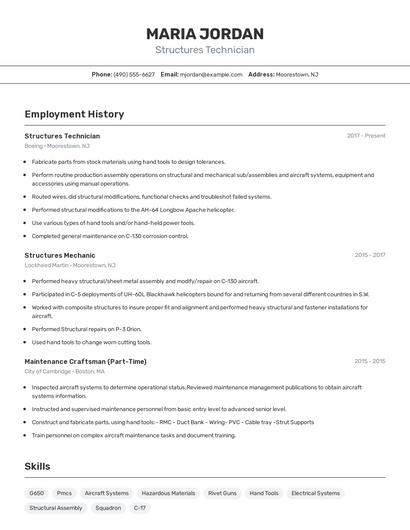
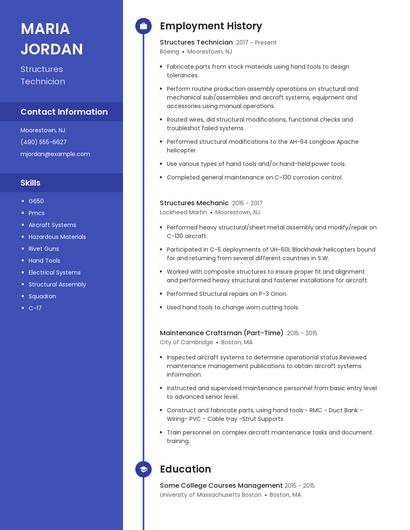
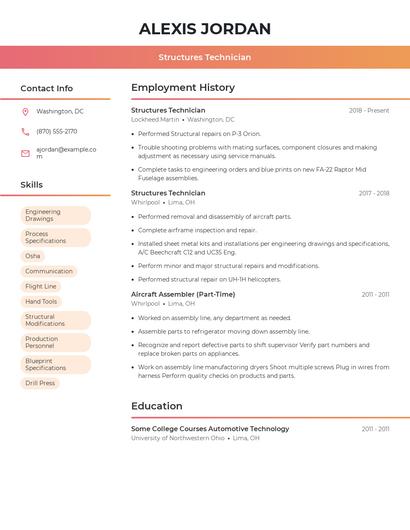
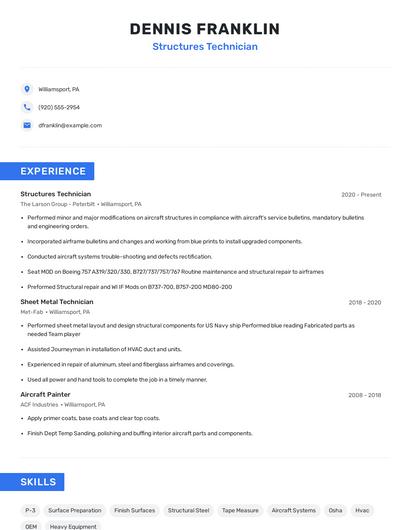
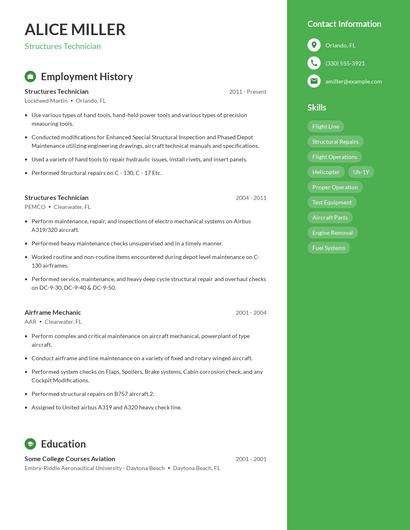
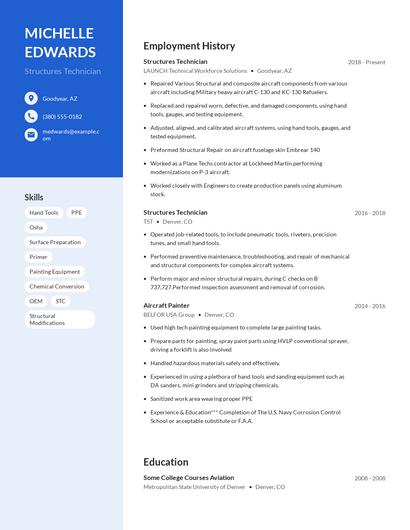
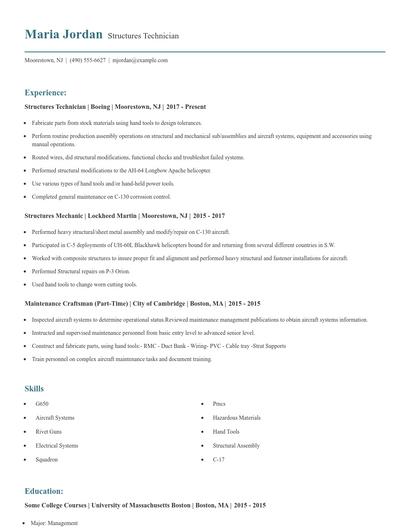
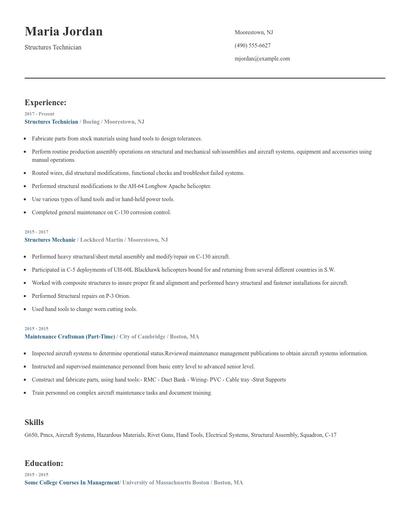
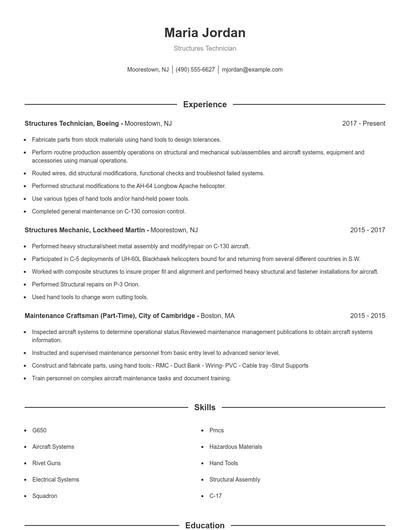
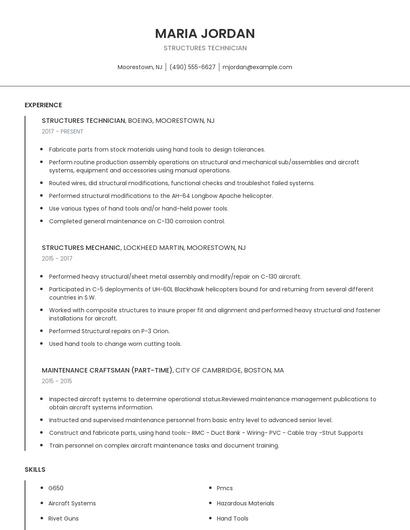
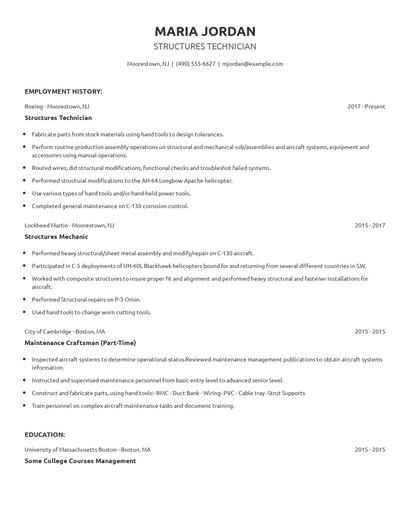
Choose from 10+ customizable structures technician resume templates
Build a professional structures technician resume in minutes. Our AI resume writing assistant will guide you through every step of the process, and you can choose from 10+ resume templates to create your structures technician resume.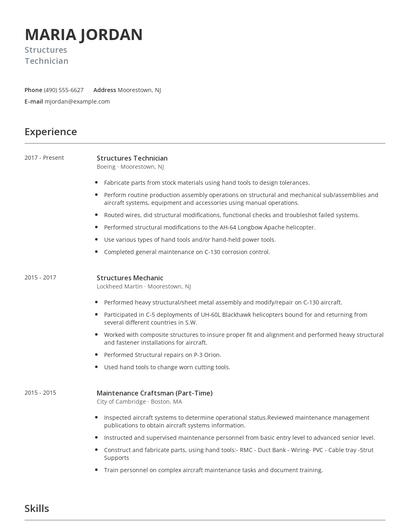
Compare different structures technicians
Structures technician vs. Aircraft fueler
Aircraft fuelers' primary role is to ensure the proper refueling of aircraft before and after a flight. The position is essential, as proper refueling determines the safety of an aircraft. An aircraft fueler manages refueling equipment, transports fuel, and ensures adherence to safety protocols. They are also responsible for monitoring the functionality of all equipment and ordering repairs. This position requires a high level of safety-consciousness.
These skill sets are where the common ground ends though. The responsibilities of a structures technician are more likely to require skills like "hand tools," "engineering drawings," "revit," and "ladders." On the other hand, a job as an aircraft fueler requires skills like "basic math," "commercial vehicles," "aircraft weight," and "quality control checks." As you can see, what employees do in each career varies considerably.
Aircraft fuelers earn the highest salaries when working in the transportation industry, with an average yearly salary of $33,369. On the other hand, structures technicians are paid more in the manufacturing industry with an average salary of $64,055.On average, aircraft fuelers reach similar levels of education than structures technicians. Aircraft fuelers are 1.2% less likely to earn a Master's Degree and 0.0% less likely to graduate with a Doctoral Degree.Structures technician vs. Airframe and powerplant mechanic
An Airframe and Powerplant Mechanic inspects, tests, and repairs aircraft. They work on various parts of an aircraft, such as the engine, brakes, and landing gear.
Each career also uses different skills, according to real structures technician resumes. While structures technician responsibilities can utilize skills like "revit," "ladders," "maintenance manuals," and "cad," airframe and powerplant mechanics use skills like "operational checks," "federal aviation," "electrical systems," and "structural components."
Average education levels between the two professions vary. Airframe and powerplant mechanics tend to reach similar levels of education than structures technicians. In fact, they're 1.6% more likely to graduate with a Master's Degree and 0.0% more likely to earn a Doctoral Degree.Structures technician vs. Aircraft electrician
An aircraft electrician specializes in installing and repairing electrical systems in an aircraft, ensuring quality and efficiency. Their responsibilities typically include running diagnostic tests and examinations, troubleshooting problems, replacing and fixing components, understanding diagrams, and keeping records. There are also instances where they must solder wires, climb up high places, and perform regular maintenance checks. Moreover, an aircraft electrician typically works in a team setting, which requires an active communication line for an efficient and safe workflow.
There are many key differences between these two careers, including some of the skills required to perform responsibilities within each role. For example, a structures technician is likely to be skilled in "revit," "ladders," "maintenance manuals," and "cad," while a typical aircraft electrician is skilled in "electrical systems," "diagnose malfunctions," "switchboards," and "test equipment."
Aircraft electricians make a very good living in the manufacturing industry with an average annual salary of $63,434. On the other hand, structures technicians are paid the highest salary in the manufacturing industry, with average annual pay of $64,055.aircraft electricians typically earn similar educational levels compared to structures technicians. Specifically, they're 2.2% more likely to graduate with a Master's Degree, and 0.0% more likely to earn a Doctoral Degree.Structures technician vs. Aircraft mechanic
An aircraft mechanic is responsible for regularly checking and maintaining aircraft systems to ensure its safety and stability during operations. Aircraft mechanics should have extensive knowledge of troubleshooting and detecting system malfunctions. They are also required to adhere strictly with the standard protocols and regulations of the company, guaranteeing smooth procedures and efficient solutions. Aircraft mechanics must possess excellent decision-making and critical-thinking skills to perform diagnosis and inspection under minimal supervision. An aircraft mechanic should be able to utilize aviation tools and equipment, document resources, and report findings for safety concerns.
Types of structures technician
Updated January 8, 2025
