Explore jobs
Find specific jobs
Explore careers
Explore professions
Best companies
Explore companies
Job outlook for substations electrical engineers in the United States
Are substations electrical engineer jobs in demand?
Substations electrical engineer job and salary trends over time
Substations electrical engineer jobs over time
Substations electrical engineer job growth rate over time
| Year | # of jobs | % of population |
|---|---|---|
| 2021 | 169 | 0.00% |
| 2020 | 169 | 0.00% |
| 2019 | 169 | 0.00% |
| 2018 | 170 | 0.00% |
| 2017 | 167 | 0.00% |
Average substations electrical engineer salary over time
Substations electrical engineer salary by year
| Year | Avg. salary | Hourly rate | % Change |
|---|---|---|---|
| 2026 | $88,149 | $42.38 | +2.3% |
| 2025 | $86,138 | $41.41 | +2.0% |
| 2024 | $84,486 | $40.62 | +1.7% |
| 2023 | $83,104 | $39.95 | +0.9% |
| 2022 | $82,361 | $39.60 | +1.3% |
Substations electrical engineer jobs by state
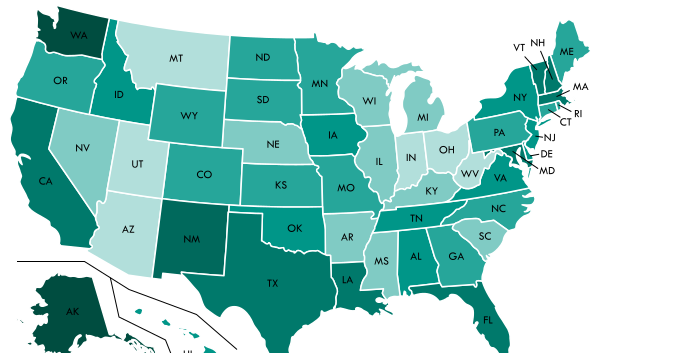
Most common states for substations electrical engineers
| Rank | State | Population | # of jobs | Employment/ 1000ppl |
|---|---|---|---|---|
| 1 | District of Columbia | 693,972 | 183 | 26% |
| 2 | Massachusetts | 6,859,819 | 737 | 11% |
| 3 | Colorado | 5,607,154 | 590 | 11% |
| 4 | Virginia | 8,470,020 | 880 | 10% |
| 5 | Delaware | 961,939 | 95 | 10% |
| 6 | Washington | 7,405,743 | 674 | 9% |
| 7 | Maryland | 6,052,177 | 569 | 9% |
| 8 | Utah | 3,101,833 | 288 | 9% |
| 9 | Wyoming | 579,315 | 51 | 9% |
| 10 | California | 39,536,653 | 3,096 | 8% |
| 11 | Arizona | 7,016,270 | 596 | 8% |
| 12 | Vermont | 623,657 | 47 | 8% |
| 13 | Wisconsin | 5,795,483 | 392 | 7% |
| 14 | Alabama | 4,874,747 | 336 | 7% |
| 15 | Oregon | 4,142,776 | 277 | 7% |
| 16 | Nebraska | 1,920,076 | 125 | 7% |
| 17 | New Hampshire | 1,342,795 | 88 | 7% |
| 18 | Minnesota | 5,576,606 | 360 | 6% |
| 19 | Iowa | 3,145,711 | 199 | 6% |
| 20 | Maine | 1,335,907 | 74 | 6% |
Most common cities for substations electrical engineers
| Rank | City | # of jobs | Employment/ 1000ppl | Avg. salary |
|---|---|---|---|---|
| 1 | Annapolis | 2 | 5% | $96,712 |
| 2 | Brea | 2 | 5% | $99,549 |
| 3 | Dover | 2 | 5% | $91,074 |
| 4 | Hartford | 2 | 2% | $88,801 |
| 5 | Lansing | 2 | 2% | $79,294 |
| 6 | Atlanta | 3 | 1% | $82,613 |
| 7 | Baton Rouge | 3 | 1% | $97,522 |
| 8 | Little Rock | 2 | 1% | $77,138 |
| 9 | Orlando | 2 | 1% | $98,390 |
| 10 | Urban Honolulu | 2 | 1% | $93,254 |
| 11 | Cedar Rapids | 1 | 1% | $92,317 |
| 12 | Phoenix | 4 | 0% | $74,652 |
| 13 | Boston | 3 | 0% | $96,051 |
| 14 | Indianapolis | 3 | 0% | $74,842 |
| 15 | Baltimore | 2 | 0% | $96,727 |
| 16 | Denver | 2 | 0% | $84,453 |
| 17 | Sacramento | 2 | 0% | $110,033 |
| 18 | Washington | 2 | 0% | $99,180 |
Substations Electrical Engineer job outlook: Expert opinions
Our panel of substations electrical engineer experts
Gonzaga University
Stevens Institute of Technology
University of Alabama at Birmingham
San Diego State University
Jackson State University
University of Utah

University of Connecticut

Old Dominion University

University of Central Florida
Tufts University
Michigan Technological University

University of Mississippi
Kennesaw State University
University of Hawaiʻi at Mānoa

University of Louisville
University of California, Davis

University of Arkansas, Fayetteville

Wright State University
University of Utah
What will help Substations Electrical Engineers increase their earning potential?
Craig Johnson Ph.D., P.E.: Master basic science and engineering concepts, as well as application of 'soft skills' such as written and verbal communication. Acquire skills and knowledge areas in electromechanical devices, especially in areas of energy and heat transfer, reflecting current issues related to climate change and power management.
What Substations Electrical Engineer skills would you recommend for someone trying to advance their career?
Steven Schennum Ph.D. P.E.: The most important skill is the ability to learn new things, and especially to unlearn things you “know” after evidence demonstrates that these things are not true. Learn how to analyze information. Your intuition, simulations, and results should all be in alignment. If they are not, then dig deeper. Learn the terminology and jargon specific to your company and your projects. Spend time reading. Don’t be afraid to ask questions. Don’t be intimidated by new software.
What will help Substations Electrical Engineers increase their earning potential?
Steven Schennum Ph.D. P.E.: Put a good resume together and follow suggestions of people who are experts at preparing resumes. Before you have an interview, practice interviewing. Participate in a mock interview and listen to feedback. Maximize salary potential by documenting your accomplishments, your work, and your results. Keep a journal. If you have good documentation, you can more easily make a case for promotion when the time comes.
What Substations Electrical Engineer skills would you recommend for someone trying to advance their career?
Min Song: Communication skills and innovative thinking skills. As emerging technologies continue to be complex and multidisciplinary, it’s important to be able to communicate with professionals in diverse disciplines. Taking robotics, for example, the electrical engineer must be able to work with mechanical and biomechanical engineers, computer engineers, software engineers, artificial intelligence experts, cognitive scientists, system engineers, etc. A person will be able to generate innovative ideas only if the person has a complete and comprehensive understanding of the entire system and can work well with other individuals with a range of expertise.
What general advice would you give to a Substations Electrical Engineer?
Arie Nakhmani: Electrical Engineering combines a dozen sub-fields such as power systems, telecommunications, embedded systems, machine learning/AI, hardware design, signal analysis, IoT, etc., and jobs in these different subfields could look completely different. Some involve office work with the computer designing algorithms or optimizing processes, others might involve inspecting power transmission lines with drones in the middle of the forest. Some jobs include testing airplane engines and others designing microchips and working in clean rooms.
What Substations Electrical Engineer skills would you recommend for someone trying to advance their career?
Arie Nakhmani: Electrical Engineering has always (from its inception) been a good profession to enter, but now it is better than ever. Now everything is becoming Electrical Engineering, and the world cannot survive without it even for a few days. Electrical Engineering is the most necessary profession for the survival of modern society.
What will help Substations Electrical Engineers increase their earning potential?
Arie Nakhmani: People who have EE degrees like being able to choose from a variety of EE sub-fields and being able to enter new areas because they learn science fundamentals and math, critical thinking, and the ability to solve difficult problems that are very helpful in life regardless of the job they pick. People dislike that solving difficult problems is difficult and requires a lot of effort. Not all are ready to put their effort in.
What general advice would you give to a Substations Electrical Engineer?
Dr. Arif Engin: Electrical engineers solve problems by skillfully applying mathematics and science. Electrical engineering classes are challenging at college, and electrical engineers must embrace lifelong learning to remain at the top of their skills. In the end, seeing the results of their work in a finished product is a rewarding experience.
What Substations Electrical Engineer skills would you recommend for someone trying to advance their career?
Dr. Arif Engin: Electrical engineering graduates are sought by a wide range of employers in government and industry for many different types of work. The top occupations in electrical engineering fields are projected to grow and sometimes require an advanced degree.
Mahmoud Manzoul
Professor of Electrical and Computer Engineering at Jackson State UniversityJackson State University
Electrical, Electronics, And Communications Engineering
What Substations Electrical Engineer skills would you recommend for someone trying to advance their career?
Mahmoud Manzoul: In addition to honing strong technical abilities, cultivating soft skills is paramount. Unfortunately, as professors, we often overlook the significance of these skills, which are indispensable for thriving in one's career. Soft skills encompass effective communication across diverse audiences and the ability to collaborate harmoniously within a team.
What will help Substations Electrical Engineers increase their earning potential?
Mahmoud Manzoul: Maximizing salary potential hinges on thorough preparation during college. I cannot stress enough the importance of securing internships before completing your degree. Internships not only facilitate networking with seasoned engineers but also foster the development of essential soft skills crucial for professional success.
Florian Solzbacher
Department Chair, Professor, Elect & Computer EngineeringUniversity of Utah
Electrical and Computer Engineering Department
What soft skills should all Substations Electrical Engineers possess?
Florian Solzbacher: Engineering is about teamwork. All major quantum leaps and most products require extensive system engineering and diverse skills. Engineers need to be able to understand the languages and workflows not only across engineering disciplines but also ranging into business, legal and ethical aspects of their work. This includes communication and project management skills.
What hard/technical skills are most important for Substations Electrical Engineers?
Florian Solzbacher: First of all, the fundamentals (mostly math, physics, materials/chemistry) and basic EE/CE concepts need to be solid. As stated above: the ability to solve real-world development and system integration problems that require "global optimization" of technical performance as opposed to local optimization of specific sub-systems or components is really critical.
Beyond that, given the accelerating breadth of specializations and sub-areas, it is important that students have sufficient depth and breadth of knowledge in the specific area they are targeting. It is important that schools are offering tracks and guidance as to what skills are needed to allow students to successfully master engineering tasks across a range of sub-areas. We have to recognize that in the context of a 4-year program, it is no longer possible to train a student in all areas of ECE - a combined BS/MS degree or MS/Ph.D. degree obviously provides more runway to add breadth.
What type of skills will young Substations Electrical Engineers need?
John Chandy Ph.D.: I don't think my answer to this question would be any different to what I may have answered a decade ago. The technical skills that they acquire as a student will establish their qualifications to do the work. That means understanding the fundamentals of computer engineering hardware and software as well as more advanced training in specific areas of interest. However, to be truly effective in a company, they need to be able to communicate (both orally and in written form) and they need to show that they can work in a team. Most modern engineering systems will often require a computer engineer to design the control/compute interface and that often requires that the computer engineer be able to understand the language of electrical engineers, mechanical engineers, and computer scientists. Finally, computer engineering is a fast-moving field, and new graduates should be prepared to continuously learn new technologies and approaches.
What type of skills will young Substations Electrical Engineers need?
Michel Audette Ph.D.: One skill that is timeless is the ability to communicate effectively, such as taking a complex design process and distilling it into intuitive slides or reports that lend themselves for senior managers to process in order to come to a decision. An engineer who has that ability will always have some tools in his/her toolbox that makes that individual attractive to a company and to the local technical ecosystem, thus a ripe target for headhunters who willing to champion them to companies looking for top talent. Moreover, speaking and writing well also comes with a vital component of diplomacy, especially in the context of increasingly distributed company workforce: the ability not just to get on with colleagues from different parts of the world, increasingly heterogeneous in terms of gender and possibly sexual preference, but embrace them for who they are. This is often maps to opportunities to travel, as some collaborations lead to meetings face to face, post-covid.
This embrace of heterogeneity is even more relevant in that technical problems being solved are increasingly multi-disciplinary, so that an engineer may need to interact with biologists, physicians, clothing or furniture designers, mathematicians, lawyers, and so on: in my own case, I have to wear a multitude of different hats, while recognizing someone who is a perfect fit for one of those hats when I meet that individual, and making the most of that opportunity to build a truly competent team. Engineers must be able to hold a meaningful, respectful conversation with any of these counterparts, not just discuss code or circuit design. I would advocate that they spend time reading, to maintain their vocabulary and stay abreast of the world around them.
Another one that I advocate is the ability to tap into a revolution that has occurred in parallel with the advent of Internet and cellular technologies, these past 30+ years: the explosion of open-source software tools. I am a committed proponent of open source, as a former contributor to them while previously employed at Kitware (a pioneer in this area, behind VTK, ITK, CMake, and myriad others). I see job ads in Indeed.com that specifically ask for the ability to work with these tools, since they save work and make it possible to produce a prototype in much less time than developing it completely in-house. This ability does not just presuppose the ability to program at a competent level, but other abilities: the ability to track bugs that not be in the calling program, but in the open-source software library itself, the willingness to get answers in the community of developers, the eye for details that extends to graphical processor units that result in accelerations an order of magnitude or better, and so on. These go way beyond writing a self-contained algorithm. Hardware designers may also have similar tools, based on broad standards, Arduino, and the prevalence of 3D printers that make it possible to physically replicate digital models.
Finally, a vital skill is the willingness and ability to keep learning, while embracing revolutions that take place at breathtaking pace. The latest one is the reliance on deep neural networks (DNNs) to synthesize algorithms that can learn and adapt to their data, with much faster performances than feasible with the previous algorithms that DNNs have replaced. The point to make here is not to embrace neural networks in a proximal sense, but that we cannot anticipate what will come next, downstream of DNNs. Graduates of 2021 have to be willing to keep their curiosity and work ethic enough to be responsive to the next wave of technologies, and embrace them for the opportunities that they represent.
Will there be an enduring impact of the coronavirus pandemic on Substations Electrical Engineers?
Michel Audette Ph.D.: My take on this is what I've seen with my wife's work in industry, which suggests that the industrial landscape is going to be increasingly equipped for, and open to, remote work. I think that the implication for graduates is that they may need to be flexible about working within a geographically distributed team. If company deciders feel that someone is worth employing because of a unique skill set, then they would typically be more willing to hire that person even if unable to make it to work regularly, if that is feasible given the nature of the work; some work, such as hardware testing or industrial production, may not lend itself to remote contributions.
Nonetheless, for those areas that accommodate geographically distributed activity, such as software development, graduates can expect to interact with team members all over the US, possibly all over the world, if someone is deemed unique enough to hire despite living abroad. This places a high premium on the ability and willingness to work in a heterogeneous team, where not only will members look different, but also have myriad accents in their English, which will also impose a certain adaptability and tolerance to team members.
A related impact could also be that global hiring will make it easier for multi-national companies to hire a portion of their talent in countries where wages are lower and motivate US-based engineers to seek out graduate degrees in order to increase their competitiveness and employability at US salaries.
Maria Jacob
ProfessorUniversity of Central Florida
Department of ECE
Will there be an enduring impact of the coronavirus pandemic on Substations Electrical Engineers?
Maria Jacob: Well, this is a somewhat difficult question, since it's hard to predict what is going to happen.
Given the current research, everything seems to indicate that even with the vaccine, we won't be able to come back to what we were used to for a long time.
This will mean, work and classes from home for some time. Although I see and enjoy some of the advantages of staying at home (that go from clothing to saving money on gas), I feel we are losing some of the human contact we were used to. Of course, we have software like Zoom or Meet that helps us to communicate with others, but this virtuality is just simply different. For example, some students do just fine, and others can't deal with the fact that they have to write their questions over a chat. More than that, some students have family making everything more difficult.
There are other aspects that also impact the knowledge the new graduates have at the time of start working. For example, we as professors also have to take into account that we are living special circumstances and that some students may find this new system more difficult. Then, sometimes is easy to overcompensate and be more lenient with some things. If we are not careful this could lead to students graduating having less knowledge in some topics, where students pass a class not knowing certain topics that they should.
What type of skills will young Substations Electrical Engineers need?
Maria Jacob: I feel that the skills needed will not change to what is currently required; however, it may well happen that some of the graduates don't have them. For example, good communications skills. It may happen that the graduates have good written skills but not verbal, since more and more we send emails than calling someone. I know, I sound like an old person, which is funny because I'm writing this...
What type of skills will young Substations Electrical Engineers need?
Eric Miller Ph.D.: Collaboration and communication. The most pressing problems being addressed by engineers all have critical, non-technical components. The impact of possible solutions on people or the environment, the ethical implications of new and evolving technologies, the tradeoffs of investing in one area rather than another; all of these and related issues are increasingly integral to the engineering process. As such, it is critical for new graduates to be able to work not just well, but truly productively with people from all sorts of backgrounds and in all different fields. Central to this effort is an ability to communicate technical issues clearly and concisely to highly intelligent people whose skills may be in very non-technical areas such as law, public policy, media, and the like.
Will there be an enduring impact of the coronavirus pandemic on Substations Electrical Engineers?
Joshua Pearce Ph.D: I think the virtualization of work and automation, in general, has been accelerated by the pandemic. This means that the competition for what most of us consider 'normal' jobs will become fiercer, and the skills a graduate needs to get those jobs are becoming more sophisticated. Graduates need to work at home, and a lot of it relies on the advanced use of computing (think AI, CV, etc., not merely staring at a screen for entertainment).
This also means graduates are competing against a global workforce - hungry people willing to work hard. Overall, we have also seen a massive shift in wealth in the last year, the undereducated are now in real trouble, and the hyper-educated and wealthy are better off than ever before. Graduates will want to make sure they stay in the latter group, bolstering their education and picking up advanced skills. This does not have to be a chore - one of the best ways to do this is to dive into an open-source project and maybe save/make a little money along the way.
What type of skills will young Substations Electrical Engineers need?
Joshua Pearce Ph.D: The trends were already present before COVID - but they have been accelerated: graduates need to work remotely and function in virtual teams on large complex projects. Many jobs have been virtualized, and recruiters are targeting talent with proven abilities. Many graduates received a crash course in large-scale cooperation with massive open-source development projects like the thousands of engineers that joined Helpful Engineering to combat COVID. They worked on everything from designing PPE that overran the NIHs 3D printing Exchange to complicated electronics for open-source ventilators.
What type of skills will young Substations Electrical Engineers need?
Dr. Ramanarayanan "Vish" Viswanathan Ph.D.: All graduates need to 1) have a broad understanding of electrical engineering and have programming skills, 2) be able to work collaboratively, and 3) effectively communicate with co-workers, both orally and through writing. Additionally, depending upon the nature of the job, some would need effective communication skills to interface with external stakeholders, and some would need strong foundations on theory and applications of electrical engineering, including networking of computers and devices.
Will there be an enduring impact of the coronavirus pandemic on Substations Electrical Engineers?
Hai Ho Ph.D.: I believe the impact is short term, and once vaccines are effective and available, our graduates will have expected graduation and access to a responsive job market.
Are there any particularly good places in the United States for Substations Electrical Engineers to find work opportunities?
Hai Ho Ph.D.: For computer engineers, most sectors still have a very healthy demand, because this type of engineer is so versatile and critical in any systems or products involving electronics and sensors. The Southeast region, such as companies in metro Atlanta, hired many of our spring graduates during the pandemic.
What are the biggest trends we'll see in the Substations Electrical Engineer job market given the pandemic?
Aaron Ohta Ph.D.: I think the EE job market will be relatively stable in the near future. There are many areas that continue to need electrical engineers right now. Obvious examples are companies that help with communication, such as video chats. Our recent graduates are not having problems getting jobs, and I don't think that employment will be a problem for electrical engineers, even with the impacts of COVID-19. Of course, if any electrical engineers are having difficulties entering the job market, now would be a great time to go back to school to get a graduate degree. Universities typically see enrollments rise when the job market is poor, as it makes sense to learn new skills and earn more degrees to make yourself more marketable, once the job market improves.
Cindy Harnett Ph.D.
Assoc Professor, Electrical & Computer EngUniversity of Louisville
J.B. Speed School of Engineering
Will there be an enduring impact of the coronavirus pandemic on Substations Electrical Engineers?
Cindy Harnett Ph.D.: I had an EE student who was an essential worker because he worked part-time at the power company. The power systems field is going to stay in demand. He had multiple jobs to choose from at graduation.
We also do a lot of device simulations and draw up circuit layouts in software. That's great for remote work, something students are likely to be thinking about now.
For students who are more hardware-oriented, prospects for remote work are still pretty good, thanks to miniaturization and low cost of setting up a workbench. My embedded systems students were able to carry on with remote coursework by taking small circuit boards home.
In 2020 when we can't go into the office, EEs can still be productive working from home.
We do seek grad students to work in research labs and we'll pay their tuition, salary, and health insurance.
Going to grad school means doing cutting-edge research and writing papers. It's exciting but it also means looking for a job in a few years.
It's too soon for me to spot a 2020 trend yet, but in recent years they've largely gone with their co-op employers right out of the master's degree program.
Will there be an enduring impact of the coronavirus pandemic on Substations Electrical Engineers?
Andre Knoesen Ph.D.: As an educator of electric engineers, I am optimistic that the core skillsets we provide our students will continue to be essential for the immediate future, albeit that demands by industry maybe different. One positive aspect is that new engineers have gained practical experience working in virtual environments, a trend that had become commonplace in industry before the pandemic. Effectively operating such virtual collaborative team environments will be expected from new engineers.
Robert Saunders P.E.
Assistant Department HeadUniversity of Arkansas, Fayetteville
Electrical Engineering Department
What general advice would you give to a Substations Electrical Engineer?
Robert Saunders P.E.: The job market for an electrical engineering student coming out of college is challenging right now. Many companies are still hiring electrical engineering students but, the students can't be as finicky about what jobs they are accepting. More than half of the students are starting their new jobs working remotely, which is a large shift from normal but the companies seem to be using this time to bring the new hires up to speed on policy, procedures, and industry regulations.
What Substations Electrical Engineer skills would you recommend for someone trying to advance their career?
Robert Saunders P.E.: Project management and/or leadership training, either at the university they graduated from, or a good online source. Either or both of these would demonstrate the proactive attitude of the student. And get involved in something; community service groups, design a project, anything that shows you are pushing forward professionally and personally, not just sitting at home.
What general advice would you give to a Substations Electrical Engineer?
Fred Garber Ph.D.: I think the primary question, in the minds of those who are yet to graduate or are still searching, is in regard to the strength of the technical job market, especially the local job market. But you are in a position to definitively answer that question.
In you article, I would ask that you address the following:
Number of employers looking to fill and number of job offerings in the region (by engineering and computer science major) compared to last year and to the previous five years.
Any noticeable differences in job descriptions Zippia is receiving relative to work environment, benefits, starting salaries, etc.
Many of our soon-to-graduate students would be very interested in these quantitative and qualitative comparisons. Additionally, vast numbers of potential students would benefit from such information to guide their career choices.
Will there be an enduring impact of the coronavirus pandemic on Substations Electrical Engineers?
Fred Garber Ph.D.: Many of our EE grads had jobs in place before March. Some of these have been put on hold, especially some that require relocating.
What general advice would you give to a Substations Electrical Engineer?
Dr. Angela Rasmussen: Take heart that while Electrical Engineering jobs have been impacted by COVID19, it's impact is minimal in comparison to most other areas. While many areas have been hit hard by layoffs, Electrical Engineering has only slightly been affected in comparison. Many companies have declared hiring freezes and many others are still hiring. Therefore, don't get discouraged. There are Electrical Engineerings jobs needing to be filled! Make sure to be professional in all your interactions and work on improving your online presence.