
Automatically apply for jobs with Zippia
Upload your resume to get started.
Supervisor nuclear medicine skills for your resume and career
15 supervisor nuclear medicine skills for your resume and career
1. Patient Care
Patient care entails the diagnosis, recovery, and control of sickness as well as the maintenance of physical and emotional well-being through the use of healthcare providers' services. Patient care is described as services provided to patients by health practitioners or non-professionals under guidance.
- Represented the radiology department in hospital radiation safety committee meetings relating to patient care.
- Reviewed patient care procedural changes for effectiveness, serving as liaison between management and clinical staff.
2. PET
- Managed team of 8 healthcare professionals, including RNs, MAs, Nuclear, PET, CT and MRI technologists.
- PET Radiopharmaceuticals: Involves the safe handling and storage of PET radiopharmaceuticals.
3. Radiology
Radiology means a division of medicine that concentrates on the use of radiant energy or any other radioactive material in the process of diagnosis and ailment treatments. It deals specifically with X-rays and radiations bearing high-energy, used in medicine and diagnosis.
- Shared management responsibilities of Imaging Services Department including Radiology, CT, US, MRI, and Interventional Radiology.
- Performed accurate nuclear medicine and radiology procedures while providing excellent customer service and patient care and submit results to the radiologist.
4. Radiation Safety
Radiation safety is the management of radioactive material and the use of radiation following IAEA's regulation. It aims to minimize the harmful effects and exposure of ionization radiation such as x-rays, alpha particles, beta particles, gamma rays, neutrons etcetera, for the general public, cancer patients, and the radiation therapy personnel.
- Full responsibility for Quality Assurance, Radiation Safety, License maintenance and patient dosing documentation.
- Designated Alternate Radiation Safety Officer-oversight of the Radiation Safety Committee and Radiation Safety program.
5. ALARA
- Reviewed records, maintained film badges reports and kept employees under ALARA (as low as reasonably achievable) radiation levels.
- Review monthly employee exposure records and provide radiation protection education to employees to ensure reduced radiation exposure utilizing ALARA.
6. Patients
- Developed acquisition protocols reporting of patients.
- Established and implemented the initial Wildly Important Goals for four departments which enriched the patients' satisfaction and experience of care.
Choose from 10+ customizable supervisor nuclear medicine resume templates
Build a professional supervisor nuclear medicine resume in minutes. Our AI resume writing assistant will guide you through every step of the process, and you can choose from 10+ resume templates to create your supervisor nuclear medicine resume.7. Pacs
Picture archiving and communication system or, as is more commonly shortened, PACS, is a type of imaging scan used in medical treatment and other such work which provides effective storing and access to images and scans created by a large variety of machinery and medical tools. This might include scans such as CTs and MRIs and even basic X-rays and the system can also potentially be used to store digitised versions of originally physical paper documents.
- Assisted with PACS implementation and training.
- Consulted and assisted in the implementation of PACS along with training of doctors and staff members.
8. Ultrasound
Ultrasound refers to an imaging method that uses high-frequency sound waves to produce images of structures within your body.
- Experience with GE OEC C-arm, GE P6 ultrasound, SonoSite ultrasound and all peripheral equipment used in the IR suites.
- Trained students and new hospital employees in ultrasound imaging and hospital policies.
9. Nuclear Medicine Procedures
- Perform Nuclear Medicine Procedures and Therapies according to established written protocols and procedures.
- Supervised Nuclear Medicine Department and performed Nuclear Medicine procedures
10. Patient Satisfaction
- Maintained high patient satisfaction scores Negotiated and maintained service contracts Promotes the Nuclear Medicine Department to both internal and external customers
- Developed cross training program and promoted team work which increased productivity and patient satisfaction.
11. MRI
Magnetic Resonance Imaging (MRI) is a non-invasive and painless procedure that uses strong magnetic fields, radio waves, and computers to create detailed and cross images of the body's inner parts. MRI scanner can detect anomalies inside the brain and spinal cord, find tumors or cysts, detect heart, liver, and other abdominal organ problems, and many more. MRIs are very useful in studying soft tissues and the nervous system. Aside from diagnosing diseases, doctors also use MRI to check how well you have recovered from a particular treatment.
- Performed technical duties for Nuclear Medicine, PET/CT and MRI for local area hospitals and clinics.
- Participate in marketing for PETCT, Nuclear Medicine, and MRI.
12. Radiopharmaceuticals
- Maintained all records to comply with Nuclear Regulatory Commission on radiopharmaceuticals, instrumentation, quality control, and wrote procedure manual.
- Administer radiopharmaceuticals orally and intravenously.
13. SPECT
- Preformed resting and stress SPECT imaging with consistent patient positioning to reduce or eliminate imaging correction with processing software.
- Performed all aspect of nuclear medicine imaging including SPECT cardiology.
14. Radioactive Materials
Radioactive materials are substances that are radioactive due to a natural or non-natural process. Radioactive materials are studied as part of nuclear science which is the study of the atomic world. The study of these materials sometimes combines imaging, chemistry, physics, mathematics, computer technology, and medicine.
- Maintain DOH regulatory guidelines for Radioactive Materials license.
- Handled JCAHO and Radioactive Materials License Inspections very well and was complimented by the Director and Vice President.
15. Nuclear Power
Nuclear power produces heat which is used to power machines and heat homes through nuclear reactions. This can be obtained when uranium atoms are split apart causing the release of energy inside a nuclear reactor in a process known as fission.
- Provided physical protection of nuclear power generating facilities against intrusion and acts of sabotage.
5 Supervisor Nuclear Medicine resume examples
Build a professional supervisor nuclear medicine resume in minutes. Browse through our resume examples to identify the best way to word your resume. Then choose from 5+ resume templates to create your supervisor nuclear medicine resume.

What skills help Supervisors Nuclear Medicine find jobs?
Tell us what job you are looking for, we’ll show you what skills employers want.
List of supervisor nuclear medicine skills to add to your resume
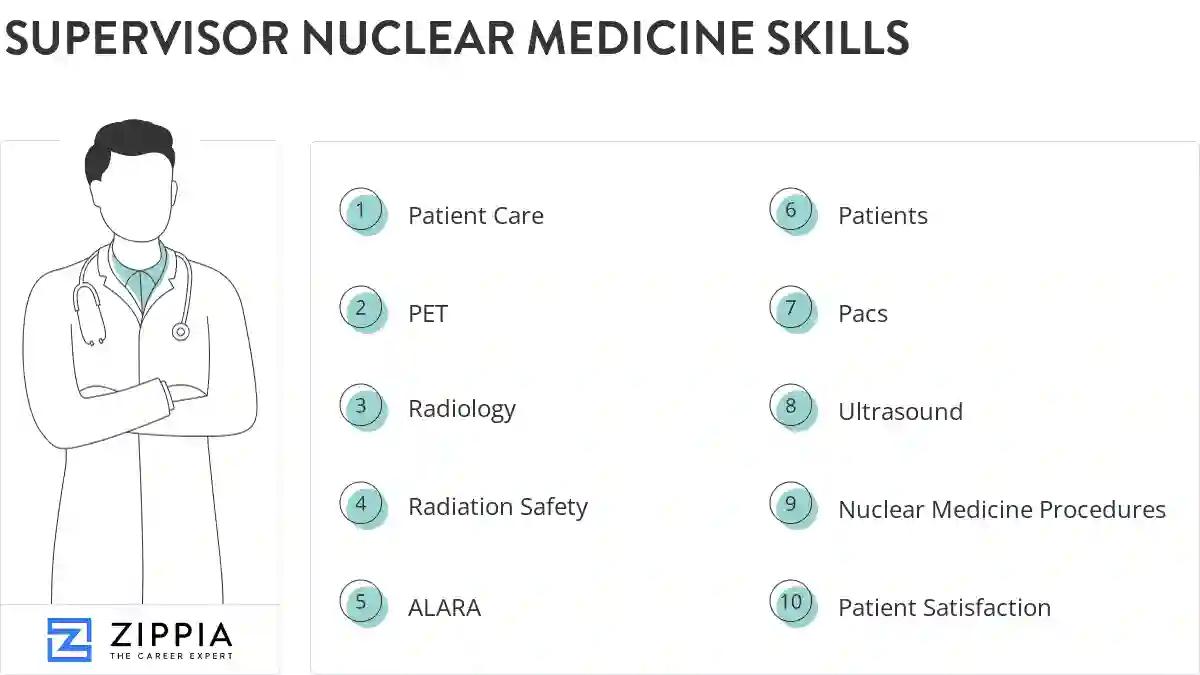
The most important skills for a supervisor nuclear medicine resume and required skills for a supervisor nuclear medicine to have include:
- Patient Care
- PET
- Radiology
- Radiation Safety
- ALARA
- Patients
- Pacs
- Ultrasound
- Nuclear Medicine Procedures
- Patient Satisfaction
- MRI
- Radiopharmaceuticals
- SPECT
- Radioactive Materials
- Nuclear Power
- Computer Processing
- ACR
- Gamma Cameras
- Nuclear Medicine
- QC
- JCAHO
- NRC
- EKG
- Capital Expenditures
- Staff Scheduling
- Hot Lab
- Payroll
- Performance Evaluations
- Research Projects
- Thyroid
- Vital Signs
- Performance Reviews
- Nuclear Regulatory
- Hippa
- Laboratory Equipment
- Icanl
- Personnel Actions
- Quality Assurance Program
- Positron Emission Tomography
- Front Desk
- Adac
- FTE
Updated January 8, 2025
