What does a test engineer do?

Test engineers are professionals who observe and record the quality of products, which includes functionality, durability, speed, and safety. They are responsible for checking the materials and procedures thoroughly throughout the production cycle. It is their duty to run tests on different criteria to identify and fix technical issues. They analyze reactions to determine the causes of malfunctions and recommend potential improvements. Moreover, they test products before they are launched to ensure customers get high-quality and functional products.
Test engineer responsibilities
Here are examples of responsibilities from real test engineer resumes:
- Manage design, correction, and modification of the installations monitor in Citect-SCADA software (HMI).
- Perform quality assurance tests to Intel processors and communications components using advance testing equipment in UNIX and Linux environments.
- Conduct final acceptance testing for DOD security products.
- Experience in mobile testing both manual and automation using APPIUM.
- Used Appium to configure test to run it on different mobile devices.
- Involve in designing and writing functionalities of the web applications using ruby.
- Serve on team provide support engineering support to U.S. Army and DOD clients.
- Code check-in using terminal and source tree in git repository, code verify using crucible.
- Create testing system in python that simulates user traffic on servers and devices around the world.
- Participate daily scrum meeting, planning, organization, peer reviews, implementation and monitoring of requirements.
- Perform data processing in UNIX, load the files in database, and test the processing of mortgages.
- Design and implement a test API to reduce redundant code, improve reliability, and reduce human error.
- Used selenium grid to execute test cases on multiple machines and create jobs in Jenkins to run test suites.
- Develop or modify scripts, queries, and batch files by performing script-level programming for HMI and administrative uses.
- Work as an automation engineer in the software company producing the most popular SCADA system, MasterSCADA in Russia.
Test engineer skills and personality traits
We calculated that 7% of Test Engineers are proficient in Python, C++, and C #.
We break down the percentage of Test Engineers that have these skills listed on their resume here:
- Python, 7%
Created an automated Python based test program updater/optimizer which utilized CP/CPK data collected to help stabilize and enhance tests.
- C++, 5%
Develop mathematical simulations of casino games using C++ in order to perform mathematical analysis to determine jurisdictional compliance of software.
- C #, 5%
Designed/maintained automation using in-house C # automation library.
- Test Results, 5%
Drive continuous improvement activities through data analysis of test results, silicon characterization and qualification to ensure devices meet specification.
- Java, 5%
Designed a Client-Server-Client application in Java using NetBeans, Designed a weather forecasting console in Java using NetBeans.
- Test Procedures, 4%
Generated and edited detailed test procedures/cases for end-to-end testing/validation of various medical devices such as IV infusers and heart monitors.
Common skills that a test engineer uses to do their job include "python," "c++," and "c #." You can find details on the most important test engineer responsibilities below.
The three companies that hire the most test engineers are:
- Raymond104 test engineers jobs
- Apple53 test engineers jobs
- Honeywell48 test engineers jobs
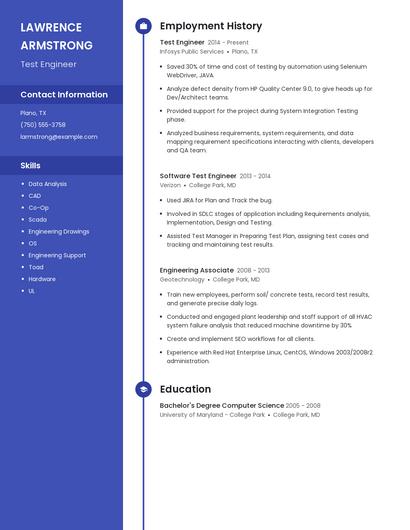
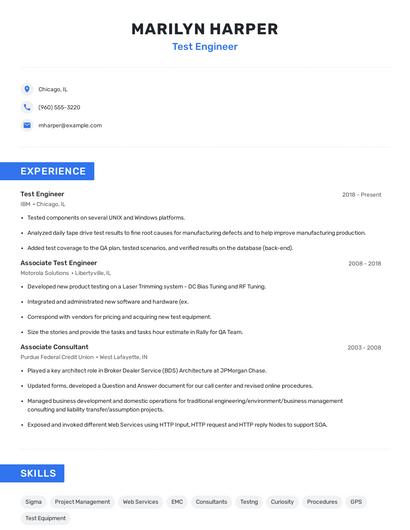
Choose from 10+ customizable test engineer resume templates
Build a professional test engineer resume in minutes. Our AI resume writing assistant will guide you through every step of the process, and you can choose from 10+ resume templates to create your test engineer resume.




Compare different test engineers
Test engineer vs. Engineer lead quality assurance lead
Engineer Lead Quality Assurance Leads are responsible for managing the designing and operations of hardware or software testing. Their duties include developing testing plans, implement risk mitigation strategies, communicate process improvements to cross-teams such as marketing and engineering, resolve the conflict between teams, and ensures product or software adheres to the organization and industry standards. They are also involved in reviewing technical design and specification, setting performance targets, and writing progress reports for management updates.
There are some key differences in the responsibilities of each position. For example, test engineer responsibilities require skills like "python," "test procedures," "test equipment," and "troubleshoot." Meanwhile a typical engineer lead quality assurance lead has skills in areas such as "api," "selenium webdriver," "jmeter," and "web services." This difference in skills reveals the differences in what each career does.
Engineers lead quality assurance lead earn the highest salaries when working in the hospitality industry, with an average yearly salary of $114,398. On the other hand, test engineers are paid more in the telecommunication industry with an average salary of $88,414.engineers lead quality assurance lead tend to reach similar levels of education than test engineers. In fact, engineers lead quality assurance lead are 2.0% more likely to graduate with a Master's Degree and 0.1% more likely to have a Doctoral Degree.Test engineer vs. Senior quality assurance engineer
A senior quality assurance engineer oversees the testing procedures conducted in software development, ensuring technical accuracy and efficiency. They are primarily responsible for working alongside software designers and quality engineers, reviewing quality control reports, inspecting specifications, and devising particular test procedures. Moreover, it is also essential to troubleshoot issues and identify any inconsistencies or bugs. As someone with more experience in the team, they must supervise and serve as a mentor to the younger quality assurance engineers in the joint effort to develop efficient software.
While some skills are similar in these professions, other skills aren't so similar. For example, resumes show us that test engineer responsibilities requires skills like "test equipment," "troubleshoot," "data analysis," and "rf." But a senior quality assurance engineer might use other skills in their typical duties, such as, "test automation," "api," "git," and "selenium web."
Senior quality assurance engineers may earn a higher salary than test engineers, but senior quality assurance engineers earn the most pay in the telecommunication industry with an average salary of $112,284. On the other hand, test engineers receive higher pay in the telecommunication industry, where they earn an average salary of $88,414.Average education levels between the two professions vary. Senior quality assurance engineers tend to reach higher levels of education than test engineers. In fact, they're 5.3% more likely to graduate with a Master's Degree and 0.1% more likely to earn a Doctoral Degree.What technology do you think will become more important and prevalent for test engineers in the next 3-5 years?
Andrea Welker Ph.D.
Associate Dean for Academic Affairs, College of Engineering Professor, Civil and Environmental Engineering, Villanova University
Test engineer vs. Software engineer-consultant
A software engineer consultant develops and recommends strategies to optimize a company's software engineering operations. Their responsibilities revolve around conducting extensive research and analysis to find new opportunities, performing software evaluations and risk assessments, identifying the strengths and weaknesses of existing processes, and developing solutions against problem areas. Through the findings of their research, a software engineer consultant draws conclusions and recommendations that will help the company to reach their short and long-term goals and resolve issues or concerns.
Some important key differences between the two careers include a few of the skills necessary to fulfill the responsibilities of each. Some examples from test engineer resumes include skills like "c #," "test results," "test procedures," and "test equipment," whereas a software engineer-consultant is more likely to list skills in "architecture," "software development," "api," and "database. "
Software engineers-consultant earn the best pay in the insurance industry, where they command an average salary of $118,185. Test engineers earn the highest pay from the telecommunication industry, with an average salary of $88,414.software engineers-consultant typically earn higher educational levels compared to test engineers. Specifically, they're 5.9% more likely to graduate with a Master's Degree, and 1.0% more likely to earn a Doctoral Degree.Test engineer vs. Quality assurance engineer
A Quality Assurance Engineer's role is to oversee the overall production and ensure that the product is cost-efficient and aligns with the company's standards. The responsibility mainly revolves around conducting activities that examine and scrutinize the condition of a product or service to identify issues and come up with possible solutions to resolve the issue or attain stronger customer satisfaction. Furthermore, the Quality Assurance Engineer must also ensure that the product adheres to the government regulations and market guidelines.
Even though a few skill sets overlap between test engineers and quality assurance engineers, there are some differences that are important to note. For one, a test engineer might have more use for skills like "test procedures," "test equipment," "troubleshoot," and "data analysis." Meanwhile, some responsibilities of quality assurance engineers require skills like "api," "git," "selenium web," and "test suites. "
In general, quality assurance engineers earn the most working in the technology industry, with an average salary of $100,740. The highest-paying industry for a test engineer is the telecommunication industry.The average resume of quality assurance engineers showed that they earn similar levels of education compared to test engineers. So much so that theyacirc;euro;trade;re 2.8% more likely to earn a Master's Degree and less likely to earn a Doctoral Degree by 0.0%.Types of test engineer
Updated January 8, 2025
