What does a tractor trailer operator do?
A Tractor-Trailer Operator typically operates a heavy-duty tractor/trailer over the road or city shuttle service or for trailer spotting operations. He/She knows how to make use of GPS and maps to chart the best and cost-efficient routes for delivery purposes. You will be responsible for dispatching vehicles for emergency response. You'll also do the following; monitor the performance of the trailer, perform regular maintenance on it and complete all paperwork. Besides, you'll be in constant communication with the aid of a CB radio for needed instructions.
Tractor trailer operator responsibilities
Here are examples of responsibilities from real tractor trailer operator resumes:
- Experience in semi driving, logging, managing bills of lading, light maintenance, vehicle inspections.
- Operate a tractor trailer OTR trhu center and west coast of the country.
- Well verse in using GPS and maps to chart out time and cost efficient routs for delivery purpose.
- Deliver refrigerated products between multiple states while operating a semi tractor trailer.
- Operate a variety of equipment such as dump trucks, forklifts, shovels, axes and mechanic tools.
Tractor trailer operator skills and personality traits
We calculated that 23% of Tractor Trailer Operators are proficient in CDL, DOT, and Safety Inspections. They’re also known for soft skills such as Hand-eye coordination, Hearing ability, and Physical health.
We break down the percentage of Tractor Trailer Operators that have these skills listed on their resume here:
- CDL, 23%
Maintained current Class-A CDL with Hazardous Materials and Doubles and Triples endorsements.
- DOT, 13%
Completed all applicable paperwork related to customer deliveries and DOT regulations.
- Safety Inspections, 8%
Conduct safety inspections and maintain required paperwork per Department of Transportation standards.
- Two-Way Radio, 8%
Operated two-way radio for continuous communications as both tractor-trailer operator and dispatcher.
- Vehicle Service, 6%
Job Description: Maintain logs of working hours and of vehicle service and repair status, following applicablestate and federal regulations.
- Tractor-Trailer Combination, 6%
Operated diesel-powered tractor-trailer combination to transport and delivered products and material in liquid and package form.
Common skills that a tractor trailer operator uses to do their job include "cdl," "dot," and "safety inspections." You can find details on the most important tractor trailer operator responsibilities below.
Hand-eye coordination. The most essential soft skill for a tractor trailer operator to carry out their responsibilities is hand-eye coordination. This skill is important for the role because "drivers of heavy trucks and tractor-trailers must be able to coordinate their legs, hands, and eyes simultaneously so that they will react appropriately to the situation around them and drive the vehicle safely." Additionally, a tractor trailer operator resume shows how their duties depend on hand-eye coordination: "maintain accurate and safe log book.load unload freight.communicate with brokers dispatch and coordination of loads"
Hearing ability. Many tractor trailer operator duties rely on hearing ability. "truck drivers need good hearing," so a tractor trailer operator will need this skill often in their role. This resume example is just one of many ways tractor trailer operator responsibilities rely on hearing ability: "transport and deliver customer goods while adhearing to strict deadlines and safety regulations for professional drivers. "
Physical health. This is an important skill for tractor trailer operators to perform their duties. For an example of how tractor trailer operator responsibilities depend on this skill, consider that "federal regulations do not allow people to become truck drivers if they have a medical condition, such as high blood pressure or epilepsy, which may interfere with their ability to operate a truck." This excerpt from a resume also shows how vital it is to everyday roles and responsibilities of a tractor trailer operator: "license cdl a class with hazmat, triple-doubles, air brake, tanker endorsement one licenses and current dot physical card".
Visual ability. For certain tractor trailer operator responsibilities to be completed, the job requires competence in "visual ability." The day-to-day duties of a tractor trailer operator rely on this skill, as "truck drivers must be able to pass vision tests." For example, this snippet was taken directly from a resume about how this skill applies to what tractor trailer operators do: "maintained education in successfully, handling hazardous materials; visually recognized colored labels and placards. "
The three companies that hire the most tractor trailer operators are:
- New York State Restaurant Association2 tractor trailer operators jobs
- McKesson1 tractor trailer operators jobs
- MCC Holdings Inc1 tractor trailer operators jobs
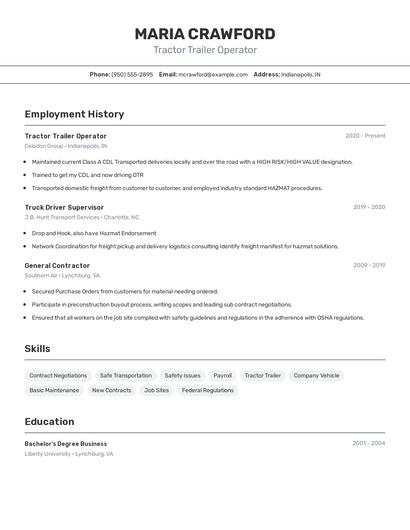
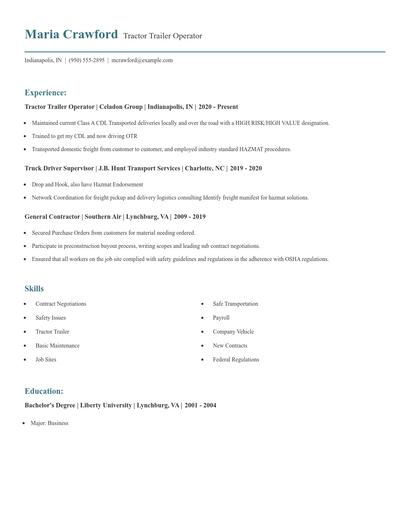
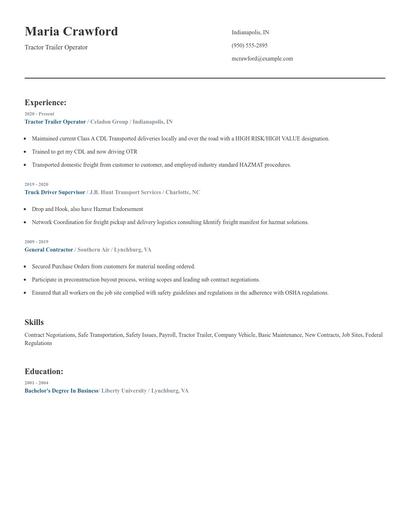
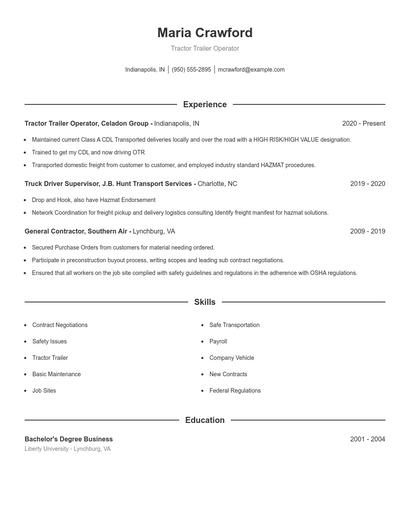
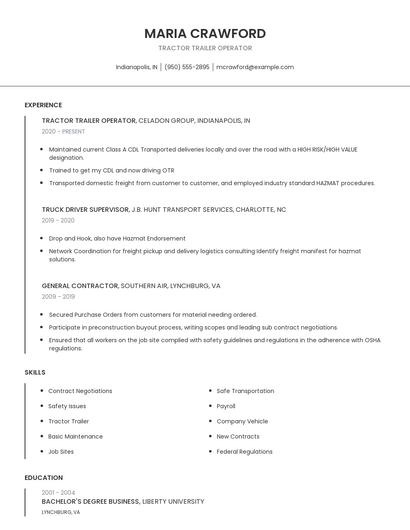
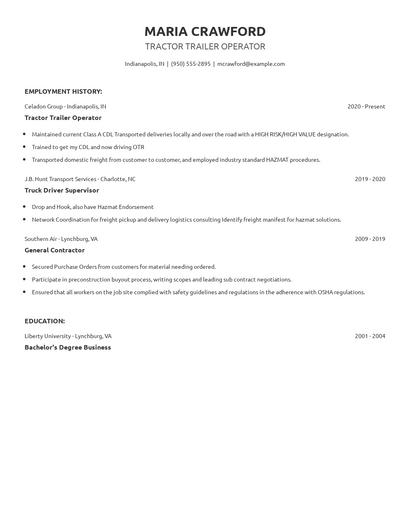
Choose from 10+ customizable tractor trailer operator resume templates
Build a professional tractor trailer operator resume in minutes. Our AI resume writing assistant will guide you through every step of the process, and you can choose from 10+ resume templates to create your tractor trailer operator resume.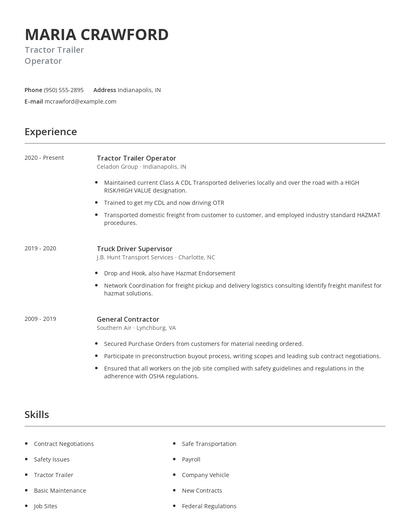


Compare different tractor trailer operators
Tractor trailer operator vs. Cdl class a driver
A CDL Class A driver is a driver with a Class A commercial driver's license. A commercial driver's license is necessary to operate large, heavy, and placarded vehicles. There are several classifications of a commercial driver's license, and Class A is for a car towing a trailer with a gross vehicle weight of more than 10,000 pounds (5 t). Drivers with this type of license are entitled to operate a commercial motor vehicle such as passenger buses, tractor-trailers, semi-trucks, and dump trucks. They have the choice to add endorsements to their CDL, which allows them to operate particular types of commercial motor vehicles.
These skill sets are where the common ground ends though. The responsibilities of a tractor trailer operator are more likely to require skills like "cdl," "dot," "safety inspections," and "two-way radio." On the other hand, a job as a cdl class a driver requires skills like "customer service," "customer locations," "math," and "dot regulations." As you can see, what employees do in each career varies considerably.
Cdl class a drivers earn the highest salaries when working in the transportation industry, with an average yearly salary of $57,733. On the other hand, tractor trailer operators are paid more in the transportation industry with an average salary of $39,156.The education levels that cdl class a drivers earn slightly differ from tractor trailer operators. In particular, cdl class a drivers are 0.8% less likely to graduate with a Master's Degree than a tractor trailer operator. Additionally, they're 0.4% more likely to earn a Doctoral Degree.Tractor trailer operator vs. Line haul driver
A line haul truck driver is in charge of transporting heavy materials using large vehicles such as tractor-trailers, ensuring timeliness and efficiency. Their responsibilities typically revolve around securing documents or invoices, adhering to specific routes, driving for long durations, liaising and building positive relationships with companies, and ensuring the safety and quality of all cargo. Furthermore, as a line haul truck driver, it is essential to abide by all the traffic laws and perform regular vehicle maintenance checks to ensure a safe and productive work environment.
Each career also uses different skills, according to real tractor trailer operator resumes. While tractor trailer operator responsibilities can utilize skills like "dot," "two-way radio," "mechanical failures," and "trip reports," line haul drivers use skills like "post-trip inspections," "line haul," "customer service," and "dot regulations."
Line haul drivers may earn a higher salary than tractor trailer operators, but line haul drivers earn the most pay in the manufacturing industry with an average salary of $53,344. On the other hand, tractor trailer operators receive higher pay in the transportation industry, where they earn an average salary of $39,156.Average education levels between the two professions vary. Line haul drivers tend to reach similar levels of education than tractor trailer operators. In fact, they're 0.3% less likely to graduate with a Master's Degree and 0.4% more likely to earn a Doctoral Degree.What technology do you think will become more important and prevalent for tractor trailer operators in the next 3-5 years?
Don Lefeve
President & Chairman of the Board, CVTA
Tractor trailer operator vs. Class a driver
A Class A driver is an individual driver who has acquired a commercial driver's license (CDL) to operate trucks or commercial vehicles to transport materials and heavy equipment. Class A drivers are required to plan over-the-road (OTR) travel by using GPS and ensure that they follow bulk cargo transportation laws, regulations, and guidelines. They must conduct proper maintenance of the company vehicles and provide accurate daily logs to stay in compliance with the company's regulations. Class A drivers should also know how to operate equipment such as citizen band (CB) radios and telephones.
The required skills of the two careers differ considerably. For example, tractor trailer operators are more likely to have skills like "dot," "safety inspections," "two-way radio," and "mechanical failures." But a class a driver is more likely to have skills like "customer service," "post-trip inspections," "pallets," and "dot regulations."
Class a drivers earn the highest salary when working in the transportation industry, where they receive an average salary of $60,830. Comparatively, tractor trailer operators have the highest earning potential in the transportation industry, with an average salary of $39,156.Most class a drivers achieve a similar degree level compared to tractor trailer operators. For example, they're 0.6% less likely to graduate with a Master's Degree, and 0.1% less likely to earn a Doctoral Degree.Tractor trailer operator vs. Company driver
A company driver helps an organization with all transport-related duties and ensures that these are carried out on time. Company drivers transport and deliver goods, equipment, products, and staff members to locations required by the organization. They maintain the cleanliness of their vehicles and are responsible for informing the organization about repairs and maintenance. Company drivers must also obtain the appropriate licenses and should have clean driving records with no accidents and traffic violations.
Updated January 8, 2025
