What does a train operator do?

The Train Operator ensures the train gets to and from destinations in a timely and safe manner. This person is responsible for the train's operation, maintenance, repairs, and upgrades. The passengers' safety and convenience fall on the train operator's shoulders, and it is the operator's obligation that trains always depart and arrive on time. Add responsibilities of a train operator is to ensure the security of all passengers and to report all irregularities observed during one's duty.
Train operator responsibilities
Here are examples of responsibilities from real train operator resumes:
- Develop training content for eLearning and instructor lead classrooms by evaluating Predix user experiences.
- Manage the master calendar and schedule resources such as communication equipment, weapons, transportation and ammunition forecast and delivery.
- Develop and write operator training manuals and ISO procedures for injection molding lines, metalizers, coaters and inspection equipment.
- Climb ladders on railway cars.
- Act as SME for safety.
- Maintain trainingrecords and LMS system.
- Facilitate use of Webinar and LMS when necessary.
- Serve as a SME for assign jurisdictions and training responsibilities.
- Qualify individuals in proper CPR techniques and life saving skills.
- Analyze GIS web grids and profiles of waste water lines.
- Conduct extensive training in obedience, patrol, detection and combat operations.
- Present PowerPoint presentations to new hires that help them better understand their function.
- Train all new employees with the RF scanners and all necessary job duties.
- Specialize in OSHA, MSHA, EPA regulations, audits, training and inspections.
- Maintain up-to-date knowledge of all domestic and international shipping regulations including DOD 4500-9 and IATA.
Train operator skills and personality traits
We calculated that 12% of Train Operators are proficient in Training Programs, Safety Procedures, and Training Sessions. They’re also known for soft skills such as Analytical skills, Communication skills, and Creativity.
We break down the percentage of Train Operators that have these skills listed on their resume here:
- Training Programs, 12%
Developed and implemented training programs for newly hired employees on all corporate policies and procedures and technical system operations.
- Safety Procedures, 9%
Performed complete training for incoming new employees for equipment operation and safety procedures.
- Training Sessions, 8%
Completed scheduled in-house training sessions to maintain knowledge of company operations and policies.
- PowerPoint, 7%
Provided training for new agents on policies and procedures utilizing PowerPoint presentations, Train the Trainer, and New Hire Orientations.
- Ladders, 6%
Climbed ladders to inspect loads after loading was complete, in order to ensure that cargo was secure.
- DOD, 4%
Maintained up-to-date knowledge of all domestic and international shipping regulations including DOD 4500-9 and IATA.
Common skills that a train operator uses to do their job include "training programs," "safety procedures," and "training sessions." You can find details on the most important train operator responsibilities below.
Analytical skills. The most essential soft skill for a train operator to carry out their responsibilities is analytical skills. This skill is important for the role because "training and development specialists must evaluate training programs, methods, and materials and choose those that best fit each situation." Additionally, a train operator resume shows how their duties depend on analytical skills: "perform business case analysis for auto dealers design and develop employee leadership and training materials"
Communication skills. Many train operator duties rely on communication skills. "training and development specialists must convey information clearly and facilitate learning to diverse audiences.," so a train operator will need this skill often in their role. This resume example is just one of many ways train operator responsibilities rely on communication skills: "transformed regional hr from administrative role into a strategic business partner and trusted advisor by providing an atmosphere of open communication. "
Creativity. Another skill that relates to the job responsibilities of train operators is creativity. This skill is critical to many everyday train operator duties, as "specialists should be resourceful when developing training materials." This example from a resume shows how this skill is used: "assist with any spreadsheet updates assist qa with centrax inventory process new routers and delivering to foundries for new parts. "
Instructional skills. train operator responsibilities often require "instructional skills." The duties that rely on this skill are shown by the fact that "training and development specialists deliver employee training programs." This resume example shows what train operators do with instructional skills on a typical day: "schedule and monitor on-the-job training, ensuring that all instructional methods meet the plant s official guidelines and updates. "
The three companies that hire the most train operators are:
- HKA Enterprises10 train operators jobs
- Black Hills5 train operators jobs
- Generac Holdings4 train operators jobs
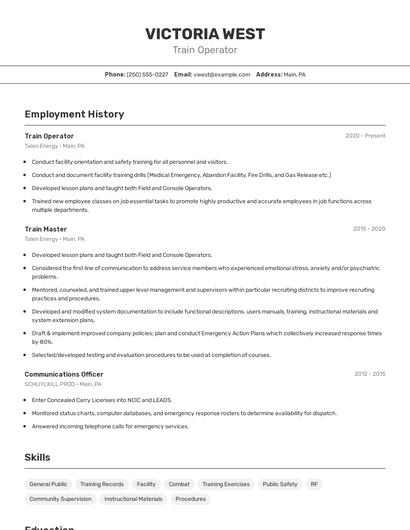
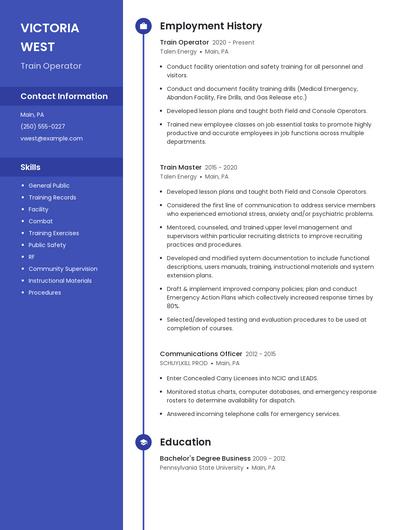
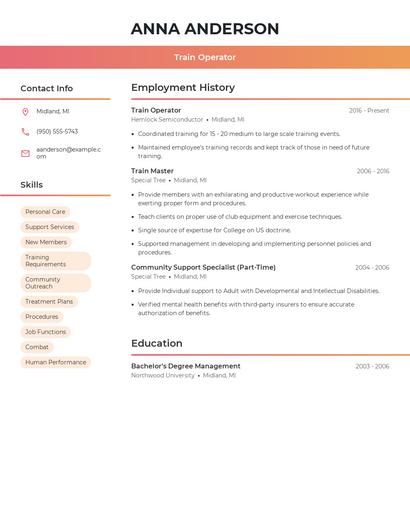
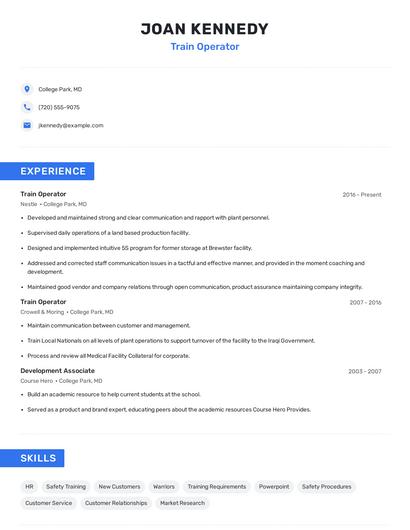
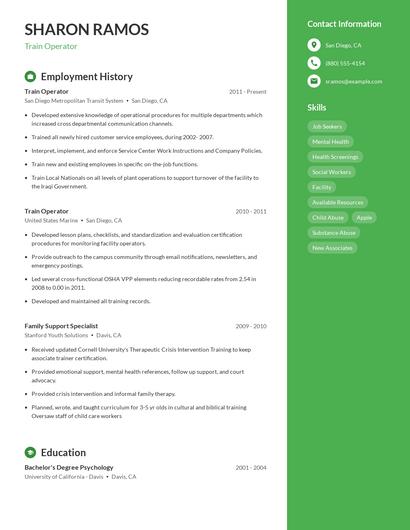
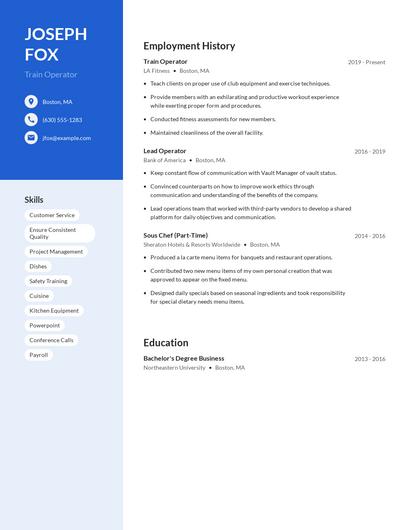
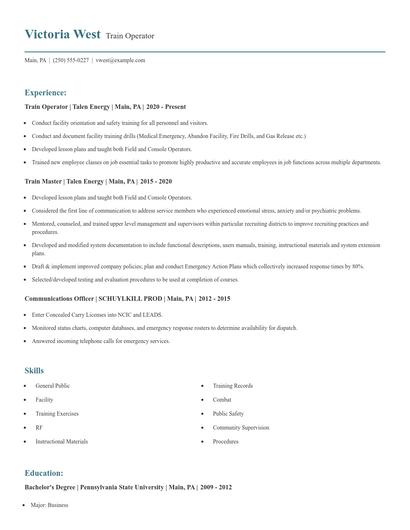
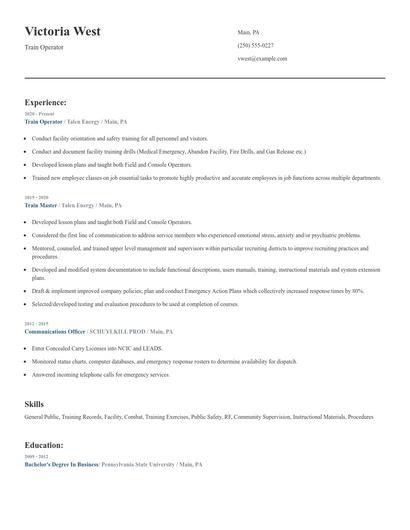
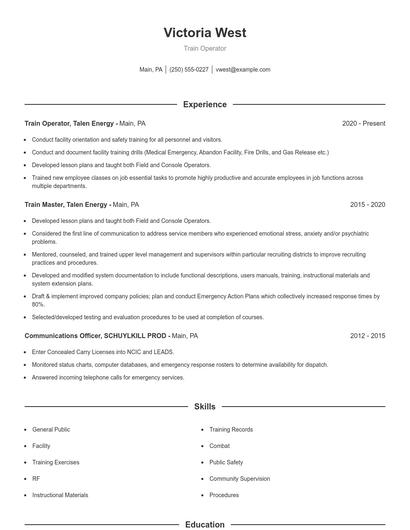
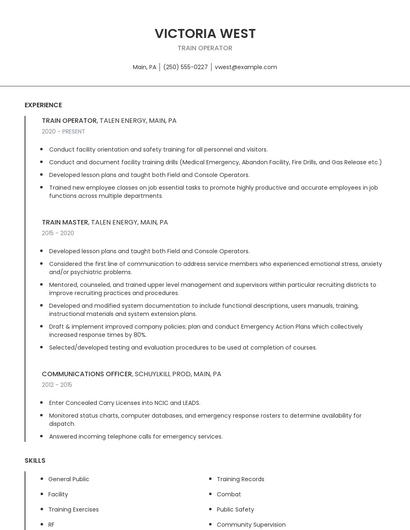
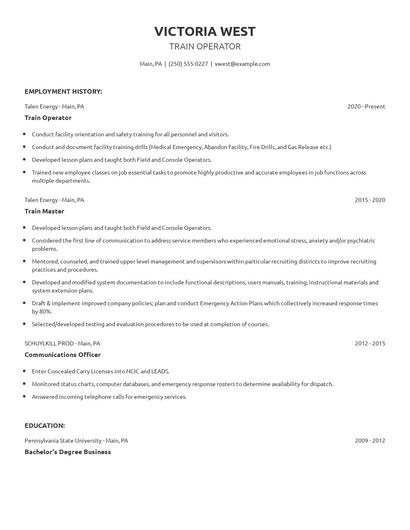
Choose from 10+ customizable train operator resume templates
Build a professional train operator resume in minutes. Our AI resume writing assistant will guide you through every step of the process, and you can choose from 10+ resume templates to create your train operator resume.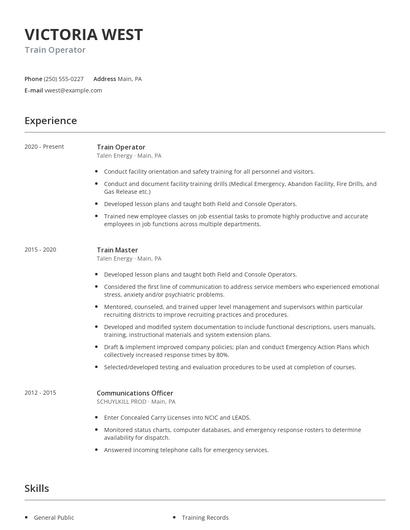
Compare different train operators
Train operator vs. Workforce development specialist
A workforce development specialist is responsible for designing and conducting training and development programs to significantly improve organizational and individual performance. You will perform a few duties that include evaluating training delivery modes, such as virtual or in-person to optimize training effectiveness and costs, developing, obtaining, or organizing training guides and procedure manuals, and coordinating the placement of trainees. As a workforce development specialist, you also have to choose and assign training instructors and negotiating contracts with clients.
These skill sets are where the common ground ends though. The responsibilities of a train operator are more likely to require skills like "safety procedures," "training sessions," "ladders," and "dod." On the other hand, a job as a workforce development specialist requires skills like "social services," "community resources," "career development," and "supportive services." As you can see, what employees do in each career varies considerably.
Workforce development specialists tend to make the most money working in the transportation industry, where they earn an average salary of $60,428. In contrast, train operators make the biggest average salary, $43,593, in the transportation industry.The education levels that workforce development specialists earn slightly differ from train operators. In particular, workforce development specialists are 6.6% more likely to graduate with a Master's Degree than a train operator. Additionally, they're 0.5% more likely to earn a Doctoral Degree.Train operator vs. Development specialist
A development specialist is responsible for monitoring career training and programs for the employees, improving their capabilities and maximum potential to contribute to the company's growth and success. Development specialists also assist in assessing departmental operations, evaluating training needs, and facilitate skill development discussions and exercises. A development specialist helps identify business opportunities to generate more revenues for the organization and improve profitability status. A development specialist must have excellent communication and organization skills and comprehensive knowledge of human management to assist employees with their inquiries and concerns.
Each career also uses different skills, according to real train operator resumes. While train operator responsibilities can utilize skills like "safety procedures," "ladders," "dod," and "on-the-job training," development specialists use skills like "customer service," "customer satisfaction," "patients," and "excellent interpersonal."
Average education levels between the two professions vary. Development specialists tend to reach higher levels of education than train operators. In fact, they're 9.0% more likely to graduate with a Master's Degree and 0.5% more likely to earn a Doctoral Degree.Train operator vs. Epic credentialed trainer
Epic credential trainers are professionals who are trained at the hospital client where they provide training to users. The responsibilities of the trainers include the delivery of end-user training and assistance in technicalities. They balance various projects and their deadlines while still managing caseloads. Their job involves the establishment and enforcement of training interventions. Also, they offer extensive customer service through communication on a professional level and provide support via telephone or WebEx.
Some important key differences between the two careers include a few of the skills necessary to fulfill the responsibilities of each. Some examples from train operator resumes include skills like "training programs," "safety procedures," "ladders," and "dod," whereas an epic credentialed trainer is more likely to list skills in "ehr," "patients," "curriculum development," and "end user training. "
Epic credentialed trainers make a very good living in the health care industry with an average annual salary of $77,624. On the other hand, train operators are paid the highest salary in the transportation industry, with average annual pay of $43,593.When it comes to education, epic credentialed trainers tend to earn higher degree levels compared to train operators. In fact, they're 8.9% more likely to earn a Master's Degree, and 0.6% more likely to graduate with a Doctoral Degree.Train operator vs. Senior technician specialist
Senior technician specialists are technicians in the office who specialize in a specific activity or task. They are more tenured than entry-level employees and, at times, given bigger responsibilities than their junior counterparts. They may even be asked to lead specific projects. Senior technician specialists are usually involved in the technical or technological needs of the organization. As such, they should be familiar with the different equipment, fixtures, and infrastructure in the office. They are expected to perform installations, repairs, updates, and maintenance. Senior technician specialists should also be able to provide support to office employees on technical and technological aspects.
Even though a few skill sets overlap between train operators and senior technician specialists, there are some differences that are important to note. For one, a train operator might have more use for skills like "training programs," "safety procedures," "training sessions," and "ladders." Meanwhile, some responsibilities of senior technician specialists require skills like "patients," "customer service," "c #," and "project management. "
The technology industry tends to pay the highest salaries for senior technician specialists, with average annual pay of $101,461. Comparatively, the highest train operator annual salary comes from the transportation industry.The average resume of senior technician specialists showed that they earn higher levels of education compared to train operators. So much so that theyacirc;euro;trade;re 5.2% more likely to earn a Master's Degree and more likely to earn a Doctoral Degree by 0.9%.Types of train operator
Updated January 8, 2025
