What does a transit department clerk do?

It's the job of a Transit Department Clerk to process and verify all shipment documents that are both inbound and outbound. Your primary job will be to perform a ton of clerical duties in a transportation environment/organization. The Transit Clerk also ensures that all goods are safely processed and well secured for shipment. Furthermore, you'd have to identify and tag goods with the help of the shipment documents. Finally, your job will also be to supervise the delivery of goods to customers to their specific locations.
Transit department clerk responsibilities
Here are examples of responsibilities from real transit department clerk resumes:
- Demonstrate strong math skills in managing inmate s accounts and calmly and effectively deescalating outbursts of belligerent inmates.
- Maintain cleanliness and organization of overstock product.
- Calculate weekly payroll and furnish information to accountants to prepare tax return.
- Process monthly supplemental instructional staff payroll, including internal staff and outside contractors.
- Transfer to transportation department to schedule transportation for Kentucky Medicaid clients and other qualifying facilities.
- Complete accurate demographic and insurance information, including verification of insurance according to private, Medicaid, and/or Medicare guidelines.
- Verify Medi-cal and additional government plans prior to patient attending appointment.
Transit department clerk skills and personality traits
We calculated that 25% of Transit Department Clerks are proficient in Customer Satisfaction, Customer Orders, and Patients. They’re also known for soft skills such as Customer-service skills, Detail oriented, and Organizational skills.
We break down the percentage of Transit Department Clerks that have these skills listed on their resume here:
- Customer Satisfaction, 25%
Ensured customer satisfaction through extensive telephone, electronic and postal correspondence.
- Customer Orders, 23%
Locate and package bulk customer orders for processing to shipping.
- Patients, 9%
Maintain composure and facilitate cooperative and productive communication with hostile, impaired or distraught patients.
- Cleanliness, 6%
Maintained cleanliness and organization of overstocked product.
- Allergies, 5%
Communicate with Dieticians, Dietetic Technicians concerning patient diets, allergies and menu entries.
- Sales Floor, 5%
Ensured stock levels on the sales floor are maintained.
Common skills that a transit department clerk uses to do their job include "customer satisfaction," "customer orders," and "patients." You can find details on the most important transit department clerk responsibilities below.
Customer-service skills. The most essential soft skill for a transit department clerk to carry out their responsibilities is customer-service skills. This skill is important for the role because "general office clerks often provide general information to company staff, customers, or the public." Additionally, a transit department clerk resume shows how their duties depend on customer-service skills: "post and balance incoming payments to customer accounts (data entry). "
Detail oriented. Another essential skill to perform transit department clerk duties is detail oriented. Transit department clerks responsibilities require that "general office clerks perform many clerical tasks that require attention to detail, such as preparing bills." Transit department clerks also use detail oriented in their role according to a real resume snippet: "worked on and managed specialized department projects and multiple programs, detailed data entry, organization and multitasking. "
Organizational skills. This is an important skill for transit department clerks to perform their duties. For an example of how transit department clerk responsibilities depend on this skill, consider that "general office clerks file and retrieve records." This excerpt from a resume also shows how vital it is to everyday roles and responsibilities of a transit department clerk: "increased meeting efficiency by developing meeting agendas, prepared meeting minutes, and memorandums for organizational support. ".
The three companies that hire the most transit department clerks are:
- Kaiser Permanente4 transit department clerks jobs
- SACH S.A.2 transit department clerks jobs
- Hy-Vee2 transit department clerks jobs
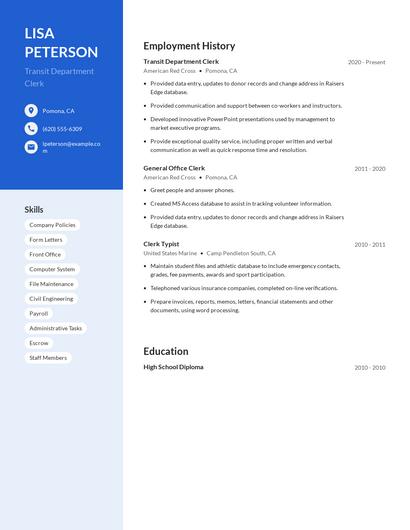
Choose from 10+ customizable transit department clerk resume templates
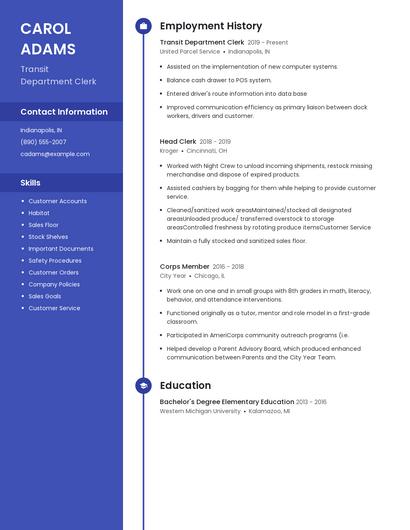
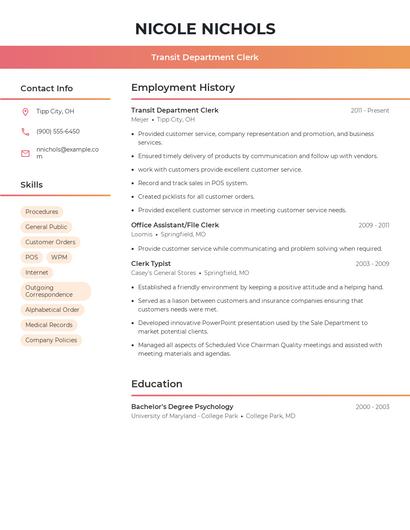
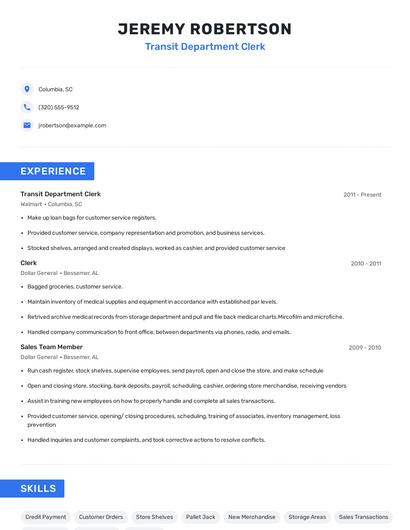
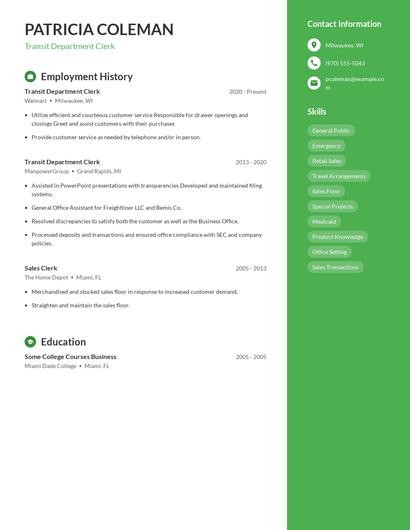
Build a professional transit department clerk resume in minutes. Our AI resume writing assistant will guide you through every step of the process, and you can choose from 10+ resume templates to create your transit department clerk resume.



Compare different transit department clerks
Transit department clerk vs. Office specialist
An office specialist is responsible for performing administrative and clerical duties to support the organization's daily operations. Office specialists must be highly organizational, as well as having excellent time-management skills to handle work units. They have duties including data entry procedures, greeting visitors, responding to customers' inquiries through phone calls and e-mails, and filing and sorting documents. Office specialists are responsible for creating meeting reports, scheduling appointments, evaluating financial statements, coordinating with other staff for event planning, and assisting the senior management with complex functions.
While similarities exist, there are also some differences between transit department clerks and office specialist. For instance, transit department clerk responsibilities require skills such as "customer satisfaction," "customer orders," "cleanliness," and "sales floor." Whereas a office specialist is skilled in "phone calls," "office support," "financial reports," and "office operations." This is part of what separates the two careers.
Office specialists earn the highest salaries when working in the finance industry, with an average yearly salary of $37,752. On the other hand, transit department clerks are paid more in the finance industry with an average salary of $35,204.On average, office specialists reach similar levels of education than transit department clerks. Office specialists are 0.5% more likely to earn a Master's Degree and 0.0% less likely to graduate with a Doctoral Degree.Transit department clerk vs. Office associate
Office associates have varied duties and responsibilities within an organization. They are responsible for the cash management operation, customer service functions, and administrative services. Other responsibilities include organizing and maintaining files and documents, administering all bookkeeping activities, and managing the entire office. Office associates also oversee the overall human resource activities within an organization, such as handling employment forms and health insurance administration. The skills required for this position include communication skills, organizational skills, and active listening skills.
Each career also uses different skills, according to real transit department clerk resumes. While transit department clerk responsibilities can utilize skills like "customer satisfaction," "cleanliness," "allergies," and "slicers," office associates use skills like "patient appointments," "strong customer service," "phone calls," and "transcription."
Office associates may earn a lower salary than transit department clerks, but office associates earn the most pay in the finance industry with an average salary of $36,923. On the other hand, transit department clerks receive higher pay in the finance industry, where they earn an average salary of $35,204.In general, office associates achieve similar levels of education than transit department clerks. They're 0.6% more likely to obtain a Master's Degree while being 0.0% more likely to earn a Doctoral Degree.Transit department clerk vs. Office worker
An office worker is responsible for performing administrative and clerical duties to support the daily operations of the business. Office workers assist in receiving calls to respond to the clients' inquiries and concerns, as well as welcoming visitors, verifying their appointments, and leading them to the appropriate personnel and department for their business needs. They also do data processing, sorting mail, and filing documents for easy retrieval and reference, especially during meetings and company activities.
The required skills of the two careers differ considerably. For example, transit department clerks are more likely to have skills like "customer satisfaction," "customer orders," "patients," and "cleanliness." But a office worker is more likely to have skills like "administrative tasks," "computer programs," "direct calls," and "credit card."
Office workers earn the best pay in the education industry, where they command an average salary of $40,267. Transit department clerks earn the highest pay from the finance industry, with an average salary of $35,204.Most office workers achieve a similar degree level compared to transit department clerks. For example, they're 0.5% less likely to graduate with a Master's Degree, and 0.2% less likely to earn a Doctoral Degree.Transit department clerk vs. Clerk typist
A clerk typist is responsible for data entry procedures and document transcriptions, alongside other clerical and administrative duties as required by the employer. Clerk typists create reports and presentation materials, transcribe audio meetings, write business drafts, and send documents to appropriate office personnel or clients. A clerk-typist must show excellent organizational and time-management skills, especially with handling various typing tasks under strict deadlines and minimal supervision. They also respond and take calls from clients and customers, assisting with their inquiries and concerns.
Types of transit department clerk
Updated January 8, 2025
