
Automatically apply for jobs with Zippia
Upload your resume to get started.
Transportation security screener skills for your resume and career

15 transportation security screener skills for your resume and career
1. Security Procedures
A security procedure is a verification protocol used to check if an electronic signature, record, or performance belongs to that specific person. It is a set of necessary procedures that need to be performed to maintain security. These procedures are step-by-step guidelines on how to implement, enable, or enforce security.
- Instructed passengers on proper Homeland Security procedures and policies for new United States Regulations.
- Conducted daily staff briefings on performance and updated security procedures.
2. Customer Service
Customer service is the process of offering assistance to all the current and potential customers -- answering questions, fixing problems, and providing excellent service. The main goal of customer service is to build a strong relationship with the customers so that they keep coming back for more business.
- Demonstrate the highest level of customer service to travelers and airline personnel to achieve superior customer service satisfaction.
- Received several performance awards for outstanding job performance and excellent customer service and management skills.
3. X-Ray Machines
- Operated screening equipment and assisted in performing maintenance checks on x-ray machines, explosives detection machines, and metal detectors.
- Operated basic security equipment such as x-ray machines and hand wands at screening checkpoints.
4. Transportation Security Administration
- Conducted screening of passengers and baggage to ensure compliance with Transportation Security Administration (TSA) regulations.
- Perform airline passenger and baggage screening for the US Transportation Security Administration.
5. Metal Detectors
- Asked passengers to remove shoes and divest themselves of metal objects prior to walking through metal detectors.
- Performed screening of passengers' checked baggage using explosive trace detectors, x-ray equipment and metal detectors.
6. X Ray Machines
- Trained for and operated x ray machines, Elemental detection software and various other screening devices.
- Used x ray machines and body scanners certified in both.
Choose from 10+ customizable transportation security screener resume templates
Build a professional transportation security screener resume in minutes. Our AI resume writing assistant will guide you through every step of the process, and you can choose from 10+ resume templates to create your transportation security screener resume.7. Security Checkpoint
- Oversee security checkpoints; manage security officers; conduct security briefings and ensure regulatory compliance.
- Certified to operate all Security Checkpoint equipment including Explosive Trace Detection and X-Ray equipment.
8. Law Enforcement
Law enforcement is the task of certain members of the community who work together to uphold the law by identifying, preventing, rehabilitating, or prosecuting others who break society's laws and norms. The phrase refers to the police, the judiciary, and the correctional system.
- Reported specific findings or incidents to management or law enforcement.
- Acted as a Mentor to upper management pertaining to specialized screening procedures at the Law Enforcement Door.
9. Explosive Trace Detection
- Conducted Explosive Trace Detection System and Electronic Detection and imaging equipment training.
- Operate explosive trace detection equipment looking for improvised explosive devices.
10. X-Ray Equipment
X-ray equipment is used to generate images of tissues and structures inside of the body.
- Do pat downs on passengers, utilize x-ray equipment to monitor safety of passengers.
- Operate x-ray equipment to scan for explosive devices or other hazardous materials.
11. Incident Reports
An Incident Report, in a medical facility such as hospitals and nursing homes, is a type of paperwork filled out immediately after and in the case of an incident of some sort, with the goal of describing the incident and its consequences, as well as the measurements taken after or during the incident, as well as any other information relevant to said incident. Such an incident might be a patient acting out or a patient being injured.
- Complete daily SPOT Score Sheets and Incident Reports on a regular basis.
- Have experience with assisting with investigations of incidents, and preparing incident reports or other documents that convey required information.
12. ETD
- Conduct continuous testing of electronic devices, carry-on baggage and clothing items using the Explosive Trace Device (ETD).
- Use EDS & ETD machines to screen baggage for airline safety, oversees SOP guidelines within immediate team.
13. Detection System
- Provided maintenance of explosive detection systems.
- Implemented training and recorded compliance of explosive detection system maintenance within the 5 airport regional system.
14. Hazardous Materials
Any substance or good that is harmful to human health as well as the environment are called hazardous materials. Such materials must be handled carefully to avoid any mishaps. Harmful gases. chemicals, strong medicines or drugs, radioactive elements required for radiation purposes, a human blood sample that carries germs, all of these are considered hazardous materials.
- Screen and inspect checked international baggage for explosive devices, hazardous materials, while observing for suspicious behaviors.
- Ensured zero contraband or hazardous materials were transported via airlines by utilizing special techniques and equipment.
15. Front Line Security
- Provided front line security and protection of travelers, airport and airplanes by identifying prohibited items in baggage and on passengers.
- Front Line security servicing Detroit Metro Airport.
5 Transportation Security Screener resume examples
Build a professional transportation security screener resume in minutes. Browse through our resume examples to identify the best way to word your resume. Then choose from 5+ resume templates to create your transportation security screener resume.

What skills help Transportation Security Screeners find jobs?
Tell us what job you are looking for, we’ll show you what skills employers want.
List of transportation security screener skills to add to your resume
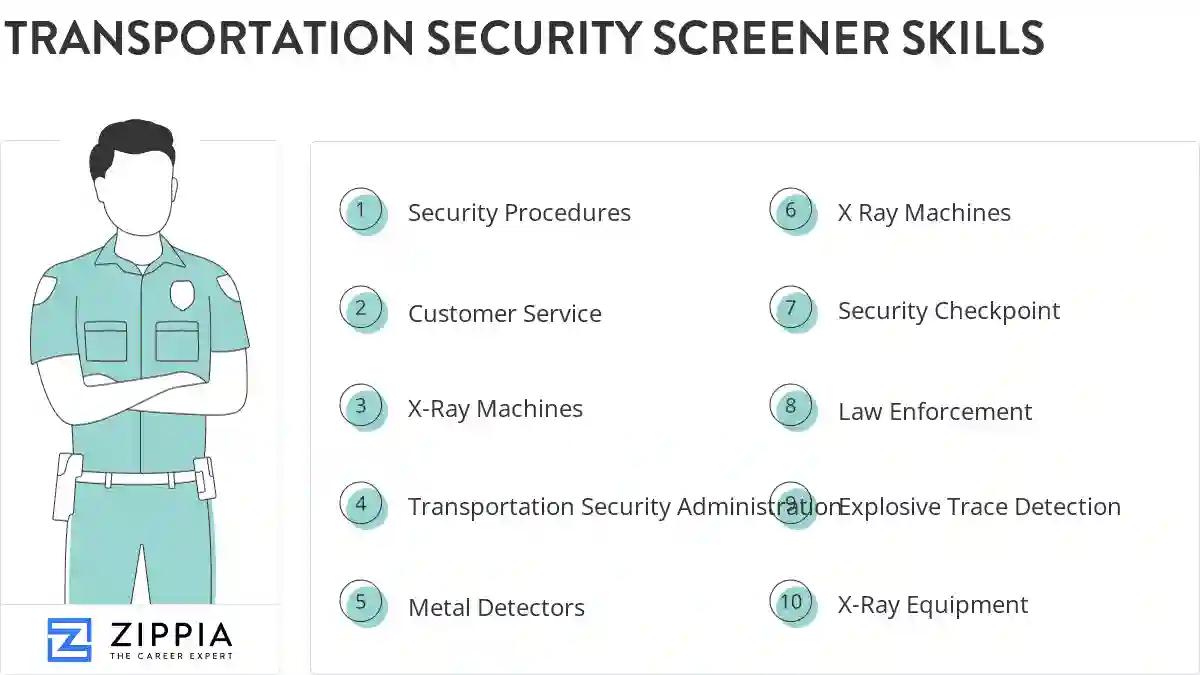
The most important skills for a transportation security screener resume and required skills for a transportation security screener to have include:
- Security Procedures
- Customer Service
- X-Ray Machines
- Transportation Security Administration
- Metal Detectors
- X Ray Machines
- Security Checkpoint
- Law Enforcement
- Explosive Trace Detection
- X-Ray Equipment
- Incident Reports
- ETD
- Detection System
- Hazardous Materials
- Front Line Security
- Routine Situations
- Equipment Maintenance
- Stressful Environment
- Appropriate Management
- Bag Searches
- Physical Searches
- Technical Training
- EDS
- FAA
- CTX
- Ticket Review
- Pat-Down Searches
- Two Way Radios
- Federal Guidelines
- Art Technology
- IED
Updated January 8, 2025
