Explore jobs
Find specific jobs
Explore careers
Explore professions
Best companies
Explore companies
Job outlook for underwriting managers in the United States
Are underwriting manager jobs in demand?
Underwriting manager job and salary trends over time
Underwriting manager jobs over time
Underwriting manager job growth rate over time
| Year | # of jobs | % of population |
|---|---|---|
| 2021 | 3,475 | 0.00% |
| 2020 | 3,347 | 0.00% |
| 2019 | 3,376 | 0.00% |
| 2018 | 3,169 | 0.00% |
| 2017 | 2,994 | 0.00% |
Average underwriting manager salary over time
Underwriting manager salary by year
| Year | Avg. salary | Hourly rate | % Change |
|---|---|---|---|
| 2026 | $77,426 | $37.22 | +3.3% |
| 2025 | $74,951 | $36.03 | +1.5% |
| 2024 | $73,855 | $35.51 | +2.3% |
| 2023 | $72,175 | $34.70 | +2.7% |
| 2022 | $70,254 | $33.78 | +3.2% |
Underwriting manager jobs by state
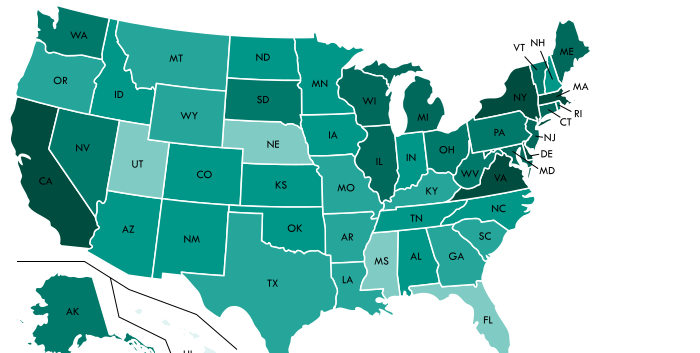
Most common states for underwriting managers
| Rank | State | Population | # of jobs | Employment/ 1000ppl |
|---|---|---|---|---|
| 1 | District of Columbia | 693,972 | 241 | 35% |
| 2 | Illinois | 12,802,023 | 1,379 | 11% |
| 3 | Massachusetts | 6,859,819 | 747 | 11% |
| 4 | Delaware | 961,939 | 105 | 11% |
| 5 | Washington | 7,405,743 | 715 | 10% |
| 6 | Arizona | 7,016,270 | 708 | 10% |
| 7 | Maryland | 6,052,177 | 597 | 10% |
| 8 | Colorado | 5,607,154 | 584 | 10% |
| 9 | Connecticut | 3,588,184 | 345 | 10% |
| 10 | Utah | 3,101,833 | 304 | 10% |
| 11 | New York | 19,849,399 | 1,699 | 9% |
| 12 | Pennsylvania | 12,805,537 | 1,092 | 9% |
| 13 | Georgia | 10,429,379 | 895 | 9% |
| 14 | New Jersey | 9,005,644 | 788 | 9% |
| 15 | Virginia | 8,470,020 | 783 | 9% |
| 16 | Minnesota | 5,576,606 | 509 | 9% |
| 17 | Oregon | 4,142,776 | 375 | 9% |
| 18 | Rhode Island | 1,059,639 | 93 | 9% |
| 19 | California | 39,536,653 | 3,227 | 8% |
| 20 | Ohio | 11,658,609 | 905 | 8% |
Most common cities for underwriting managers
| Rank | City | # of jobs | Employment/ 1000ppl | Avg. salary |
|---|---|---|---|---|
| 1 | Englewood | 1 | 3% | $77,131 |
| 2 | Scottsdale | 4 | 2% | $74,144 |
| 3 | East Hartford | 1 | 2% | $91,330 |
| 4 | Jeffersonville | 1 | 2% | $70,792 |
| 5 | Manassas | 1 | 2% | $98,070 |
| 6 | Minnetonka | 1 | 2% | $73,481 |
| 7 | Atlanta | 4 | 1% | $69,736 |
| 8 | Allentown | 1 | 1% | $85,000 |
| 9 | Dearborn | 1 | 1% | $87,124 |
| 10 | Frederick | 1 | 1% | $87,313 |
| 11 | Chicago | 5 | 0% | $91,687 |
| 12 | New York | 4 | 0% | $98,405 |
| 13 | Boston | 3 | 0% | $93,337 |
| 14 | Dallas | 3 | 0% | $71,310 |
| 15 | Los Angeles | 2 | 0% | $93,433 |
| 16 | Anaheim | 1 | 0% | $93,168 |
| 17 | Houston | 1 | 0% | $70,024 |
Underwriting Manager job outlook: Expert opinions
Our panel of underwriting manager experts
University of Georgia

Loyola University Maryland
South College

Red Rocks Community College
National Association of Health Underwriters
Robert Hoyt, Ph.D.
Department Head and Dudley L. Moore Jr. Chair of InsuranceUniversity of Georgia
Risk Management and Insurance Program
What's a day at work look like for an Underwriting Manager?
Robert Hoyt, Ph.D.: They are training for it now. Due to pandemic restrictions, they are taking classes in a hybrid environment with less face-to-face class time integrated with virtual interaction. Some of their classmates are restricted to their home countries and are joining virtually throughout the class. Group work in our courses is always important, but now they are having to working in teams through virtual platforms. This is how business will be done and it will be increasingly global given the convenience of engaging virtually without the cost of travel. In my opinion, the future work environment in insurance is going to look a lot like how we are educating students currently. However, thankfully, without the masks and with more opportunities for face-to-face socializing with clients and colleagues. As I note in more detail below, I think geographic limits will be much less important going forward due to the ability to be effective through virtual platforms and much more flexibility around where and when we work with be the norm.
What technical skills for an Underwriting Manager stand out to employers?
Robert Hoyt, Ph.D.: The ability to collect information, work with data, and translate this into insights and knowledge is key in insurance going forward. An important focus in our classes is helping students apply what they are learning to real business situations through projects that are often carried out in teams. The growth of digital strategies in insurance means that emerging graduates are excited by and embrace the use and application of such approaches. However, the ability to engage with people to assist them in managing their personal or business risks is what matters most in this business. At the end of the day, building relationships and trust are the key in insurance.
Dr. JP Krahel Ph.D.
Associate Professor of Accounting, Accounting Department ChairLoyola University Maryland
Accounting Department
What technical skills for an Underwriting Manager stand out to employers?
Dr. JP Krahel Ph.D.: First, Excel. It's the most basic, essential tool for the accounting professional. If you can come in on Day 1 knowing essential keyboard shortcuts, proper formula and reference use, and how to format a spreadsheet properly, you'll have an immediate advantage over your peers.
Second, believe it or not, is writing. People think that accounting is all about numbers, but really, it's less about the math (which Excel does for you) and more about being able to explain the deeper meaning behind the results. Can you explain complex depreciation methods to an audit client? Give bad news to a tax client in an understandable way? These are big deals.
Third is data analytics. Given the immense volume of data now available to firms, someone who can extract, clean, and present that data using modern software tools will have an edge. It's really another form of communication, and one that early-career accounting professionals would do well to familiarize themselves with before entering the workforce.
What Underwriting Manager skills would you recommend for someone trying to advance their career?
D. Pace Porter: I am not a big fan of an accounting graduate, or any graduate for that matter, taking a gap year, but I understand if one must due to family or other legitimate reasons. You are entering a profession, not just seeking a job, so enter that profession. The accounting profession, including accounting, audit and tax disciplines, constantly changes. Therefore, it would be critical to stay on top of those technical changes in a gap year. Studies have clearly demonstrated that it is best to take the CPA exam as soon after graduation or completion of sufficient academic hours as possible. You can stay current through readings of professional journals and other resources. Other skills to enhance would include the "soft skills" of communication, critical thinking and analysis, and creativity.
Janet Tarase
Lead Accounting Faculty / Accounting Department ChairRed Rocks Community College
Accounting Department
What are the biggest trends we'll see in the Underwriting Manager job market given the pandemic?
Janet Tarase: Even though over 7 million people are currently unemployed, employers still need individuals to maintain their operations. Human Resource departments are recruiting individuals through social media platforms. My daughter works in HR recruiting and they only use LinkedIn. Companies are using video or phone interviews to select candidates. Which means that potential candidates have to communicate effectively and make a good first impression quickly.
Employers will be looking for individuals that have proven communication, organizational and time management skills that are able to work independently since telecommuting will be continuing in the future. Applicants will also need to have technological and critical thinking skills to manage the challenges presented while working from home. Because of the pandemic and so many of us having to work from home, companies may broaden their recruiting geography to find the best candidates out of state or in different time zones. Finally, employees need to be flexible and resilient - you never know what the next job requirement will demand.
Max Wilson
National Association of Health Underwriters
What type of skills will young Underwriting Managers need?
Max Wilson: The ability to communicate with others is an essential skill that I have noticed many young adults have trouble with. Many of my peers have expressed difficulty when attempting to start a conversation with others. As an agent, communication is key. One thing I have noticed in the months that I shadowed an agent from Colonial was that many business owners do not realize how affordable some insurance policies can be. It's on my generation to be able to communicate these policies in effective ways.
Are there any particularly good places in the United States for Underwriting Managers to find work opportunities?
Max Wilson: Having exposure to the voluntary benefits side, I have noticed that there can be tremendous room for growth in a variety of densely populated areas such as Northern Alabama, or areas with large recent economic growth.
How do you envision technology impacting Underwriting Managers in the next 5 years?
Max Wilson: Technology will allow agents to expand their services over a variety of industries. With the development of cybersecurity and telematics, I think there is no limit to what could be insured. When these services become available, we need agents to step up to the plate and inform the consumers.