What does a validation specialist do?
A validation specialist participates in validation, calibration, and temperature mapping activities. You will perform various tasks that include measuring software or instrument performance, establishing and maintaining methods for controlling the manufacturing process, and developing efficient ways to analyze data and monitor product performance. As a validation specialist, you are responsible for developing and testing algorithms and performing failure analysis and software and hardware debugging. You are also expected to work closely with senior engineers to improve the quality assurance and development process.
Validation specialist responsibilities
Here are examples of responsibilities from real validation specialist resumes:
- Manage all cleaning validation schedule and coordinate activities with QA and/or external laboratories and operations.
- Perform cleaning validation for a bulk pharmaceutical blending facility and take part in GMP training of plant employees.
- Qualify sterile transfer skid equipment, transfer and clean-in-place (CIP) processes.
- Perform gap analysis of QC procedures and protocols for dissolution bath and washer machines.
- Generate URS, ICA, and IOQ documents used to qualify and validate equipment.
- Create and write procedures for validation, reliability, and returns departments for ISO certification.
- Review and approve all validation protocols to industry standards for both cGMP and ISO requirements.
- Develop and validate CIP systems for different stages of the manufacture of the active ingredient.
- Gain experience in high level hardware and software debugging using oscilloscopes, logic analyzers, and simulators.
- Develop URS, DQ, IQ, OQ and PQ protocols and discussion with clients on protocols and reports.
- Design and implement quality database systems that addressed GMP compliance to include monitoring, tracking and scheduling stability shelf life samples.
- Develop CSV documents for laboratory instruments.
- Develop CSV documents, incorporate revision comment, and documentation management.
- Perform temperature mapping of incubators, autoclaves, and stability chambers.
- Project include generation and execution of multiple IQ/OQ/PQ documentation and commissioning support activities.
Validation specialist skills and personality traits
We calculated that 7% of Validation Specialists are proficient in GMP, FDA, and IQ/OQ/PQ. They’re also known for soft skills such as Leadership skills, Problem-solving skills, and Time-management skills.
We break down the percentage of Validation Specialists that have these skills listed on their resume here:
- GMP, 7%
Involved in preparing GMP Assessments, 21CFR11 Assessments, and Risk Analysis, on seventeen PLC & PC based systems.
- FDA, 7%
Examined and documented pharmaceutical manufacturing lines for adherence to FDA guidelines; developed operating manuals for industrial manufacturing lines and machinery.
- IQ/OQ/PQ, 5%
Developed commissioning protocols and validation IQ/OQ/PQ protocols for fermentation and cell culture population.
- Iq Oq Pq, 5%
Execute IQ OQ PQ protocols and work with customer validation experts.
- Summary Reports, 4%
Developed commissioning and qualification documents such as Impact Assessments, User Requirements, Commissioning Protocols, Commissioning Checklists and Summary Reports.
- Laboratory Equipment, 4%
Reviewed and approved Computer Software Validation projects for laboratory equipment and automated systems; verified LIMS and CDAS systems.
"gmp," "fda," and "iq/oq/pq" are among the most common skills that validation specialists use at work. You can find even more validation specialist responsibilities below, including:
Leadership skills. To carry out their duties, the most important skill for a validation specialist to have is leadership skills. Their role and responsibilities require that "to keep the production process running smoothly, industrial production managers must motivate and direct employees." Validation specialists often use leadership skills in their day-to-day job, as shown by this real resume: "provide qa leadership and oversight for software and equipment validation and qualification activities for glp and gmp operations. "
Problem-solving skills. Another essential skill to perform validation specialist duties is problem-solving skills. Validation specialists responsibilities require that "production managers must identify and address problems that arise." Validation specialists also use problem-solving skills in their role according to a real resume snippet: "provided 21 cfr part 11 guidance on the implementation of iso train web 6 training management solution. "
The three companies that hire the most validation specialists are:
- Sanofi US12 validation specialists jobs
- AECOM9 validation specialists jobs
- Takeda Pharmaceuticals U.S.A., Inc.7 validation specialists jobs
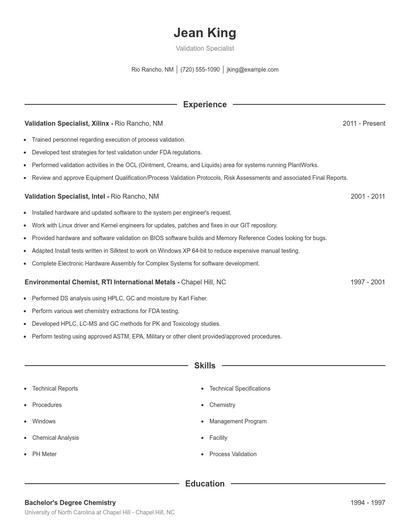
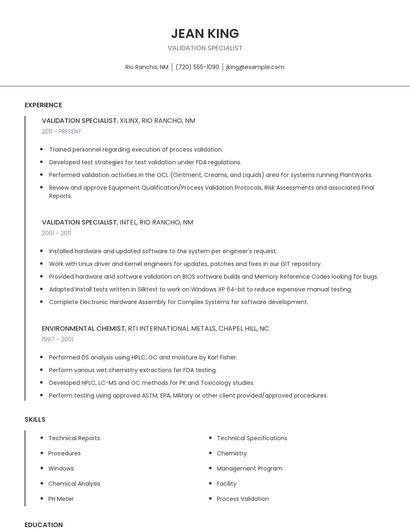
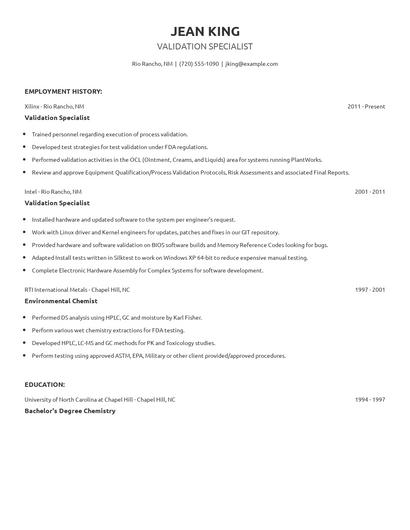
Choose from 10+ customizable validation specialist resume templates
Build a professional validation specialist resume in minutes. Our AI resume writing assistant will guide you through every step of the process, and you can choose from 10+ resume templates to create your validation specialist resume.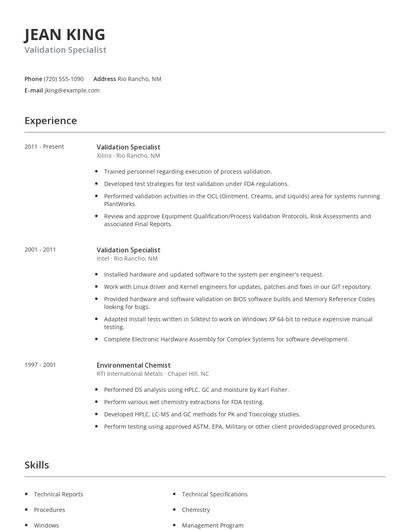
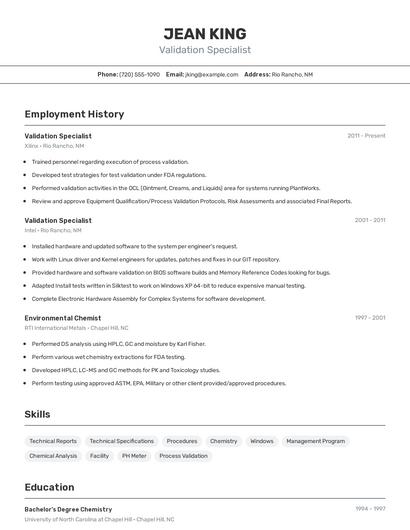


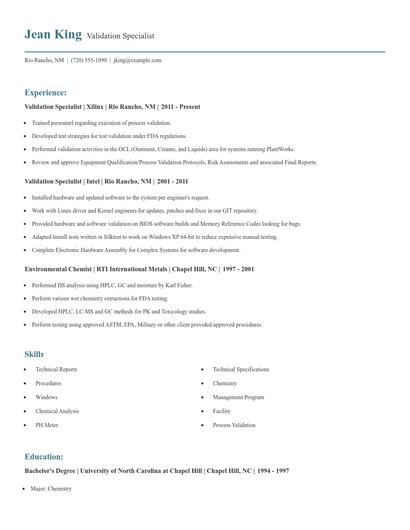
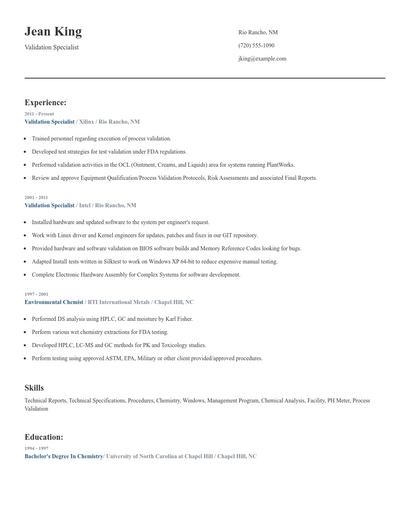
Compare different validation specialists
Validation specialist vs. Equipment validation engineer
In the manufacturing industry, a Senior Validation Engineer specializes in inspecting and developing tools, equipment, and procedures, ensuring they adhere to company standards. Their responsibilities typically involve understanding project requirements, performing installations and calibrations, troubleshooting problems, creating and implementing tests, and conducting extensive research and analyses. They must also maintain records of all transactions and procedures, organize and update databases, and prepare reports regularly. Moreover, as a Senior Validation Engineer, it is essential to lead and serve as a mentor to junior validation engineers, all while implementing the company's safety standards and regulations.
While similarities exist, there are also some differences between validation specialists and equipment validation engineer. For instance, validation specialist responsibilities require skills such as "gmp," "summary reports," "laboratory equipment," and "csv." Whereas a equipment validation engineer is skilled in "sops," "provides technical support," "quality system," and "gap analysis." This is part of what separates the two careers.
On average, equipment validation engineers reach similar levels of education than validation specialists. Equipment validation engineers are 1.9% more likely to earn a Master's Degree and 1.1% less likely to graduate with a Doctoral Degree.Validation specialist vs. Senior validation engineer
The pioneering person to manage, inspect, calibrate, test, and modify an operating system is referred to as a System Validation Engineer. Such a person does ensure all systems are running smoothly.
Each career also uses different skills, according to real validation specialist resumes. While validation specialist responsibilities can utilize skills like "laboratory equipment," "acceptance criteria," "validation process," and "validation studies," senior validation engineers use skills like "project management," "process validation," "sme," and "gamp."
Senior validation engineers may earn a higher salary than validation specialists, but senior validation engineers earn the most pay in the pharmaceutical industry with an average salary of $99,979. On the other hand, validation specialists receive higher pay in the manufacturing industry, where they earn an average salary of $92,762.In general, senior validation engineers achieve higher levels of education than validation specialists. They're 6.6% more likely to obtain a Master's Degree while being 1.1% more likely to earn a Doctoral Degree.Validation specialist vs. System validation engineer
A validation engineer is an individual responsible for managing, inspecting, testing, and modifying the instrumentation, equipment, mechanics, and procedures for the production of high-quality products. The professional's tasks include analyzing test results, preparing compliance reports, and keeping updated with industry standards and regulations. Validation engineers should possess core skills such as strong mathematical and information technology skills and the ability to resolve complex engineering problems. Possessing a bachelor's or master's degree in a relevant engineering discipline is an advantage to qualify for the position.
Some important key differences between the two careers include a few of the skills necessary to fulfill the responsibilities of each. Some examples from validation specialist resumes include skills like "summary reports," "laboratory equipment," "cleaning validation," and "computer system," whereas a system validation engineer is more likely to list skills in "python," "c #," "architecture," and "debug. "
System validation engineers make a very good living in the technology industry with an average annual salary of $94,689. On the other hand, validation specialists are paid the highest salary in the manufacturing industry, with average annual pay of $92,762.When it comes to education, system validation engineers tend to earn higher degree levels compared to validation specialists. In fact, they're 11.1% more likely to earn a Master's Degree, and 0.6% more likely to graduate with a Doctoral Degree.Validation specialist vs. Validation engineer
Types of validation specialist
Updated January 8, 2025
