
Automatically apply for jobs with Zippia
Upload your resume to get started.
Vocational trainer skills for your resume and career
15 vocational trainer skills for your resume and career
1. Developmental Disabilities
- Assist individuals with Developmental Disabilities within my caseload in developing and enhancing their skills to prepare them for employment.
- Provide vocational training and valuable employment skills to individuals with developmental disabilities so they may pursue their employment opportunities.
2. CPR
Cardiopulmonary resuscitation or CPR is a medical procedure that involves chest compression to help a patient breathe. This artificial ventilation helps in keeping the brain function in place and regulates blood throughout the body. CPR is a lifesaving procedure that is used in emergencies.
- Acquired fork lift operator certification as well as CPR and First Aid Certification.
- Provided CPR and 1st Aid training to prospective foster and adoptive parents and employees at the direction of the Program Manager.
3. Training Materials
- Improved operation of medical school simulations by streamlining training materials and developed a new training paradigm for highly skilled Standardized Patients.
- Develop training materials to effectively communicate, identify, and analyze problems to drive results towards meeting departmental needs.
4. Applied Behavior Analysis
- Provide support and structure to families/caretakers using Applied Behavior Analysis in a home based environment.
- Provided an applied behavior analysis (ABA) method of behavioral programming to instruct four autistic children, aged three to six
5. Direct Supervision
Direct supervision is a term used to indicate that a person is supervising a certain task or a certain person while being physically present or in close proximity. It refers to the presence of a person and the availability of their supervision in something if it is needed.
- Provide direct supervision to individuals residing in a group home setting in all facets of daily living on a substitute basis.
- Direct supervision of assigned individuals, ensuring their safety and knowing their history, status and location at all times.
6. Jigs
- Developed new products, jigs, fixtures, and production processes.
Choose from 10+ customizable vocational trainer resume templates
Build a professional vocational trainer resume in minutes. Our AI resume writing assistant will guide you through every step of the process, and you can choose from 10+ resume templates to create your vocational trainer resume.7. Direct Care
Direct care is the act of identifying people with special needs and offering the necessary care for them.
- Supervised a direct care vocationally geared day program for developmentally disabled adults.
- Direct care for the mentally challenged
8. Mental Illness
- Trained adults with mental illness and traumatic brain injury.
- Served adults experiencing cognitive disabilities and chronic mental illness within six different programs.
9. Physical Disabilities
- Help those with mental and physical disabilities learn job and life skills.
- Trained the clients with mental and physical disabilities how to become independent.
10. Independent Living
- Increased the vocational, social and independent living skills of students participating in job program at the center.
- Collaborated with student, parents, and school members on independent living skills and behavioral interventions
11. Competitive Employment
Competitive employment is a job that is performed on a full/ part-time basis in which entities are paid for their work, according to the job. However, the compensation must be at par or above the standard of the minimum wage. The cost of compensated benefits by the employer should be at the same level for similar work performed by abled people.
- Engaged clients and established trusting, collaborative relationships directed toward the goal of competitive employment in community setting.
- Developed networking relationships with numerous businesses and implemented programs for consumers who were ready to seek competitive employment.
12. Community Employment
- Provided support for students to obtain and maintain employment through teaching valuable readiness skills that facilitated their transition to community employment.
- Helped Program demonstrate necessary evidence to suggest that persons with severe disabilities can work in competitive community employment settings.
13. Data Collection
Data collection means to analyze and collect all the necessary information. It helps in carrying out research and in storing important and necessary information. The most important goal of data collection is to gather the information that is rich and accurate for statistical analysis.
- Complete written notes as assigned by supervisor including daily documentation and data collection for Individual Service and Behavioral Plans as necessary.
- Streamlined systems and processes for tracking and recording vocational activities, improving accuracy and timeliness of data collection and reporting.
14. Direct Support
Direct support is a one-on-one service that helps with daily life skills and tasks that strengthen one's independence. A direct support professional is responsible for a variety of tasks related to the general care of people with physical, cognitive, or developmental disabilities. The goal is to assist people to reach their full potential and to integrate and get engaged in their community.
- Provided direct support to people with disabilities out in the community.
- Provide direct support of the individuals in the home and during community activities.
15. Intellectual Disabilities
- Assisted patients diagnosed with Autism spectrum disorders, Down syndrome, intellectual disabilities, and articulation and phonological processing disorders.
- Provided quality training to residents with significant intellectual disabilities in achieving independence through acquisition of basic living skills.
5 Vocational Trainer resume examples
Build a professional vocational trainer resume in minutes. Browse through our resume examples to identify the best way to word your resume. Then choose from 5+ resume templates to create your vocational trainer resume.

What skills help Vocational Trainers find jobs?
Tell us what job you are looking for, we’ll show you what skills employers want.
List of vocational trainer skills to add to your resume
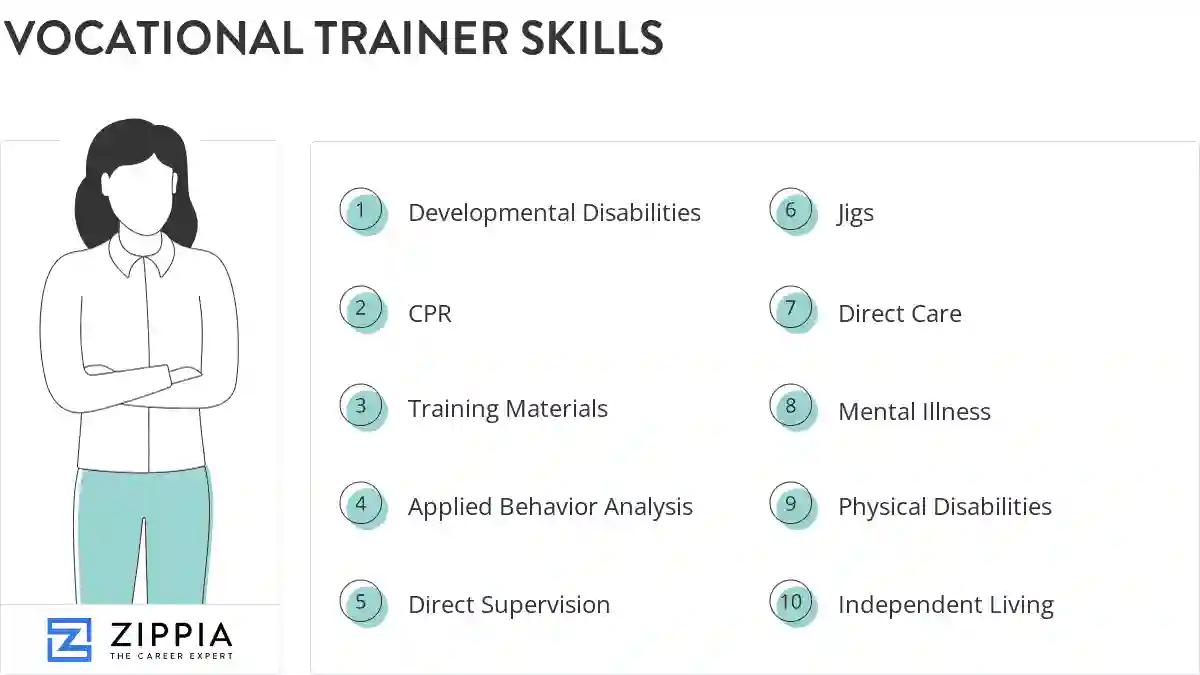
The most important skills for a vocational trainer resume and required skills for a vocational trainer to have include:
- Developmental Disabilities
- CPR
- Training Materials
- Applied Behavior Analysis
- Direct Supervision
- Jigs
- Direct Care
- Mental Illness
- Physical Disabilities
- Independent Living
- Competitive Employment
- Community Employment
- Data Collection
- Direct Support
- Intellectual Disabilities
- Vital Signs
- Behavior Modification
- Community Integration
- Community Resources
- PowerPoint
- Behavior Management
- Incident Reports
- Behavioral Issues
- Mental Disabilities
- Role Model
Updated January 8, 2025
