Find a Job You Really Want In
Hiring has surged as companies continue to bounce back in a dynamic job market. However, many employers still face challenges in attracting qualified applicants.
The past few years have transformed the landscape of work and reshaped what employees expect from their roles. More professionals than ever have experienced the benefits of remote work, realizing their productivity thrives in flexible environments.
During this time, many workers have also taken the opportunity to reassess their careers and prioritize what truly matters to them, leading to significant shifts in job expectations.
To better understand how these changes have influenced workers’ preferences, we surveyed 500 individuals from various industries across the United States to answer, “What do workers want (and expect) in a post-pandemic job market?”
The findings? Flexibility has transitioned from a preference to a critical requirement for many job seekers.
KEY FINDINGS AND FAST FACTS
- 76% of currently employed workers are either casually or actively exploring new job opportunities.
- 36% of respondents plan to stay in their current job for less than a year, with 16% aiming for a duration of under six months.
- The most sought-after job benefit is a “flexible work environment.”
- Following closely are health insurance (59%), remote work (58%), and retirement benefits (46%) as top priorities.
- Less than 15% of respondents view perks like free food, gym memberships, and charitable contributions as their most desired benefits.
- 58% of workers consider a long commute a deal breaker.
- Other significant deterrents include poor work-life balance (57%), an unpleasant office atmosphere (51%), and inflexible work arrangements (42%).
- 50% of workers identify remote work as their ideal work environment, surpassing all other options.
- 63% of job seekers are actively looking for remote or work-from-home roles, more than any other type.
- Most job seekers prioritize full-time positions after remote roles.
- Temporary, seasonal, and internship roles attract the least interest among applicants.
- 89% of respondents view the lack of remote work options as a deal breaker or a significant downside.
- The primary reason for not applying to a job is location, with 73% indicating this as a deterrent.
- Other common reasons include company reputation (55%), vague job descriptions (43%), and inadequate benefits (41%).
- 22% of workers will abandon applications if they are required to create an account or redirected to another site.
- Only 11% of workers stated that remote work availability is unimportant to them.
A Labor Force That’s “Open” To New Opportunities

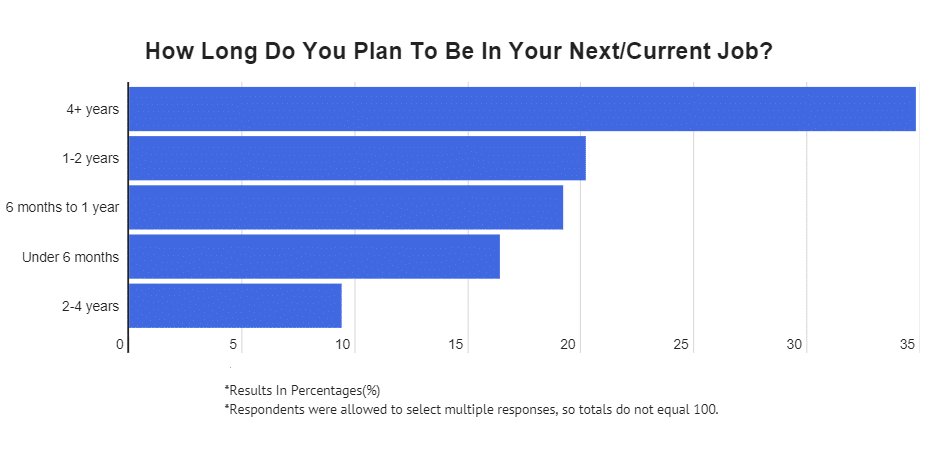
After a prolonged period of uncertainty, many workers are reevaluating their career paths and exploring new opportunities. A substantial 76% of employed individuals are at least “open” to job offers. Employers may be surprised to see loyal employees resigning or expecting counteroffers, indicating that most workers feel unbound by their current roles.
With 36% of respondents intending to remain in their jobs for under a year and 16% for less than six months, the job market is witnessing a significant shift.
Given the high cost of employee turnover, it raises the question: What can employers do to improve retention and attraction?
We will delve deeper into the wants and deterrents of job seekers below.
What Type Of Jobs Are Workers Looking For?
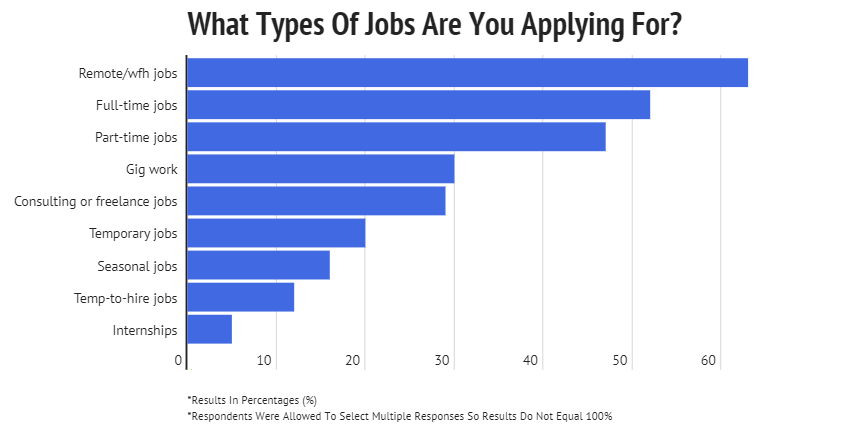
The recent shift towards remote work has heightened awareness of its advantages. For many, the flexibility of working from home and eliminating commutes makes these positions particularly appealing. Notably, 63% of job seekers are focused on remote work opportunities, surpassing all other job types.
Following remote positions, full-time jobs are the most sought after by workers.
With a wide array of job openings available, candidates now have the luxury of being selective about the positions they pursue. There is a noticeable reluctance to apply for temporary, seasonal, and internship roles, as applicants favor more stable job options.
Interestingly, gig work has gained traction, preferred by 30% of applicants compared to less than 20% for other temporary roles. This trend reflects a growing demand for workplace flexibility.
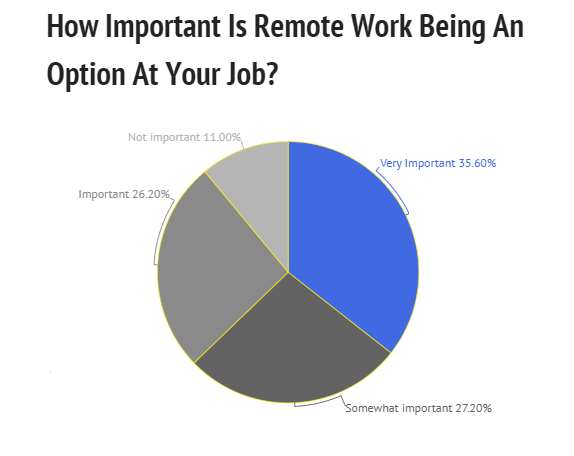
Only 11% of workers indicated that remote work availability is unimportant. In contrast, 89% view a lack of remote options as a deal breaker or a substantial drawback.
This means that employers who fail to adapt may find their candidate pool shrinking or may need to enhance their compensation and benefits to attract talent.
Job Hunting Turn-Offs
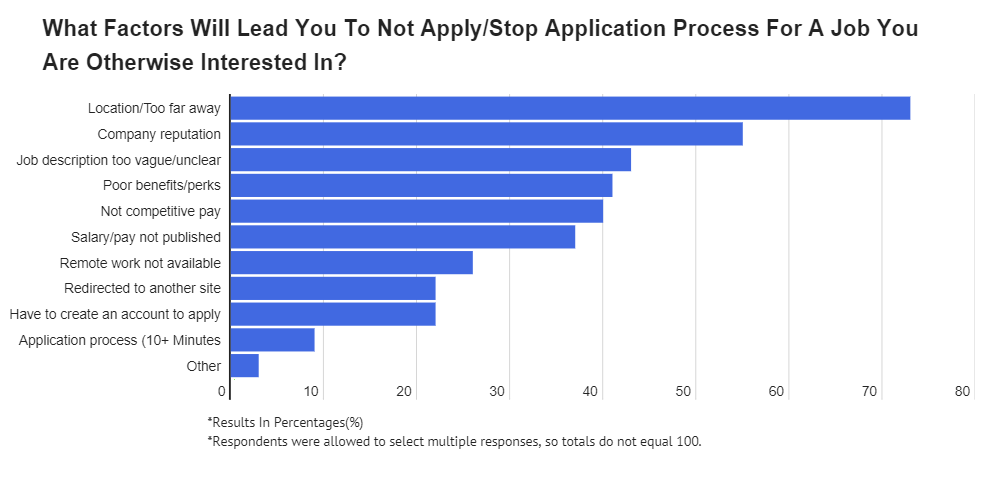
Many employers struggle to capture the attention of qualified candidates from the outset. The lack of enthusiasm among applicants can stem from both structural issues (the company and role) and cosmetic factors (the hiring process and job listing quality).
The most significant turn-off is job location, with 73% of respondents stating it has deterred them from applying. This is followed by company reputation (55%), vague job descriptions (43%), and insufficient benefits (41%).
While some companies may hesitate to offer fully remote work, adopting hybrid or flexible schedules to reduce commute times could widen their pool of applicants.
With an abundance of job opportunities, candidates are now prioritizing clear and informative job listings (including upfront salary ranges) and prefer not to jump through hoops or create accounts to apply.
In addition, we asked respondents about other job turn-offs not previously listed. Here are some of the most common responses:
Other Turn-Offs
- Job assessments
- Dress code/job environment
- Amount of PTO
- Poor schedule/lack of flexibility
- Company’s COVID-19 response
- Excessive responsibilities
- Being under or overqualified
MOST DESIRABLE Job BENEFITS, Deal Breakers, and Dream Office Environment
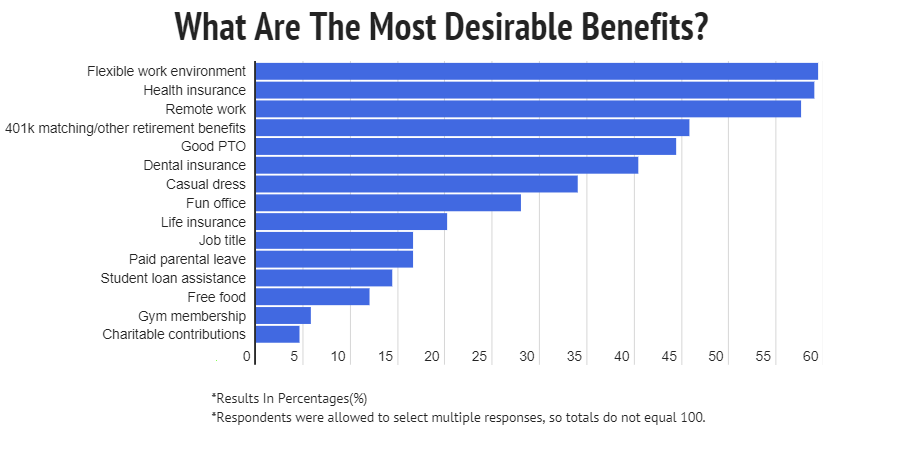
The demand for flexible work environments has surged since the pandemic’s onset, with 59.4% of respondents ranking “flexible work environment” as their top benefit, up from only 24% two years ago.
Following this are health insurance (59%), remote work (58%), and retirement benefits (46%) as highly desired offerings.
This increase in preference for flexibility does not diminish the importance of traditional benefits. Employers must provide comprehensive packages and innovative work arrangements to attract and retain skilled workers.
Interestingly, perks like free food, gym memberships, and charitable contributions are not highly valued, with under 15% of respondents considering them as their most desirable benefits.
This finding suggests that companies might be better off eliminating superficial perks in favor of offering employees more autonomy and flexibility.
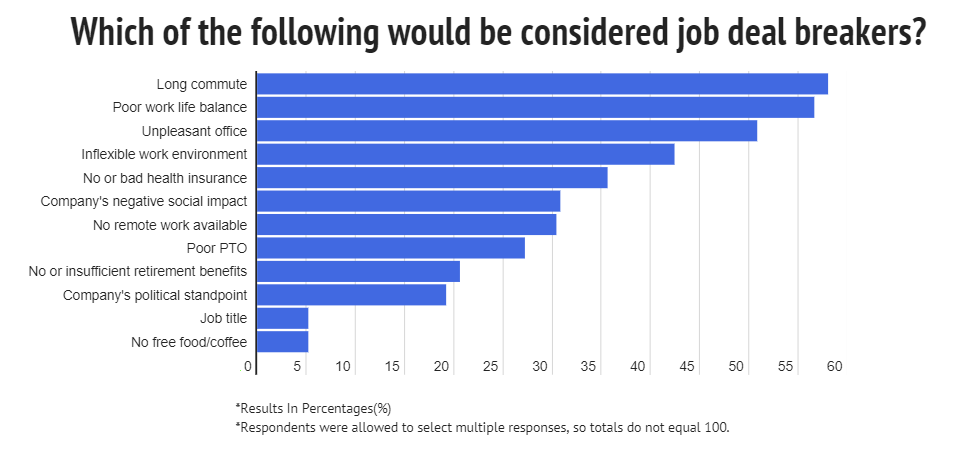
While attractive benefits can lure candidates, certain factors may prevent them from considering a job at all, regardless of how appealing the package may be.
The top deal breaker is a long commute, with 58% of workers citing this as a strong deterrent.
Following this are poor work-life balance (57%), unpleasant office atmosphere (51%), and inflexible work arrangements (42%) as reasons candidates would reject a job or not apply initially.
Conversely, factors such as a company’s political stance, job title, and availability of free food or coffee are less significant for candidates.
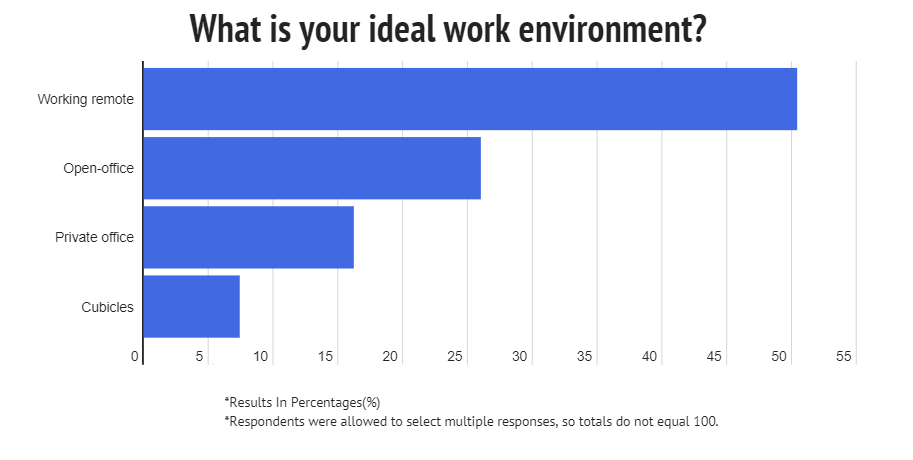
Half of the workers surveyed express that remote work is their ideal environment, more than any other choice. The second most popular option is open office spaces, selected by only 26% of respondents.
In contrast, cubicles are the least favored environment. Although traditional cubicles often outperform open offices in direct comparisons, when given a broader range of choices, remote work is preferred. This suggests that most individuals value privacy and the ability to customize their work environment.
METHODOLOGY
The data presented in this report were collected through an online survey commissioned by Zippia. We surveyed 500 American job seekers to uncover current expectations and desires in the job market.
Respondents were recruited through ClickWorker, and the survey was hosted on their platform. Each participant answered a standardized set of questions regarding their job-hunting behaviors and preferences.
SUMMARY
The pandemic has accelerated the shift towards remote work. Our survey highlights a clear increase in demand for flexible work setups.
In a competitive job market where hiring demand remains high, with 76% of employed workers open to new opportunities, companies must adapt their policies and benefits to attract and retain top talent.
With 50% of workers identifying remote work as their ideal setting and an impressive 59.4% seeking flexible work environments, it’s evident that traditional office structures must evolve. Deal breakers such as long commutes, poor work-life balance, and inflexible arrangements underscore the need for a shift toward more adaptable work environments.
While the desire for conventional benefits has not diminished, the message is clear: the future workspace is flexible. Organizations that fail to embrace this change may struggle with recruitment and retention in the years to come.

Author

Kathy is the head of content at Zippia with a knack for engaging audiences. Prior to joining Zippia, Kathy worked at Gateway Blend growing audiences across diverse brands. She graduated from Troy University with a degree in Social Science Education.