Find a Job You Really Want In
Expedia has transformed the way we travel by providing an extensive range of discounted travel options through its user-friendly website. Customers can effortlessly compare prices, discover deals, and book their hotel and airline reservations—all at no cost. This raises a common question: How does Expedia generate revenue?
In this article, you’ll gain insights into Expedia’s business model and revenue streams.
Key Takeaways
-
Travelers can book airline tickets, hotel accommodations, car rentals, cruises, vacation packages, and more via Expedia.
-
Expedia’s revenue primarily comes from commission fees and the purchase of discounted hotel bookings, which are then sold at a markup.
-
Customers may incur additional fees during their travels, contributing to Expedia’s earnings.

What is Expedia?
Founded in 1996, Expedia is an online travel agency that revolutionized an industry that was once labor-intensive and inefficient. By digitizing the booking and search processes, Expedia made it significantly easier for users to find and reserve hotels while exploring various travel options.
Initially a subsidiary of Microsoft, Expedia went public in 2001 after achieving considerable success. The company is headquartered in Bellevue, WA, across Lake Washington from Seattle, home to Microsoft.
What Can You Book Through Expedia?
Expedia’s intuitive web interface allows users to manage various aspects of their travel plans. This comprehensive approach has contributed to its popularity. The services available for booking through Expedia include:
-
Airline tickets
-
Hotel accommodations
-
Car rentals
-
Cruises
-
Vacation packages
-
Other travel-related services typically associated with traditional travel agents
How Does Expedia Generate Revenue?
-
Hotel Bookings
The primary source of Expedia’s revenue comes from hotel bookings, which accounts for approximately 70% of its total revenue. The company employs a supply and demand strategy to maximize profitability. By purchasing a substantial number of hotel rooms at discounted rates, Expedia can advertise these bookings as the best available prices online.
For instance, Expedia may negotiate to acquire a block of rooms at a discounted rate from a hotel on a remote Caribbean island, purchasing, say, 100 rooms at a bulk rate. They then bundle these accommodations with plane tickets, often at standard prices, and present the package to travelers at a competitive price, ensuring both customer satisfaction and profitability.
-
Commission Fees
Expedia also earns revenue through commission fees. By positioning itself as a provider of lower prices than hotels, Expedia attracts more bookings. Hoteliers are inclined to partner with Expedia, as receiving some revenue is preferable to having unoccupied rooms. The typical commission fee ranges from 20% to 25%.
For example, if a hotel sells a room to Expedia for $100, Expedia would collect the full amount and pay the hotel $75, retaining the $25 for operational costs, which includes customer service and marketing.
Are There Hidden Fees?
Expedia does generate additional revenue through fees that are not immediately apparent but are disclosed in the booking process. Since Expedia does not charge users a booking fee upfront, these additional charges can include:
-
Cancellation fees for bookings canceled more than 24 hours after confirmation
-
Overweight baggage fees for certain airlines
-
Wi-Fi charges at select hotels
-
Fees for excursions outside resort areas
-
Parking fees at specific venues
-
Meal costs at hotels
-
Charges for amenities such as spas, gyms, and pools
How Does Expedia Gather Data?
Expedia does not rely on a team of employees to manually search for hotels and negotiate room rates. Instead, the company employs a third-party sourcing organization, leveraging a model known as “Merchant Inventory.” Local contractors, who act as the company’s on-the-ground representatives, collect essential data about hotels in various regions.
Additionally, Expedia utilizes Global Distribution Systems (GDS) like Sabre, Amadeus, and Galileo to organize and access information, enhancing their database management capabilities.
What is Expedia’s Annual Revenue?
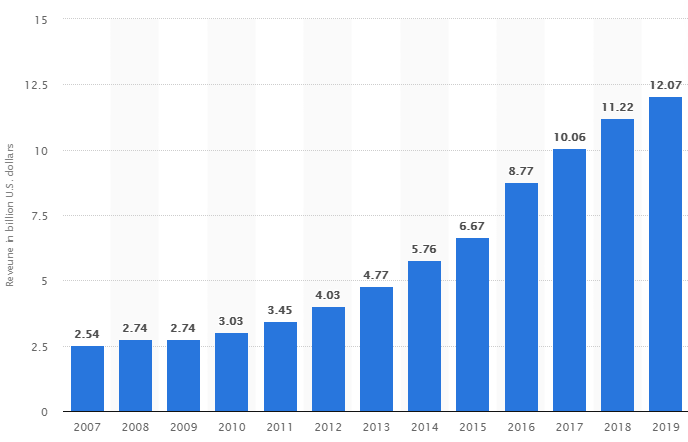
Expedia has demonstrated strong financial performance and continues to capitalize on lucrative acquisitions of competing companies, further solidifying its market position. The following graph illustrates the company’s impressive revenue growth year over year:
Who Are Expedia’s Main Competitors?
While some of its perceived competitors, such as Orbitz, HomeAway, Hotwire.com, and Travelocity, are part of the Expedia Group, the company still faces substantial competition from external sources. Its primary rivals include:
-
Hotels.com
-
Airbnb
-
Booking Holdings
-
Sabre
-
TripAdvisor
-
Booking.com
-
Carlson Wagonlit Travel
-
The Trip.com Group
-
Google
How Do Hotels Receive Payments from Expedia?
Hotels do not face coercion from Expedia, but the company’s significant market share makes it difficult for them to operate without it. Hotels trust that Expedia will help fill rooms that would otherwise remain vacant, particularly at discounted rates. For this service, Expedia retains a portion of the booking fee, typically allowing hotels to receive 75%-80% of the sale price.
Tour guides and activity providers in popular destinations can also list their services on Expedia. They must go through an application process to ensure their credibility and safety, after which they can be included in the platform’s offerings. To receive payment, these providers submit invoices to Expedia for tours booked successfully.
Expedia FAQ
-
What percentage does Expedia take?
Expedia typically takes 10-30% of the booking price as a commission. The hotel or host then retains the remaining 70-90%. It’s worth noting that Expedia generally receives the commission only after guests have completed their stay.
-
Who is Expedia’s biggest competitor?
Expedia’s primary competitor is Hotels.com, based on web traffic. Additionally, it competes with Airbnb, TripAdvisor, Booking Holdings, and Booking.com, among others.
-
Does Expedia own Airbnb?
No, Expedia does not own Airbnb. However, it does own VRBO, which serves as a direct competitor to Airbnb.

Author

Amanda Postma is a writer for the Zippia Career Advice blog with a focus on creating entertaining content to help you through your job search. She received her BA from the University Of Missouri-Columbia.