- Glossary
- What Is Gross Monthly Income?
- What Is Management?
- What Is A Problem Statement?
- What Is Annual Net Income?
- What Is A Letter Of Transmittal?
- What Is Attrition?
- What Does White Collar Mean?
- What Does Blue Collar Mean?
- What Is Efficiency Vs Effectiveness?
- What Is A Dislocated Worker?
- What Is Human Resource (HR)?
- Thank You Letter Scholarships
- What Is Constructive Criticism?
- What Is A Quarter Life Crisis?
- What Is Imposter Syndrome?
- What Is Notes Payable?
- Types Of Communication
- Economic Demand
- Cost Benefit Analysis
- Collective Bargaining
- Key Performance Indicators
- What Is Gender Bias In A Job Description?
- What Is The Hidden Job Market?
- What Is The Difference Between A Job Vs. A Career?
- What Is A Prorated Salary?
- W9 Vs. 1099
- Double Declining Balance Method
- Divergent Vs Convergent Thinking
- Budgeting Process
- Types Of Intelligence
- What Is Bargaining Power?
- What Is Operating Capital?
- Difference Between Margin Vs Markup
- Participative Leadership
- Autocratic Leadership
- Authoratarian Leadership
- Situational Leadership
- Difference Between Generalist Vs Specialist
- Strategic Leadership
- Competitive Strategies
- Equity Vs Equality
- What Is Marginalization?
- Colleague Vs Coworker
- What Is The Glass Ceiling?
- What Are Guilty Pleasures?
- Emotion Wheel
- Nepotism In The Workplace
- Sustainable Competitive Advantage
- Organizational Development
- Pay For Performance
- Communication Styles
- Contingent Workers
- Passive Vs Non Passive Income
Find a Job You Really Want In
The economy is a complex system made up of interconnected layers that influence various factors critical to its overall health. These interconnected elements, much like layers in a film, highlight the diverse components that shape economic dynamics. Understanding these factors is crucial, especially in today’s rapidly evolving labor market where technology, consumer behavior, and global events continue to reshape economic landscapes.
When we observe high levels of consumer and business spending, we describe the economy as thriving. Conversely, when spending declines, it indicates economic distress.
Demand is a fundamental factor in this equation, playing a key role in understanding economic fluctuations. Therefore, grasping the concept of demand is essential for navigating the complexities of the modern economy effectively.
What Is Economic Demand?
Economic demand represents the willingness and ability of consumers to purchase a specific quantity of a good or service at a given price. It can also be viewed as the consumers’ readiness to pay for goods or services available in the market.
Demand is a driving force behind economic activity. Businesses thrive on consumer demand; without it, they struggle to survive. Hence, understanding demand is vital for businesses, and by extension, for employees who must align their roles with market needs. This is particularly relevant in fields such as market research and sales, where success hinges on accurately gauging client and customer demands.
Understanding demand is rooted in comprehending consumer behavior, which is influenced by a mix of internal desires and external market conditions. These influences are known as the determinants of demand.
What Are The Determinants of Demand?
Determinants of demand are the various factors that consumers evaluate, consciously or unconsciously, when deciding whether to purchase a good or service. These factors may pertain to their willingness or ability to pay.
When discussing determinants, we often reference the term “ceteris paribus,” meaning “all other things being equal.” This acknowledges that while each determinant influences demand, they also interact with one another.
We can consider several key determinants of demand:
-
Price. Price remains the primary consideration for economists and businesses. According to the Law of Demand, as prices increase, the quantity demanded typically decreases. This principle drives companies to optimize pricing strategies that maximize profit while maintaining consumer interest.
-
Price of related or competitive goods/services. The demand for a product can be significantly influenced by the prices of related or competing goods. A price drop from a competitor can shift consumer demand away from your product.
-
Income. Generally, as consumer incomes rise, the demand for goods increases. However, it’s important to consider the concept of marginal utility, which suggests that the additional satisfaction derived from consuming more of a product diminishes over time.
-
Tastes and preferences. Consumer preferences are shaped by various factors, including cultural trends and personal values. Businesses must adapt to these changing preferences, such as increasing demand for sustainable and eco-friendly products.
-
Expectations. Consumers often base their purchasing decisions on anticipated future market conditions. For instance, if they expect prices to rise, they may choose to buy more now, particularly for limited-supply items like concert tickets.
-
Number of competitive consumers. An increase in the number of consumers vying for a product can elevate demand as consumers may be willing to pay more to outbid others.
What Are the Types of Demand?
Demand can be categorized to better understand its relationship with goods and services. Key types of demand include:
-
Effective demand. This is the actual willingness and ability of consumers to purchase goods at various prices. Monitoring effective demand provides insights into the economy’s health.
-
Derived demand. This type of demand arises from the need for goods or services that are essential for producing final products. For example, a surge in demand for cars translates to increased demand for steel and other raw materials.
-
Composite demand. Composite demand occurs when a single product has multiple uses. The overall demand for that product reflects the sum of its various applications. Plastic serves as a prime example, as its demand varies based on its diverse uses across industries.
-
Joint demand. This refers to the interdependent demand for complementary goods. When demand for one item rises, it typically boosts demand for related goods, such as ketchup alongside french fries.
Demand Schedule and Demand Curve
Understanding the determinants and types of demand allows businesses to organize their strategies effectively. Demand arises from specific consumer needs and wants, particularly influenced by price and quantity demanded.
The Law of Demand indicates that, all else being equal, higher prices lead to lower quantities demanded. A demand schedule can illustrate these changes by tracking prices against quantities demanded.
For instance, imagine a business that sells apples by the pound. As prices increase, the quantity demanded by customers typically decreases. The demand schedule might look like this:
| Price/lb for Apples | Quantity of Apples |
|---|---|
| $0.25 | 20 |
| $1.00 | 10 |
| $3.00 | 5 |
| $5.00 | 3 |
| $7.00 | 1 |
Economists often represent demand schedules graphically with a demand curve, which visually depicts how demand changes with price fluctuations.
In our apple business scenario, the demand curve would resemble the following:
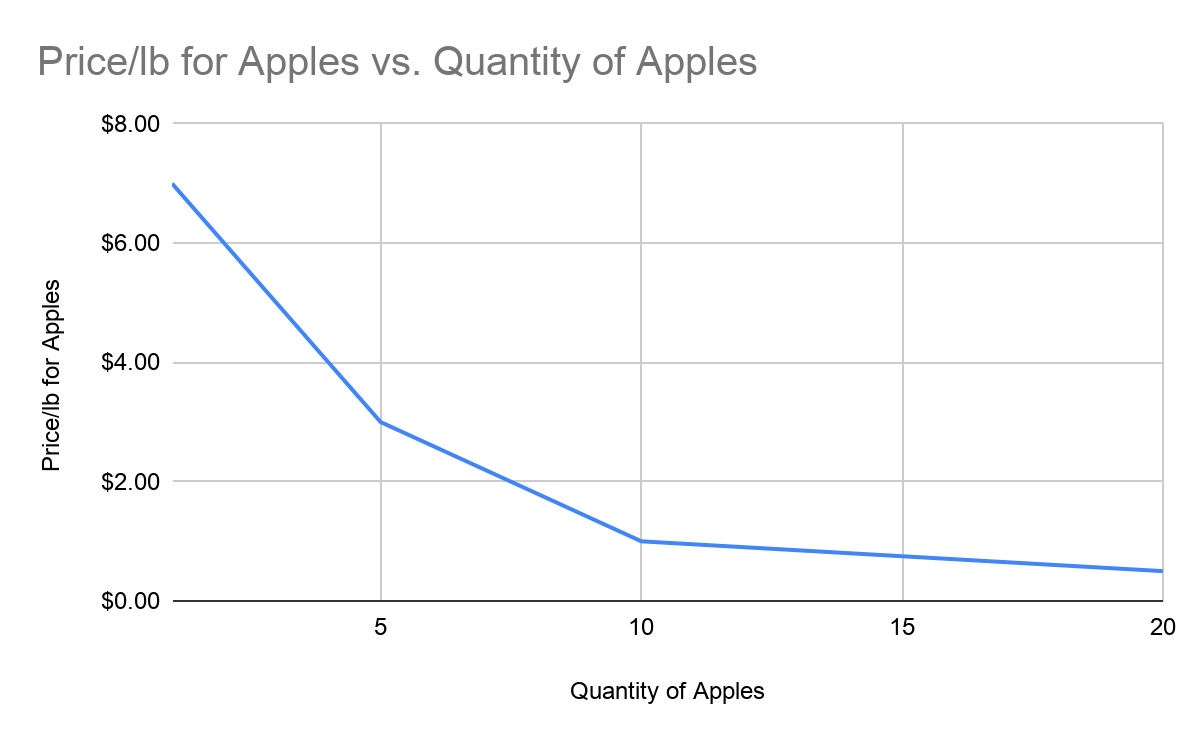
In economic graphs, price is plotted on the y-axis. Observing the graph, we note that significant price increases lead to noticeable declines in quantity demanded, indicating that the demand for apples is elastic.
Price elasticity refers to the sensitivity of demand to price changes. A highly elastic demand implies that even minor price adjustments can significantly influence the quantity demanded.
Changes in other demand determinants can shift the demand curve, necessitating the drawing of a new curve. For instance, a decline in consumer income would shift the demand curve leftward, indicating a decrease in quantity demanded at all price levels.
Supply and Demand Curves
Demand interacts closely with supply, another critical economic component.
Supply represents the total quantity of a good or service that businesses are prepared to produce. The relationship between supply and demand is fundamental to understanding market dynamics. The intersection of supply and demand determines the market price for a given product or service.
Typically, the demand curve and supply curve exhibit an inverse relationship: as the price of a good rises, the quantity demanded decreases, while the quantity supplied tends to increase.
Businesses aim to maximize profits by producing and selling at optimal prices. This often results in discrepancies along both curves. For example, at a low price, consumers may demand a high quantity, but producers may supply only a small amount due to low profitability.
Returning to our apple example, if we assume that supply inversely mirrors demand at the same price, the combined supply and demand curves could be illustrated as follows:
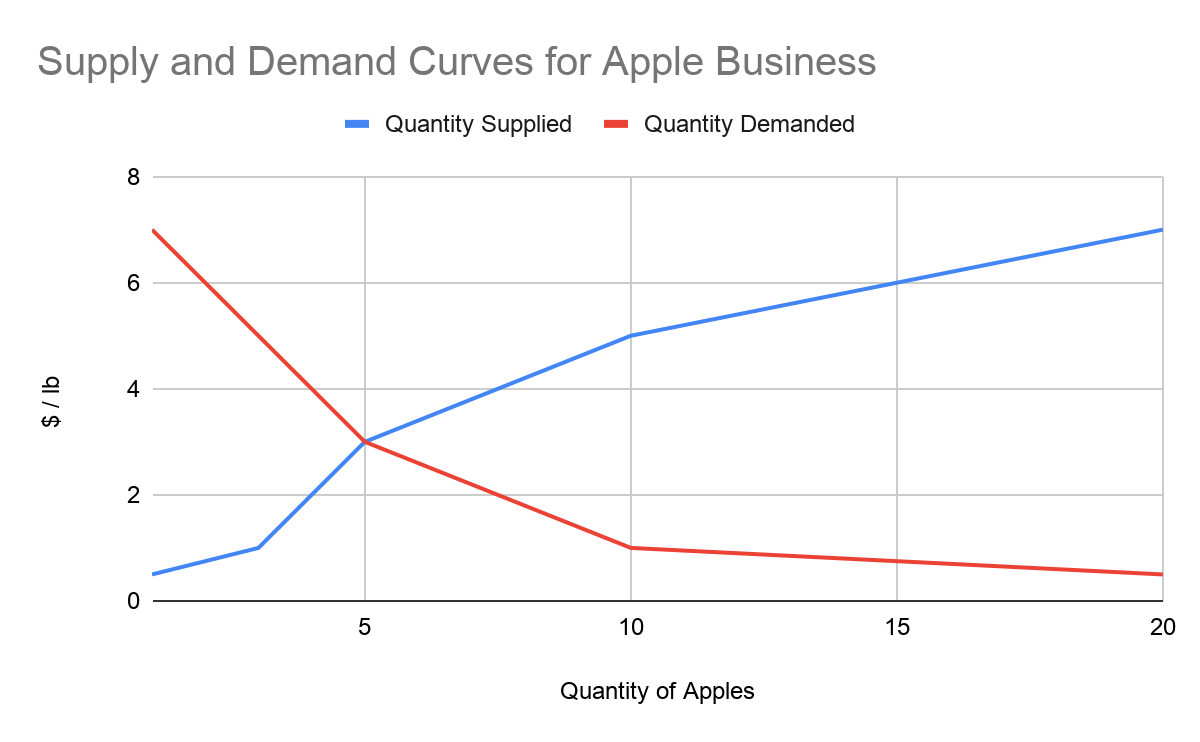
At a price of $3.00/lb, the quantity demanded equals the quantity supplied, reaching a state known as market equilibrium. This equilibrium point signifies the most efficient market condition where consumer demand aligns with producer supply at an acceptable price for both parties.
Prices above equilibrium create a surplus, where supply exceeds demand. Conversely, prices below equilibrium lead to a shortage, where demand outstrips supply. Both surpluses and shortages indicate potential market inefficiencies.
Why Is Understanding Demand Important?
For employees in profit-driven organizations, meeting consumer demand sustainably is crucial. Businesses must price their products at equilibrium to operate effectively while satisfying consumer needs.
Your specific role, whether as an accountant or in marketing, will influence your focus on different demand determinants to ensure profitability and consumer engagement.
Final Thoughts
Consumer demand is a critical force in the economy that cannot be overlooked. A solid understanding of demand dynamics helps businesses avoid pitfalls like surpluses and shortages, which can have cascading negative effects.
To successfully offer competitive goods or services in today’s market, continuous monitoring of demand is essential.
- Glossary
- What Is Gross Monthly Income?
- What Is Management?
- What Is A Problem Statement?
- What Is Annual Net Income?
- What Is A Letter Of Transmittal?
- What Is Attrition?
- What Does White Collar Mean?
- What Does Blue Collar Mean?
- What Is Efficiency Vs Effectiveness?
- What Is A Dislocated Worker?
- What Is Human Resource (HR)?
- Thank You Letter Scholarships
- What Is Constructive Criticism?
- What Is A Quarter Life Crisis?
- What Is Imposter Syndrome?
- What Is Notes Payable?
- Types Of Communication
- Economic Demand
- Cost Benefit Analysis
- Collective Bargaining
- Key Performance Indicators
- What Is Gender Bias In A Job Description?
- What Is The Hidden Job Market?
- What Is The Difference Between A Job Vs. A Career?
- What Is A Prorated Salary?
- W9 Vs. 1099
- Double Declining Balance Method
- Divergent Vs Convergent Thinking
- Budgeting Process
- Types Of Intelligence
- What Is Bargaining Power?
- What Is Operating Capital?
- Difference Between Margin Vs Markup
- Participative Leadership
- Autocratic Leadership
- Authoratarian Leadership
- Situational Leadership
- Difference Between Generalist Vs Specialist
- Strategic Leadership
- Competitive Strategies
- Equity Vs Equality
- What Is Marginalization?
- Colleague Vs Coworker
- What Is The Glass Ceiling?
- What Are Guilty Pleasures?
- Emotion Wheel
- Nepotism In The Workplace
- Sustainable Competitive Advantage
- Organizational Development
- Pay For Performance
- Communication Styles
- Contingent Workers
- Passive Vs Non Passive Income

Author

Conor McMahon is a writer for Zippia, with previous experience in the nonprofit, customer service and technical support industries. He has a degree in Music Industry from Northeastern University and in his free time he plays guitar with his friends. Conor enjoys creative writing between his work doing professional content creation and technical documentation.