- Job Seeker Statistics
- Career Change statistics
- Internship Statistics
- Job Search Statistics
- Average Number Of Jobs Applied
- Average Salary Increase When Changing Jobs
- Part Time Job Statistics
- Age Discrimination Statistics
- Networking Statistics
- Interview Statistics
- Average Number of Jobs In A Lifetime
- Resume Statistics
- Side Hustle Statistics
- Teacher Statistics
20+ Essential Part-Time Job Statistics [2026]: Who Works Part-Time And Why?
Research Summary: Part-time workers are a significant segment of the U.S. labor market, essential for various industries, especially those reliant on seasonal staffing. Here are key statistics about this workforce:
-
As of January 2026, there are approximately 27.52 million part-time workers in the U.S.
-
63% of part-time workers are women.
-
Part-time workers represent about 17% of the employed U.S. workforce as of 2023.
-
The primary motivation for individuals to work part-time is to attend school or participate in training programs.
For further insights, we have segmented the data into various categories:
Working Part-time | Trends and Projections | Industry | Employee | Work Demographics
General Part-Time Job Statistics
-
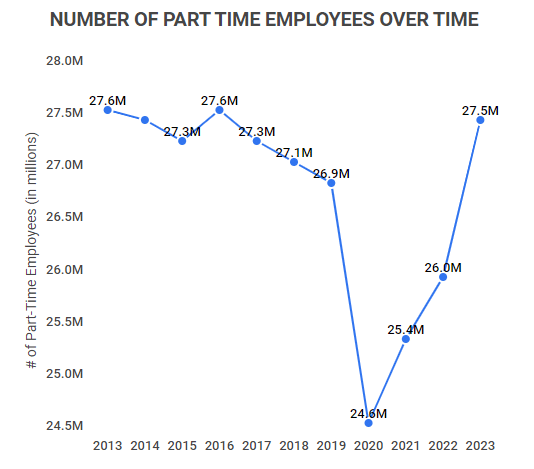
In 2023, approximately 24.61 million people were employed part-time in the U.S.
This figure shows a decrease from 26.94 million part-time workers in 2019, with a significant drop noted in 2020 and 2021, likely influenced by shifting employment trends, economic factors, and changes in workforce demands.
-
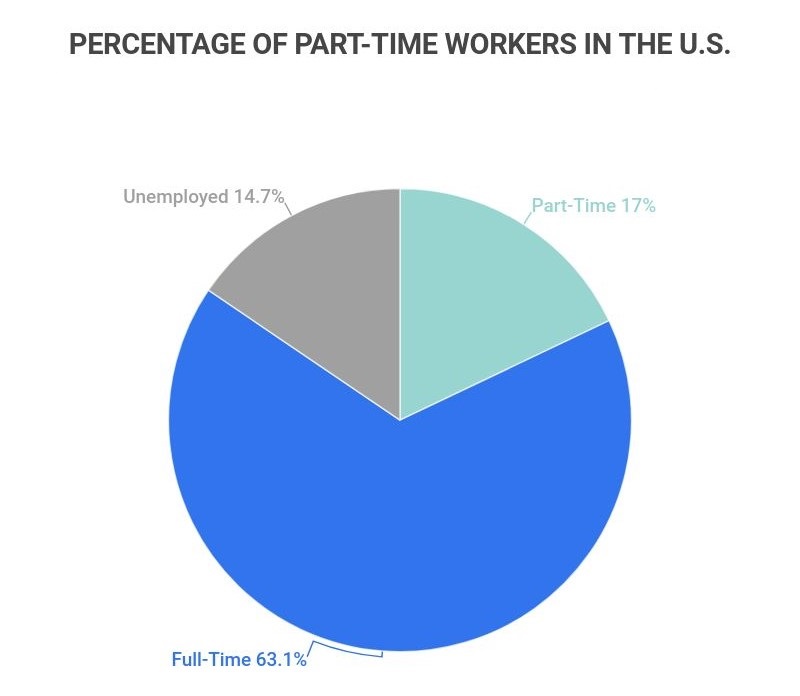
About 17% of the employed U.S. workforce works part-time.
Currently, there are around 132.34 million full-time workers and 27.52 million part-time workers in the U.S.
Among the unemployed, 10.22 million are seeking full-time work, while 2.73 million are looking for part-time positions.
-
The Netherlands boasts a part-time employment rate of 51%.
This is among the highest globally, with Switzerland following at 27%.
Percent of Population That Works Part-Time by Country
| Country | % Of The Population That Works Part-Time |
|---|---|
| Netherlands | 51 |
| Switzerland | 27 |
| Israel | 26 |
| Australia | 25 |
| United Kingdom | 23 |
| Ireland | 23 |
| Germany | 22 |
| Japan | 22 |
| Austria | 21 |
| New Zealand | 21 |
| Denmark | 20 |
| Canada | 19 |
| United States | 17 |
Reasons for Working Part-Time
-
More than 75% of part-time workers prefer this arrangement for non-economic reasons.
This indicates that many part-time employees are not constrained by the job market but are making conscious choices to work fewer hours. These individuals are often referred to as “voluntary” part-time workers, although some may face obligations that limit their availability.
-
The leading reason for voluntary part-time work is attending school or training programs.
In recent years, educational commitments have become a primary factor for many opting for part-time roles.
Other reasons include family obligations, health issues, and the necessity of flexible hours to accommodate personal responsibilities.
-
28% of female part-time workers cite family and personal commitments as their primary reason for part-time work.
In contrast, only 7% of male part-time workers indicate similar reasons.

Part-Time Work Trends and Projections
-
The number of part-time workers in the U.S. rose from 20.13 million in 1990 to 26.05 million in 2022.
This figure peaked at 27.68 million in 2016 before trending downward, reflecting broader economic shifts and workforce dynamics.
-
The number of part-time workers in the U.S. increased from 25.87 million in January 2022 to 27.52 million in January 2023.
This fluctuation reflects seasonal employment trends, with numbers peaking during certain months due to increased hiring in various sectors.
Part-Time Industry Statistics
-
The education and health services sector employs the highest number of part-time workers at approximately 8,104,000.
This is followed by wholesale and retail trade with 5,072,000 and leisure and hospitality with 4,845,000 part-time employees.
-
46% of employees in the leisure and hospitality sector work part-time.
This is the highest percentage across all industries, with self-employed workers following closely behind at 42%.
-
The education and health services industry has the largest number of involuntary part-time workers, totaling about 1.26 million.
These workers desire full-time hours but face challenges in securing such positions, often due to economic conditions or seasonal demands.
Part-Time Employee Statistics
-
The median weekly earnings of part-time workers stood at $340 as of 2022.
This reflects an increase from $317 in 2021 and includes both hourly and salaried part-time employees aged 16 and over.
-
Approximately 79% of companies offer health insurance benefits to part-time employees.
This trend is on the rise as employers recognize the importance of retaining part-time talent by providing competitive benefits.
-
Married women are the most likely demographic to work part-time voluntarily.
They represent 16.7% of prime-age voluntary part-time workers, compared to only 2.3% of married men.
Part-Time Work Demographics
-
Women constitute 63% of part-time workers.
This contrasts with their representation in full-time roles, where they make up 43.6% of the workforce.
-
Individuals aged 20 to 24 hold approximately 17% of part-time positions.
They are closely followed by the 16 to 19 and 55 to 64 age groups, each holding just under 15% of part-time roles.
-
Over 80% of 16 to 17-year-olds opt for part-time work.
This demographic is followed by 52% of those aged 18 to 19 and about 35% of workers aged 65 and over.
-
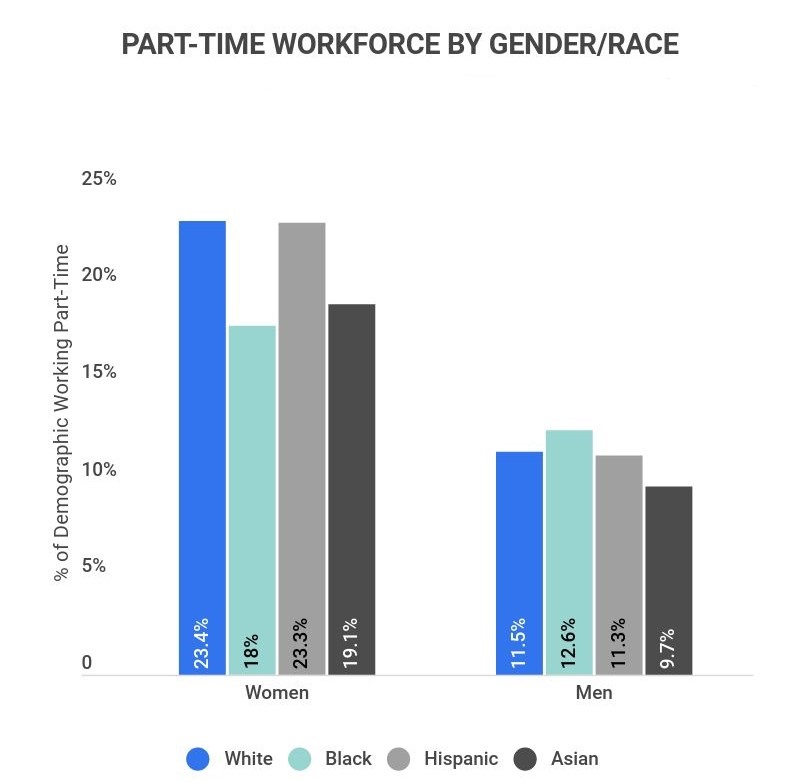
White women represent the largest group in the part-time workforce at 23.4%.
Hispanic women closely follow at 23.3%, with Asian and Black women at 19.1% and 18%, respectively.
Part-Time Job Statistics FAQ
-
What does working part-time mean?
Working part-time means averaging 34 or fewer hours per week. While the U.S. Bureau of Labor Statistics does not provide a definitive definition, this is the standard most employers follow.
-
Does the Affordable Care Act require companies to provide health insurance for part-time employees?
No, the Affordable Care Act does not mandate health insurance for part-time employees. Employers have the discretion to offer these benefits but are not required to do so.
-
How old do you have to be to get a part-time job?
Individuals must be at least 16 years old to work part-time. In some states, minors aged 14 to 15 can also work part-time with restrictions on hours and types of work.
-
What percentage of U.S. jobs are full-time?
63.1% of U.S. jobs are full-time. This consists of 63.1% of workers in full-time roles, 17% in part-time positions, and 14.7% classified as unemployed.
-
A zero-hour contract has both advantages and disadvantages. It does not guarantee a minimum number of hours, providing flexibility but also potential unpredictability in income and scheduling.
-
What are the pros of working part-time?
Part-time work offers several advantages, including:
-
Work-Life Balance: Fewer hours can lead to better energy management and more time for personal relationships and activities.
-
Experience and Opportunity: Gaining part-time experience can open doors to future job opportunities.
-
Supplemental Income: Part-time work can help meet financial needs while allowing for other commitments.
-
-
What are the cons of working part-time?
Cons of part-time work primarily include the lack of benefits. Here are some of the main downsides:
-
Few to No Benefits: Many part-time roles do not offer benefits, which may impact long-term financial security.
-
Less Job Security: Part-time workers may be considered more expendable, resulting in reduced job security during layoffs.
-
“On-Call” Stress: Part-time employees may experience stress from unpredictable scheduling demands.
-
Conclusion
Part-time workers play a crucial role in the U.S. labor market and their numbers continue to grow. Women dominate part-time employment, and both young individuals and older adults are more likely to pursue part-time opportunities compared to those in their prime working years.
While some workers may have limited options to work part-time due to economic factors or industry constraints, many choose this path for its flexibility, allowing them to balance various commitments such as education and family responsibilities.
Encouragingly, employers are increasingly recognizing the value of part-time workers and are beginning to offer benefits like health insurance, retirement plans, and tuition reimbursement, making it easier for employees to manage their professional and personal lives.
References
-
Statista. “Number of Part-Time Employees in the U.S. From 1990 to 2022.” Accessed on February 26, 2026.
-
U.S. Bureau of Labor Statistics. “Labor Force Statistics From the Current Population Survey.” Accessed on August 27, 2021.
-
World Atlas. “12 Countries with the Highest Rates of Part-Time Employment.” Accessed on August 27, 2021.
-
U.S. Bureau of Labor Statistics. “Monthly Labor Review: Who Chooses Part-Time Work and Why?” Accessed on August 27, 2021.
-
Statista. “Monthly Number of Part-Time Employees in the United States From July 2020 to January 2023.” Accessed on February 26, 2026.
-
Trading Economics. “United States Part Time Employment.” Accessed on August 27, 2021.
-
U.S. Bureau of Labor Statistics. “Labor Force Statistics From the Current Population Survey-21.” Accessed on August 27, 2021.
-
U.S. Bureau of Labor Statistics. “Labor Force Statistics From the Current Population Survey-38.” Accessed on August 27, 2021.
-
HR Dive. “Part-Timers are Gaining Ground in Employee Benefits.” Accessed on August 27, 2021.
-
U.S. Department of Labor. “Full-Time/Part-Time Employment.” Accessed on August 27, 2021.
-
Paychex. “What To Know About Offering Employment Benefits to Part-Time Employees.” Accessed on August 27, 2021.
-
U.S. Department of Labor. “Age Requirements.” Accessed on August 27, 2021.
- Job Seeker Statistics
- Career Change statistics
- Internship Statistics
- Job Search Statistics
- Average Number Of Jobs Applied
- Average Salary Increase When Changing Jobs
- Part Time Job Statistics
- Age Discrimination Statistics
- Networking Statistics
- Interview Statistics
- Average Number of Jobs In A Lifetime
- Resume Statistics
- Side Hustle Statistics
- Teacher Statistics

Author

Chris Kolmar is a co-founder of Zippia and the editor-in-chief of the Zippia career advice blog. He has hired over 50 people in his career, been hired five times, and wants to help you land your next job. His research has been featured on the New York Times, Thrillist, VOX, The Atlantic, and a host of local news. More recently, he's been quoted on USA Today, BusinessInsider, and CNBC.