Night Shift Research Summary. Night shifts are vital to many industries, with dedicated workers keeping essential services running around the clock. Despite their crucial role, night shifts come with a complex array of advantages and disadvantages, particularly concerning health and well-being.
If you’re currently working or considering a night shift job, this article explores the psychological and physical effects associated with this work schedule. According to our recent research:
-
There are approximately 15 million night shift workers in the US.
-
7.4% of American workers are engaged in night shift work.
-
Night shift workers face a 40% heightened risk of depression and anxiety.
-
Individuals who have worked night shifts for more than 10 years have a 37% increased risk of coronary heart disease compared to daytime workers.
-
The average hourly wage for night shift workers in the US is $16.06.
-
Only 3% of Americans are on the job at 2 AM, contrasting with 69% at 2 PM.
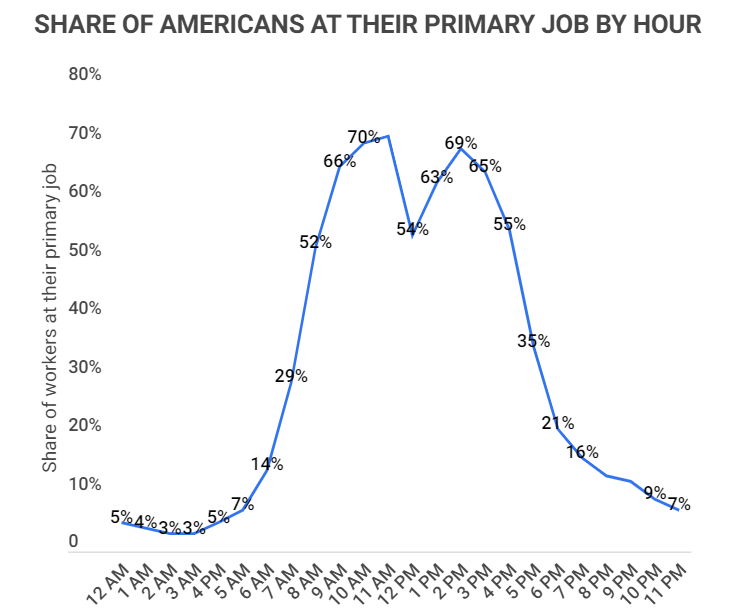
Share of Americans Employed at Their Primary Job by the Hour
| Hour | Share of Workers |
|---|---|
| 12 AM | 5% |
| 1 AM | 4% |
| 2 AM | 3% |
| 3 AM | 3% |
| 4 PM | 5% |
| 5 AM | 7% |
| 6 AM | 14% |
| 7 AM | 29% |
| 8 AM | 52% |
| 9 AM | 66% |
| 10 AM | 70% |
| 11 AM | 71% |
| 12 PM | 54% |
| 1 PM | 63% |
| 2 PM | 69% |
| 3 PM | 65% |
| 4 PM | 55% |
| 5 PM | 35% |
| 6 PM | 21% |
| 7 PM | 16% |
| 8 PM | 13% |
| 9 PM | 12% |
| 10 PM | 9% |
| 11 PM | 7% |
Night Shift Workers by Industry, Location, and Race/Ethnicity
The demographics of night shift workers, including who they are and where they work, vary significantly based on several factors. Here are key insights about night shift workers:
Top 10 Cities by Share of Night Shift Workers
| City | Share of Night Shift Workers |
|---|---|
| Las Vegas, NV | 16.53% |
| San Bernardino, CA | 16.17% |
| Augusta, GA | 15.64% |
| Reno, NV | 15.62% |
| Toledo, OH | 15.60% |
| Stockton, CA | 15.31% |
| Lancaster, PA | 14.30% |
| Louisville, KY | 14.19% |
| Phoenix, AZ | 14.02% |
| Greensboro, NC | 13.97% |
-
Las Vegas has the highest percentage of night shift workers in the US, at 16.53%.
The top five cities for night shift workers also include San Bernardino, CA (16.17%), Augusta, GA (15.64%), Reno, NV (15.62%), and Toledo, OH (15.60%).
-
Los Angeles has the largest number of night shift workers in the US, totaling over 263,100.
Although Los Angeles ranks 43rd by share of night shift workers, its significant population results in a high overall number. Other cities with a notable night shift workforce include Chicago, IL (156,600), and San Bernardino, CA (129,100).
-
Nevada boasts the highest proportion of night shift workers in the US, at 9.5%.
Conversely, Vermont has the lowest proportion, with only 3.8% of its workforce working night shifts.
-
The Transportation and Utilities sector has the highest share of night shift workers, at 6.3%.
The Manufacturing and Wholesale/Retail Trade sectors follow, with 5.7% and 5.1%, respectively.
-
The Information sector has the smallest share of night shift workers, at only 0.3%.
It remains the only industry where less than 1% of workers are engaged in night shifts.
Share of Night Shift Workers by Industry
Industry Share of Night Shift Workers Transportation and Utilities 6.3% Manufacturing 5.7% Wholesale and Retail Trade 5.1% Education and Health Services 4.3% Public Administration 4.2% Agriculture, Forestry, Fishing, and Hunting 2.9% Leisure and Hospitality 2.6% Other Services 2.0% Construction 1.3% Financial Activities 1.3% Professional and Business Services 1.1% Information 0.3% -
Protective Service workers are the most likely to work night shifts, with 26% on duty at 11 PM.
Other common night shift roles include Healthcare Support (16% working at 11 PM) and Production (13%).
Top 5 Jobs by Share of Night Shift Workers
Position 11 PM 12 AM 1 AM 2 AM 3 AM Protective Service 26% 23% 20% 17% 19% Healthcare Support 16% 10% 10% 10% 11% Production 13% 11% 10% 8% 8% Transportation 11% 8% 8% 7% 7% Healthcare Practitioners & Technical 10% 8% 6% 7% 7% -
64.1% of night shift managers identify as White.
While this aligns with the overall demographic of the US population, only 8.6% of night shift managers are Black, despite their representation of over 13% of the population.
Share of Night Shift Workers by Race/Ethnicity
Race/Ethnicity Share of Night Shift Managers White 64.1% Hispanic 11.4% Asian 9.6% Black 8.6% -
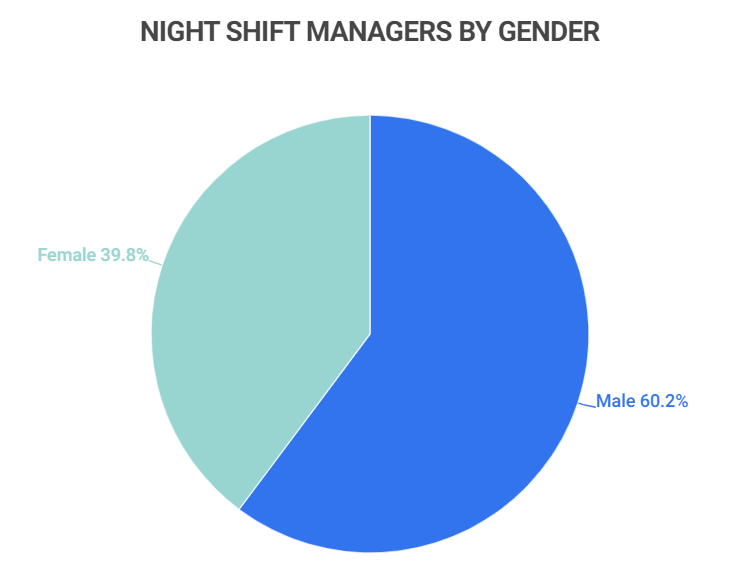
60.2% of night shift managers are men.
Statistical data indicates that men are more likely to occupy night shift management roles, with women making up only 39.8% of all night shift managers.
-
Individuals aged 15-24 are the most likely to work night shifts, with 5.6% of workers in that age group doing so.
In contrast, only 2.4% of workers aged 55-64 engage in night shift work, making them the least likely demographic to do so.
Share of Night Shift Workers by Age
Age Range Share of Night Shift Workers 15-24 5.6% 25-34 3.8% 35-44 3.1% 45-54 3.3% 55-64 2.4% 65+ 3.3% -
In 1985, only 2.7% of workers were on night shifts full time.
This figure has risen significantly over the decades, with an estimated 5-10% of workers now engaged in full-time night shift roles, reflecting a notable trend in workforce dynamics.
Night Shift FAQ
-
How unhealthy is working the night shift?
Working a night shift can pose significant health risks, especially with prolonged exposure. For example, current night shift workers face a 22% increased risk of coronary heart disease, while those with 10 years of night shift experience see a 37% increase.
Psychological effects are equally concerning, as night shifters are 40% more likely to experience depression and anxiety.
Here are additional health issues commonly associated with night shift work:
-
Diabetes
-
Obesity
-
Stroke
-
Metabolic disorders
-
Insomnia
-
Digestive problems
-
-
What are the long-term effects of night shift work?
Night shift work can lead to a variety of long-term health issues. Some common effects include:
-
Disruption of natural sleep patterns
-
Increased risk of breast cancer
-
Heightened anxiety and depression
-
Difficulty in managing weight, blood sugar, and insulin levels
-
Gastrointestinal problems (e.g., diarrhea and ulcers)
-
Deficiency in vitamin D
While some of these risks can be mitigated through improved diet and lifestyle choices, others may persist for long-term night shift workers.
-
-
Do you recover from working the night shift?
Recovery from night shifts may require at least three days. This includes one full day of sleep (around 12 hours) and a 48-hour period away from work.
Since such extensive recovery may not be feasible for most night shift workers, maintaining healthy eating and sleeping habits is crucial. For example, ensuring 8 hours of sleep after a night shift and avoiding late-night meals can aid recovery.
Conclusion
Night shift workers play an indispensable role in sustaining the infrastructure of the United States, yet the challenges they face are considerable. Currently, those working night shifts are 22% more likely to develop coronary heart disease and 40% more likely to suffer from depression and anxiety.
Despite these risks, approximately 15 million Americans choose to work night shifts across various industries. The Transportation and Utilities sector has the highest proportion of night shift workers, with 6.3% of the workforce engaged in these roles.
While night shifts often come with benefits such as higher pay, it is essential to be aware of the potential physical and psychological drawbacks. Ultimately, the choice to work the night shift is a personal decision based on individual circumstances and career goals.
References
-
PMC – Effects of Factors Related to Shift Work on Depression and Anxiety in Nurses
-
ESC – Night Shift Work is Linked to Increased Risk of Heart Problems
-
BLS – Careers for Night Owls and Early Birds
-
BLS – Table 7. Workers by Shift Usually Worked and Selected Characteristics, Averages for the Period

Author

Jack Flynn is a writer for Zippia. In his professional career he’s written over 100 research papers, articles and blog posts. Some of his most popular published works include his writing about economic terms and research into job classifications. Jack received his BS from Hampshire College.