Average Office Size Research Summary: Determining the ideal office size is a balancing act between ensuring employee comfort and managing rental costs. Many offices across the United States aim to strike this balance, leading to a relatively standard amount of space allocated per employee.
If you are a job seeker or a business owner contemplating optimal office space, this article provides valuable insights. Our research indicates:
-
The average office size in the U.S. currently ranges from 150-175 square feet per employee.
-
Technology companies tend to utilize even less space, averaging around 155 square feet per employee (with a range of 125-175 ft²).
-
It is advisable to add an extra 10-20% of office square footage to accommodate future growth.
-
While OSHA does not mandate minimum office size requirements, experts recommend allowing for at least 50 square feet per employee.
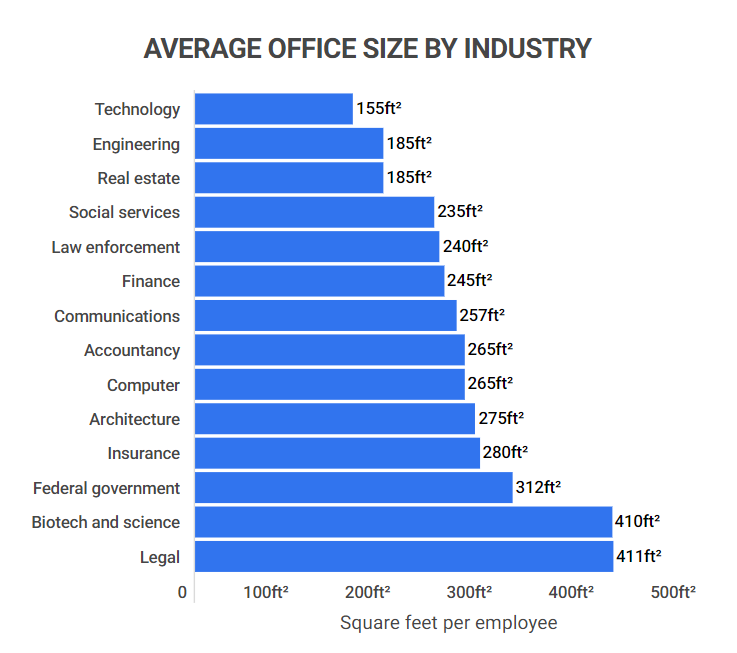
Average Office Size by Industry
While the general office size averages 150-175 square feet per employee, significant variations exist across different industries. Below is a detailed breakdown of average office space by sector:
Average Office Space by Industry
| Industry | Average Office Space per Employee |
|---|---|
| Technology | 155 ft² |
| Engineering | 185 ft² |
| Real Estate | 185 ft² |
| Social Services | 235 ft² |
| Law Enforcement | 240 ft² |
| Finance | 245 ft² |
| Communications | 257 ft² |
| Accountancy | 265 ft² |
| Computer | 265 ft² |
| Architecture | 275 ft² |
| Insurance | 280 ft² |
| Federal Government | 312 ft² |
| Biotech and Science | 410 ft² |
| Legal | 411 ft² |
Among these industries, the Technology sector requires the least space, averaging 155 square feet per employee, while the Legal sector demands the most, with an average of 411 square feet per employee. This means that office space in the Legal field is approximately 1.65 times larger than that in the Tech industry.
For potential job seekers, the appeal of a spacious office environment is often more attractive than the confines of a cubicle.
Average Office Size Over Time
Historically, the average size of offices has seen a decrease. For instance, in 2011, the average office space was 225 square feet per employee, which dropped to 195 square feet per employee by 2020.
This trend showcases a significant reduction of approximately 33% from 2011 to 2023, indicating that modern offices are now only about two-thirds the size they were a decade ago.
The future trajectory of office sizes remains uncertain. However, with the Technology industry, one of the fastest-growing sectors, leading with smaller office sizes, it is likely that this trend may continue.
Average Office Size FAQ
-
How much office space do you need per employee?
To ensure employee comfort, you should allocate at least 150 square feet per employee. However, the specific amount of space required can vary based on the nature of your business, industry, job roles, and work environment.
A practical approach is to determine the Personal Usable Square Footage (USF) necessary for your business, which helps assess the space each employee needs to perform their tasks effectively.
-
Do certain industries need more office space per employee compared to others?
Yes, certain industries do require more space per employee. Fields such as law, insurance, architecture, and government typically necessitate more square footage per employee, while industries like technology, real estate, finance, and engineering often have lower space requirements.
For example, the Legal sector averages 411 square feet per employee, whereas the Tech sector averages just 155 square feet.
-
What’s the smallest size an office can be?
An office should not be smaller than 50 square feet, although this is quite limited. Generally, a space of 50-70 square feet is adequate for a basic workstation that includes essentials like a phone, computer, and desk. However, such compact offices are usually most suitable for environments like call centers.
While OSHA does not regulate office sizes, having a small, uncomfortable office can lead to high turnover rates and low employee satisfaction.
-
How much office space do you need to accommodate 100 employees?
To accommodate 100 employees, you would require between 15,000 and 17,500 square feet. Following expert recommendations, it’s advisable to allocate at least 150-175 square feet per employee. Thus, multiplying this by 100 employees results in a requirement of 15,000 to 17,500 square feet.
Furthermore, it’s wise to factor in an additional 10-20% of space for anticipated future growth, suggesting a target of 18,000 to 21,000 square feet if you expect your business to expand.
-
How can you account for future growth when calculating the required square footage per employee?
To plan for future growth, it’s prudent to include an additional 10-20% of space in your calculations. It’s also recommended to aim for your occupancy to reach around 2/3 or 3/4 of the total available space during your lease term.
This approach allows for a smoother accommodation of potential growth. While you can use extra space if needed, it is far more challenging to create additional office space when it is unavailable. Planning for expansion ensures you have the necessary room as your team grows.
Conclusion
Choosing the right office size is crucial, whether you are a job seeker or an entrepreneur starting a new venture. While average office sizes vary by industry, the current standard in 2026 remains between 150-175 square feet per employee.
The Legal industry continues to have one of the largest average office spaces at 411 square feet per employee, while the Technology sector maintains the smallest at just 155 square feet per employee.
Overall, the trend of decreasing office sizes appears to persist, with the average office in 2023 being significantly smaller than in previous years. Future trends may lean towards even smaller spaces, particularly as the Tech industry evolves.
References
-
GAO – Agencies Focus on Space Utilization As They Reduce Office and Warehouse Space

Author

Jack Flynn is a writer for Zippia. In his professional career he’s written over 100 research papers, articles and blog posts. Some of his most popular published works include his writing about economic terms and research into job classifications. Jack received his BS from Hampshire College.