20 Telling Procrastination Statistics [2026]: The Prevalence of Procrastination
Procrastination Research Summary. We’ve all experienced it: the temptation to delay tasks in favor of immediate gratification. Procrastination is a widespread issue in the workforce, affecting productivity and overall workplace morale, with significant implications for the broader US economy.
If you’re an employer or a job seeker grappling with procrastination, you’re in the right place. We’ve compiled the latest procrastination statistics to shed light on this pervasive challenge. According to our comprehensive research:
-
20-25% of individuals engage in chronic procrastination.
-
88% of employees procrastinate for over 60 minutes daily during work hours.
-
80-95% of college students procrastinate to some extent.
-
75% of the population views procrastination as a personality trait or issue.
-
Procrastination costs the US economy approximately $70 billion annually.
For further insights, we have categorized the data as follows: Adult Procrastination | Student Procrastination | Effects of Procrastination | Workplace Procrastination
Adult Procrastination
Procrastination affects many adults both at work and in personal life. Here are some key insights regarding adult procrastination:
-
20% of adults procrastinate regularly.
While some individuals claim that regular procrastination does not affect them negatively, many experience chronic anxiety and various mental and physical health challenges as a result.
-
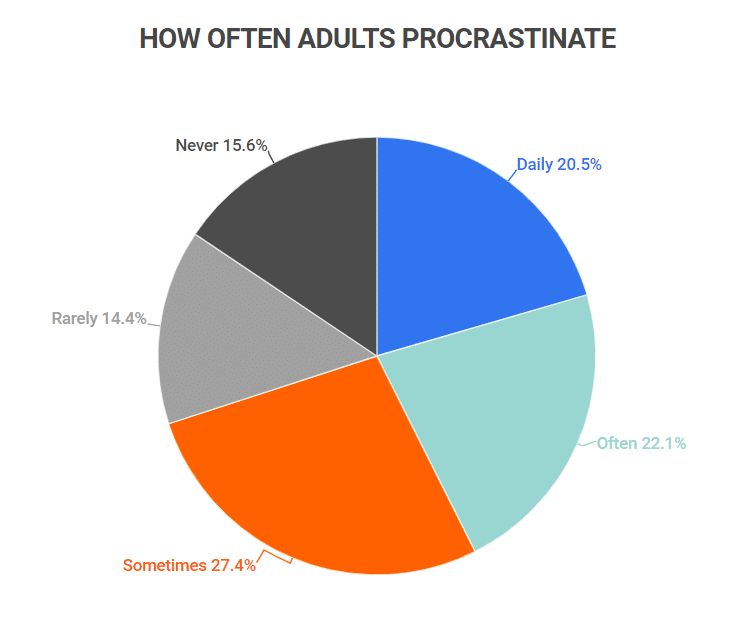
42.6% of adults procrastinate frequently or daily.
Nearly half of adults report procrastinating regularly, with 20.5% indicating it as a daily struggle. Conversely, only 15.6% claim they never procrastinate.
How Often Adults Procrastinate
Procrastination Frequency Share of Adults Daily 20.5% Often 22.1% Sometimes 27.4% Rarely 14.4% Never 15.6% -
The average adult spends 218 minutes procrastinating daily.
That’s over three and a half hours of procrastination. Many find time to indulge in their favorite shows or hobbies while avoiding work-related tasks.
-
41% of adults procrastinate due to a lack of motivation.
Apathy in both professional and academic settings contributes to procrastination. Other common reasons include not having enough time (25%) and perceiving tasks as non-urgent (24%).
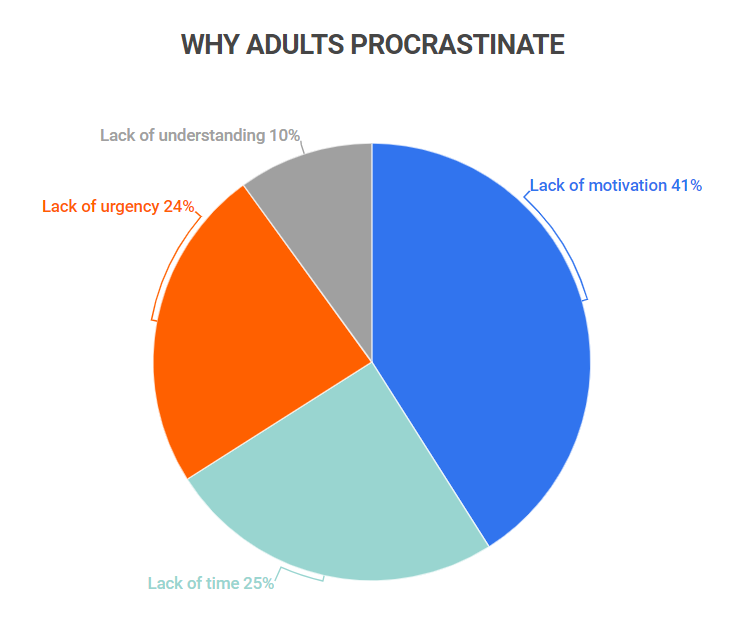
Reasons Adults Procrastinate
Reason for Procrastination Share of Adults Lack of Motivation 41% Lack of Time 25% Lack of Urgency 24% Lack of Understanding 10% -
Individuals aged 14 to 29 are the most likely to procrastinate.
Generally, procrastination decreases with age. This may be influenced by various factors, including relationship status, as single adults tend to procrastinate more than their married counterparts.
-
54% of men are identified as procrastinators.
In comparison, 46% of women procrastinate, indicating that men are 17% more likely to procrastinate than women, potentially due to a mix of biological and environmental factors.
Student Procrastination
Regardless of whether you completed high school or pursued higher education, procrastination on assignments is a widespread phenomenon. Here are some revealing statistics regarding student procrastination:
-
86% of high school students procrastinate on assignments.
Common reasons for this behavior include balancing sports, extracurricular activities, work, and other responsibilities, along with easy access to distractions.
-
46% of students procrastinate on writing term papers.
Writing essays is the most commonly procrastinated task, followed by reading weekly assignments (30%) and studying for exams (28%).

Top Assignments Students Procrastinate On
Assignment Share of Students Term Papers 46% Weekly Reading 30% Studying for Exams 28% Attendance Tasks 23% Administrative Tasks 11% General School Activities 10% -
61% of students watch TV or movies while procrastinating.
This distraction is closely followed by checking social media (58%), with more than half of students relying on these activities to avoid their responsibilities.
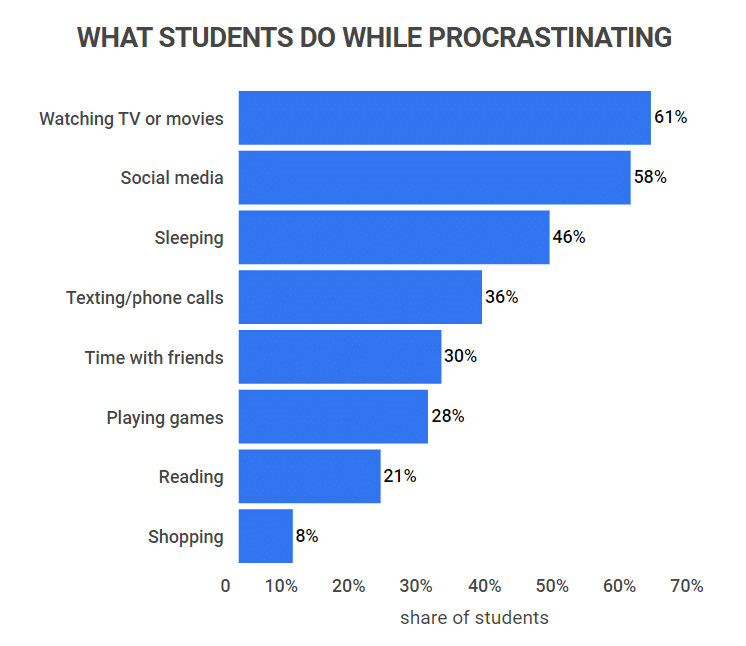
What Students Do While Procrastinating
Distraction Method Share of Students Watching TV or Movies 61% Checking Social Media 58% Sleeping 46% Texting or Talking on the Phone 36% Time with Friends 30% Playing Games 28% Reading 21% Shopping 8%
Effects of Procrastination
Procrastination can lead to numerous adverse physical and mental health consequences. The habit often exacerbates anxiety, resulting in significant issues. Below are some ways procrastination can affect your well-being:
-
11.55% of individuals procrastinate primarily due to underlying depression.
This creates a vicious cycle where procrastination worsens depressive symptoms. Procrastinators often experience poor sleep and heightened anxiety, further fueling their depression.
-
94% of people feel discontented about their procrastination.
Moreover, 18% of these individuals describe the impact on their happiness as “extremely negative.”
-
The incidence of chronic procrastination has increased fourfold over the past 30 years.
In 1978, only 5% of the population identified as chronic procrastinators. Today, that figure has risen to a quarter of the population.
Workplace Procrastination
Procrastination is prevalent in the workplace, affecting both employees and employers, and ultimately impacting the entire US economy. Consider these significant statistics regarding workplace procrastination:
-
80% of employees are distracted by social interactions at work.
Specifically, 47% of employees find in-person conversations distracting, followed by phone calls (20%) and chat platforms (15%).
Distracting Methods of Office Chatting
Type of Chatting Share of Workers Who Get Distracted In-Person 47% Phone Calls 20% Chat Platforms 15% -
The average worker spends 2 hours and 11 minutes procrastinating at work each day.
This accounts for around 25% of an 8-hour workday, equating to approximately 11 hours of procrastination each work week—over an entire workday lost—amounting to 23 working days annually.
-
12.4% of employees report increased procrastination since the onset of the pandemic.
This uptick can be partly attributed to the shift to remote work, which has introduced more distractions into the home office environment.
Procrastination FAQ
-
How much does the average person procrastinate?
The average person procrastinates for 218 minutes daily. This translates to losing up to 55 days per year to procrastination. Individual experiences may vary.
-
What is the difference between active and passive procrastination?
Active procrastination involves completing another task to avoid the main task, while passive procrastination is characterized by a lack of action altogether.
-
Active Procrastination: Putting off one task by engaging in a different productive activity.
-
Passive Procrastination: The classic approach of “I’ll do it later,” resulting in no productive output.
-
-
How many days are lost to procrastination each year for the average person?
Between 23 and 55 days are typically lost to procrastination annually. For individuals working a standard 40-hour week, an average of 23 days may be lost, while students and others may lose up to 55 days.
Conclusion
Procrastination is a harmful habit, resulting in the loss of countless hours of productive work and study time each year. The average individual forfeits up to 55 days annually due to procrastination, with more than three hours lost each day.
Currently, approximately one-quarter of the population identifies as chronic procrastinators, representing a fourfold increase since 1978, when only 5% reported chronic procrastination. Contributing factors to this rise include modern distractions and the changing landscape of remote and hybrid work environments.
Addressing procrastination is essential for both employers and job seekers. Strategies such as minimizing distractions and implementing effective scheduling can help combat this pervasive issue.
References
-
Verywell Mind – 12 Ways to Deal With Chronic Procrastination
-
Solving Procrastination – Student Procrastination: Why Students Procrastinate and How to Stop It
-
The Study Blog – Combat procrastination right now!
-
Best of SNO – Students suffer at the hands of time: the root of procrastination in high school
-
Human Resources – How much time are your employees spending procrastinating?

Author

Jack Flynn is a writer for Zippia. In his professional career he’s written over 100 research papers, articles and blog posts. Some of his most popular published works include his writing about economic terms and research into job classifications. Jack received his BS from Hampshire College.